
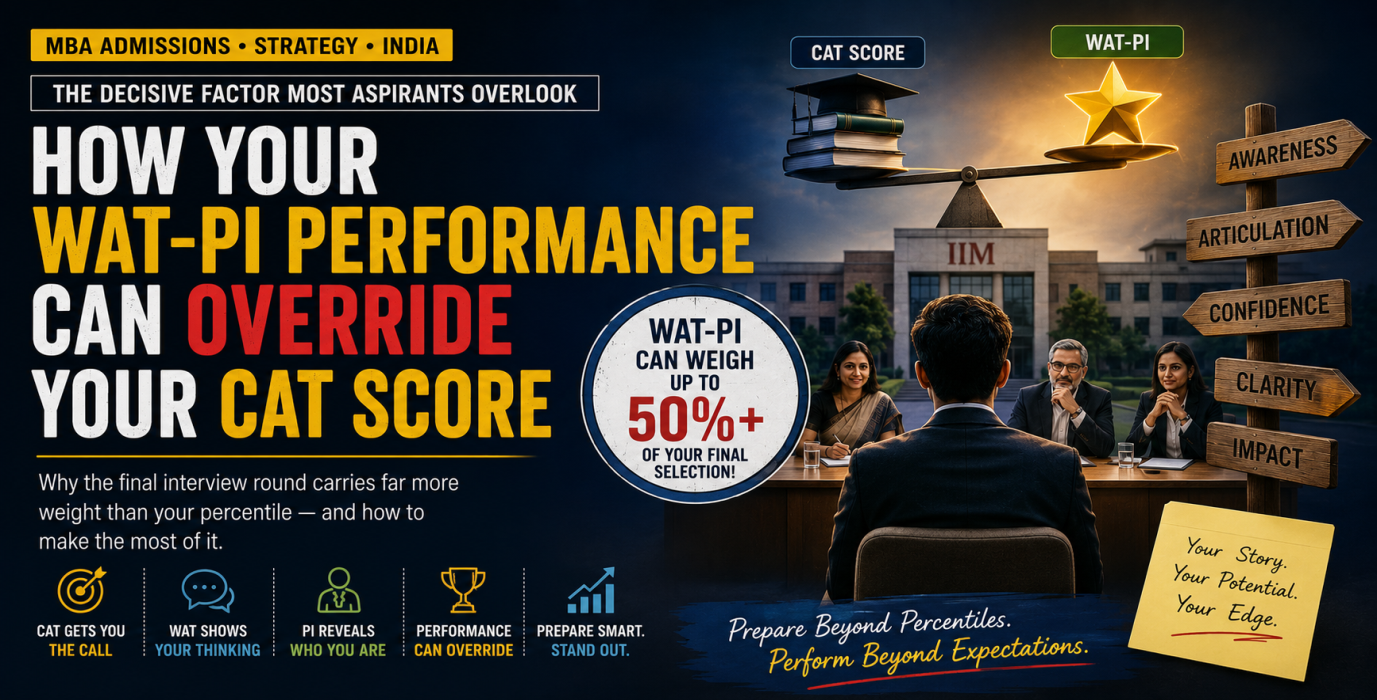
How Your WAT-PI Performance Can Override Your CAT Score
MBA Admissions · Strategy · India | 12 min read | Updated May 2026
A comprehensive guide to understanding why the final interview round carries far more weight than your percentile — and how to make the most of it.
Table of Contents
01. The Myth of the All-Powerful Percentile
02. What WAT-PI Actually Means
03. The Ceiling of What a CAT Score Can Do
04. How Weightage Actually Works at Top IIMs
05. Mastering the Written Ability Test
06. Cracking the Personal Interview
07. Where Real Score Overrides Actually Happen
08. A Practical 30-Day Preparation Blueprint
09. Nine Mistakes That Quietly Kill Conversions
10. 15 Frequently Asked Questions
1. The Myth of the All-Powerful Percentile
Every year, thousands of aspirants walk into WAT-PI centres clutching their CAT scorecards like shields. A 99-percentile earns celebration, and anything below 95 draws anxiety. Yet, surprisingly, a 93-percentile candidate has made it into IIM Ahmedabad — while some 99-percentilers have returned home without a single offer letter.
This outcome, however, is not luck. It reflects a structural reality of IIM admissions that rarely receives open discussion: the WAT-PI stage carries a weight that can genuinely override written performance. Furthermore, this weight is no footnote — at several top institutes, it constitutes more than 50% of the final composite score.
Consequently, understanding how this stage operates — and how to leverage it — becomes as important as preparing for the CAT itself. This guide breaks down everything an aspirant needs to know.
2. What WAT-PI Actually Means
The Written Ability Test, or WAT, is a short essay-writing exercise typically lasting 30 minutes. Candidates receive a topic — often a contemporary issue, a quote, or an abstract statement — and must produce a structured, well-argued response. Meanwhile, the Personal Interview runs for 15–30 minutes and assesses depth of knowledge, self-awareness, and communication ability.
Together, these two components form what IIMs officially call the final selection process. Importantly, the WAT evaluates clarity of thought, while the PI evaluates the totality of who a candidate is as a potential manager. Neither component follows a formula — and that is precisely why both offer such a powerful opportunity for differentiation.
The IIM Admission Journey — Stage by Stage
| Stage | Component | What It Evaluates |
| 1 | CAT Examination | Aptitude across VARC, DILR, and QA |
| 2 | Application Shortlisting | CAT score, academics, work experience, diversity |
| 3 | Written Ability Test (WAT) | Structure, articulation, and critical thinking |
| 4 | Personal Interview (PI) | Academics, work experience, awareness, personality |
| 5 | Final Composite Score | All components merged; WAT-PI often exceeds 50% |
3. The Ceiling of What a CAT Score Can Do
A strong CAT score does one thing exceptionally well: it earns a seat in the interview room. Beyond that threshold, however, its influence diminishes sharply. Once the institute shortlists candidates, the panel assumes every candidate present has already crossed a baseline of aptitude. What panelists then attempt to uncover is something far more nuanced — potential, leadership instinct, and institutional fit.
Moreover, the CAT score carries no memory into the interview room. Many institutes train panelists to set the written score aside during evaluation. As a result, two candidates with a 30-point CAT percentile gap can leave the same interview with entirely reversed outcomes. The candidate who enters more prepared and more self-aware will invariably perform better, regardless of their written score.
| Key Insight A 99-percentile is the door. The WAT-PI is the room on the other side — and most aspirants never truly prepare for what is inside it. |
4. How Weightage Actually Works at Top IIMs
Each IIM publishes its selection criteria annually, and these numbers reveal an important truth. At IIM Ahmedabad, the WAT and PI together account for 50 out of 100 points in the final composite. Similarly, IIM Bangalore assigns significant weight to the interview stage relative to the academic and CAT components combined. Furthermore, newer IIMs often assign even higher proportional weight to the interview round, given their emphasis on holistic selection.
WAT-PI Weightage Across Leading IIMs
| Institute | CAT Score Weight | WAT + PI Weight |
| IIM Ahmedabad | 25% | 50% |
| IIM Bangalore | 30% | 42% |
| IIM Calcutta | 30% | 45% |
| IIM Lucknow | 28% | 48% |
| Newer IIMs (avg) | 20–25% | 50–55% |
Figures are approximate and sourced from published admission criteria. Always verify with official IIM notifications for the current year.
5. Mastering the Written Ability Test
Structure Is Scored, Not Just Style
Many candidates make the mistake of treating WAT like a debate. However, it is best approached as a structured argument. A strong WAT response follows a clear three-part architecture: a concise introduction that stakes your position, two or three developed paragraphs with distinct points, and a balanced conclusion that acknowledges nuance.
Additionally, panelists specifically evaluate whether ideas are developed logically or merely listed. Therefore, depth over breadth should always guide your approach. One well-supported argument carries more weight than five shallow claims strung together.
Word Count, Tone, and Legibility
A WAT response of 200–250 words generally hits the sweet spot. Conciseness earns marks, whereas sprawling essays often signal a lack of editorial control. Furthermore, the tone must remain measured and analytical — extreme positions, emotional language, or sycophantic phrasing are all penalised by experienced evaluators.
Since WAT is handwritten at most institutes, legibility also forms part of the assessment. Clean paragraphing and consistent margins signal discipline — qualities that evaluators directly associate with managerial communication ability.
WAT Practice Approach
- Write on at least one topic daily during the four weeks before your interview date.
- Practise both abstract topics (quotes, concepts) and factual topics (policy, business issues).
- Time yourself strictly — 30 minutes from reading the topic to final sentence.
- Read each essay back after writing and cut any sentence that does not add a new idea.
- Ask a mentor or peer to evaluate structure, not just language.
6. Cracking the Personal Interview
The Four Pillars That Panels Actually Assess
Contrary to popular belief, PI panels do not follow a universal script. Nevertheless, four broad areas appear consistently: academic background (especially graduation subject), work experience for working professionals, general and current affairs awareness, and personality or self-awareness. Preparation across all four areas is therefore non-negotiable.
Importantly, panels remain particularly alert to inconsistency. A candidate whose resume lists a hobby they cannot speak to, or whose responses contradict earlier answers, immediately loses credibility. Consequently, authentic preparation — rooted in genuinely knowing yourself — outperforms rehearsed answers every time.
The “Why MBA” Question Is a Trap for the Unprepared
Almost every PI opens with a variation of “Why MBA?” and it is, arguably, the most mishandled question in the entire process. Generic answers about leadership skills and diverse industry exposure collapse within the first sentence. Instead, your answer must anchor itself in a specific, credible career story. The panel wants to see a thread — from your past, through your present, into a future that genuinely requires an MBA.
Moreover, specificity matters enormously here. Naming the sector you want to enter, the role you are targeting, and why that combination requires an IIM degree is far more compelling than abstract aspirations. Panels interview hundreds of candidates, and specificity remains the only reliable way to stand out.
High-Impact PI Preparation Checklist
- Read and reflect on your resume as if meeting yourself for the first time.
- Prepare at least three stories from your academic or professional past that demonstrate initiative.
- Track ten current affairs stories per week for at least six weeks before your interview date.
- Practise answering questions aloud — not just in your head — with a timer running.
- Research the specific IIM you are interviewing at: its pedagogy, notable alumni, and recent news.
- Prepare a 90-second “walk me through your profile” answer that flows naturally and ends with a hook.
- Rehearse transitions — how you move from one topic to another without appearing flustered.
7. Where Real Score Overrides Actually Happen
Consider a candidate from a non-engineering background with a 94-percentile — a score that, on paper, looks risky for IIM-A. Through exceptional self-awareness in the PI, deep knowledge of her graduation subject, and a compelling career narrative, such a candidate can earn a conversion on the spot. Simultaneously, a 99-percentiler from a top engineering college with a vague “why MBA” story and nervous delivery may fail to convert a single top-five IIM despite a superior written score.
These outcomes are not outliers. The structural design of the admission process deliberately produces exactly these results. As a result, every percentage point of WAT-PI weightage translates into a meaningful opportunity for candidates who prepare intelligently. Additionally, diversity considerations — gender and academic background — further open pathways for candidates whose CAT scores do not sit at the very top of the shortlisted pool.
What the Data Tells Us
| The Override Formula An exceptional PI performance + a clear career narrative + a structured WAT = conversion potential that no CAT percentile can replicate or cancel. The IIM composite scoring system is deliberately built to make this possible. |
8. A Practical 30-Day Preparation Blueprint
With interview season typically running from January to March, candidates usually have four to eight weeks between shortlist announcement and interview date. Thirty days, however, is sufficient for focused and structured preparation — provided the effort concentrates intelligently.
Week One — Know Thyself
During the first week, the entire focus belongs on self-reflection. Write a detailed profile analysis covering your academic journey, professional highlights, key decisions, failures, and turning points. From this material, develop three to four compelling anchor stories — each one usable across multiple question types. Additionally, finalise a crisp and confident “tell me about yourself” answer by the end of day seven.
Week Two — Current Affairs and Domain Knowledge
The second week demands aggressive reading. Business newspapers, economic surveys, and industry-specific developments are all fair game for panels. Furthermore, if your graduation background covers engineering, science, or commerce, prepare and refine at least three core subject questions during this window. Panels frequently return to graduation subjects as a way of separating genuine learners from credential-chasers.
Week Three — Mock Sessions
By week three, preparation shifts from input to output. Conduct at least five mock PIs — ideally with people who provide honest feedback rather than reassurance. Record and review each session. Common pitfalls such as filler words, slouching, inconsistent eye contact, and over-long answers only become visible on playback. Conduct daily WAT writing practice throughout this week as well.
Week Four — Fine-Tuning and Mental Readiness
The final week calls for consolidation, not panic. Revisit any weak areas that mocks identified, calmly and methodically. Additionally, complete all practical preparation — confirming the venue, assembling documents, selecting formal attire — by day 26. Reserve the last two days for light reading, rest, and building mental composure.
9. Nine Mistakes That Quietly Kill Conversions
Even well-prepared candidates lose marks through avoidable errors. The following list documents the most common ones, drawn from admission consulting experience and panel feedback across multiple cycles.
- Rehearsing answers verbatim rather than practising the ability to think aloud.
- Over-relying on CAT preparation and underestimating the interview as a soft-skills exercise.
- Providing inconsistent information — for example, claiming a passion for finance while being unable to name a basic concept.
- Answering before the panel finishes asking — a signal of anxiety, not confidence.
- Failing to research the specific IIM at which the interview takes place.
- Treating WAT as a Group Discussion — arguing only one extreme rather than demonstrating critical balance.
- Deflecting academic subject questions with “I studied it long ago” — a phrase panels note negatively.
- Neglecting to prepare for stress questions such as “Why should we take you over someone with a better CAT score?”
- Losing composure when the panel corrects you — panels frequently introduce wrong information deliberately to test poise.
10. Frequently Asked Questions
Q1. Can a candidate with a 90-percentile CAT score still get into an IIM through WAT-PI?
Yes, though it becomes statistically less common. Several newer IIMs set section-wise cutoffs as low as 80 percentile for certain categories. If a candidate clears the shortlist cutoff, an exceptional WAT-PI performance can absolutely produce a final offer — particularly when diversity factors and strong academics also feature in the profile.
Q2. How much does the WAT score typically weigh compared to the PI?
At most IIMs, the WAT carries 10–20% of the final composite, while the PI carries 30–40%. However, both components are evaluated together, and a weak WAT can set a negative tone going into the interview. Combined, the two at leading IIMs account for 42% to 55% of the final score.
Q3. Do IIM panelists know your CAT percentile before the interview?
In most IIMs, panelists receive your application form and profile, which typically includes your CAT score. However, evaluation norms at many institutes actively discourage panelists from letting the written score influence their assessment. The interview process is designed to stand on its own merit.
Q4. What is the ideal length of a WAT essay?
Between 200 and 250 words represents the widely accepted sweet spot. Essays shorter than 150 words appear underdeveloped, while those crossing 300 words risk losing structural clarity. Quality and coherence matter far more than volume.
Q5. Is it acceptable to disagree with the interviewer during a PI?
Yes — and panels often encourage it. However, disagreement must be expressed respectfully and backed by clear reasoning. Panelists at top IIMs deliberately introduce provocative statements to test whether a candidate can hold a position under pressure. Immediate capitulation signals intellectual weakness, while aggressive pushback without substance earns an equally negative response.
Q6. How should a fresher approach the PI differently from a working professional?
Freshers should anchor their PI in academic depth, extracurricular leadership, internships, and future direction. Since work experience narratives are unavailable, academic projects, research, and campus initiatives become primary material. The “why MBA now” question draws more scrutiny for freshers, so that answer needs especially careful crafting.
Q7. Do panelists read the WAT essay before the PI begins?
At most institutes, a separate assessor evaluates the WAT and the score does not reach PI panelists in real time. However, some IIMs allow panelists to see the WAT essay, which means it can occasionally become a conversation starter. Writing a clear, balanced essay therefore carries double value.
Q8. How many mock PIs does a candidate typically need for solid preparation?
A minimum of five to eight full-length mock PIs is strongly advisable. The first two mocks expose baseline weaknesses, the next three allow correction, and the final few build refinement under pressure. The quality of feedback received during mocks matters more than sheer repetition.
Q9. Does the WAT topic category affect scoring — for example, abstract vs. factual?
The topic category affects difficulty, but the scoring rubric stays consistent: structure, clarity, analytical depth, and language quality are evaluated regardless of topic type. Abstract topics reward creative lateral thinking, while factual topics reward demonstrated awareness. Practising both types is therefore advisable.
Q10. Can a strong PI performance compensate for a weak academic record?
To a significant extent, yes. IIMs use composite scoring, and a brilliant PI can offset the academic component in the formula. However, panelists are often aware of academic records and may ask pointed questions about low grades or gaps. Addressing these proactively and honestly — rather than defensively — is always the recommended approach.
Q11. How important is current affairs preparation for the PI?
Current affairs carry enormous weight, particularly at IIM Ahmedabad, Calcutta, and Lucknow, where panels favour current affairs-heavy interviews. Coverage should span economic policy, business news, national developments, and global affairs. Depth on a few topics impresses panels more than shallow knowledge across many — knowing one issue thoroughly outperforms skimming dozens.
Q12. What is the most underrated aspect of a PI that candidates regularly miss?
Listening carefully and answering precisely what the panel asks. Many candidates prepare extensively but deliver adjacent answers rather than responding to the precise question posed. Panels notice immediately when answers feel pre-loaded rather than responsive. Pausing for two seconds before answering — while appearing thoughtful — is one of the most effective habits a candidate can build.
Q13. Do women candidates benefit from diversity weight during the WAT-PI stage as well?
Diversity points typically apply at the shortlisting stage rather than within WAT-PI scoring. During the interview, all candidates face the same rubric. That said, the combined effect of diversity shortlisting and a strong WAT-PI performance creates a compounding advantage that can produce final selection at relatively lower CAT percentiles.
Q14. How should a candidate handle a question they genuinely do not know the answer to?
Acknowledging the gap honestly and offering a logical first-principles response consistently outperforms guessing or bluffing. A candidate who says “I am not certain of the exact figure, but based on the broader trend, I would estimate…” demonstrates intellectual honesty and reasoning ability — both of which panels value more than a memorised correct answer.
Q15. Is joining a coaching institute necessary for WAT-PI preparation?
Coaching is helpful but not essential. What matters most is the quality of feedback received during mock sessions, the regularity of essay writing practice, and disciplined current affairs reading. Many successful candidates have prepared entirely through peer mock groups, online forums, and self-review of recorded sessions. Coaching can accelerate the process, but no institute can substitute for self-awareness and genuine effort.
This article is intended for informational purposes. Admission criteria vary by institute and year — always verify with official IIM notifications.
You may also visit: CATMOCK INDIA|CATMOCK