

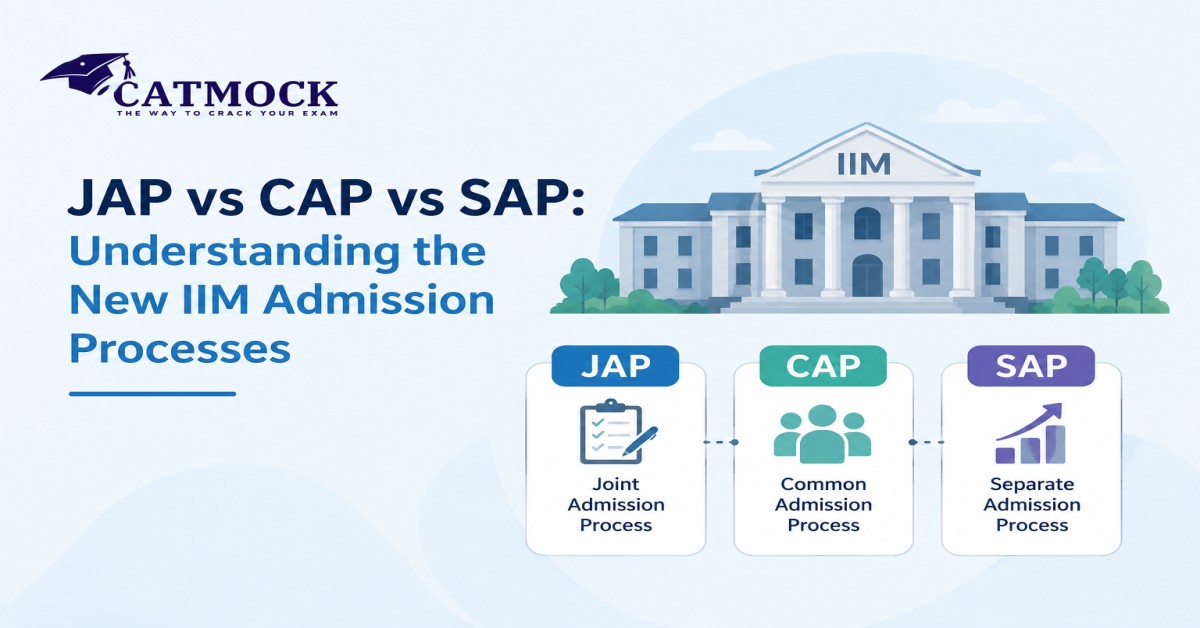
Understanding the New IIM Admission Processes
Table of Contents:
1. Why the IIM Admission Map Changed in 2026
2. What Is JAP (Joint Admission Process)?
3. What Is CAP (Common Admission Process)?
4. How the Selection Process Works
5. What Is SAP (Supplementary Admission Process)?
6. JAP vs. CAP vs. SAP: Brief Comparison
7. The Bottom Line: JAP, CAP, and SAP
8. Frequently Asked Questions (FAQs)
Why the IIM Admission Map Changed in 2026
For nearly a decade, eight newer IIMs relied on a single shared selection procedure known as CAP. After completing a single form and attending a single interview, candidates awaited offers from each participating institution. Until before a few IIMs made the decision to follow their own path, that system operated without any problems.
IIM Raipur, IIM Kashipur, IIM Ranchi, and IIM Tiruchirappalli split apart to create a new procedure known as JAP starting with the 2026 admissions cycle. In the meantime, IIM Nagpur and IIM Udaipur decided to conduct independent admissions processes. Consequently, just three institutions—IIM Jammu, IIM Bodh Gaya, and IIM Sirmaur—remained within the original CAP umbrella.
This article breaks down JAP, CAP, and SAP in plain language, with the latest 2026-cycle data, so that applicants know exactly where they stand. Furthermore, we include a comparison table, two data charts, and a process flow diagram to make the differences easy to scan. By the end, choosing the right route should feel far less confusing.
What Is JAP (Joint Admission Process)?
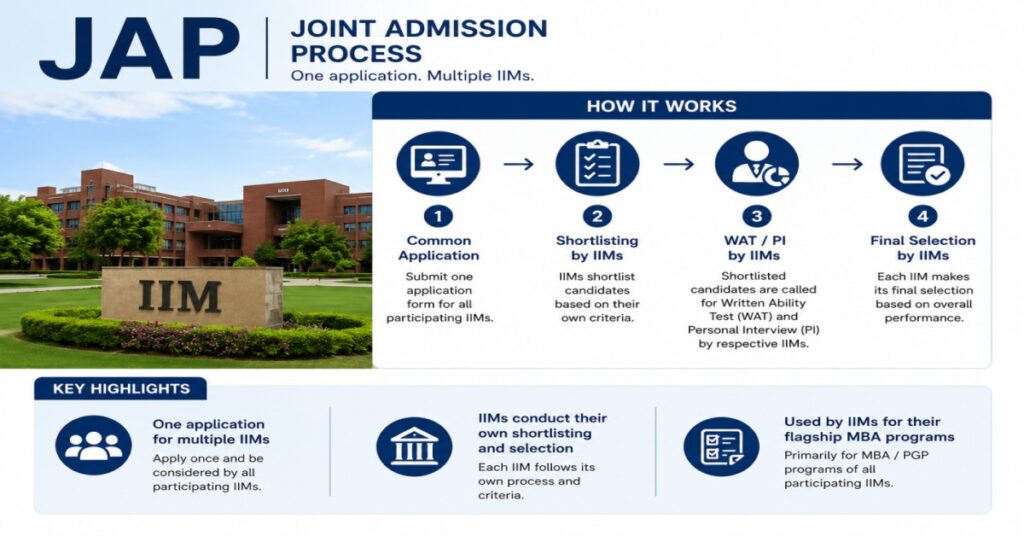
The newest addition to this list is JAP, which stands for Joint Admission Process. It was announced on September 9, 2025, and IIM Raipur is in charge of organizing it on behalf of three partner institutions. This is significant since it is the first time that these four IIMs have operated a truly collaborative selection process.
A candidate’s CAT 2025 percentile, academic standing, previous employment history, and diversity considerations are all taken into account when shortlisting them under JAP. Crucially, a single personal interview is conducted for all four institutes put together. The requirement to attend four different interview rounds—which was previously costly and taxing—is eliminated by this single-window strategy.
Participating Institutes Under JAP:-
- IIM Raipur (coordinating institute)
- IIM Kashipur
- IIM Ranchi
- IIM Tiruchirappalli
Each of these four institutes still issues its own final offer letter. However, they share the shortlisting and interview stage, so the candidate minimises duplication of effort.
Read Full Blog: IIM JAP 2026: Eligibility, Selection Process & Cutoff
What Is CAP (Common Admission Process)?
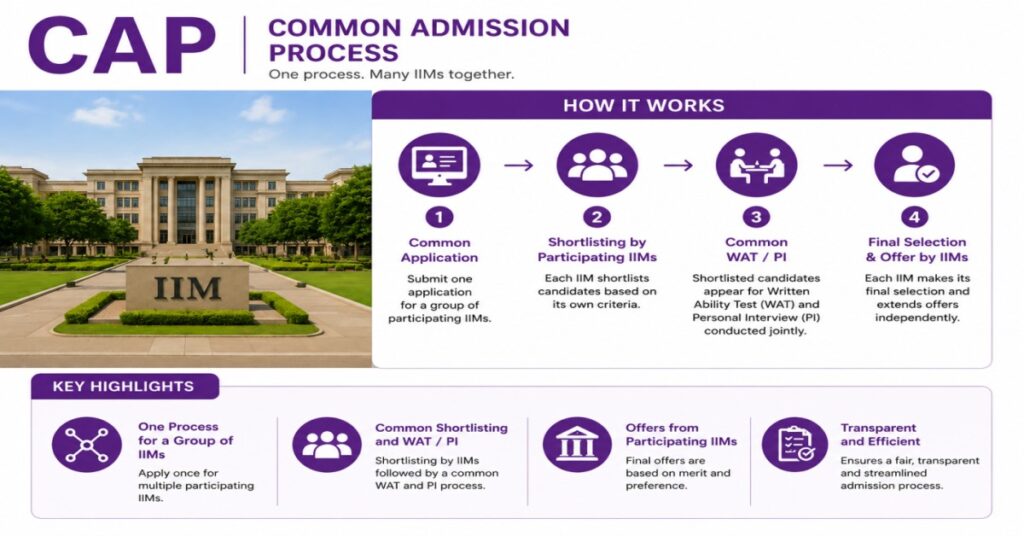
The Common Admission Process, or CAP, is still the most popular joint path among candidates for IIM. Five of the eight newer IIMs that were once a part of this collaboration have subsequently left to either operate their own selection or join JAP. However, for the institutes that are still a part of it, CAP remains an effective centralized solution.
Under CAP, a Personal Interview is paired with a written Ability Test, or WAT. Scores are distributed across all participating institutes when both institutes complete them in a single session. Before creating its own merit list, each IIM then gives these shared scores its own merit.
Participating Institutes Under CAP:-
- IIM Jammu (CAP coordinator for 2026)
- IIM Bodh Gaya
- IIM Sirmaur
This is a sharp drop from the eight institutes that took part as recently as last year. IIM Kashipur, IIM Raipur, IIM Ranchi, and IIM Tiruchirappalli moved to JAP, while IIM Udaipur and IIM Nagpur opted for independent admissions.
How the Selection Process Works
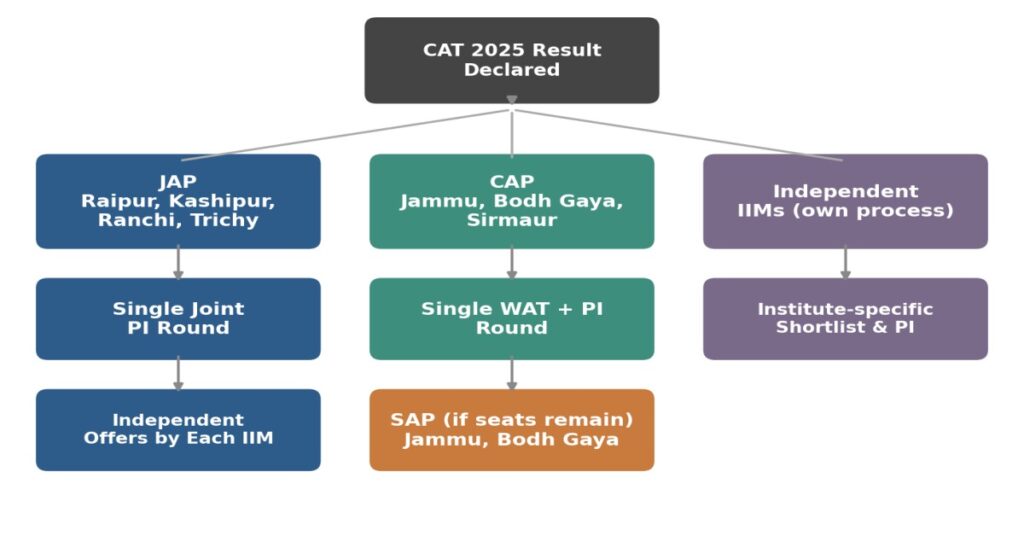
After the authorities declare the CAT 2025 results, eligible candidates can apply through either the Joint Admission Process (JAP) or the Common Admission Process (CAP), depending on the participating IIMs. Both processes initially shortlist candidates based on their overall and sectional CAT percentiles and category. Under JAP, institutes such as IIM Raipur announce institute-specific interview cutoffs. For example, the General category requires a 96.25 percentile, while EWS and OBC candidates need 75 percentile, SC candidates 60 percentile, and ST candidates 50 percentile. Meeting these cutoffs qualifies candidates for the Personal Interview (PI) but does not guarantee final admission. In CAP, multiple newer IIMs conduct a common selection process. General category candidates typically require an overall CAT percentile of 90–95 with at least 65 percentile in each section, while reserved categories receive relaxed cutoffs. After the common interview, each participating IIM independently prepares its final merit list using a composite score that considers CAT performance, PI/WAT scores, academics, work experience, and other admission criteria.
Read Full Blog: IIM CAP Explained: Meaning, Cutoff & Participating IIMs
What Is SAP (Supplementary Admission Process)?
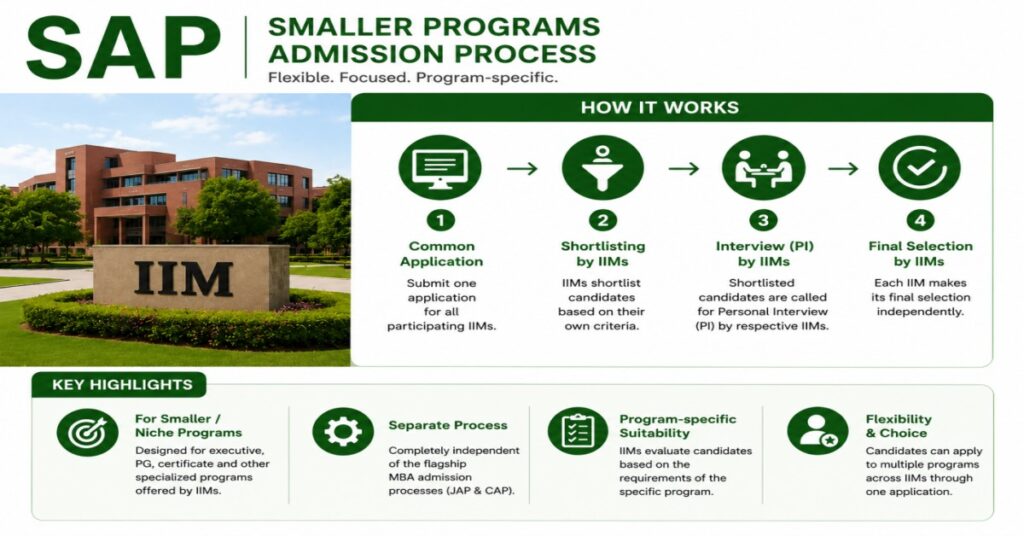
SAP’s main objective is to fill open seats following the conclusion of CAP. For candidates who just missed the CAP shortlist, it is a second chance rather than a parallel pathway. Due to IIM Sirmaur’s decision to opt out, only IIM Jammu and IIM Bodh Gaya are using SAP in the current cycle.
SAP does not involve a written test, in contrast to CAP. Instead, candidates show up in person for a personal interview as long as they meet each participating institute’s lenient threshold. Although there are generally fewer seats available, this significantly speeds up SAP. SAP suits candidates whose CAT percentile sits close to, but below, the CAP cutoff. It also helps candidates who attended a CAP interview yet were not picked in the first merit round. In short, SAP exists to ensure that no IIM seat goes unused simply due to a process gap.
JAP vs CAP vs SAP: Brief Comparison
The table below places all three processes next to one another for quick reference. Each row highlights a single decision factor:-
| Parameter | JAP | CAP | SAP |
| Full form | Joint Admission Process | Common Admission Process | Supplementary Admission Process |
| Coordinator | IIM Raipur | IIM Jammu (rotating) | Individual SAP institutes |
| Participating IIMs (2026) | Raipur, Kashipur, Ranchi, Trichy | Jammu, Bodh Gaya, Sirmaur | Jammu, Bodh Gaya |
| Stage at which it runs | After CAT 2025 result | After CAT 2025 result | After CAP results are out |
| Selection rounds | One common Personal Interview | One common WAT and PI round | Personal Interview only |
| Indicative General cutoff | Around 90–96 percentile | Around 90–95 percentile | Below the CAP cutoff |
| Best suited for | Aspirants targeting the four JAP institutes together | Aspirants targeting the three CAP institutes together | Aspirants who narrowly missed the CAP shortlist |
The Bottom Line: JAP, CAP, and SAP
Choosing between JAP, CAP, and SAP usually is not a matter of preference, since eligibility is decided by which institutes a candidate selected during CAT registration. Therefore, the real task is understanding which bucket an applicant already falls into. Once that is clear, preparation can be tailored accordingly.
Candidates aiming for Raipur, Kashipur, Ranchi, or Trichy should prepare for a single, all-encompassing personal interview under JAP. In contrast, those targeting Jammu, Bodh Gaya, or Sirmaur should focus equally on the Written Ability Test and the interview, since CAP scores both. If a CAP attempt narrowly fails, SAP can still offer a legitimate second opportunity at Jammu or Bodh Gaya.
Additionally, candidates should never assume that meeting a stage-one cutoff guarantees a seat. Academic record, work experience, and diversity scoring all factor into the final merit list across every process. Staying alert to portal deadlines is equally important, because a missed registration window can disqualify an otherwise strong applicant.
Frequently Asked Questions (FAQs)
1. What does JAP stand for in IIM admissions?
JAP stands for Joint Admission Process.IIM Raipur coordinates a 2026 admission route for itself, IIM Kashipur, IIM Ranchi, and IIM Tiruchirappalli.
2. How is CAP different from JAP?
CAP includes a Written Ability Test along with the interview, while JAP relies on a single personal interview without any written component. Additionally, CAP and JAP cover entirely different sets of institutes this year.
3. Which IIMS are currently part of sap?
Only IIM Jammu and IIM Bodh Gaya are running SAP for the 2026 cycle. IIM Sirmaur, which previously took part, has opted out this year.
4. Is the cat cutoff the same across JAP,CAP and SAP?
No, cutoffs differ across all three. SAP generally carries the lowest cutoff, since it is designed to fill seats left vacant after CAP concludes.
5. Can a candidate apply to JAP,CAP and SAP at the same time?
Eligibility depends on which IIMs were selected during CAT registration, not on personal choice. A candidate may qualify for more than one process if their chosen institutes span across JAP, CAP, and SAP.
6. Does clearing the JAP and CAP cutoff guarantee admission?
Clearing the cutoff only secures an interview call, not a seat. Final selection still depends on the composite score, which includes academics, work experience, and diversity factors.
7. Why did several IIMS leave the original cap group?
Some institutes preferred more control over their own selection criteria and timelines. As a result, Kashipur, Raipur, Ranchi, and Trichy moved to JAP, while Udaipur and Nagpur chose independent processes entirely.
8. How many interviews does a JAP candidate attend?
Only one. JAP’s entire design is built around a single joint personal interview that covers all four participating institutes together.
9. Is a written ability test required for SAP?
No, SAP involves only a Personal Interview. This is one of the clearest differences between SAP and CAP, where a WAT is mandatory.
10. When does the SAP process typically begin?
SAP usually opens shortly after the participating institutes declare CAP results, often around February. However, the participating institutes announce exact dates separately each year.
You may also visit: CATMOCK INDIA|CATMOCK