

- Introduction
- What is NPAT?
- Why NPAT Matters
- NPAT 2027: Important Dates (Expected)
- Eligibility Criteria
- How to Apply for NPAT 2027
- Exam Pattern
- NMIMS Campuses You Can Get Through NPAT
- Section-Wise Topics to Focus On
- How to Prepare: A Practical Approach
- Frequently Asked Questions
- Quick Recap
Introduction
If you are a Class 12 student and want to pursue a BBA, B.Com (Hons.), or integrated BBA-MBA from NMIMS, then NPAT is the one exam that will provide you a seat across seven campuses of NMIMS. Each year, more than 80,000 students compete for some 3,000 places, so the admission rate is less than 4%. This means that a clear plan is more important than last-minute panic. In this blog, we’ll walk you through everything—what NPAT is, expected dates in 2027, eligibility, the exam pattern, section-wise topics, a realistic prep timeline, and answers to the questions students ask the most.
What is NPAT?
The official entrance exam for admission to SVKM’s NMIMS Deemed-to-be University’s undergraduate programs is called NPAT (NMIMS Programs After Twelfth). All of the NMIMS campuses in Mumbai, Bengaluru, Navi Mumbai, Hyderabad, Indore, Chandigarh, and Ahmedabad use the results of this one computer-based test (CBT). One NPAT score, submitted through a single application, opens the door to all of them, assuming you meet the corresponding cutoffs. This eliminates the need for you to take separate exams for each school. NPAT scores are accepted for a wide range of programs, including:
- BBA
- B.Com (Hons.)
- B.Sc. (Finance) and B.Sc. (Economics)
- BBA (FinTech)
- Integrated BBA-MBA
- BBA (Branding & Advertising)
- BBA (International Business, in collaboration with Kingston University)
- BA (Liberal Arts)
- BBA (Management & Marketing) and BBA (Finance)
You can apply to up to five programs in one go, and you don’t need to register separately for each campus—campus and program preference are indicated during the common registration process itself, in priority order.
Why NPAT Matters
NPAT isn’t just another entrance test on your calendar—it’s a single gateway to one of India’s more recognized private university networks for undergraduate commerce and management education. Unlike some other entrance exams that lock you into one attempt, NPAT’s three-attempt structure gives you a genuine second and third chance to improve your score, which takes some of the pressure off a single bad exam day. That said, competition is real: with 80,000+ candidates chasing roughly 3,000 seats across all campuses, the effective admission rate sits under 4%, and it’s noticeably tighter for the Mumbai campus specifically, since that’s NMIMS’s flagship location with the widest range of programs. Knowing this upfront helps you set realistic targets rather than assuming any single attempt will work out — plan for improvement across your allowed attempts rather than banking everything on the first one.
NPAT 2027: Important Dates (Expected)
NMIMS hasn’t released the official NPAT 2027 notification yet. Based on how the last few cycles have gone, here’s what the timeline is expected to look like—treat these as planning estimates, not confirmed dates, and check the official site closer to the date.
| Event | Expected Timeline |
| Registration opens | Mid-December 2026 |
| Registration closes | April 2027 |
| Exam window | February/March – May 2027 |
| Admit card release | Rolling, after slot booking |
| Phase 1 merit list | Mid-April 2027 (tentative) |
| Phase 2 merit list | First week of June 2027 (tentative) |
For reference, NPAT 2026’s exam window ran from February 10, 2026 to June 1, 2026, with the Phase 1 merit list out on April 16, 2026 and Phase 2 in the first week of June. Bookmark the official site (npat.nmims.edu) and check it from November 2026 onward for the actual notification, since NMIMS typically announces dates 2–3 months before registrations open.
Eligibility Criteria
| Criterion | Requirement |
| Academic qualification | Passed or appearing in Class 12 (10+2) from a recognised board (CBSE, ICSE, IB, state boards, etc.) |
| Minimum marks | 50% aggregate in Class 12 (60% for BBA International Business Dual Degree) |
| Attempts in Class 12 | Must have passed all subjects in a single attempt |
| Age limit | Maximum 25 years at the time of admission |
| Alternate scores accepted | SAT/ACT scores also accepted for eligible programmes |
Note: NMIMS has no management quota for admissions and doesn’t authorize any third party to offer direct admission—anything on social media claiming otherwise is fake, and NMIMS has publicly warned students against falling for such claims.
How to Apply for NPAT 2027
- Register on npat.nmims.edu using your email ID and mobile number.
- Fill the application form with your personal and academic details.
- Upload documents—Class 10 & 12 mark sheets, a passport-size photo, and your signature.
- Choose up to 5 programs and rank your campus preferences.
- Pay the application fee online (debit/credit card or net banking).
- Book your exam slot—date, time, and center—as early as possible.
- Download your admit card once your slot is confirmed, and carry it with a valid photo ID on exam day.
A few things to double-check before you hit submit: your exam date and test center cannot be changed once booked, so make sure your details are correct beforehand. There is a correction window (typically in late May, closer to the exam) that allows edits to certain fields — but it’s safer to get it right the first time than to rely on that window being available.
Exam Pattern
NPAT is a 100-minute, computer-based test with 120 MCQs split equally across three sections. There’s no sectional time limit, so you manage your own time across the paper, and there’s no negative marking. So attempt everything, since a wrong guess costs you nothing.
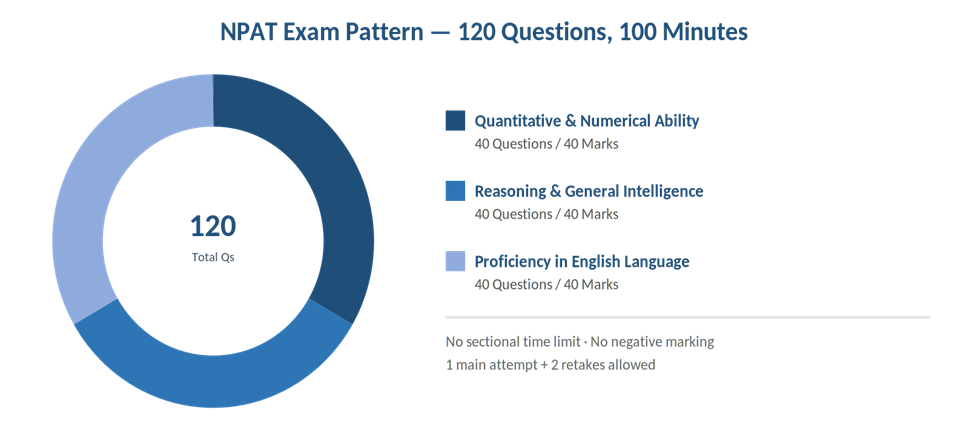
The difficulty level is often compared to the SAT — it’s more about speed and accuracy on fundamentals than deep conceptual difficulty. You get one main attempt plus two retakes (three attempts in total across the exam window), and your highest score across all attempts is what counts for the merit list, so there’s real room to improve if your first attempt doesn’t go as planned.
NMIMS Campuses You Can Get Through NPAT
NMIMS doesn’t publish an official cut-off for NPAT. Once the exam window closes, seats are allotted through campus-wise and program-wise merit lists built directly on your normalized score out of 120—there’s no separate percentile or cutoff PDF to check. So instead of chasing one magic number, you can set a realistic target from the start.
One NPAT score is valid across all of NMIMS’s campuses — you don’t write separate exams for each. During registration, you rank your preferred campuses and programs in priority order, and your final allotment depends on your score, your preferences, and seat availability at each location.
The 7 NMIMS Campuses Accepting NPAT Scores:
- NMIMS Mumbai — the flagship campus, with the widest range of programs and the highest number of seats. Also the most competitive, since most top-scoring students rank it first.
- NMIMS Navi Mumbai — a growing campus with a solid range of BBA, B.Com, and B.Sc. programs.
- NMIMS Bengaluru—popular for students who want a campus outside Maharashtra, with strong industry connections given the city’s business ecosystem.
- NMIMS Hyderabad — offers core BBA and commerce programs with relatively easier accessibility for good NPAT scorers.
- NMIMS Indore — one of the more accessible campuses, good for students still building their profile.
- NMIMS Chandigarh — NMIMS’s presence in North India, useful if you want to stay closer to that region.
- NMIMS Dhule/Shirpur — offers select undergraduate programs, generally more accessible in terms of cutoff.
Important: NMIMS does not release an official, published cutoff list. Any cutoff numbers you see floating around (including in blogs like this one) are estimates based on past trends, not confirmed by NMIMS. On top of that, cutoffs are not uniform—they vary by campus, by program (BBA, B.Com Hons., B.Sc. Finance, Branding & Advertising, etc. all have different demand levels), and by year, depending on how tough the paper was and how many seats were open. So don’t fixate on a specific number you saw somewhere—treat it as a rough compass, not a target to hit exactly.
How campus choice actually plays out:
Since NPAT uses a single common application, you’re not choosing one campus and hoping—you rank up to five program-campus combinations in priority order. NMIMS then allots you a seat based on where your score fits among all applicants, moving down your preference list if you don’t make the cut for your first choice. This means:
- Rank your list realistically—don’t put only Mumbai BBA as your sole choice and leave the rest blank; that limits your options if your score lands you just outside Mumbai’s range.
- A campus you rank lower isn’t a “lesser” outcome by default — many of these campuses have strong recruiters and placement records for their specific specializations, so it’s worth researching each campus’s placement page rather than assuming Mumbai is the only good outcome.
- Since counseling happens in multiple rounds (first list, then subsequent lists as seats open up), a rough first attempt doesn’t lock you out—you can still move up in later rounds if seats free up, or use your improved score from a retake in the next merit list cycle.
Note: The Ahmedabad (Sanand) campus is officially listed as “Proposed” on NMIMS’s website, with BBA and B.Com shown as proposed programs for 2026–27. Since it hasn’t run an admission cycle yet, there’s no merit list history to estimate a safe score from.
Section-Wise Score Targets for a Safe Rank
If you’re aiming for 85+ marks to be safe at a top-tier campus, it helps to know roughly how that should split across sections rather than treating it as one combined target. Prep coaches typically recommend these minimum sectional marks:
- Quantitative & Numerical Ability — 22+ marks
- Reasoning & General Intelligence — 28+ marks
- Proficiency in English Language — 32+ marks
Since there’s no sectional time limit and no negative marking, use these as guardrails while practicing—if one section is consistently falling short of its target, that’s where your prep time should go next.
Section-Wise Topics to Focus On
Quantitative & Numerical Ability
- Arithmetic — percentages, profit & loss, time-speed-distance, time & work
- Algebra — equations, number series, sets & functions
- Basic Trigonometry and Mensuration
- Class 10–12 level Mathematics overall — nothing beyond board syllabus
Reasoning & General Intelligence
- Data Interpretation — tables, bar graphs, pie charts (often the most time-consuming part)
- Logical/Critical reasoning and seating arrangements
- Spatial reasoning — figure analogy, figure series, figure matching
Proficiency in English Language
- Reading Comprehension — passages of 400–500 words, 5 questions each
- Error recognition and applied grammar (prepositions, tenses, connectives)
- Vocabulary and contextual usage
- Para-jumbles / sequencing of ideas
How to Prepare: A Proper Timeline
Most NPAT aspirants start preparing anywhere between 3 and 5 months before their exam window opens. Since the syllabus is Class 10–12 level, the goal isn’t learning new concepts from scratch—it’s sharpening speed and accuracy on things you’ve already studied. Here’s a realistic 16-week plan broken into five phases, followed by a week-by-week breakdown you can adapt to your own start date.
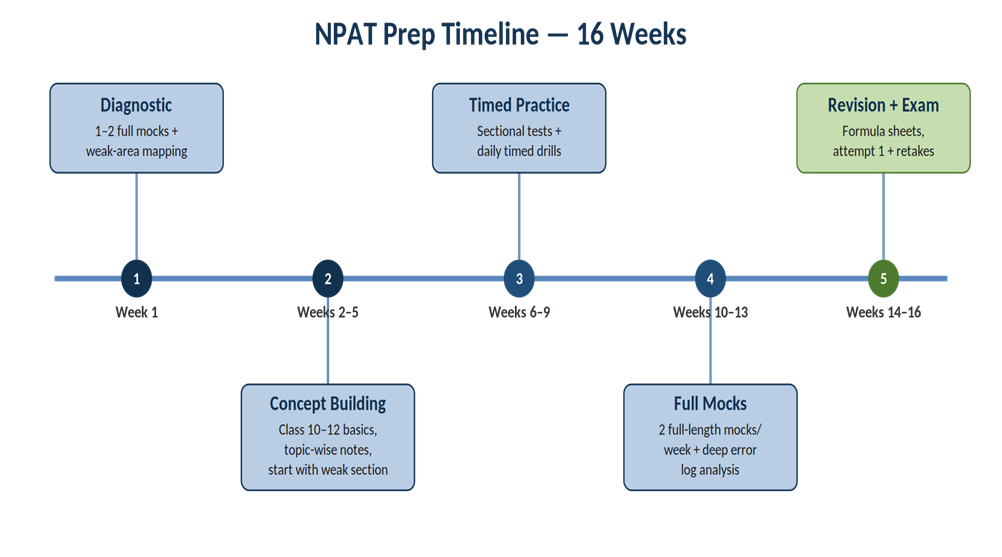
Phase 1: Diagnostic (Week 1)
Before opening a single book, take 1–2 full-length mocks under real exam conditions—100 minutes, no pausing, and no notes. This tells you your actual starting point across QA, Reasoning, and Verbal and which section is genuinely weak versus which one you just feel unsure about. Skipping this step is the most common reason students waste the first month on the wrong topics.
Phase 2: Concept Building (Weeks 2–5)
- Start with your weakest section first, since it has the most room for improvement.
- Rebuild Class 10–12 fundamentals—Arithmetic and Algebra for QA, grammar rules for Verbal, and basic DI reading for Reasoning.
- Keep a running formula and shortcut notebook from day one; you’ll lean on it heavily in phases 4 and 5.
- Read newspaper editorials daily from week 2 onward—Verbal gains compound slowly, so an early start pays off later.
Phase 3: Timed Practice (Weeks 6–9)
- Move from untimed topic practice to timed sectional tests — 30–35 minutes per section, matching real exam pacing.
- Focus specifically on Data Interpretation sets; they’re consistently the most time-consuming part of the Reasoning section.
- Track a simple error log — question type, why you got it wrong (concept gap vs. silly mistake vs. ran out of time)—and revisit it weekly.
Phase 4: Full Mocks (Weeks 10–13)
- Take 2 full-length mocks a week under strict exam conditions, ideally at the same time of day you’d sit the real exam.
- Spend at least as much time analyzing each mock as you spent taking it—this is where most of the actual score improvement happens.
- Since there’s no negative marking, use mocks to build the habit of attempting every question rather than skipping uncertain ones.
Phase 5: Revision and Exam Window (Weeks 14–16)
- Shift to pure revision — formula sheets, error log review, and lighter, shorter practice sets rather than new material.
- Book your first attempt with a buffer before your target date, so a rough first attempt still leaves room for 2 retakes.
- Treat your highest-scoring attempt as final—since only the best of your 3 attempts counts, use the first as a real data point, not just a formality.
Week-by-Week Snapshot
| Weeks | Phase | Primary Focus |
| Week 1 | Diagnostic | 1–2 full mocks, identify weak section |
| Weeks 2–5 | Concept Building | Fundamentals, weakest section first, daily reading habit |
| Weeks 6–9 | Timed Practice | Sectional tests, DI-focused drills, error log |
| Weeks 10–13 | Full Mocks | 2 full-length mocks/week + deep analysis |
| Weeks 14–16 | Revision & Exam | Formula revision, first attempt, retakes |
If you’re starting later than 16 weeks out, compress Phases 2 and 3 rather than skipping Phase 1 or Phase 4—the diagnostic and full-mock phases are where most of the actual percentile gains come from, so protect those even under time pressure.
Frequently Asked Questions
Q. Is there negative marking in NPAT?
No. There is no negative marking in NPAT, so you should attempt every question.
Q. How many times can I attempt NPAT?
You get one main attempt and two retakes — three attempts in total during the exam window. Your highest score across all attempts is considered for the merit list.
Q. What is the NPAT 2027 exam pattern?
120 MCQs across three sections—Quantitative & Numerical Ability, Reasoning & General Intelligence, and Proficiency in English Language — 40 questions each, to be completed in 100 minutes with no sectional time limit.
Q. Can I use my SAT or ACT score instead of NPAT?
Yes, SAT/ACT scores are accepted for eligible programs as an alternative to appearing for NPAT.
Q. Does NMIMS have a management quota?
No. NMIMS has officially confirmed there is no management quota, and admissions are purely merit-based on NPAT (or accepted alternate) scores.
Q. How many programs can I apply for through one NPAT registration?
You can select up to five programs and indicate your campus preferences in priority order during the same registration.
Q. When will NPAT 2027 registrations open?
NMIMS hasn’t announced an official 2027 date yet. Based on past cycles, registrations are expected to open around mid-December 2026 — keep checking npat.nmims.edu for the actual notification.
Q. What are the eligibility criteria?
To apply, you must be under 25 years old and have passed Class 12 with at least 60% aggregate. For core programs (like Finance and Economics) at major campuses, mathematics or statistics is mandatory in class 12.
Q. Is the NPAT syllabus fixed or officially published?
NMIMS does not release a detailed, official syllabus. The topics commonly tested are based on consistent exam analysis over previous years, not a formal notification, so treat topic lists (including this one) as a guide rather than a guarantee.
Quick Recap
| Aspect Aspect | Details |
| Conducting body | SVKM’s NMIMS Deemed-to-be University |
| Mode | Online, computer-based test (CBT) |
| Duration | 100 minutes |
| Total questions | 120 (40 each in QA, Reasoning, Verbal) |
| Negative marking | None |
| Attempts allowed | 1 main + 2 retakes (best score counted) |
| Campuses accepting NPAT | Mumbai, Bengaluru, Navi Mumbai, Hyderabad, Indore, Chandigarh, Ahmedabad |
Disclaimer: NMIMS has not released the official NPAT 2027 notification at the time of writing. Dates in this article are estimates based on previous years’ patterns and should be verified against the official website (npat.nmims.edu) once the notification is out.