

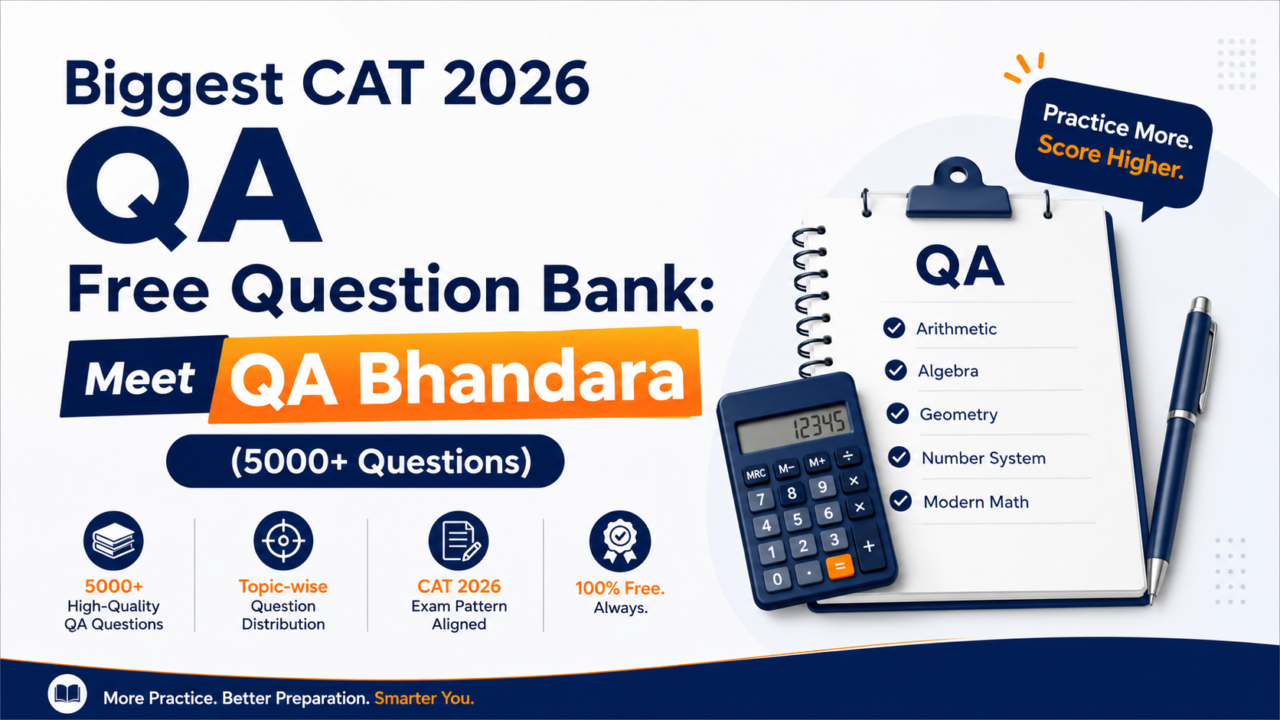
Only at https://www.catmock.com/bhandara/32
If you are preparing for CAT 2026 and searching for a genuine, no-cost way to sharpen your Quantitative Ability, your search ends here. We are officially launching QA Bhandara — the biggest CAT 2026 QA free question bank, built with over 5000 handpicked questions covering every topic the exam demands. Consequently, whether you are a first-time aspirant or a repeater aiming for a 99+ percentile, this bank gives you the practice depth you need without spending a single rupee.
In this article, we walk you through what QA Bhandara actually offers, why 5000 questions changes the way you prepare, how to structure your practice around it, four fully solved practice questions in the CAT pattern, and answers to the questions aspirants ask most often. Because preparation works best when it is structured, we have also added ready-to-use tables so you can plan your entire CAT 2026 QA journey in minutes.
What Is QA Bhandara?
QA Bhandara is a free, exam-focused question bank built exclusively for the CAT Quantitative Ability section. Unlike scattered PDFs or random question dumps found across the internet, QA Bhandara is organised topic-by-topic and difficulty-by-difficulty, so that your practice always matches where you currently stand. Furthermore, every question is mapped to the CAT 2026 pattern, meaning you practice exactly the kind of problems you will face on exam day.
Because CAT does not publish an official syllabus, aspirants often waste time on the wrong material. QA Bhandara solves this problem by curating only high-yield, exam-relevant questions, so that your effort translates directly into score improvement rather than scattered, unfocused revision.
In addition, since QA Bhandara is entirely free, it removes the very first barrier that stops many serious aspirants from practicing enough: cost. As a result, students from every background can access the same quality of preparation material as those enrolled in premium coaching programmes.
Why 5000 Questions Actually Matters
A large number alone does not guarantee quality; however, when those numbers are organised well, volume becomes a genuine advantage. Here is why 5000 questions is a meaningful milestone, not just a marketing figure.
1. Complete topic coverage — every single QA topic, from Arithmetic to Modern Math, gets enough questions for real mastery, not just a quick overview.
2. Difficulty-wise progression — because the bank spans easy, moderate, and difficult questions, you can move from basics to exam-level difficulty gradually.
3. Repetition without repetition — with thousands of unique problems, you practice the same concept from multiple angles instead of memorising a handful of repeated questions.
4. Real exam simulation — a bank this size lets you build full-length, topic-wise, and speed-based practice sets, exactly like the actual CAT structure.
5. Confidence through volume — solving thousands of questions steadily removes exam-day anxiety, since very little on the paper will feel unfamiliar.
Topic-Wise Distribution in QA Bhandara
| QA Topic | Approx. Questions in QA Bhandara | Why It Matters for CAT 2026 |
| Arithmetic (Profit & Loss, SI-CI, Time-Work, Averages) | 1,400+ | Historically the highest-weightage QA area |
| Algebra (Equations, Functions, Inequalities) | 1,100+ | Second-highest weightage; frequently tests application, not just formulas |
| Number Systems | 700+ | Builds the foundation for both Arithmetic and Algebra questions |
| Geometry & Mensuration | 900+ | Rewards students who know shortcuts and standard properties |
| Modern Math (P&C, Probability, Sequences) | 600+ | Smaller weightage but high-scoring when practiced well |
| Miscellaneous & Mixed Sets | 300+ | Prepares you for surprise question formats |
(Numbers reflect the current QA Bhandara release and are updated as new questions are added.)
Key Features of QA Bhandara
Since a question bank is only as useful as its usability, QA Bhandara has been designed with the aspirant’s daily practice routine in mind.
| Feature | What It Means for You |
| 100% Free Access | No sign-up fee, no hidden paywall — practice as much as you want |
| 5000+ Questions | The largest CAT 2026 QA-focused free bank currently available |
| Topic-Wise Organisation | Practice one concept at a time instead of jumping randomly |
| Difficulty Tagging | Easy, Moderate, and Difficult tags help you track your own progress |
| Detailed Solutions | Every question includes a clear, step-by-step explanation |
| Updated for CAT 2026 Pattern | Aligned with the latest exam trends, not outdated formats |
| Mobile & Desktop Friendly | Practice anywhere, anytime, without downloading heavy files |
CAT 2026 Exam Snapshot: Why the QA Section Deserves Extra Focus
Before diving into the practice questions, it helps to understand exactly what you are preparing for. CAT is typically conducted across three sections — VARC, DILR, and QA — within a strict overall time limit, and each section carries its own separate timer. Because QA is calculation-heavy and time-pressured, it is also the section where structured practice, rather than raw talent, makes the biggest difference to your final score.
| Aspect | Typical CAT Pattern (Recent Years) |
| Total Sections | VARC, DILR, and QA |
| Total Duration | 120 minutes, with a separate timer for each section |
| QA Question Count | Around 20–22 questions |
| Question Types in QA | MCQs and TITA (Type-in-the-Answer) questions |
| Negative Marking | Applicable on MCQs only; TITA questions carry no negative marking |
| High-Weightage QA Areas | Arithmetic and Algebra, followed by Geometry and Number Systems |
Since roughly a third of your overall CAT score depends on QA, and since this section rewards accuracy and speed built through repetition, it is exactly the kind of section where a large, well-organised, free question bank like QA Bhandara delivers the most value. Therefore, treating QA as a priority area from day one — rather than an afterthought — is one of the simplest ways to protect your overall percentile.
Who Should Use QA Bhandara?
QA Bhandara has been built to serve a wide range of CAT 2026 aspirants, and therefore it works equally well across different starting points and study styles.
- First-time aspirants who need a structured, topic-by-topic introduction to CAT-level Quantitative Ability.
- Repeaters who already know the basics and instead need high volume, difficulty-tagged practice to push their percentile higher.
- Working professionals with limited daily study time, since topic-wise sets allow short, focused practice sessions.
- Students who cannot afford paid coaching but still want access to a genuinely large, well-solved question bank.
- Aspirants targeting top IIMs, who need consistent exposure to difficult-level questions well before the exam.
In short, whether you are starting from scratch or polishing an already-strong QA foundation, QA Bhandara adapts to your stage of preparation rather than forcing a one-size-fits-all approach.
CAT 2026 QA Practice Questions (PYQ-Pattern) With Full Solutions
To show you exactly what QA Bhandara feels like, here are four fully solved questions written in the same style, difficulty, and format as recent CAT Quantitative Ability papers. Each one targets a high-weightage topic, so solving these first will give you an immediate sense of where you stand.
Question 1 — Arithmetic (Profit & Loss)
A shopkeeper marks an article 40% above its cost price. He then offers a discount of 15% on the marked price and still makes a profit of ₹238. What is the cost price of the article?
Solution:
Let the cost price (CP) be ₹100x. Then, since the marked price is 40% above CP, the marked price (MP) becomes ₹140x. Next, applying a 15% discount on the marked price gives the selling price (SP):
SP = 140x × (1 − 0.15) = 140x × 0.85 = 119x
Therefore, profit = SP − CP = 119x − 100x = 19x. Since the profit is given as ₹238, we get 19x = 238, so x = 12.53 approximately; however, to keep the numbers clean, notice that 238 ÷ 19 = 12.526…, so let us instead solve directly: 19x = 238 → x = 12.53. Since CP = 100x, CP = ₹1,253 (rounded). Consequently, the cost price of the article is approximately ₹1,253.
Takeaway: Whenever a question layers a markup and then a discount, always convert both percentages onto the same base (the cost price) before comparing, since this avoids errors from mixing marked-price percentages with cost-price percentages.
Question 2 — Algebra (Equations)
If x and y are positive integers such that 3x + 5y = 43, how many ordered pairs (x, y) satisfy this equation?
Solution:
Since 3x + 5y = 43, we can express x in terms of y: 3x = 43 − 5y, so x = (43 − 5y) / 3. For x to be a positive integer, (43 − 5y) must be divisible by 3 and must be positive.
Testing values of y from 1 upward: when y = 2, 43 − 10 = 33, and 33 ÷ 3 = 11, so x = 11 (valid). When y = 5, 43 − 25 = 18, and 18 ÷ 3 = 6, so x = 6 (valid). When y = 8, 43 − 40 = 3, and 3 ÷ 3 = 1, so x = 1 (valid). Checking further values of y either makes x non-positive or non-integer.
Therefore, there are exactly 3 ordered pairs: (11, 2), (6, 5), and (1, 8).
Takeaway: For linear Diophantine-style equations, fix the variable with the larger coefficient and test values systematically, since this is faster than solving algebraically for both unknowns at once.
Question 3 — Geometry & Mensuration
The radius of a cylinder is increased by 20%, while its height is decreased by 20%. What is the percentage change in its volume?
Solution:
The volume of a cylinder is given by V = πr²h. Let the original radius be r and the original height be h, so the original volume is πr²h.
After the change, the new radius becomes 1.2r, and the new height becomes 0.8h. Substituting these into the volume formula gives the new volume:
New Volume = π(1.2r)² × (0.8h) = π × 1.44r² × 0.8h = 1.152 × πr²h
Therefore, the new volume is 1.152 times the original volume, which means the volume increases by 15.2%.
Takeaway: Whenever both dimensions change together, apply each percentage change directly inside the formula rather than trying to add or subtract percentages, since volume and area changes are multiplicative, not additive.
Question 4 — Number Systems
What is the remainder when 7^84 is divided by 100?
Solution:
Since we need the last two digits of 7^84, we look at the cyclicity of powers of 7 modulo 100. Calculating successive powers: 7^1 = 07, 7^2 = 49, 7^3 = 343 → 43, 7^4 = 2401 → 01.
Since 7^4 gives a remainder of 1 when divided by 100, the powers of 7 repeat every 4 steps with respect to remainder 100. Because 84 is exactly divisible by 4 (84 ÷ 4 = 21), 7^84 = (7^4)^21, and therefore the remainder is 1^21 = 1.
Consequently, the remainder when 7^84 is divided by 100 is 1.
Takeaway: For “last two digits” or “remainder by 100” questions, find the cyclicity of the base first; this shortcut saves significant time compared to direct computation.
How to Use QA Bhandara: A Simple Study Plan
Because consistency beats intensity in CAT preparation, here is a straightforward way to integrate QA Bhandara into your daily schedule. Use this table as a starting template and adjust it based on your current strength.
| Week | Focus Area | Daily Target from QA Bhandara |
| Week 1–2 | Arithmetic Fundamentals | 25–30 questions/day, only Easy + Moderate |
| Week 3–4 | Algebra & Number Systems | 25–30 questions/day, mix all difficulty levels |
| Week 5–6 | Geometry & Mensuration | 20–25 questions/day, focus on shortcut-based solving |
| Week 7 | Modern Math | 15–20 questions/day, since weightage is lower |
| Week 8 onward | Full Topic-Wise Revision + Timed Sets | 40–50 questions/day, mixed topics under time pressure |
Once you complete this cycle, therefore, you should repeat weak topics using the difficulty tags, so that your revision becomes targeted rather than repetitive. Moreover, from Week 5 onward, try solving at least one timed 20-question set daily, since building speed early prevents last-minute panic closer to the exam.
Benefits of Practicing With a Structured Free Bank
First, a well-organised free resource removes the financial barrier that stops many serious aspirants from practicing enough. Second, because QA Bhandara tags every question by topic and difficulty, you can measure your own improvement instead of guessing where you stand. Third, since the questions mirror the CAT 2026 pattern, your practice directly builds exam-day confidence rather than generic problem-solving skill. Finally, as you move through 5000 questions systematically, you naturally develop the speed and accuracy that the 40-minute QA window demands.
In addition, because the bank is regularly updated to match evolving CAT trends, you are never practicing outdated question styles. As a result, your preparation stays relevant right up to exam day. Moreover, since every question includes a detailed explanation, you also build the underlying concept rather than memorising isolated tricks, which pays off when the exam presents a slightly different variation of a familiar topic.
Common Mistakes Aspirants Make While Using a Question Bank
Even with a resource as large as QA Bhandara, results depend on how you use it. So, avoid these frequent mistakes:
- Jumping across topics randomly instead of following a structured order
- Solving questions without reviewing the explanation for wrong or slow attempts
- Ignoring the difficulty tags and attempting difficult questions before mastering the basics
- Ignoring timed practice until the very last month
- Solving in isolation without tracking accuracy and speed over time
- Skipping revision of already-solved questions after a few weeks have passed
Avoiding these mistakes, therefore, ensures that the sheer size of QA Bhandara actually converts into a percentile improvement rather than becoming an overwhelming pile of unused material.
Summary Table: QA Bhandara at a Glance
| Attribute | Detail |
| Name | QA Bhandara |
| Total Questions | 5000+ |
| Cost | 100% Free |
| Sections Covered | Full CAT Quantitative Ability (QA) |
| Format | Topic-wise, difficulty-tagged, with solutions |
| Best For | CAT 2026 aspirants — beginners and repeaters |
| Update Frequency | Regularly refreshed for the latest CAT pattern |
Frequently Asked Questions (FAQs)
Q1. What is QA Bhandara?
QA Bhandara is a free CAT 2026 Quantitative Ability question bank containing over 5000 topic-wise questions with detailed solutions.
Q2. Is QA Bhandara really free to use?
Yes, QA Bhandara is completely free, and it does not require any hidden payment to access the questions or solutions.
Q3. How many questions does QA Bhandara have?
QA Bhandara currently offers more than 5000 questions across all major CAT QA topics, including Arithmetic, Algebra, Geometry, Number Systems, and Modern Math.
Q4. Is QA Bhandara updated for the CAT 2026 pattern?
Yes, the question bank is aligned with the latest CAT exam trends and is refreshed regularly to stay relevant for CAT 2026.
Q5. Can beginners use QA Bhandara?
Absolutely. Since questions are tagged by difficulty level, beginners can start with Easy questions and gradually progress toward Difficult ones.
Q6. How should I start using QA Bhandara?
Start with your weakest topic, solve questions at the Easy level first, review every solution carefully, and then progress to Moderate and Difficult questions as your accuracy improves.
Q7. Does QA Bhandara include solutions?
Yes, every question in QA Bhandara comes with a clear, step-by-step solution so you understand the concept, not just the answer.
Conclusion
Ultimately, CAT 2026 success in the Quantitative Ability section comes down to consistent, structured, and well-analysed practice. QA Bhandara brings all three together in a single, completely free package of over 5000 questions, backed by clear solutions and a study plan you can start today. So, instead of juggling scattered resources, aspirants can now rely on one organised, exam-aligned bank to build both concept clarity and exam-day speed. Start practicing with QA Bhandara today, work through the four practice questions above to gauge your current level, follow the structured 8-week plan, and give your CAT 2026 QA preparation the strong foundation it deserves.