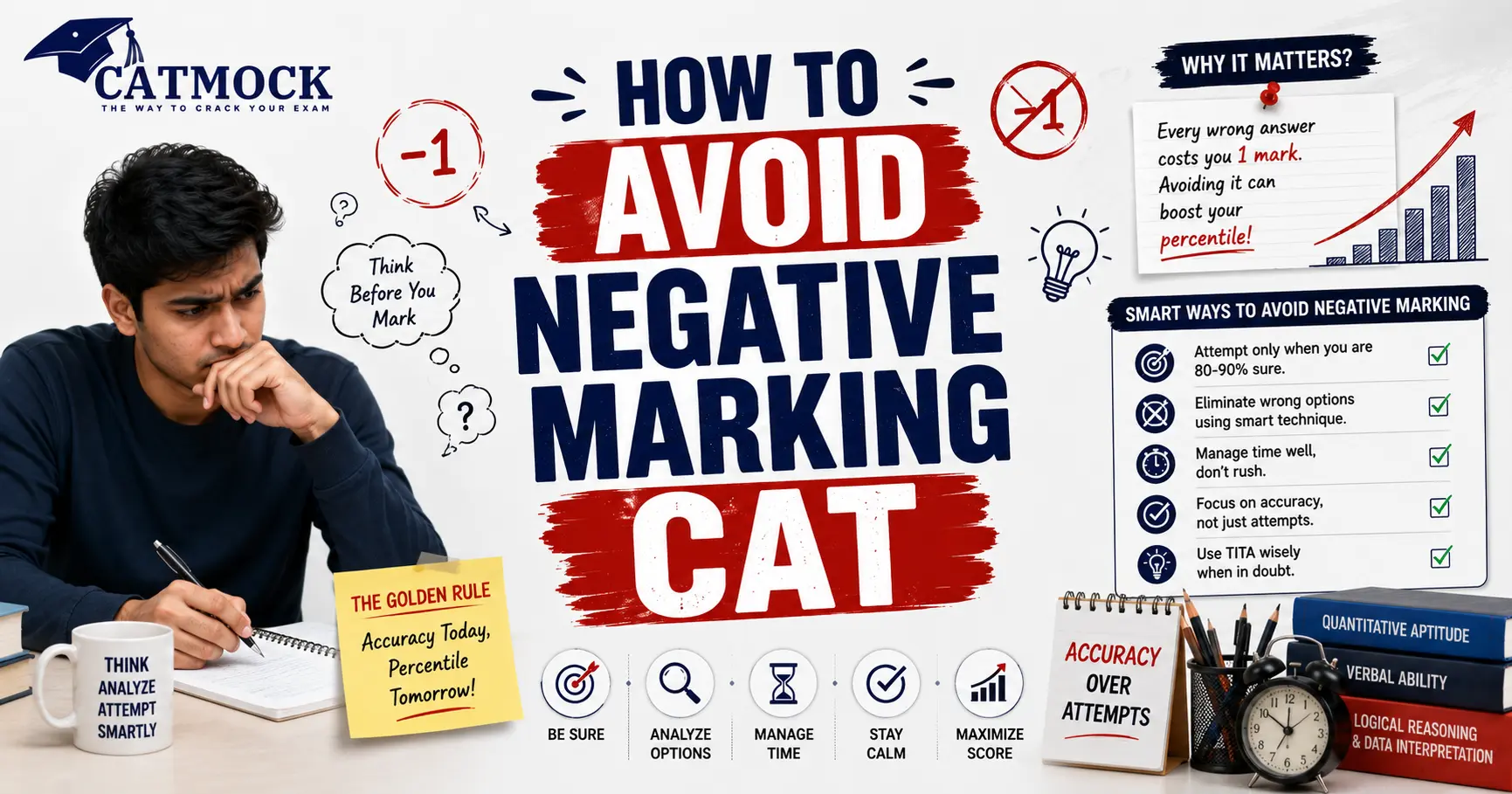
Every year, thousands of CAT aspirants lose their dream IIM call not because they lacked knowledge, but because they lost hard-earned marks to careless guessing. If you’ve ever wondered how to avoid negative marking in CAT, the answer isn’t just “be careful” — it’s a structured mix of exam psychology, section-wise tactics, and disciplined mock-test practice. This guide breaks down everything you need to protect your score and convert your preparation into a strong percentile.
What Is Negative Marking in CAT?
Negative marking in CAT is a penalty system designed to discourage random guessing. For every Multiple Choice Question (MCQ) you answer incorrectly, one mark is deducted from your total score. Questions you leave unattempted carry no penalty at all, and Type In The Answer (TITA) questions — where you type a numeric or text response instead of choosing from options — have zero negative marking, even if your answer is wrong.
This distinction is the single most important thing to internalize before exam day: CAT does not punish you for skipping a question you’re unsure about, but it does punish you for guessing wrong on an MCQ.
CAT 2026 Marking Scheme at a Glance
| Question Type | Marks for Correct Answer | Marks for Incorrect Answer | Marks for Unattempted |
|---|---|---|---|
| MCQ | +3 | −1 | 0 |
| TITA (Type In The Answer) | +3 | 0 | 0 |
| Total Exam Marks | 204 | — | — |
CAT 2026 is expected to have 68 questions across three sections, with a total exam duration of 120 minutes (40 minutes per section, non-transferable). Understanding this structure is the foundation for building an accuracy-first strategy.
Section-Wise Breakdown
| Section | Number of Questions | MCQs | TITA | Time Limit |
|---|---|---|---|---|
| Verbal Ability & Reading Comprehension (VARC) | 24 | 22 | 2 | 40 minutes |
| Data Interpretation & Logical Reasoning (DILR) | 22 | 12 | 10 | 40 minutes |
| Quantitative Aptitude (QA) | 22 | 14 | 8 | 40 minutes |
| Total | 68 | 48 | 20 | 120 minutes |
Notice that DILR and QA have a much higher share of TITA questions than VARC. This matters strategically: in these two sections, you can afford slightly more “educated attempts” since wrong TITA answers don’t cost you marks — while in VARC, where most questions are MCQ-based, discipline around accuracy becomes even more critical.
Why Negative Marking Exists (And Why It’s Not Your Enemy)
Negative marking isn’t designed to trip you up — it’s designed to reward genuine preparation over luck. Think of it as a filter that separates candidates who know the answer from those who are hoping to land on it. Once you view it this way, your CAT strategy shifts from “how many can I attempt” to “how many can I get right.”
This is also why CAT test-takers with fewer attempts but higher accuracy often outperform those who attempt every question. A candidate who attempts 40 questions with 90% accuracy will typically score higher than one who attempts 55 questions with 65% accuracy, even though the second candidate “did more.”
The Math Behind Guessing: Should You Ever Guess?
Here’s a simple way to think about expected value on a 4-option MCQ:
- If you guess randomly with zero information, your odds of being correct are 1 in 4. Statistically, over many such guesses, you lose more marks than you gain.
- If you can eliminate even one wrong option, your odds improve to 1 in 3 — the math starts to favor an educated guess, though it’s still a coin-toss level risk.
- If you can eliminate two options, you’re down to a 50-50 call, and an educated guess becomes a reasonable calculated risk rather than a gamble.
This is the core logic behind the elimination technique discussed below — it’s not about avoiding all guesses, but about only taking calculated ones.
7 Proven Strategies to Avoid Negative Marking in CAT
1. Attempt Only What You’re Genuinely Confident About
The single biggest driver of negative marks is attempting questions “just to try.” Before marking an answer, ask yourself: Am I solving this, or am I hoping? If it’s the latter, skip it and move on. An unattempted question protects your score; a wrong guess erodes it.
2. Use the Elimination Technique Wisely
Rather than treating every unfamiliar question as a coin toss, actively eliminate options you know are wrong. Removing even one or two implausible choices meaningfully shifts the odds in your favor and turns a blind guess into an informed decision.
3. Read Every Question Twice Before Solving
A large share of CAT negative marks come not from lack of knowledge but from misreading the question — missing a “not,” a unit conversion, or a specific condition. Reading carefully the first time saves you from re-verifying under time pressure later.
4. Prioritize TITA Questions When Unsure
Since TITA questions carry no penalty for wrong answers, they’re the safer space to make an educated attempt when you’re genuinely stuck between two possible approaches. Use your elimination and estimation skills here more liberally than you would on MCQs.
5. Solve Easy Questions First, Then Return to Tough Ones
Sectional time limits mean you can’t borrow time from one section for another, but within a section, sequencing matters. Clear the questions you find straightforward first — this builds accuracy-driven momentum and leaves your remaining time for calculated attempts on harder questions, rather than rushed guesses.
6. Double-Check Before Final Submission, Not During Solving
Many candidates solve a question correctly on their rough sheet but select the wrong option on screen due to hurry. Build a habit of a two-second confirmation glance before locking an answer — this single habit alone eliminates a surprising number of avoidable negative marks.
7. Track and Analyze Every Mock Test
Mock tests are where this entire strategy gets tested and refined. After every mock, don’t just look at your score — build an error log that separates “conceptual mistakes” from “guessing mistakes.” Over time, this log tells you exactly which topics tempt you into risky guesses, so you can consciously slow down there in the real exam.
Common Negative-Marking Mistakes vs. How to Fix Them
| Common Mistake | Why It Happens | How to Fix It |
|---|---|---|
| Guessing on unfamiliar MCQs to “not waste the question” | Fear of leaving marks on the table | Remind yourself: an unattempted question scores zero, a wrong guess scores −1 — skipping is safer |
| Misreading question conditions (e.g., “which is NOT true”) | Rushing due to time pressure | Read the question twice; underline key conditions mentally |
| Selecting the wrong option despite solving correctly | Hurrying between rough work and final selection | Add a brief confirmation step before submitting each answer |
| Spending too long on one tough question | Sunk-cost thinking (“I’ve already invested time”) | Set a mental cap (60–90 seconds) to decide attempt or skip |
| Treating all wrong answers the same | Not distinguishing MCQ vs. TITA penalty structure | Apply slightly more risk tolerance to TITA, strict discipline to MCQ |
| Not reviewing mock-test errors | Focusing only on the score, not the pattern | Maintain a weekly error log split by mistake type |
A Simple Decision Framework: Attempt or Skip?
Use this quick framework while attempting each MCQ during your mocks and the actual exam:
| Confidence Level | Options Eliminated | Recommended Action |
|---|---|---|
| Fully confident in the answer | N/A | Attempt |
| Somewhat confident, can eliminate 2 of 4 options | 2 | Attempt (calculated risk) |
| Unsure, can eliminate only 1 option | 1 | Attempt only if time permits and accuracy has been strong so far |
| No idea, cannot eliminate any option | 0 | Skip — do not guess |
| TITA question with a rough estimate | N/A | Attempt (no penalty for wrong answer) |
Section-Wise Tips to Minimize Negative Marking
In VARC: Since most questions here are MCQs, prioritize reading comprehension passages you understand well before attempting para-jumbles or summary questions, which tend to have subtler traps.
In DILR: Attempt a full data set only after quickly scanning whether you can decode the underlying logic. Partial understanding of a DILR set often leads to a cascade of wrong answers across multiple questions tied to the same data.
In QA: Watch for calculation traps like sign errors, unit mismatches, and misread values. Since QA has a healthy share of TITA questions, use your estimation skills confidently there, but stay conservative on QA MCQs involving multiple steps.
How Mock Tests Help You Build an Accuracy-First Habit
Simulating exam conditions repeatedly is the only reliable way to convert these strategies into instinct. Each mock test should be treated as a rehearsal for three things: your attempt-vs-skip judgment, your time allocation, and your error-review discipline. Over 15–20 mocks, most serious aspirants notice their guess-driven negative marks drop significantly, while their accuracy on genuine attempts climbs above 85–90% — which is typically the range associated with strong percentile outcomes.
Quick Summary
- Negative marking in CAT applies only to MCQs: +3 for correct, −1 for incorrect, 0 for unattempted.
- TITA questions carry no negative marking, making them the right place for educated estimates.
- CAT 2026 has 68 questions and 204 total marks across VARC, DILR, and QA.
- Prioritize accuracy over volume — fewer, well-chosen attempts consistently outperform reckless attempts.
- Use the elimination technique only when you can genuinely rule out at least one or two options.
- Read questions twice, double-check answers before submission, and treat every mock test as a chance to refine your attempt-vs-skip instinct.
Conclusion
Learning how to avoid negative marking in CAT ultimately comes down to one mindset shift: treat every question as an accuracy decision, not an attempt quota to fill. The candidates who consistently score well aren’t necessarily the ones who know the most — they’re the ones who know when to hold back. Combine the marking-scheme awareness, the elimination technique, and a disciplined mock-test review cycle outlined above, and you’ll walk into the CAT exam hall with a strategy that protects your score instead of gambling with it.
If you’re still building your overall preparation timeline, it helps to pair this accuracy strategy with a broader look at the CAT exam pattern and syllabus and a realistic CAT preparation study plan so that your accuracy habits are backed by solid conceptual clarity. Once you start taking mocks, use a CAT percentile predictor to see how your improved accuracy translates into real percentile gains. For the most authoritative and updated exam details, always cross-check with the official CAT website.
Frequently Asked Questions (FAQs)
1. Is there negative marking for all questions in CAT?
No. Negative marking applies only to MCQs. TITA (Type In The Answer) questions have no penalty for incorrect responses.
2. How many marks are deducted for a wrong answer in CAT?
One mark is deducted for every incorrect MCQ answer. There is no deduction for unattempted questions or wrong TITA answers.
3. Is guessing ever a good strategy in CAT?
Only when you can eliminate at least one or two of the available options, turning a blind guess into a calculated, higher-probability attempt. Completely random guessing on MCQs tends to reduce your score over time.
4. Does CAT deduct marks for skipping a question?
No. Unattempted questions score zero marks — there is no penalty for skipping.
5. How many questions should I attempt to get a good percentile?
There’s no fixed number, since accuracy matters more than volume. Many high percentile scorers attempt fewer questions with 85–90%+ accuracy rather than attempting everything with lower accuracy.
6. Are TITA questions safer to attempt than MCQs?
Yes, in terms of marking, since wrong TITA answers carry no penalty. However, they still require genuine effort — an unreasoned answer is unlikely to be correct even without a mark deduction.
7. What is the total marks and negative marking structure for CAT 2026?
CAT 2026 carries a total of 204 marks across 68 questions, with +3 for every correct answer and −1 for every incorrect MCQ answer.
8. How can mock tests help reduce negative marking?
Mock tests let you practice the attempt-vs-skip decision under real time pressure and help you build an error log that identifies which topics tempt you into risky guesses, so you can correct that pattern before the actual exam.
For deeper section-wise preparation, explore our detailed guides on [CAT Exam Pattern and Marking Scheme], [Time Management Strategies for CAT], and [CAT Percentile Predictor Tool]. For official exam updates and notifications, refer to the official CAT website (iimcat.ac.in).
You May Also Like : CATMOCK / CATMOCK PYQ
Follow Us On : Facebook / Instagram