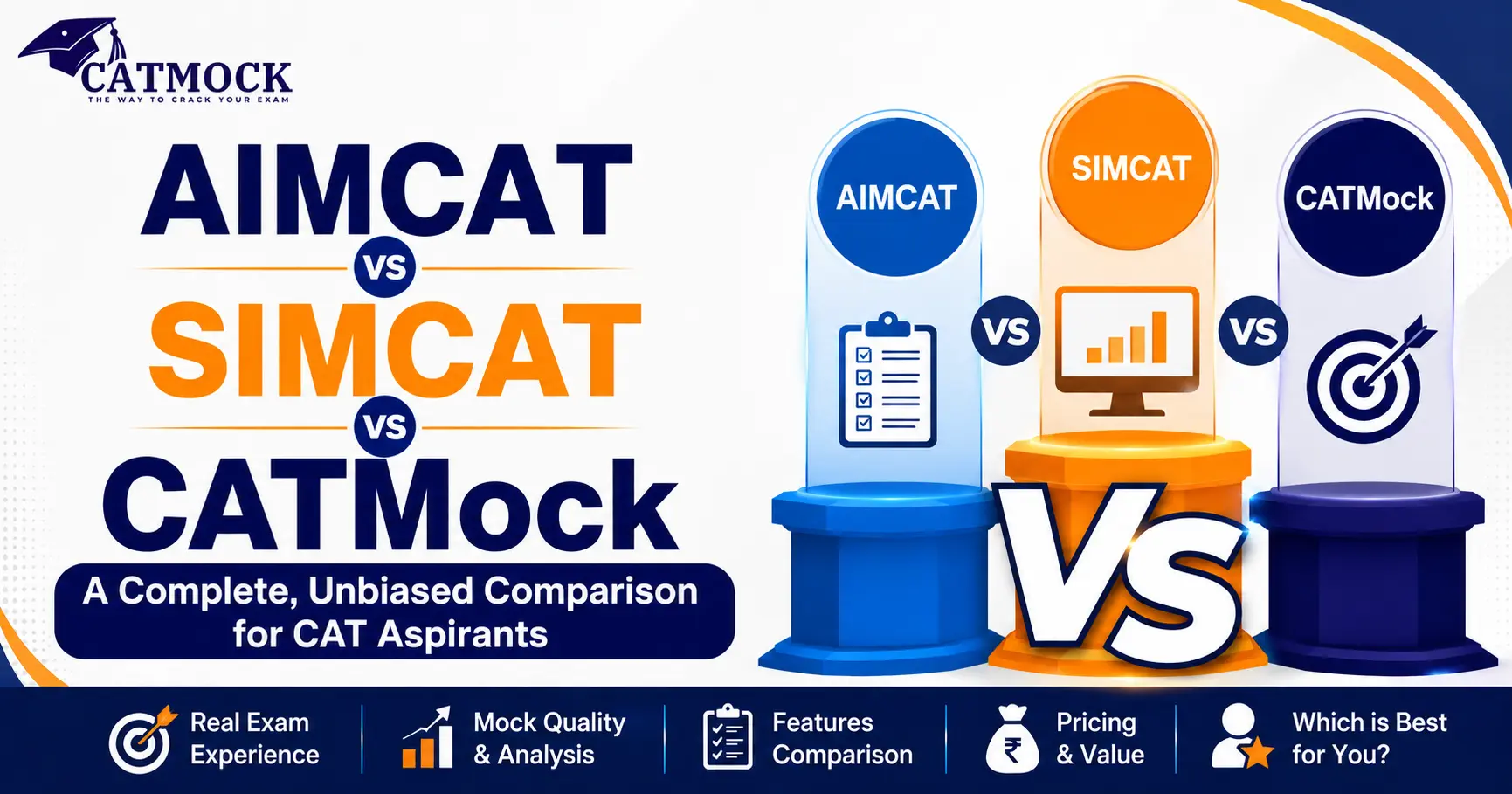
If you’ve started shortlisting a mock test series for CAT, you’ve almost certainly run into these three names: AIMCAT by T.I.M.E., SIMCAT by IMS, and CATMock, a newer, self-prep-focused platform. All three promise CAT-level mocks, but they’re built around different philosophies — legacy classroom-linked test series versus a leaner, affordability-first, self-study platform — and that difference matters more than most comparison articles let on.
This guide breaks down what each platform actually offers, where they genuinely differ, and how to decide based on your own preparation stage, budget, and weak areas — not on brand recall alone.
Quick Answer: AIMCAT vs SIMCAT vs CATMock
- Choose AIMCAT if you want T.I.M.E.’s long-running, large-scale test series with both invigilated and non-invigilated mocks and a very large national test-taking pool for benchmarking.
- Choose SIMCAT if you want IMS’s tiered test series (Core, Plus, Ultimate) with AI-driven adaptive practice questions and mocks for exams beyond CAT bundled into the higher tiers.
- Choose CATMock if you’re looking for an affordable, self-prep platform that combines full-length and sectional mocks, previous year papers, daily practice sets, and GDPI guidance in one place, especially if you’re also preparing for SNAP, NMAT, XAT, or CMAT alongside CAT.
Many serious aspirants don’t pick just one — they use a primary series for benchmarking and a second, more affordable series for extra practice volume and section-specific work. The comparison below explains why.
At a Glance: AIMCAT vs SIMCAT vs CATMock
| Factor | AIMCAT (T.I.M.E.) | SIMCAT (IMS) | CATMock |
|---|---|---|---|
| Parent organisation | T.I.M.E. (Triumphant Institute of Management Education) | IMS Learning Resources | Independent self-prep platform founded by IIM/FMS alumni and CAT toppers |
| Test format | Invigilated (centre-based) and non-invigilated (online) full-length mocks, plus sectional tests | Full-length SimCATs with video solutions, sectional tests, and Pre-SimCATs, offered across Core/Plus/Ultimate tiers | Full-length and sectional mocks, daily VARC/DILR/QA practice sets, and previous year papers |
| Approx. scale of test-takers | Historically among the largest CAT mock pools in India, with T.I.M.E. reporting well over 60,000 unique AIMCAT test-takers a year | Large national pool built over IMS’s multi-decade CAT-coaching history | Growing user base; smaller benchmarking pool than the two legacy players |
| Analytics | Sectional reports, percentile projection, detailed performance breakdowns | AI-powered performance insights, adaptive practice questions, national benchmarking | Detailed post-mock analysis, error tracking, and performance reports |
| Video/text solutions | Text-based analysis; discussion videos available for select mocks depending on package | Video and text solutions across all SimCATs | Concept videos and detailed written solutions, including PYQ solutions |
| Coverage beyond CAT | Primarily CAT-focused, with some MBA-exam-oriented resources | Higher tiers include ADMATs (mocks for other MBA entrance exams) alongside CAT | Covers CAT, XAT, SNAP, NMAT, CMAT, MAT, and CUET-PG under one platform |
| Extra prep support | Test-taking strategy sessions, chat/discussion access depending on package | CAT Masterclass exercises with video solutions in select tiers | Free live lectures, daily practice, a topic-wise practice bank, and dedicated GDPI faculty for interview prep |
| Positioning | Established, classroom-linked legacy test series | Established, classroom-linked legacy test series | Lower-cost, self-prep-first platform with free mocks to start |
Exact mock counts, pricing, and package inclusions for AIMCAT and SIMCAT change from one CAT cycle to the next, so always confirm current numbers on T.I.M.E.’s and IMS’s own test-series pages before purchasing.
What Is AIMCAT?
AIMCAT (All India Mock CAT) is T.I.M.E.’s flagship test series and one of the oldest, most widely taken mock series for CAT preparation in India. It’s built around large-scale, benchmarked testing: T.I.M.E. states that its AIMCATs are attempted by well over 60,000 unique test-takers every year, which gives the percentile data a large comparison pool.
Historically, AIMCAT packages have combined invigilated (centre-based) and non-invigilated (online, self-administered) full-length mocks along with sectional tests, discussion videos for select mocks, and test-taking strategy sessions. Because AIMCAT questions are often described by aspirants and coaching reviewers as slightly tougher or “trap-style” in DILR and QA compared to the actual CAT, many students use a lower-than-expected AIMCAT score as a diagnostic signal rather than a final verdict on their preparation.
Good fit if: you want a long-established, large-cohort series primarily for CAT and are comfortable with a classroom-coaching-linked ecosystem.
What Is SIMCAT?
SIMCAT is IMS Learning Resources’ CAT mock series, built on IMS’s multi-decade history in CAT coaching. For CAT 2026, IMS structures SIMCAT into three tiers — SimCAT Core, SimCAT Plus, and SimCAT Ultimate — with the higher tiers adding more resources on top of the same base of mocks.
Across these tiers, IMS bundles full-length SimCATs with video solutions, a set of Pre-SimCATs, sectional tests, AI-powered adaptive practice questions, and AI-driven performance insights for national benchmarking. The top tier (Ultimate) also includes ADMATs, which are full-length mocks for MBA entrance exams other than CAT, making it relevant for aspirants targeting multiple exams in the same season. Aspirants and coaching reviewers often describe SIMCAT question design as closely mirroring the tone and structure of actual CAT papers, with a strong sectional-test component that’s useful for isolating DILR practice before attempting full-length tests.
Good fit if: you want a tiered, IMS-branded series with strong video solutions and are open to bundling in mocks for other MBA entrance exams through the higher tiers.
What Is CATMock?
CATMock takes a different approach from AIMCAT and SIMCAT. Rather than being an add-on to a classroom coaching program, it’s built as a self-contained, self-prep platform, developed by CAT toppers and CAT mentors, including some with multiple 99.5+ percentile scores, with the stated goal of keeping high-quality, CAT-relevant preparation affordable and accessible.
On the platform, CAT preparation is organised into a few connected pieces rather than one single test series:
- Full-length and sectional mocks under CATMock’s Test Series, including a dedicated full-length CAT mock category and a separate CAT sectional test category, with a mix of free mocks to try the format and paid mocks for deeper practice.
- Daily VARC, DILR, and QA practice through the Daily Practice section, useful for building a consistent, low-friction practice habit outside full mock days.
- A large topic-wise question bank, branded as “Bhandara,” with hundreds of RC sets, DILR sets, and QA sets that let students drill a specific weak topic instead of only attempting full-length tests.
- Previous year papers with detailed solutions, available through the CAT PYQ archive, so aspirants can study how actual CAT questions have been framed across recent years.
- Free live lectures on the platform’s Free Lectures page, plus dedicated GDPI (Group Discussion and Personal Interview) faculty for the post-CAT admission stage, which most pure mock-test series don’t cover.
- Coverage of exams beyond CAT, including XAT, SNAP, NMAT, CMAT, MAT, and CUET-PG, listed on the platform’s About Exams page, which is relevant if you’re keeping multiple MBA entrance options open in the same season.
Because CATMock is newer than AIMCAT and SIMCAT, its national test-taking pool for benchmarking is still smaller than the decades-old cohorts that T.I.M.E. and IMS have built. Where it differentiates itself is cost and breadth: lower pricing relative to legacy test series, a genuinely free tier to start with, and a single platform that also covers daily practice, topic-wise drilling, previous year papers, and interview preparation, rather than requiring separate products for each.
Good fit if: you want an affordable, self-prep-first platform that goes beyond just full-length mocks, or you’re preparing for CAT alongside SNAP, NMAT, XAT, or CMAT and want one dashboard for all of it.
AIMCAT vs SIMCAT vs CATMock: Key Comparison Factors
1. Difficulty and pattern accuracy
Aspirant feedback across CAT preparation forums generally places AIMCAT on the tougher end, particularly in DILR and QA, while SIMCAT is often described as closely calibrated to actual CAT difficulty with a slight tilt toward standard question design over trap-style wording. Neither institute’s difficulty positioning is officially quantified, so treat these as directional patterns from long-running student feedback rather than fixed rules — difficulty also varies test to test within the same series. CATMock positions its mocks as CAT-relevant without unnecessary or artificial difficulty, aiming to mirror the exam’s actual demands rather than over-index on trickiness for its own sake.
The practical takeaway is the same across all three: a single mock’s difficulty matters less than what you do with your post-mock analysis — reviewing exactly where you lost time, which questions you should have skipped, and which concepts need revision, a process explained in more depth in this guide on increasing CAT accuracy.
2. Number and structure of mocks
AIMCAT packages have historically mixed invigilated and non-invigilated full-length tests along with sectional tests, with exact counts varying by the specific package tier in a given CAT cycle. SIMCAT’s 2026 structure spans three tiers, with the base Core tier built around a set of full-length SimCATs plus Pre-SimCATs and section tests, and higher tiers layering in additional sectional practice and ADMATs. CATMock organises its full-length and sectional CAT mocks separately, with a mix of free and paid tests, alongside daily practice sets that function as an additional, lighter-weight layer between full mocks.
Because package inclusions change every admission cycle for all three platforms, always check the current test-series or combo page directly before comparing numbers — a count that was accurate last season may not hold for this one.
3. Analytics and performance tracking
All three platforms provide post-mock analytics, but the depth and framing differ. SIMCAT’s higher tiers add AI-powered performance insights layered on top of standard sectional and percentile reports. AIMCAT provides sectional performance breakdowns and percentile projection tied to its large benchmarking pool. CATMock provides detailed performance reports and error tracking designed to help pinpoint specific weak areas rather than only reporting an overall percentile.
If in-depth, topic-level error tracking matters more to you than the size of the benchmarking cohort, weigh that against how large a peer group you want your percentile compared against.
4. Video solutions and doubt support
SIMCAT includes video solutions across its SimCATs as a core feature. AIMCAT’s discussion videos are typically available for select mocks depending on the package tier rather than universally across every test. CATMock pairs its mock solutions with concept videos and detailed written explanations, and separately offers free live lecture sessions where students can get doubts addressed outside the mock itself.
5. Coverage of exams beyond CAT
If CAT is your only target exam, this factor matters less. If you’re also appearing for SNAP, NMAT, XAT, CMAT, or CUET-PG, it’s worth checking how much a series actually supports those exams versus CAT alone. SIMCAT’s Ultimate tier bundles in ADMATs for other MBA entrance tests. CATMock natively supports XAT, SNAP, NMAT, CMAT, MAT, and CUET-PG mock categories alongside CAT on the same platform and login, which can simplify tracking your prep across exams instead of juggling separate subscriptions.
6. Pricing and accessibility
Pricing structures differ meaningfully. AIMCAT and SIMCAT are typically positioned as premium, classroom-coaching-linked test series, with package pricing set by T.I.M.E. and IMS respectively (check their official pages for current rates, as these change by cycle). CATMock is explicitly positioned around affordability, offering a free tier to start and lower-cost paid packages for the fuller test series, which matters if you’re comparing options primarily on a budget-per-mock basis rather than brand alone.
7. Additional preparation support
Beyond mocks, CATMock also bundles daily topic-wise practice, a large topic-wise question bank (Bhandara), previous year papers, and dedicated GDPI faculty for the interview stage that follows a good CAT score. AIMCAT and SIMCAT are more narrowly focused on the mock-test and analysis layer of preparation, which is a reasonable choice if you’re already getting concept coverage and interview prep through a separate coaching program.
AIMCAT vs SIMCAT: Which One First?
This is the most common sub-question aspirants ask before even considering a third option. Based on how the two are generally positioned by students and coaching reviewers:
- If your weaker sections are DILR or QA and you want practice under tougher, trap-style conditions, AIMCAT’s reputation for higher difficulty in these areas can be useful stress-testing.
- If you want mocks that closely track actual CAT difficulty and tone, with a strong sectional-test layer for isolating DILR practice, SIMCAT is frequently the preferred pick.
- If you’re preparing for other MBA entrance exams alongside CAT, SIMCAT’s Ultimate tier (with ADMATs) adds more built-in coverage than AIMCAT’s base CAT-focused offering.
Neither is objectively “better” — many toppers have cracked CAT using either, or a mix of both, alongside consistent, honest post-mock analysis.
Where Does CATMock Fit Into This Decision?
CATMock isn’t trying to be a like-for-like replacement for a decades-old, classroom-linked test series with a large benchmarking pool — it’s a different kind of tool. It’s most useful as either:
- A primary platform for self-preparing aspirants who want full-length mocks, sectional tests, daily practice, PYQs, and even GDPI guidance in one affordable place without needing to enrol in classroom coaching.
- A supplementary series alongside AIMCAT or SIMCAT, for extra mock volume, daily practice between full-length attempts, or topic-wise drilling through Bhandara, especially if budget is a constraint for adding a second full-priced test series.
- A single-login option for multi-exam aspirants targeting CAT plus SNAP, NMAT, XAT, or CMAT in the same cycle, since these are natively supported without separate subscriptions.
How Many Mocks Do You Actually Need?
Regardless of which series (or combination) you choose, most experienced CAT mentors converge on a similar range: roughly 20–30 full-length mocks across your full preparation cycle, taken with disciplined post-mock analysis, tend to be more useful than a much larger number of mocks attempted without proper review. Mock volume without analysis is one of the most commonly cited preparation mistakes among repeat CAT test-takers. If your score has plateaued despite regular mocks, it’s worth reading about the common reasons a CAT mock score stops improving before adding more tests to your routine.
Frequently Asked Questions
Is AIMCAT or SIMCAT better for CAT preparation?
Both are well-established, classroom-linked test series with large national test-taking pools. Aspirant feedback generally places AIMCAT on the tougher end, especially in DILR and QA, while SIMCAT is often described as closely calibrated to actual CAT difficulty with a strong sectional-test component. The right choice depends on your weak areas and whether you also need mocks for other MBA entrance exams.
Is CATMock as good as AIMCAT and SIMCAT?
CATMock is a newer, smaller-scale platform compared to the decades-old AIMCAT and SIMCAT cohorts, so its benchmarking pool is currently smaller. Where it competes well is affordability, a genuinely free tier, and a broader single-platform bundle of full-length mocks, sectional tests, daily practice, PYQs, and GDPI prep, plus coverage of exams like SNAP, NMAT, XAT, and CMAT alongside CAT.
Can I use AIMCAT, SIMCAT, and CATMock together?
Yes. Many aspirants combine a primary, well-benchmarked series (AIMCAT or SIMCAT) with a more affordable platform like CATMock for additional full-length attempts, daily practice, and topic-wise drilling. Just be mindful of mock fatigue — more mocks without analysis rarely translates into a higher percentile.
Which test series should I choose if I’m also preparing for SNAP, NMAT, XAT, or CMAT?
If you want built-in coverage for these exams without separate subscriptions, CATMock supports CAT, XAT, SNAP, NMAT, CMAT, MAT, and CUET-PG on one platform. SIMCAT’s higher tier includes ADMATs for other MBA entrance exams, while AIMCAT is more narrowly CAT-focused.
Prices, mock counts, and package features for AIMCAT and SIMCAT are set by T.I.M.E. and IMS respectively and can change every CAT cycle — confirm current details on their official test-series pages before purchasing. Details about CATMock reflect information published on catmock.com at the time of writing.