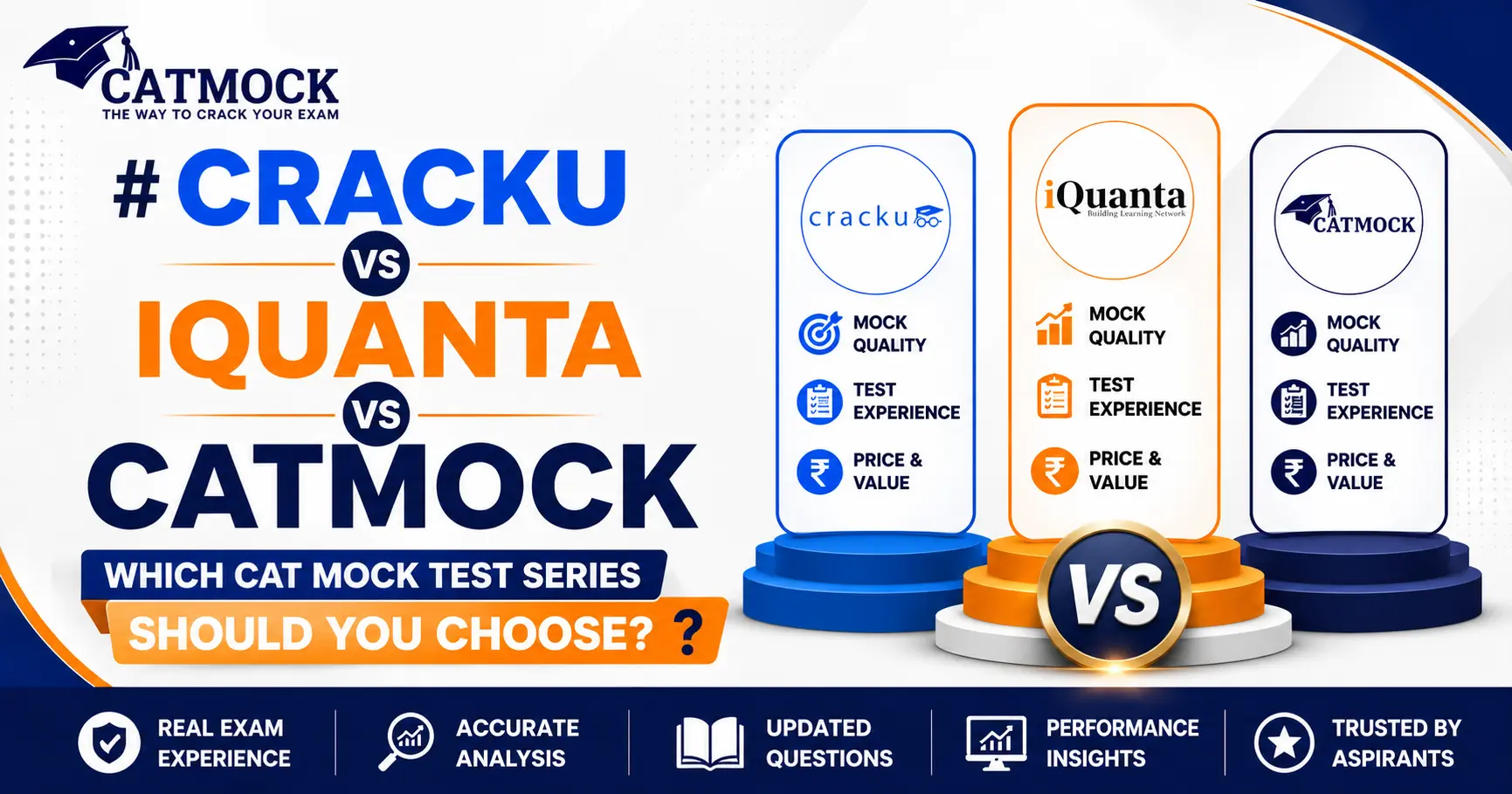
Every CAT season, the same debate resurfaces on forums, Quora threads, and CAT prep groups: Cracku or iQuanta — and increasingly, where does a newer, affordability-first platform like CATMock fit into that decision? All three have built loyal followings among CAT aspirants, but they’ve grown out of different founding stories and cater to slightly different kinds of preparation styles.
This article breaks down what Cracku, iQuanta, and CATMock actually offer — their mock structure, analytics, pricing, and additional prep support — so you can choose based on your own weak areas, budget, and study style rather than secondhand opinions alone.
Quick Answer: Cracku vs iQuanta vs CATMock
- Choose Cracku if you want a large free-resource library (previous year papers, daily targets, topic tests) built by IIM Ahmedabad alumni and CAT 100-percentilers, alongside a tiered DashCAT mock series.
- Choose iQuanta if you want a large peer community, AI-based mock analysis with features like a Goal Tracker and Error Tracker, and a platform that has scaled from a CAT doubt-solving group into a full online coaching ecosystem.
- Choose CATMock if you want an affordable, single-platform option that bundles full-length and sectional mocks, daily practice, previous year papers, and GDPI (interview) preparation, especially if you’re also targeting SNAP, NMAT, XAT, or CMAT alongside CAT.
Many aspirants don’t restrict themselves to just one platform — pairing a primary mock series with a lighter, more affordable one for extra practice volume is a common, sensible strategy discussed further below.
At a Glance: Cracku vs iQuanta vs CATMock
| Factor | Cracku | iQuanta | CATMock |
|---|---|---|---|
| Founded by | IIM Ahmedabad alumni, including a 4-time 100-percentiler and a 2-time 99.97-percentiler | Indrajeet Singh, in 2015, starting as a CAT doubt-solving Facebook group | CAT toppers and mentors, including some with multiple 99.5+ percentile scores; associated with IIM/FMS alumni |
| Core mock series | DashCAT full-length mocks + sectional tests + daily targets | iCAT full-length and sectional mock series | Full-length and sectional CAT mocks under its Test Series |
| Free resources | 3 free full-length mocks, 3 free sectionals, 100+ free topic tests, free previous year papers | Free iCAT mock(s) with unlocked unproctored mocks at various points in the season | Free mocks to try the format, plus free daily practice and free live lectures |
| Distinct analytics feature | Detailed performance analytics, adaptive difficulty in its Study Room feature | Goal Tracker, Error Tracker, and B-School Predictor as named platform features | Detailed post-mock analysis and error tracking |
| Video solutions | Yes, alongside text solutions for mocks and daily targets | Yes, for full-length and sectional mocks | Yes, alongside concept videos and written PYQ solutions |
| Doubt support | Doubt-solving feature with responses typically within 24 hours | Peer-driven doubt solving rooted in its community/group origins | Free live lecture sessions for doubt clarification |
| Coverage beyond CAT | Also supports XAT, CMAT, and other MBA entrance exams | Primarily CAT-focused, with resources extending to other MBA exams over time | Natively covers CAT, XAT, SNAP, NMAT, CMAT, MAT, and CUET-PG on one login |
| Community scale | Large user base built over years of free-resource distribution | Reports supporting over 4 lakh students and 8,000+ IIM conversions to date | Smaller, growing community relative to the other two |
| Pricing positioning | Mid-range, with DashCAT packages typically priced in the low-thousands (₹) | Mid-to-premium, reflecting its expanded coaching-style ecosystem | Positioned around affordability, with free tiers to start |
Exact mock counts, pricing tiers, and package inclusions for all three platforms are revised every CAT cycle, so always confirm current details on each platform’s own pricing page before purchasing.
What Is Cracku?
Cracku was built by a group of IIM Ahmedabad alumni, and its mock content is closely associated with two names often cited by aspirants: a four-time 100-percentiler and a two-time 99.97-percentiler who help curate the question sets. Cracku’s premium offering, the DashCAT series, is typically sold across a few pricing variants and bundles full-length national-level mocks, sectional tests split evenly across VARC, DILR, and QA, a large volume of “daily targets” for daily practice, and a set of previous year papers.
What differentiates Cracku for many aspirants is the sheer size of its free tier: a handful of free full-length mocks, free sectional tests, and well over a hundred free topic-wise tests, alongside a sizable bank of previous year questions. Cracku also runs a Study Room feature with adaptive-difficulty practice and an on-screen calculator that mirrors the actual CAT interface, plus Cracku Adda, a discussion forum for MBA aspirants. Aspirant reviews frequently highlight the Daily Targets feature as a strong consistency tool and describe DashCAT mocks as closely matching CAT’s actual difficulty and interface.
Good fit if: you want to start with a large, genuinely free resource library before committing to a paid series, and you value daily-practice discipline as much as full-length mocks.
What Is iQuanta?
iQuanta has one of the more distinctive origin stories in CAT prep: it began in 2015 as a Facebook doubt-solving group started by Indrajeet Singh, who built a following for his Quant explanations before iQuanta became an organised coaching platform. Over time, iQuanta has grown into a platform reporting support for over 4 lakh students, with more than 8,000 students converting IIM calls to date.
iQuanta’s mock offering, branded as iCAT, is structured around a mix of full-length and sectional mock tests, with a portion of full-length mocks offered as proctored tests and the rest unproctored. Distinct platform features include a Goal Tracker, an Error Tracker for AI-assisted mistake analysis, and a B-School Predictor tool. iQuanta’s community-first roots also mean a large peer-support ecosystem is baked into the platform, which some aspirants find valuable for motivation and doubt-solving beyond just the mock analytics themselves.
Good fit if: you want a platform with a strong sense of peer community, a named error-tracking and goal-tracking system, and a track record built specifically around Quant-first mentorship.
What Is CATMock?
CATMock takes a different approach from both Cracku and iQuanta: rather than growing out of a single founder’s doubt-solving group or an alumni-led premium test series, it’s built as a self-contained, affordability-first self-prep platform, developed by CAT toppers and mentors, including some with multiple 99.5+ percentile scores.
On CATMock, CAT preparation is organised into several connected pieces on one dashboard:
- Full-length and sectional mocks under CATMock’s Test Series, including a dedicated full-length CAT mock category and a separate CAT sectional test category, with a mix of free mocks to try the format and paid mocks for deeper practice.
- Daily VARC, DILR, and QA practice through the Daily Practice section, functioning much like a lighter, habit-building layer between full mock attempts.
- A large topic-wise question bank, branded “Bhandara,” with hundreds of RC, DILR, and QA sets for drilling a specific weak topic rather than only attempting full-length tests.
- Previous year papers with detailed solutions through the CAT PYQ archive, useful for understanding how actual CAT questions have evolved over recent years.
- Free live lectures via the Free Lectures page, plus dedicated GDPI (Group Discussion and Personal Interview) faculty for the post-CAT admission stage — a layer most pure mock-test platforms don’t offer.
- Coverage of exams beyond CAT, including XAT, SNAP, NMAT, CMAT, MAT, and CUET-PG, detailed on the About Exams page, useful if you’re keeping multiple MBA entrance options open in the same season.
Because CATMock is a newer entrant compared to Cracku and iQuanta’s longer track records, its community size and total user base are currently smaller. Where it differentiates itself is breadth and affordability: a single, lower-cost platform covering full-length mocks, sectional tests, daily practice, PYQs, and GDPI prep, plus native support for multiple MBA entrance exams under one login.
Good fit if: you want an affordable, self-prep-first platform that goes beyond just full-length mocks, or you’re preparing for CAT alongside SNAP, NMAT, XAT, or CMAT and want one dashboard for all of it.
Mock Test Structure Compared
| Structure element | Cracku (DashCAT) | iQuanta (iCAT) | CATMock |
|---|---|---|---|
| Full-length mocks | Bundled with sectionals and daily targets across pricing variants | Mix of proctored and unproctored full-length tests | Full-length CAT mocks under a dedicated category, free and paid |
| Sectional tests | Split across VARC, DILR, and QA within each package | Sectional mocks bundled alongside full-length mocks | Separate sectional test category for CAT |
| Daily / topic-wise practice | “Daily Targets,” split across the three sections, plus 100+ free topic tests | Practice woven into the broader coaching ecosystem | Daily Practice sets (VARC/DILR/QA) plus the Bhandara topic-wise question bank |
| Previous year papers | Included, positioned as a core free resource | Available as part of broader prep material | Included with detailed solutions via a dedicated PYQ archive |
| Format simulation | On-screen calculator and interface designed to mirror actual CAT | Full-length tests aim to replicate CAT’s timing and pattern | Mocks designed to reflect the current CAT pattern without artificial difficulty |
Pricing and Value Snapshot
| Platform | Free tier | Paid positioning | What the free tier is best for |
|---|---|---|---|
| Cracku | Several free full mocks, free sectionals, 100+ free topic tests, free PYQs | Multiple DashCAT variants in the low-thousands (₹) price range, package-dependent | Getting a genuine first taste of CAT-level difficulty before paying |
| iQuanta | Free iCAT mock access, with some free unlocks through the season | Mid-to-premium pricing reflecting its wider coaching ecosystem | Testing the platform’s community and analysis style |
| CATMock | Free mocks, free daily practice, and free live lectures | Lower-cost paid packages relative to legacy or alumni-premium series | Building a full preparation habit, including practice for other exams, without an upfront cost |
Note that pricing structures for all three platforms change with each CAT admission cycle. Treat this table as a directional comparison of positioning, not a live price list — always check each platform’s current pricing page before deciding.
Key Comparison Factors
1. Difficulty and pattern accuracy
Aspirant reviews describe Cracku’s DashCAT mocks as closely tracking actual CAT difficulty and interface, aided by the fact that its question curators include past 100-percentile and near-100-percentile scorers. iQuanta’s community feedback is more mixed by section — some aspirants have flagged VARC solution quality as inconsistent while praising its Quant-first mentorship heritage, which tracks with its founding story. CATMock aims to keep its mocks CAT-relevant without inflating difficulty artificially, positioning itself as reflective of the exam’s real demands rather than optimised purely for toughness.
No platform’s difficulty claims are independently, publicly benchmarked against the actual CAT paper on a verified basis, so it’s worth trying free mocks from more than one platform and judging fit based on your own experience.
2. Analytics and performance tracking
This is where each platform’s personality shows most clearly. Cracku emphasises adaptive-difficulty practice through its Study Room and structured daily-target tracking. iQuanta names its analytics tools explicitly — a Goal Tracker, an Error Tracker for AI-assisted mistake analysis, and a B-School Predictor to translate mock percentiles into likely college outcomes. CATMock focuses on detailed post-mock performance reports and error tracking designed to help you pinpoint specific weak topics rather than only showing an overall percentile.
If a named, feature-branded analytics suite matters to you, iQuanta’s approach may feel more structured. If you prefer analytics folded into a simpler, lower-cost single dashboard, CATMock’s model may fit better.
3. Video solutions and doubt support
All three platforms provide video solutions with text explanations. However, depth and consistency can vary by section, based on aspirant feedback. Cracku offers a doubt-solving feature that many aspirants find responsive. It typically addresses doubts within 24 hours. iQuanta takes a community-first approach to doubt-solving. Students can also receive peer support through its community. CATMock combines mock solutions with concept videos. It also offers free live lectures for additional doubt-clearing support.
4. Community and benchmarking scale
iQuanta’s multi-year track record and reported base of over 4 lakh students give it one of the larger peer communities among CAT self-prep platforms, which can matter if benchmarking your percentile against a large, active cohort is a priority. Cracku has also built a large following through its extensive free-resource strategy over several CAT cycles. CATMock’s community is comparatively newer and smaller, which is worth factoring in if a large benchmarking pool specifically (rather than mock quality or affordability) is your main deciding factor.
5. Coverage of exams beyond CAT
If you’re preparing only for CAT, this matters less. If you’re also targeting SNAP, NMAT, XAT, or CMAT in the same admission cycle, it’s worth checking how well each platform actually supports those exams rather than treating them as an afterthought. Cracku extends some of its resources to other MBA entrance exams like XAT and CMAT. iQuanta’s ecosystem has expanded over time but remains primarily CAT-centred in its core positioning. CATMock natively supports CAT, XAT, SNAP, NMAT, CMAT, MAT, and CUET-PG mock categories on the same login, which can simplify tracking preparation across exams instead of managing multiple separate subscriptions.
6. Pricing and accessibility
CATMOCK stands out for its affordability-focused approach. It offers free mocks, daily practice, PYQs, and live lectures. Students can also choose lower-cost paid packages for a complete test series. This makes CATMock a practical option for budget-conscious aspirants. Cracku stands out with its strong free tier. It offers many free mocks, sectionals, topic tests, and PYQs. iQuanta follows a broader coaching-style model. Its pricing reflects access to its wider ecosystem and community.
Cracku vs iQuanta: The Direct Comparison
This is the specific question most aspirants start with before even considering a third platform. Based on how each is generally described by aspirants and coaching reviewers:
- If you want a large, genuinely free resource library (mocks, sectionals, PYQs, topic tests) with content curated by past top-percentile scorers, Cracku is frequently the starting recommendation.
- If you want a strong peer community and named analytics tools like a Goal Tracker, Error Tracker, and B-School Predictor, alongside a platform that grew out of dedicated Quant mentorship, iQuanta tends to be the pick.
- If your weakest link is Quant specifically, iQuanta’s founding focus on Quant doubt-solving may be a relevant factor, though this shouldn’t be the only criterion, since both platforms cover all three CAT sections.
Neither is universally “better” — many high-percentile scorers have used either platform, or a combination of both, alongside disciplined post-mock analysis.
Where Does CATMock Fit Into This Decision?
CATMock isn’t trying to out-scale Cracku’s free-resource library or iQuanta’s multi-lakh community overnight — it’s a different kind of tool, most useful as either:
- A primary, affordable platform for self-preparing aspirants who want full-length mocks, sectional tests, daily practice, PYQs, and GDPI guidance in one place without piecing together several separate tools.
- A supplementary series alongside Cracku or iQuanta, for extra mock volume, daily practice between full-length attempts, or topic-wise drilling through Bhandara, particularly useful if you want more practice without the cost of a second full-priced subscription.
- A single-login option for multi-exam aspirants targeting CAT plus SNAP, NMAT, XAT, or CMAT in the same cycle, since these are natively supported without separate accounts or subscriptions.
How Many Mocks Do You Actually Need?
Regardless of which platform (or combination) you choose, most experienced CAT mentors converge on a similar range: roughly 20–30 full-length mocks across your full preparation cycle, taken with disciplined post-mock analysis, tend to produce better results than a much larger number of mocks attempted without proper review. Mock volume without analysis is one of the most commonly cited mistakes among repeat CAT test-takers. If your score has plateaued despite regular mock attempts, it’s worth reading about the common reasons a CAT mock score stops improving and pairing that with practical tips on how to increase CAT accuracy before simply adding more tests to your routine.
Feature Summary: Cracku vs iQuanta vs CATMock
| Feature | Cracku | iQuanta | CATMock |
|---|---|---|---|
| Founding story | IIM Ahmedabad alumni, including top-percentile scorers | 2015 Facebook doubt-solving group turned coaching platform | Built by CAT toppers and mentors focused on affordable, self-prep access |
| Signature strength | Large free-resource library and daily-practice discipline | Named analytics tools and large peer community | Affordability, breadth (mocks + practice + PYQs + GDPI), and multi-exam coverage |
| Weakest reported area (per aspirant feedback) | Some variability across sectional difficulty calibration by season | Some inconsistency noted in VARC solution quality by a subset of reviewers | Smaller benchmarking pool given its shorter track record |
| Ideal aspirant profile | Wants extensive free practice before committing financially | Wants community support and structured, named analytics | Wants one affordable dashboard covering CAT and other MBA exams |
Frequently Asked Questions
Is Cracku or iQuanta better for CAT preparation?
Both are well-regarded, but they serve different needs. Cracku attracts students with its large free-resource library. It offers mocks, sectionals, PYQs, and topic tests. Past top-percentile scorers curate these resources. iQuanta attracts students with its strong peer community and dedicated analytics tools. Its tools include a Goal Tracker and Error Tracker. Choose based on your priority: a large free library or structured, community-driven analytics.
Is CATMock a good alternative to Cracku and iQuanta?
CATMock is a newer, more affordability-focused platform than Cracku and iQuanta’s longer-established ecosystems. It’s a strong option if you want full-length mocks, sectional tests, daily practice, PYQs, and GDPI preparation bundled into one lower-cost platform, especially if you’re also preparing for SNAP, NMAT, XAT, or CMAT alongside CAT.
Can I use Cracku, iQuanta, and CATMock together?
Yes. Many aspirants combine a primary platform for benchmarking and analytics with a second, more affordable platform for additional mock volume, daily practice, or topic-wise drilling. Be mindful of mock fatigue, though — more mocks without disciplined analysis rarely translates into a higher percentile.
Which platform is best if I’m also preparing for SNAP, NMAT, XAT, or CMAT?
If you want native, single-login support for these exams alongside CAT, CATMock covers CAT, XAT, SNAP, NMAT, CMAT, MAT, and CUET-PG on one platform. Cracku extends some resources to exams like XAT and CMAT, while iQuanta’s core ecosystem remains primarily CAT-focused.
Are the free mocks from Cracku, iQuanta, or CATMock good enough to gauge my level?
Free mocks from any of the three are a reasonable way to understand the exam format and get an early sense of where you stand. As your preparation progresses, a fuller paid series with consistent, well-analysed mock attempts becomes more useful than relying on free mocks alone, since a single free test can’t reliably represent standing on a percentile-based exam like CAT.
Which mock series is closest to the actual CAT exam — Cracku, iQuanta, or CATMock?
There’s no independently verified, like-for-like study comparing all three platforms against the actual CAT paper. Aspirant feedback varies by year and by section for every platform, so it’s worth attempting free mocks from more than one before committing to a paid series.
Conclusion
Cracku, iQuanta, and CATMock each solve a slightly different problem for CAT aspirants. Cracku’s biggest draw is its extensive free-resource library. It is backed by curators with strong personal CAT results. iQuanta’s strength lies in its large community and clearly named analytics tools. Its approach builds on a decade-long Quant-mentorship legacy. CATMock, meanwhile, is carving out space as an affordable, single-dashboard option. It bundles full-length and sectional mocks, daily practice, and previous year papers. It also includes GDPI preparation within the same platform. CATMock natively supports CAT, SNAP, NMAT, XAT, and CMAT.
There’s no single universally “correct” choice here. The more useful question isn’t “which platform is best” in the abstract, but which one matches your current weak areas, your budget, and whether you’re preparing for CAT alone or multiple MBA entrance exams in parallel. Trying the free tiers of more than one platform before committing financially remains the most reliable way to decide.
Prices, mock counts, and package features for Cracku and iQuanta are set by their respective platforms and can change every CAT cycle — confirm current details on their official pricing pages before purchasing. Details about CATMock reflect information published on catmock.com at the time of writing.