

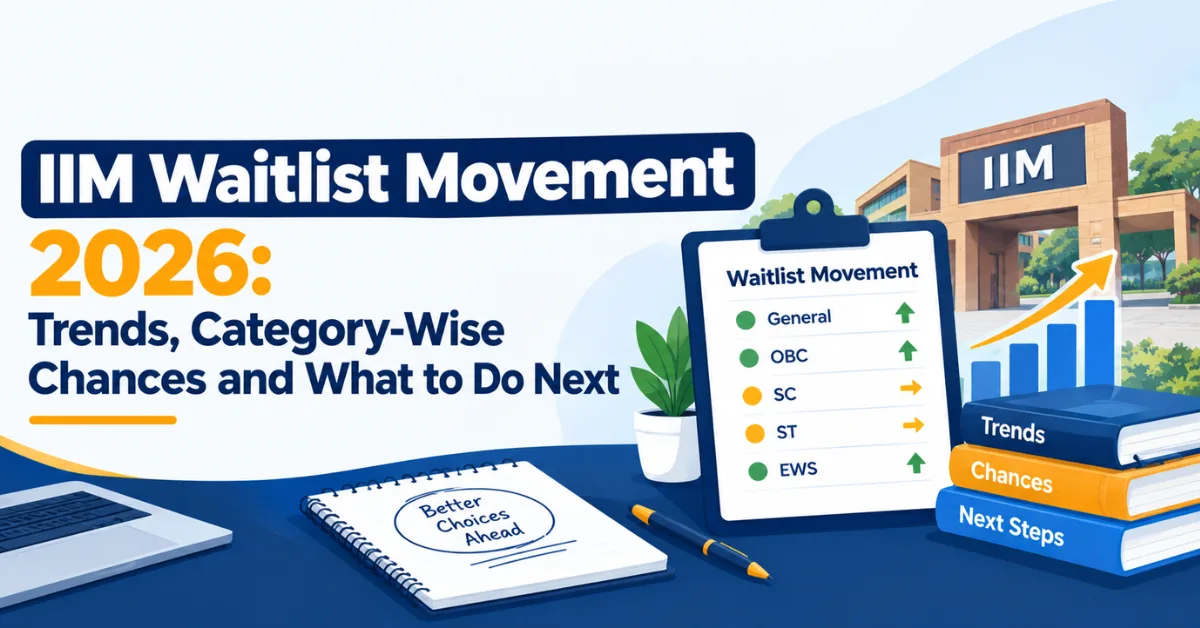
You cleared the CAT, survived the WAT-PI round, and then the result reads “Waitlisted.” Every refresh of your inbox now feels like a coin toss. The good news is that IIM waitlist movement follows patterns you can read, and understanding them can save you from two costly mistakes: giving up too early, or waiting on a list that will never move.
This guide explains how the IIM waitlist works, why it moves, how it differs across institutes and categories, and how to plan around it.
What Is IIM Waitlist Movement?
An IIM waitlist is the queue of qualified candidates who missed the first merit list because seats were limited. Waitlist movement refers to how many of those candidates later get an admission offer as earlier offers are declined.
Think of it like a queue at a popular restaurant. Some diners in front leave for a better table elsewhere, and everyone behind them steps forward. In IIM admissions, the “better table” is usually an older IIM, another top B-school, or an offer from a different institute.
How the IIM Waitlist Works, Step by Step
- The IIM releases its final result with a selected list and a waitlist.
- Selected candidates accept, pay the fee, or decline.
- Declined seats are offered to the next waitlisted candidates in each category.
- Steps 2 and 3 repeat over multiple rounds until seats are filled.
Why Does the IIM Waitlist Move?
Several factors decide how far a list travels.
| Factor | How it affects waitlist movement |
|---|---|
| Acceptance rate | High acceptance at top IIMs means few seats reopen |
| Batch size | Larger batches produce more declined seats and more movement |
| Competing offers | Candidates holding multiple IIM, ISB, XLRI or FMS calls release seats |
| Category dynamics | Reserved-category lists move on their own logic |
| Program type | Specialised programmes (analytics, finance, business management) can move differently from the flagship MBA |
| Timing | Movement peaks after all major institutes publish results |
Multiple calls are the biggest driver. A strong candidate with several offers can accept only one. The rest flow back into the system, and that is where waitlist movement comes from.
IIM Waitlist Movement Timeline: When Does It Happen?
The window is fairly predictable:
| Stage | Typical timing |
|---|---|
| Final results and first waitlists | April–May |
| First waitlist movement | May |
| Peak movement, after other institutes’ results | May–June |
| Last rounds, sometimes into the start of the academic year | June–July |
Institutes publish updates on their own portals or by email, so check both regularly. Some newer institutes also release waitlists later than the older ones.
IIM Waitlist Movement by Institute Tier
Public data varies by source and year, so treat the ranges below as indicative patterns, not guarantees.
| IIM group | Typical movement pattern | Waitlist size pattern | What it means for you |
|---|---|---|---|
| Older top IIMs (A, B, C) | Low, often under about 100 in total | Small lists (IIM A’s general list is very small in RTI-based data) | Even a low number can be risky, so keep a backup |
| Mid-tier IIMs (L, K, I) | Moderate to high, roughly 100–300 or more | Larger lists | A mid-range number has a fair chance |
| Newer IIMs | Highest, often several hundred | Very large lists (some run to thousands) | A number of 250 here is often safer than 30 at a top IIM |
Key insight: The same waitlist number means very different things at different institutes. Position 30 can be borderline at a small-list IIM, while the same number at a large-batch IIM often clears comfortably.
Category-Wise IIM Waitlist Movement
Each category has a separate queue with its own seats and its own withdrawals.
| Category | Movement behaviour | Practical tip |
|---|---|---|
| General | Tightest and most competitive | Compare your number to the institute’s seat count |
| EWS | Moderate, depends on seat quota | Track the EWS list specifically, not the general list |
| OBC (NC) | Often large lists that need several rounds | Numbers move steadily as offers are declined |
| SC / ST | Smaller lists, sometimes with quick movement | Watch official updates closely |
| PwD | Small lists, irregular movement | Contact the admissions office for clarity |
Movement in one category says nothing about another. A rising General list doesn’t mean the OBC list is moving too.
How to Judge Your Chances: A Practical Framework
Waitlist numbers alone can mislead. Use this quick method:
- Find the institute’s category seat count. Roughly how many seats exist in your category?
- Compare your number to past movement. Look at how many candidates cleared in earlier cycles.
- Rate the risk.
- Your number is well inside past movement: good chance.
- Your number is near the edge: moderate chance.
- Your number is far beyond past movement: low chance.
- Adjust for the cycle. If the batch was large or many candidates hold multiple calls, movement often rises.
Because past patterns don’t guarantee future outcomes, use this framework to plan rather than to predict.
What to Do While You Are Waitlisted
- Secure a backup seat. Accept a suitable offer and pay the fee if a deadline requires it.
- Check the official portal and your email every day. Some updates arrive only by email.
- Read the refund rules. Know each institute’s withdrawal and refund policy before paying.
- Keep your documents ready. Marksheets, category certificates and ID proofs should be scanned and organised.
- Be ready to decide fast. Waitlist offers usually carry short acceptance windows.
- Stay reachable. Keep your phone and email active, and check the spam folder.
- Avoid unofficial claims. Crowd-sourced trackers and forums help you gauge trends, but only the institute’s portal is final.
Common Mistakes Waitlisted Candidates Make
| Mistake | Why it hurts |
|---|---|
| Relying on rumours and forwards | Leads to wrong decisions in either direction |
| Comparing General numbers with reserved-category numbers | Different queues with different logic |
| Giving up a waitlist too soon | Some lists move late, into June and July |
| Waiting without a backup | You may end up with no seat at all |
| Ignoring emails | Waitlist offers often come with short deadlines |
Summary (Quick Take)
- IIM waitlist movement is the process by which waitlisted candidates receive offers after selected candidates decline seats.
- Movement typically happens between May and July in several rounds.
- Top older IIMs see small movement, while newer and mid-tier IIMs see much larger movement.
- Each category (General, EWS, OBC, SC, ST, PwD) has its own independent waitlist.
- Your waitlist number matters only relative to the seats and past movement of that IIM and category.
- Always keep a backup admission alive while you wait.
Frequently Asked Questions (FAQs)
What is IIM waitlist movement?
It is the number of waitlisted candidates who receive admission offers after earlier selected candidates decline their seats. It happens in several rounds during the admission cycle.
When does IIM waitlist movement start?
It generally begins after the first offers are released and the fee deadlines pass, usually in May, and can continue through June and July.
Does the waitlist move at IIM Ahmedabad, Bangalore and Calcutta?
Movement at these institutes is usually low because most selected candidates accept their offers. Some movement still happens in each cycle, especially in reserved categories, so a backup is essential.
Which IIMs have the highest waitlist movement?
Newer and mid-tier IIMs, and older institutes with large batches such as Indore and Kozhikode, generally show more movement. Candidates often prefer older or higher-ranked institutes, so seats reopen here.
What waitlist number is considered safe?
There is no universal number. A safe number is one that falls within the past movement for your category at that specific IIM. A number that is safe at one institute can be risky at another.
Is IIM waitlist movement category-wise?
Yes. General, EWS, OBC, SC, ST and PwD each have their own list and seat quota, so each moves independently.
Can a waitlisted candidate still get an IIM offer after joining another college?
It is possible. Many candidates hold a backup seat and switch if a waitlist offer arrives, but always check the refund and withdrawal policy first.
How can I check my IIM waitlist status?
Log in to the official admission portal of the institute and check your registered email. Institutes may also post updated lists on their websites. Third-party trackers can show trends, but they aren’t official.
Do IIMs release the waitlist number publicly?
Practices differ. Some publish full category-wise lists, some show only your own status, and some provide numbers through RTI responses. Check the institute’s admission page for its current policy.
What is the chance of converting an IIM waitlist?
It depends on the institute, category, batch size and how many candidates hold multiple offers. It is generally higher at institutes with larger batches and larger lists, and lower at the top older IIMs.
Conclusion
IIM waitlist movement isn’t random. It responds to seat counts, acceptance rates, category quotas and the choices of candidates holding multiple offers. Top older IIMs move little, while mid-tier and newer IIMs move a lot, and every category follows its own path.
Your best strategy is simple: read your number against past movement, follow official updates, and always keep a backup seat. A waitlist is a second chance, but it works best when you’re prepared for either outcome.
Related reading: CAT percentile vs IIM calls guide | IIM shortlist criteria explained | MBA Interview Preparation guide | Best MBA colleges in India |
Official sources: IIM CAT official site | IIM Ahmedabad | IIM Bangalore | IIM Calcutta | NIRF Rankings
You May Also Like : CAT MOCK, CAT MOCK PYQ
Follow Us On : Facebook, Instagram, Youtube