

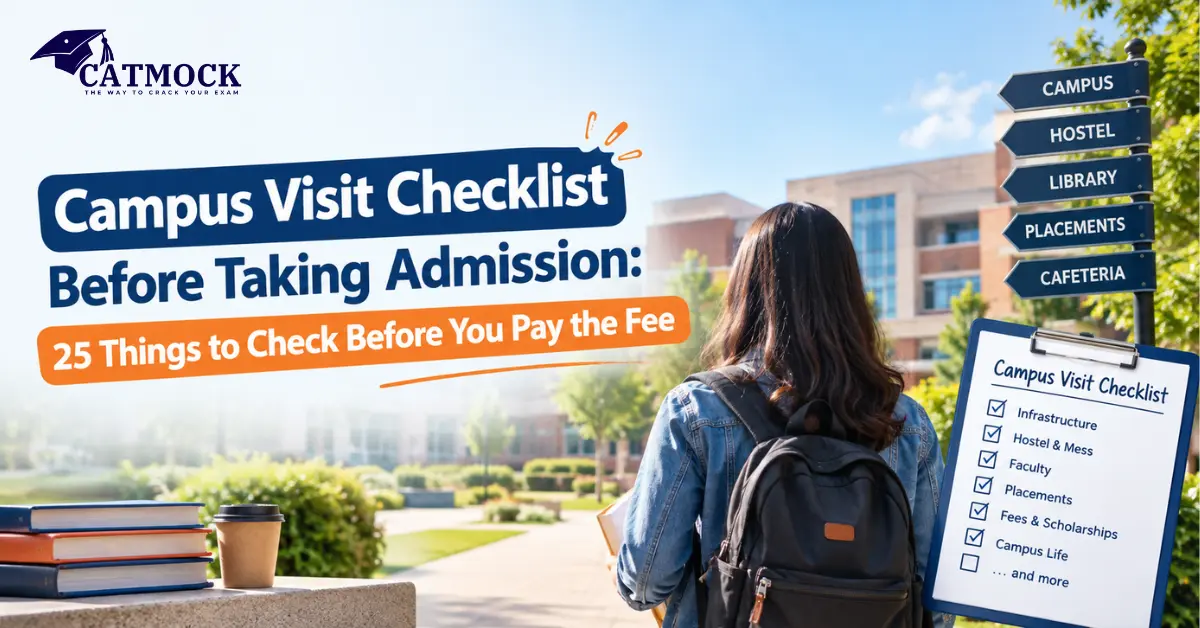
Brochures are polished. Websites are optimized. Admission counsellors are trained to smile. But none of them can tell you what a college feels like on an ordinary Tuesday afternoon.
That is the reason a campus visit checklist before taking admission matters. A degree costs lakhs of rupees and years of your life. A two-hour visit, done properly, can save you from a costly mistake or confirm that you have found the right place.
This guide gives you a complete college campus visit checklist covering what to prepare, what to observe, what to ask, and what to compare afterwards. You will find tables, ready-to-use questions, red flags and a scoring sheet you can carry on your phone.
In this guide:
- Why visiting a campus matters
- The best time to visit
- Pre-visit preparation
- Academic, infrastructure, fee, placement and safety checks
- Red flags, a scorecard and post-visit steps
- Summary, FAQs and conclusion
Why a Campus Visit Matters Before You Take Admission
Online reviews can be edited, rankings can be misread, and promotional videos show only the best angles. A physical campus tour lets you verify claims with your own eyes.
Here is what a college visit reveals that no website can:
- The real learning environment. Are classrooms engaged or half-empty?
- The condition of facilities. Labs, libraries and hostels often look different in person.
- Student honesty. Current students will tell you what the brochure won’t.
- Your comfort level. You need to feel you can live and study there for years.
Think of it as a test drive. You wouldn’t buy a car from photos alone, and a college deserves the same scrutiny.
When Is the Best Time to Visit a Campus?
Timing changes what you see. Visit when the campus is active, not when it is closed for holidays.
- Best: Regular working days while classes are in session.
- Good: Open house or orientation days, though these are staged, so pair them with a normal-day visit.
- Avoid: Exam weeks, festival breaks and summer vacations, when the atmosphere is not representative.
Visit before you pay the admission fee. Once fees are paid, refunds can be difficult. Plan two to three weeks ahead so the admissions office can arrange a guided tour and meetings with faculty.
Pre-Visit Preparation Checklist
Good visits start at home. Spend an hour on research before you leave, and you will ask sharper questions on campus.
Documents and Items to Carry
| Item | Why You Need It |
|---|---|
| Notebook or notes app | Record answers while they are fresh |
| List of questions | Stops you forgetting things under pressure |
| Mark sheets and ID proof | Useful if you want to discuss eligibility |
| Fee comparison sheet | Lets you check quoted fees on the spot |
| Phone with camera | Photograph labs, hostel rooms and notice boards, with permission |
| Water bottle and comfortable shoes | Campus tours involve a lot of walking |
Research Before You Go
- Confirm the institution’s approval status and the course’s recognition on official portals such as the University Grants Commission (UGC) or the All India Council for Technical Education (AICTE) for technical programmes.
- Check the accreditation grade on the NAAC website and, where relevant, programme accreditation through NBA.
- Look at the institution’s standing in the NIRF rankings.
- Read the prospectus and note anything unclear, especially fees, attendance rules and placement claims.
Bring a parent or guardian if you can. A second pair of eyes catches details you miss, and it helps to have someone to discuss impressions with afterwards.
Academic Checklist: What to Check in Classrooms, Labs and Faculty
Academics are the reason you are going to college, so start here.
Classrooms and Teaching Quality
- Are classrooms clean, ventilated and equipped with working projectors or smart boards?
- Is the student-to-teacher ratio reasonable, or are classes overcrowded?
- Can you sit in on a live lecture for 20–30 minutes? Ask politely. Good colleges usually agree.
Laboratories and Practical Exposure
- Do labs have modern, working equipment, or is it outdated and unused?
- How many students share one workstation or instrument?
- Are practical sessions regular, or do they happen only before exams?
Faculty Interaction
Ask to meet a professor from your chosen department. Note whether they are approachable, current in their field and honest about limitations. Ask about their qualifications, industry experience and research work.
Questions to Ask About Academics
| Question | What a Good Answer Sounds Like |
|---|---|
| What is the faculty-to-student ratio? | A specific number, not “very good” |
| How many permanent vs. visiting faculty do you have? | Mostly permanent, qualified faculty |
| How often is the syllabus updated? | Regular reviews aligned with industry needs |
| Are internships or projects mandatory? | Yes, with structured support |
| What is the attendance policy? | Clear, written and reasonably flexible |
| Is there academic support for weaker students? | Mentoring, remedial classes, doubt sessions |
Vague or evasive answers are worth noting. A confident institution answers plainly.
Infrastructure and Campus Facilities Checklist
You will spend most of your waking hours here, so facilities matter as much as academics.
Library and Study Spaces
Check the number of books and journals, digital access, seating capacity and opening hours. A library that closes at 5 PM is of little use to a student who studies late.
Hostel and Accommodation
If you plan to stay on campus, inspect the hostel yourself rather than only viewing the sample room.
- Room size, ventilation, cleanliness and furniture
- Bathrooms and water supply, including hot water
- Wi-Fi speed and power backup
- Warden availability and hostel rules such as curfew and visitor policy
- Room-sharing arrangements
Canteen, Food and Hygiene
Eat in the canteen or mess if you can. Food quality affects health and mood more than most students expect. Look at hygiene, menu variety, pricing and whether options suit your dietary needs.
Transport, Sports and Health
Ask about bus routes, timings and charges. Check sports grounds, gyms and indoor games. Find the medical room or nearby hospital, and ask whether a doctor or nurse is available during college hours.
Facilities Comparison Table
| Facility | What to Check | Rating (1–5) |
|---|---|---|
| Classrooms | Cleanliness, seating, audio-visual tools | 4 |
| Labs | Equipment condition and access | 3 |
| Library | Books, digital resources, timings | 4 |
| Hostel | Room quality, safety, food, Wi-Fi | 3 |
| Canteen | Hygiene, variety, price | 2 |
| Transport | Routes, timings, cost | 4 |
| Sports and gym | Grounds, equipment, coaching | 3 |
| Medical support | On-campus clinic, ambulance access | 5 |
Print or copy this table and fill it in for every college you visit. It makes later comparison far easier.
Fee Structure, Scholarships and Hidden Costs
Money questions are uncomfortable, but skipping them is expensive. Ask for a written fee breakdown before you leave.
Confirm these points:
- Tuition fee for each year, and whether it rises annually
- Admission, exam, lab, library, development and caution deposit charges
- Hostel and mess charges, listed separately
- Transport, uniform and study material costs
- Scholarship eligibility, renewal criteria and how to apply
- Refund policy if you withdraw, with timelines and deductions
Ask directly: “Is there any other charge not listed here?” Hidden costs are one of the most common complaints among students.
Never pay in cash without a proper receipt, and never rely on verbal promises. If a discount or seat guarantee is offered, get it in writing.
Placement and Career Support Check
Placement claims are often the most inflated part of a college’s marketing. Verify them.
Ask for:
- Placement data for the last three years: number of students eligible, number placed, and highest, average and median packages
- Names of recruiting companies and the roles offered
- Whether “placement” includes internships, off-campus drives or only on-campus offers
- Career counselling, resume workshops and mock interview facilities
- Alumni network strength and industry tie-ups
Visit the placement cell if possible, and speak to final-year students about what actually happened in their batch.
| Placement Claim | How to Verify |
|---|---|
| “100% placement” | Ask for the eligible-vs-placed number and the list of companies |
| “Highest package of X lakh” | Ask for the median package and how many students received such offers |
| “Top recruiters visit us” | Ask how many students each recruiter hired |
| “Internship guaranteed” | Ask what percentage of the last batch actually completed internships |
A good college shares data openly. Reluctance to provide numbers should make you cautious.
Campus Safety, Culture and Student Life
Academic strength alone doesn’t make a good college experience. Pay attention to how the place feels.
Safety and Security
- Are there guards, ID checks and CCTV at entry points and hostels?
- Is there an anti-ragging policy and a visible complaint mechanism?
- Are there well-lit paths and emergency contacts displayed?
- What is the process for late-night emergencies?
Student Culture
Watch how students interact with each other and with staff. Are they relaxed and engaged, or stressed and disengaged? Look at notice boards for clubs, events, fests and workshops.
Talk to Current Students
Do this away from the official guide if possible. Ask casual, honest questions:
- What do you like most and least about this college?
- How helpful are teachers outside class?
- How much do the promised facilities match reality?
- Would you choose this college again?
The answer to the last question is often the most revealing.
Red Flags to Watch Out For During a Campus Visit
Some warning signs deserve serious attention:
- Pressure to pay immediately. “Seats are filling fast, pay today” is a sales tactic, not an academic one.
- No visible approval or accreditation details. Legitimate institutions display them proudly.
- Refusal to show hostels, labs or classrooms. Transparency is a good sign, and avoidance is not.
- Unrealistic placement or salary promises.
- Empty classrooms during working hours.
- Unclear or verbal-only fee details.
- Students who avoid answering questions or seem nervous about speaking openly.
One red flag may have an explanation. Several together suggest you should look elsewhere.
Campus Visit Scorecard: Compare Colleges Objectively
Emotions can cloud judgment after a polished tour. Score each college immediately after you leave, before the memory fades.
| Category | Weight | College A | College B | College C |
|---|---|---|---|---|
| Academics and faculty | 25% | 4 (20) | 5 (25) | 3 (15) |
| Infrastructure and facilities | 20% | 3 (12) | 4 (16) | 5 (20) |
| Fees and value for money | 20% | 4 (16) | 2 (8) | 3 (12) |
| Placements and career support | 20% | 3 (12) | 4 (16) | 2 (8) |
| Safety and campus culture | 15% | 5 (15) | 4 (12) | 3 (9) |
| Total (out of 100) | 100% | 75 | 77 | 64 |
Score each category from 1 to 5, divide by 5, multiply by its weight and total the results to get a score out of 100.
What to Do After the Campus Visit
Your work isn’t over when you leave the gate.
- Write your notes the same day. Details fade quickly.
- Fill in the scorecard while impressions are fresh.
- Compare fee quotes and confirm the written breakdown.
- Discuss with family and list pros and cons together.
- Send a thank-you email to the admissions officer and ask any follow-up questions in writing.
- Verify claims independently. Check placement data with alumni on professional networks and confirm approvals on official portals.
- Decide without hurry. A good college will still be there after a few days of thought.
Summary
- A campus visit is the most reliable way to verify what a college promises.
- Visit on a working day when classes are in session, and before paying any fee.
- Research approvals and accreditation first, then prepare questions and documents.
- Inspect classrooms, labs, library, hostel, canteen and transport yourself.
- Ask for a written fee breakdown and the refund policy, and watch for hidden charges.
- Verify placement claims with actual data and talk to current students.
- Look out for red flags such as payment pressure and lack of transparency.
- Use a weighted scorecard to compare colleges objectively.
Frequently Asked Questions (FAQs)
1. Why is a campus visit important before taking admission?
A campus visit lets you check facilities, faculty, culture and safety in person. It helps you verify the claims made in brochures and online, so you can avoid regret after paying fees.
2. What should I check during a college campus visit?
Check classrooms, labs, the library, hostel, canteen, transport, safety measures, fee details, placement data and student behaviour. Meeting faculty and current students adds valuable insight.
3. What questions should I ask during a campus visit?
Ask about the faculty ratio, attendance rules, internships, total fees and hidden costs, refund policy, scholarships, placement statistics and hostel rules. Prefer questions that need specific answers rather than yes-or-no replies.
4. When is the best time to visit a campus?
Visit on a regular working day while classes are running. Avoid exam periods, holidays and summer breaks, since the campus won’t reflect everyday life.
5. Can I visit a college without an appointment?
Some colleges allow walk-ins, but an appointment is better. It ensures someone from admissions is available to guide you and arrange meetings with faculty and students.
6. What if I cannot visit in person?
Ask for a virtual tour and request video calls with faculty and current students. Check official approvals online. If possible, ask a local friend or relative to visit for you.
7. How many colleges should I visit before deciding?
Three to five shortlisted colleges is a practical number. It gives you enough to compare without causing decision fatigue.
Conclusion
Choosing a college is one of the biggest decisions you will make. A thoughtful campus visit checklist before taking admission turns that decision from guesswork into evidence. You check the classrooms, taste the food, question the faculty, examine the fee sheet and listen to students who live there every day.
Carry this checklist, use the scorecard, and trust what you see over what you are told. Take your time, verify every claim and choose the college that fits your goals, your budget and your comfort. The best time to ask hard questions is before you pay the fee, not after.
Ready to begin? Shortlist your top colleges, book your visits and start ticking off this list.
You May Also Like : CAT MOCK, CAT MOCK PYQ
Follow Us On : Facebook, Instagram, Youtube