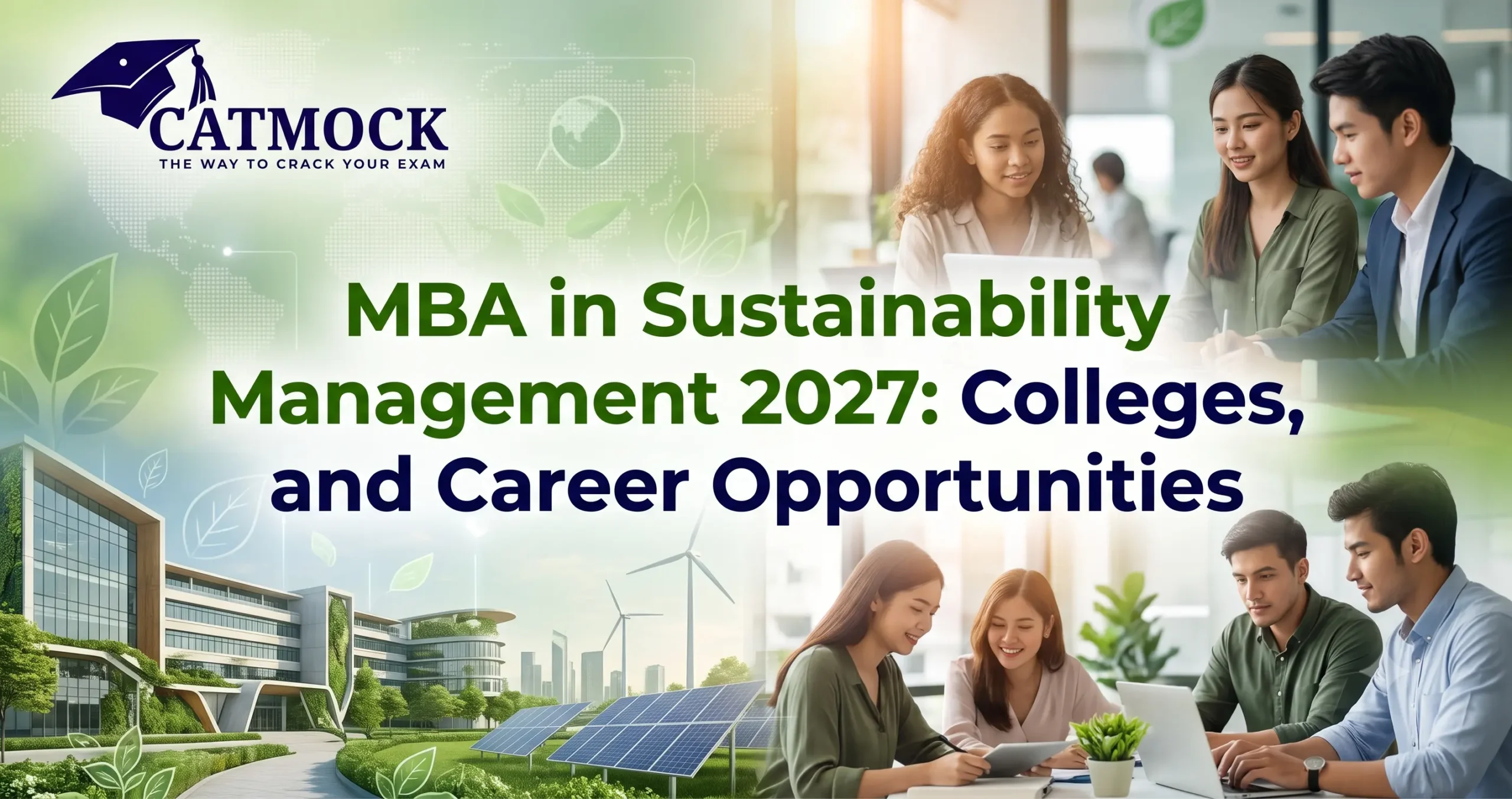
Walk into any boardroom today and you will hear the same words again and again: net zero, ESG, carbon footprint, circular economy, responsible sourcing. A decade ago, these were side topics for the corporate social responsibility team. Now they shape investor decisions, supply-chain contracts and the rules that companies must follow to operate. That shift explains why an MBA in Sustainability Management 2027 has moved from a niche choice to one of the most future-facing management specialisations.
This guide explains what the programme covers, which kinds of colleges offer it, what it costs, and which careers it opens. You will also find admission guidance, skill advice and a practical checklist for choosing the right programme for the 2027 intake.
Quick Summary (Key Takeaways)
- An MBA in Sustainability Management combines core business education with environmental, social and governance (ESG) strategy.
- Colleges offering the specialisation include forestry and management institutes, university sustainability schools and private business schools, so compare curriculum and placements, not brand alone.
- Fees vary widely by institute type. Always verify the current fee structure on the college’s official page.
- Career options include ESG analyst, sustainability consultant, CSR manager, climate-risk analyst, sustainable supply-chain manager and corporate sustainability head.
- Strong demand is driven by sustainability reporting rules, investor expectations and global trade regulations.
What Is an MBA in Sustainability Management?
An MBA in Sustainability Management is a postgraduate programme, usually two years long, that teaches you to build profitable businesses while reducing environmental harm and creating social value. It is offered as a dedicated MBA, a specialisation inside a general MBA, or a related programme such as sustainable development management or business sustainability.
Unlike a conventional MBA, this sustainability MBA treats every business function through a sustainability lens:
- Strategy becomes long-term value creation under climate and resource constraints.
- Finance includes green finance, impact investing and carbon accounting.
- Operations covers circular design, energy efficiency and responsible sourcing.
- Marketing addresses ethical branding and avoiding misleading green claims.
- Governance includes disclosure, assurance and stakeholder engagement.
Why It Matters in 2027
Several forces keep demand high for trained sustainability managers:
- Disclosure rules. Large listed companies in India report under SEBI’s Business Responsibility and Sustainability Reporting framework, and global investors expect comparable data. Standards such as those from the Global Reporting Initiative and the ISSB shape what companies must measure.
- Trade regulation. Carbon-related border measures and supply-chain due-diligence laws affect exporters, who need staff who understand them.
- CSR obligations. Qualifying Indian companies must spend on corporate social responsibility under the Companies Act, which keeps demand steady for CSR and impact professionals.
- Investor pressure. Funds increasingly screen companies on ESG performance.
- Climate and energy transition. Renewable energy, electric mobility, waste management and water solutions are growing sectors that hire management talent.
MBA in Sustainability Management 2027 at a Glance
| Parameter | Details |
|---|---|
| Programme level | Postgraduate (MBA / PGDM) |
| Typical duration | 2 years full-time; shorter or part-time formats exist at some institutes |
| Eligibility | Bachelor’s degree from a recognised university, usually with 50% marks |
| Entrance tests | CAT, XAT, GMAT, CMAT, MAT or institute-specific tests |
| Selection | Written test, group discussion, personal interview, profile review |
| Core focus | ESG strategy, sustainability reporting, climate risk, CSR, sustainable operations |
| Typical roles | ESG analyst, sustainability consultant, CSR manager, climate-risk analyst |
| Hiring sectors | Consulting, manufacturing, energy, banking, FMCG, technology, NGOs |
Curriculum: What You Will Study
The structure differs by institute, but most programmes combine a foundation year with a sustainability-focused second year. This is the typical MBA in Sustainability Management curriculum.
Year 1: Management Foundations
- Principles of management and organisational behaviour
- Managerial economics and financial accounting
- Marketing management and operations management
- Business analytics and statistics
- Business ethics and communication
- Introduction to sustainability and environmental science
Year 2: Sustainability Specialisation
- ESG strategy and corporate sustainability
- Sustainability reporting and disclosure standards
- Climate change, carbon accounting and net-zero planning
- Green finance and sustainable investing
- Circular economy and sustainable supply chains
- Renewable energy management
- Corporate social responsibility and impact assessment
- Environmental law and policy
- Sustainable marketing and consumer behaviour
- Capstone project or industry dissertation
Focus Areas Within the Specialisation
| Focus Area | What You Learn | Typical Employers |
|---|---|---|
| ESG and reporting | Metrics, frameworks, assurance, investor communication | Consulting firms, listed companies, rating agencies |
| Climate and carbon | Emissions accounting, reduction plans, offsets and markets | Energy firms, manufacturers, advisory firms |
| Sustainable supply chain | Responsible sourcing, traceability, circular design | FMCG, retail, automotive, exporters |
| Green finance | Sustainable funds, green bonds, risk analysis | Banks, asset managers, development institutions |
| CSR and impact | Programme design, measurement, stakeholder engagement | Corporates, foundations, NGOs |
| Renewable energy management | Project economics, policy, operations | Energy developers, utilities, infrastructure firms |
What Good Practical Learning Looks Like
A strong programme goes beyond lectures. Look for:
- Live projects where students draft sustainability reports or carbon-reduction plans for real organisations.
- Field exposure through plant visits, rural projects and community engagement.
- Industry mentors from consulting, energy and corporate sustainability teams.
- Tools training in carbon calculators, data dashboards and reporting frameworks.
- International opportunities such as exchange programmes or global case competitions.
Colleges Offering MBA in Sustainability Management
Choosing among colleges is easier when you understand the types of institutes and what each offers. Course directories list programmes in sustainability management at institutes such as the Indian Institute of Forest Management in Bhopal, the Xavier School of Sustainability at XIM University in Bhubaneswar, and several private universities. Always confirm whether an institute currently runs the programme and which intake it is accepting by checking its official website, for example the IIFM site.
Types of Institutes to Consider
| Institute Type | Strengths | Points to Check |
|---|---|---|
| Management and forestry institutes | Strong focus on natural resources, ecology and policy | Intake size, placement sectors, entrance process |
| University sustainability schools | Dedicated faculty and interdisciplinary projects | Accreditation, industry links, alumni outcomes |
| Established private business schools | Brand, corporate network, flexible electives | Depth of sustainability courses versus a single elective |
| Online and executive programmes | Flexibility for working professionals | Recognition, assessment quality, networking opportunities |
| International business schools | Global exposure and research strength | Cost, visa rules, return on investment |
How to Shortlist the Right College
- Check approvals. Confirm that the programme is recognised by AICTE or the UGC and review the institute in the NIRF rankings.
- Read the full syllabus. A programme with only one sustainability elective is not a true specialisation.
- Examine faculty profiles. Look for people with research or industry experience in ESG, climate or CSR.
- Study placement data. Ask for roles, employers and compensation specifics, not just the highest package.
- Speak to alumni. Their experience reveals how the programme performs in the real job market.
- Compare total cost. Include tuition, hostel, travel, project costs and opportunity cost.
Fees: What to Expect
Fees depend on the type of institute, its facilities and its placement record. Rather than rely on rough averages, compare current figures on each college’s official admission page. In general terms:
- Government-supported and public institutes: usually among the most affordable, with competitive selection.
- Private universities and business schools: a wide range, from moderate to high, depending on brand and infrastructure.
- Online and executive formats: often lower than full-time residential programmes, suitable for working professionals.
- Overseas programmes: significantly higher once living costs, travel and insurance are included.
Ways to Reduce the Cost
- Apply for institute scholarships and merit-based fee waivers.
- Explore education loans, comparing interest rates and repayment terms.
- Look for sponsored seats if you are already working in a relevant organisation.
- Choose a programme with strong paid internship opportunities.
Judging Return on Investment
Compare the total programme cost with realistic starting salaries, the growth of the field and the strength of the alumni network. A moderately priced programme with transparent placement outcomes can offer a better return than an expensive one with vague claims.
Skills You Need for a Sustainability Career
A strong MBA in Sustainability Management helps you build a mix of technical and interpersonal strengths.
Technical and Analytical Skills
- ESG and reporting knowledge: understanding frameworks, metrics and disclosure rules. The UN Sustainable Development Goals offer a common language for many organisations.
- Data analysis: working with emissions, energy and supply-chain data in Excel, Power BI or similar tools.
- Financial acumen: valuing sustainability investments, assessing climate risk and building business cases.
- Regulatory awareness: tracking environmental regulations, reporting requirements and trade rules.
- Lifecycle thinking: assessing the environmental impact of products from raw material to disposal.
Interpersonal Skills
- Stakeholder engagement: working with investors, regulators, communities and employees.
- Communication and storytelling: turning complex data into credible, honest narratives.
- Change leadership: persuading teams to adopt new practices.
- Critical thinking: spotting greenwashing and weak claims.
- Collaboration: working across finance, operations, legal and marketing.
Career Opportunities After an MBA in Sustainability Management
The scope of an MBA in Sustainability Management covers consulting, corporates, finance, energy and the social sector. Common roles are described below.
1. ESG Analyst or Manager
You collect and analyse environmental, social and governance data, prepare disclosures and advise leadership on performance gaps.
2. Sustainability Consultant
You help organisations design strategies, measure emissions, prepare reports and meet regulatory requirements.
3. CSR and Impact Manager
You plan, fund and measure community and environmental programmes, ensuring they deliver real outcomes.
4. Climate-Risk and Carbon Analyst
You model climate risks, calculate emissions and support decarbonisation plans.
5. Sustainable Supply-Chain Manager
You redesign sourcing, logistics and packaging to reduce impact and meet buyer expectations.
6. Green Finance Associate
You support sustainable investment products, green bonds and risk assessment at banks and funds.
7. Chief Sustainability Officer (long-term goal)
With experience, you lead company-wide sustainability strategy and report to senior leadership.
Career Path and Salary Snapshot
Pay depends on the institute, city, sector and your prior experience. The ranges below are indicative for India and will change with the market, so check actual placement reports before deciding.
| Career Stage | Typical Role | Indicative Annual Pay (India) |
|---|---|---|
| Entry | ESG analyst, sustainability executive, CSR executive | ₹5–12 LPA |
| Mid (3–6 years) | Sustainability manager, consultant, climate analyst | ₹12–25 LPA |
| Senior (7–12 years) | Head of ESG, senior consultant | ₹25–45 LPA |
| Leadership | Chief Sustainability Officer, ESG director | ₹45 LPA and above |
Roles at global consulting firms, large listed companies and financial institutions often sit at the higher end.
Admission Process for the 2027 Intake
- Check eligibility. Hold or be completing a bachelor’s degree with the minimum marks required.
- Choose your exams. Many institutes accept CAT, XAT, GMAT, CMAT or MAT, while some run their own tests.
- Build your profile. Internships, volunteering, environmental projects and relevant certifications strengthen applications.
- Prepare for GD and PI. Be ready to discuss current sustainability issues, such as energy transition, carbon markets or waste management.
- Apply early. Deadlines and seat numbers vary, so track each institute’s schedule.
A simple timeline works well: spend the first three months on exam fundamentals, the next four on mock tests, and the final months on applications and interview preparation.
MBA in Sustainability Management vs a General MBA
- Focus: the specialised MBA centres on ESG, climate, CSR and sustainable operations, while a general MBA spreads across all functions.
- Specialised knowledge: you gain reporting, carbon accounting and green finance skills; a general MBA depends on your electives.
- Career flexibility: the specialisation is strong in sustainability roles and still transferable, while a general MBA is the most flexible.
- Industry demand: sustainability demand is growing with regulation and investor expectations, while general management demand is stable across industries.
If you are certain about a sustainability career, the specialised route gives a clearer story. If you are still deciding, a general MBA with sustainability electives can keep your options open.
How to Make the Most of Your Programme
- Pick a niche early. ESG reporting, climate finance and supply chains are different careers.
- Do a meaningful internship. Choose consulting firms, corporate sustainability teams or climate-focused organisations.
- Earn practical credentials. Short courses in reporting standards or carbon accounting add credibility.
- Build a portfolio. Prepare a sample sustainability report, a carbon-reduction plan or a CSR impact study.
- Follow current developments. Track regulations, carbon markets and company disclosures.
- Network widely. Join industry events, alumni groups and professional communities.
Future Scope of Sustainability Careers
The field is evolving quickly. Mandatory disclosure, carbon markets, nature-related risk reporting and supply-chain transparency are widening the range of roles. Professionals who combine management training with technical knowledge and honest communication will be in demand. As sustainability becomes part of every function, graduates will increasingly move into mainstream leadership roles, not only specialist teams.
Common Mistakes to Avoid
- Choosing a college for its name without checking the sustainability curriculum.
- Ignoring placement data and relying on promotional claims.
- Treating sustainability as only an environmental topic and neglecting finance and governance.
- Skipping internships and practical projects.
- Confusing good communication with real impact. Employers look for measurable results.
Frequently Asked Questions (FAQs)
1. What is an MBA in Sustainability Management?
It is a management programme that teaches you to run businesses responsibly by combining core business subjects with ESG strategy, climate management, CSR and sustainable operations.
2. How long is the programme?
Full-time programmes usually last two years. Some institutes offer shorter, part-time or online formats.
3. Which entrance exams are accepted for the 2027 intake?
CAT, XAT, GMAT, CMAT and MAT are commonly accepted, and some institutes run their own tests. Always confirm on the official admission page.
4. What is the fee for an MBA in Sustainability Management?
Fees vary widely by institute type, location and format. Check each college’s official fee structure and compare the total cost with placement outcomes.
5. What career options are available after this MBA?
Common options include ESG analyst, sustainability consultant, CSR manager, climate-risk analyst, sustainable supply-chain manager and green finance roles.
6. What is the salary after an MBA in Sustainability Management?
Entry-level roles commonly start around ₹5 to ₹12 LPA in India, with pay rising significantly with experience and employer quality.
7. Can engineers and non-management graduates apply?
Yes. Graduates from engineering, science, commerce and arts are eligible at most institutes if they meet the minimum marks and pass the selection process.
8. Is work experience required?
Many Indian programmes accept freshers, though relevant experience or internships can strengthen your profile.
9. Is the demand for sustainability professionals growing?
Yes. Reporting requirements, investor expectations and trade rules are increasing the need for skilled sustainability managers, though demand varies by sector.
10. Is it better than a general MBA?
It is better if you are committed to a sustainability-led career. A general MBA offers broader flexibility.
Conclusion
An MBA in Sustainability Management 2027 prepares you for work that sits at the centre of modern business: reducing risk, meeting regulations, winning investor trust and creating lasting value. The best choice is a programme with a genuine specialisation, credible faculty, practical projects and transparent placement data, rather than one chosen by name or price alone. Build technical skills, gain hands-on experience and stay curious about how regulations and markets are changing, and you will be well placed for a career that matters to both business and the planet.
Ready to begin? Shortlist three programmes, compare their curriculum, fees and placement records on their official websites, and map out your entrance-exam timeline for the 2027 intake today.
You May Also Like : CAT MOCK, CAT MOCK PYQ
Follow Us On : Facebook, Instagram, Youtube