We checked every figure below against College Board’s 2026-27 SAT Weekend Student Guide and its official dates and fees pages on 12 October 2026.
Halfway through each SAT section, the test quietly decides how hard your next set of questions will be. You never see it happen, but it shapes your score.
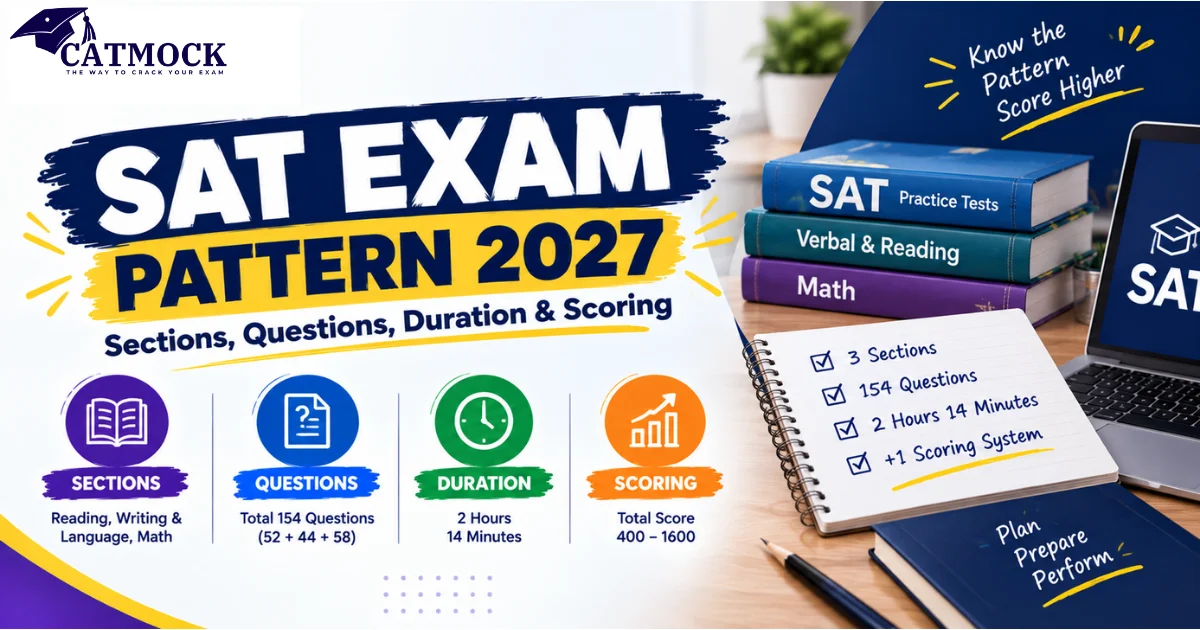
If you searched for SAT exam pattern 2027, here is the short answer. The SAT stays a digital, adaptive test with two sections (Reading and Writing, and Math), 98 questions, 2 hours 14 minutes of testing time and a score between 400 and 1600. College Board’s list of 2026-27 changes covers tools and access, such as a resizable calculator, and leaves the test format alone. The sections below show you how each part works.
Quick Answer: SAT Exam Pattern 2027 at a Glance
| Feature | 2027 pattern |
|---|---|
| Mode | Digital, on the Bluebook app, at a test centre (you cannot test on a phone) |
| Sections | Reading and Writing; Math |
| Modules | 2 per section, 4 in total, adaptive |
| Questions | 98 (54 in Reading and Writing, 44 in Math) |
| Testing time | 2 hours 14 minutes (64 + 70 minutes), plus a 10-minute break |
| Score range | 400 to 1600 (two section scores of 200 to 800) |
| Negative marking | None; College Board says guessing beats leaving a question blank |
| Calculator | Built-in Desmos calculator for the whole Math section, or your own approved one |
What Is the SAT, and Who Needs It?
The SAT is a college admission test that College Board, a not-for-profit organisation, runs. It measures reading, writing and math skills that you build in school, and students use it to apply to universities in the United States and around the world.
No government sets the SAT requirement. As EducationUSA, the U.S. Department of State’s advising network, explains, each U.S. college decides which tests it needs, and many colleges are test optional. EducationUSA also advises you to test one year to 18 months before your degree starts. Check each university’s policy before you register.
SAT Section-Wise Pattern 2027
The SAT has only two sections, and each one splits into two separately timed modules.
Reading and Writing section
| Detail | Figure |
|---|---|
| Time | 64 minutes (two modules of 32 minutes) |
| Questions | 54 (27 per module: 25 scored and 2 unscored pretest questions) |
| Format | Multiple choice, with one short passage per question |
| Time per question | About 1.19 minutes |
| Passage subjects | Literature, history and social studies, the humanities, science |
Some questions come with a table, bar graph or line graph. Four content domains appear in every module, and Bluebook groups similar skills together and orders them from easiest to hardest.
| Content domain | What it tests | Questions in the section |
|---|---|---|
| Craft and Structure | Words in context, text structure and purpose, links between texts | 13 to 15 |
| Information and Ideas | Central ideas, evidence, inferences, reading graphs | 12 to 14 |
| Standard English Conventions | Grammar, punctuation, sentence structure | 11 to 15 |
| Expression of Ideas | Rhetorical synthesis, transitions | 8 to 12 |
Math section
| Detail | Figure |
|---|---|
| Time | 70 minutes (two modules of 35 minutes) |
| Questions | 44 (22 per module: 20 scored and 2 unscored pretest questions) |
| Format | Multiple choice and student-produced responses, where you type your own answer |
| Time per question | About 1.59 minutes |
| Word problems | About 30% of questions use a real-world, science or social studies context |
You get a reference sheet of common formulas, and the Desmos calculator stays available from the first question to the last.
| Content domain | What it tests | Questions in the section |
|---|---|---|
| Algebra | Linear equations, inequalities, functions, systems of equations | 13 to 15 |
| Advanced Math | Quadratic, exponential, polynomial, rational and radical equations | 13 to 15 |
| Problem-Solving and Data Analysis | Ratios, rates, percentages, statistics, probability | 5 to 7 |
| Geometry and Trigonometry | Area, volume, lines, angles, triangles, circles | 5 to 7 |
How the Adaptive Modules Work
The SAT uses multistage adaptive testing. Here is how it plays out in each section:
- You take Module 1, which mixes easier and harder questions.
- Bluebook routes you to Module 2 based on how you performed in Module 1.
- Module 2 carries, on average, either a harder or an easier mix of questions than Module 1.
- Your section score reflects your answers and the difficulty of the questions you saw.
College Board says this design gives a shorter test that stays just as reliable. It describes the routing in general terms, so treat any exact cutoff you see online as a guess. The safe plan is simple: answer Module 1 with care, because it sets up everything that follows.
Bluebook lets you mark questions for review and return to them, but only inside the same module. Students approved for certain accommodations, such as a human reader or paper forms, take a nonadaptive version that has slightly more questions in each module.
SAT Duration and Timing 2027
| Segment | Time | Questions |
|---|---|---|
| Reading and Writing, Module 1 | 32 minutes | 27 |
| Reading and Writing, Module 2 | 32 minutes | 27 |
| Break | 10 minutes | none |
| Math, Module 1 | 35 minutes | 22 |
| Math, Module 2 | 35 minutes | 22 |
| Total testing time | 2 hours 14 minutes | 98 |
Each module runs on its own clock, so spare time in one module does not help the next. You can hide the timer, but Bluebook alerts you when 5 minutes remain, and the clock stays visible after that. Plan for about three hours at the centre, because College Board asks you to bring a device that can run for roughly that long.
SAT Scoring 2027
| Score | Range |
|---|---|
| Reading and Writing section score | 200 to 800 |
| Math section score | 200 to 800 |
| Total score | 400 to 1600 |
College Board uses item response theory to score the test. That means your score does not equal a simple count of right answers. It depends on whether you answer correctly, how hard each question is, and the chance that you guessed. The 8 pretest questions in the whole test do not count toward your score.
The SAT has no negative marking, and College Board says it is better to guess than to leave a question blank, especially after you rule out one or two options.
Your online score report also shows percentiles, so you can see how you compare with other students, plus how you did in each content domain. For most weekend tests, scores arrive 13 days after the test date. You can send scores to up to four colleges or scholarship programmes for free if you choose them by 9 days after the test, and you can use Score Choice to decide which scores each college sees. If you feel you did badly, you can cancel your score until 11:59 p.m. Eastern Time one week after the test.
Bluebook Tools You Can Use During the Test
- Desmos calculator: switch between scientific and graphing versions at any point in the Math section. College Board’s 2026-27 update lets you resize it.
- Reference sheet: open common math formulas whenever you need them.
- Highlights and Notes: mark passages and leave notes on non-math questions.
- Mark for review and question menu: flag questions and jump to any question in the module.
- Option eliminator: cross out answers you rule out.
- Line reader: focus on one line of text at a time.
- Timer: track the time left in each module.
SAT Dates, Registration and Fees for 2027
College Board lists these dates for students in the U.S. and abroad. All deadlines expire at 11:59 p.m. Eastern Time, and the registration deadline for the 7 November 2026 test falls on 23 October.
| Test date | Register by | Late registration and changes by | Scores released |
|---|---|---|---|
| 7 Nov 2026 | 23 Oct 2026 | 27 Oct 2026 | 20 Nov 2026 |
| 5 Dec 2026 | 20 Nov 2026 | 24 Nov 2026 | 18 Dec 2026 |
| 6 Mar 2027 | 19 Feb 2027 | 23 Feb 2027 | 19 Mar 2027 |
| 1 May 2027 | 16 Apr 2027 | 20 Apr 2027 | 14 May 2027 |
| 5 Jun 2027 | 21 May 2027 | 25 May 2027 | 21 Jun 2027 |
College Board also lists anticipated fall 2027 dates of 28 August, 18 September, 9 October, 6 November and 4 December, which suit students applying for 2028 entry. You can confirm every date on the official SAT dates and deadlines page.
The registration fee is USD 68 in the United States, and late registration adds USD 38. Students testing outside the U.S. pay an extra regional fee, so check the official SAT test fees page and its link to international fees before you pay. Fee waivers exist for eligible students.
Start early, because a few steps take time. Upload your photo at least five days before the test, finish exam setup in Bluebook within the five days before test day, and request a loaner device at least 30 days ahead if you need one.
How to Prepare for the SAT Pattern in 2027
- Download Bluebook. You can practise without registering, and you only need a College Board account.
- Take a full-length adaptive practice test. It gives you a score and shows how the modules feel.
- Study by domain. Use College Board’s Student Question Bank and the official SAT prep on Khan Academy to fix weak spots.
- Practise with Desmos. Learn to graph, solve and check answers inside the same tool you will use on test day.
- Time yourself. Aim for about 71 seconds per Reading and Writing question and about 95 seconds per Math question.
Common Mistakes to Avoid
- Skipping exam setup. College Board may turn you away if you do not complete it in Bluebook before test day.
- Leaving questions blank. There is no negative marking, so guess when you run short on time.
- Rushing Module 1. It decides the mix of questions you see next.
- Relying on a phone. You cannot test on one, so use an approved laptop or tablet.
- Forgetting the basics. Bring a physical photo ID, your admission ticket, your College Board login, a fully charged device and a pen or pencil.
- Trusting unofficial cutoffs. Websites guess at routing thresholds and score conversions, so check College Board for the facts.
Summary
- The SAT in 2027 is digital and adaptive, and it runs on the Bluebook app.
- It has two sections: Reading and Writing (54 questions, 64 minutes) and Math (44 questions, 70 minutes).
- Total testing time is 2 hours 14 minutes, with a 10-minute break between sections.
- Your total score runs from 400 to 1600, built from two 200 to 800 section scores.
- There is no negative marking, so answer every question.
- Desmos is available for the whole Math section.
- College Board’s 2026-27 changes touch tools and access, not the test format.
Frequently Asked Questions
What is the SAT exam pattern for 2027?
The SAT is a digital, adaptive test with two sections: Reading and Writing, and Math. It has 98 questions, takes 2 hours 14 minutes plus a 10-minute break, and gives a score from 400 to 1600.
How many questions are on the SAT in 2027?
The SAT has 98 questions: 54 in Reading and Writing and 44 in Math. Eight of them are unscored pretest questions, two in each module.
How long is the SAT in 2027?
The SAT takes 2 hours 14 minutes of testing time: 64 minutes for Reading and Writing and 70 minutes for Math. A 10-minute break separates the two sections.
Does the SAT have negative marking?
No. College Board says it is better to guess than to leave a question blank.
Is the SAT adaptive?
Yes. Each section has two modules, and your performance in the first module decides whether the second module has a harder or easier mix of questions.
Can I use a calculator on the SAT?
Yes. Bluebook includes a built-in Desmos calculator for the whole Math section, and you can also bring an acceptable calculator of your own.
Is the SAT changing in 2027?
College Board’s 2026-27 changes cover tools and access, such as a resizable calculator and easier zoom. The 2026-27 student guide still describes the same two sections and the 400 to 1600 scale.
Do all colleges require the SAT?
No. In the United States each college sets its own testing rules, and many are test optional, so check each university’s policy before you register.
Conclusion
The SAT exam pattern 2027 is steady and easy to remember: two sections, four timed modules, 98 questions, 2 hours 14 minutes and a 400 to 1600 score. What changes from student to student is the second module in each section, so build your plan around a strong first module and steady pacing.
Pick a test date from the table, finish your Bluebook setup early and take at least one full-length practice test under timed conditions. build the habit of timed practice with CatMock’s mock tests. Then confirm every date, fee and rule on College Board’s student guide before you register.
You May Also Like : CAT MOCK, CAT MOCK PYQ
Follow Us On : Facebook, Instagram, Youtube