
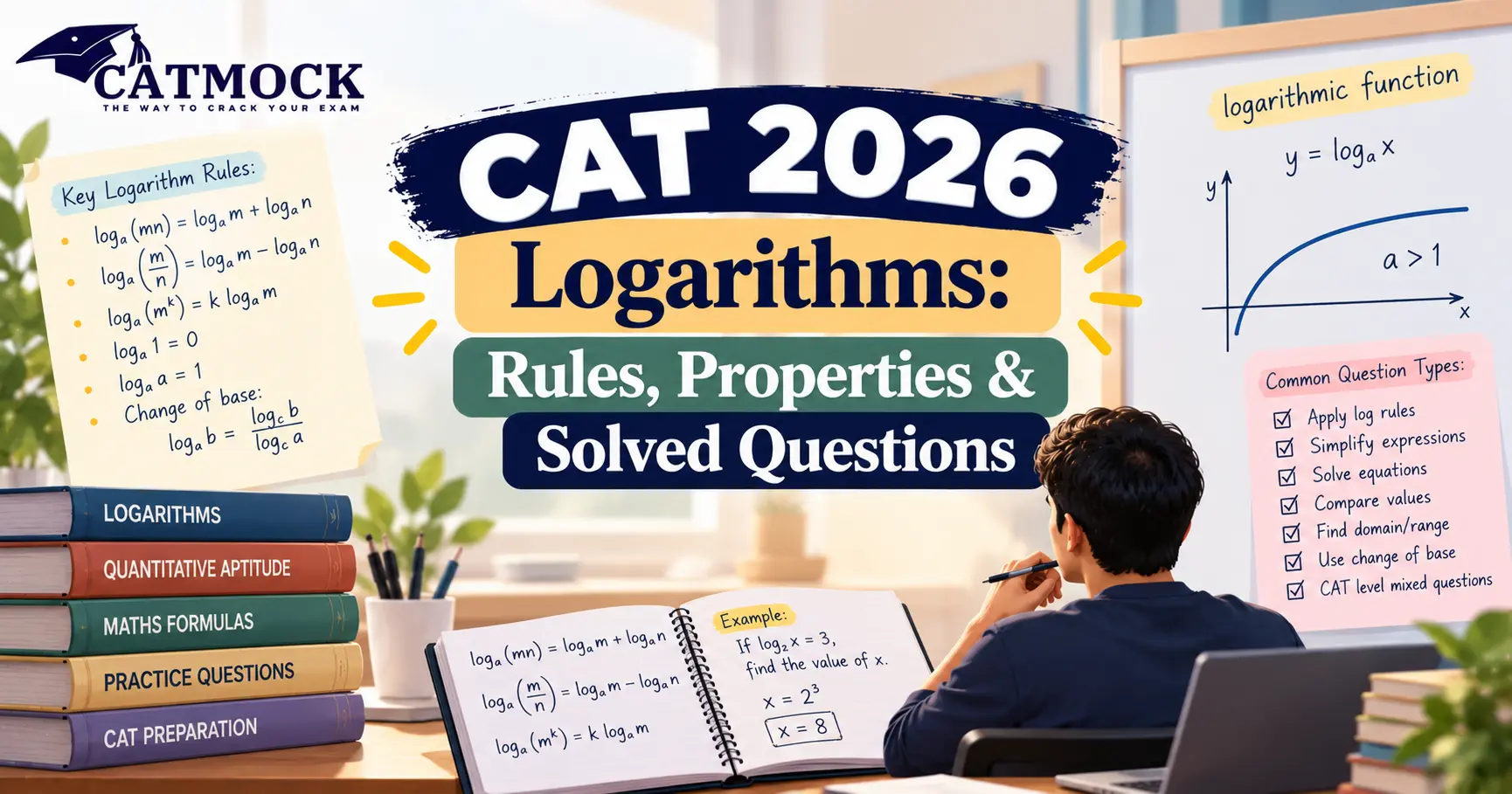
Logarithms scare more CAT aspirants than they should. The formulas fit on one page, yet a single log question can swallow five minutes if you start in the wrong place.
The good news is that CAT 2026 logarithms reward pattern recognition far more than heavy calculation. Once you know the rules, the properties, and a few traps, most questions collapse in three or four lines.
This guide gives you the complete toolkit: definitions, rules, properties, a quick-check method, nine solved questions, common mistakes, and a 14-day plan.
CAT 2026 at a Glance: Why Logarithms Deserve Your Time
CAT 2026 is scheduled for Sunday, November 29, 2026, in three sessions, with IIM Indore as the convening institute. Confirm every detail on the official site, iimcat.ac.in.
Logarithms sit inside the Quantitative Ability section, usually grouped with indices and surds. Weightage varies by year. Coaching resources note that questions from exponents and logarithms have appeared consistently in recent years and range from very easy to very hard. Another source lists 18 questions on logarithm properties in CAT over the past 5 years, which shows the topic keeps returning.
The takeaway: You may see anywhere from zero to a few log-based questions, and they are often among the more solvable items in the paper. Skipping the topic is a gamble. Learning it is cheap.
What Is a Logarithm? A Simple Definition
A logarithm answers one question: “To what power must I raise the base to get this number?”
If aˣ = N, then logₐ N = x.
- 2³ = 8, so log₂ 8 = 3
- 10² = 100, so log₁₀ 100 = 2
- 5⁰ = 1, so log₅ 1 = 0
Conditions You Must Remember
For logₐ N to be defined:
- The base a must be positive and not equal to 1.
- The number N must be positive.
These two conditions are the source of many “trap” answers, because a solution that breaks them must be rejected.
Quick Reference Values
- log of 1 in any base = 0
- log of the base itself = 1
- log₁₀ 10 = 1, log₁₀ 100 = 2, log₁₀ 1000 = 3
- Commonly given in questions: log₁₀ 2 ≈ 0.3010, log₁₀ 3 ≈ 0.4771
Essential Logarithm Rules and Properties
These are the rules you will use again and again. Standard formula sheets list the same core set, including the product rule, the power rule, the change of base formula, and the digit-count formula ⌊log₁₀ N⌋ + 1.
The Master Table
| Rule | Formula | Example |
|---|---|---|
| Product | logₐ(xy) = logₐ x + logₐ y | log₂ 6 = log₂ 2 + log₂ 3 |
| Quotient | logₐ(x/y) = logₐ x − logₐ y | log₁₀ (100/4) = 2 − log₁₀ 4 |
| Power | logₐ(xⁿ) = n · logₐ x | log₂ 32 = 5 log₂ 2 = 5 |
| Root | logₐ(ⁿ√x) = (1/n) · logₐ x | log₃ √27 = 3/2 |
| Base = argument | logₐ a = 1 | log₇ 7 = 1 |
| Log of 1 | logₐ 1 = 0 | log₉ 1 = 0 |
| Change of base | logₐ b = (log_c b) / (log_c a) | log₄ 8 = (log₂ 8)/(log₂ 4) = 3/2 |
| Reciprocal | logₐ b × log_b a = 1 | log₂ 5 × log₅ 2 = 1 |
| Base power | log_{aⁿ} b = (1/n) · logₐ b | log₄ x = (1/2) log₂ x |
| Inverse | a^(logₐ x) = x | 5^(log₅ 9) = 9 |
| Swap rule | x^(log_b y) = y^(log_b x) | 2^(log₂ 3 …) type simplifications |
Properties of Indices You Will Also Need
Logarithm questions often hide exponent rules:
- aᵐ × aⁿ = aᵐ⁺ⁿ
- aᵐ / aⁿ = aᵐ⁻ⁿ
- (aᵐ)ⁿ = aᵐⁿ
- a⁻ᵐ = 1/aᵐ
- a^(m/n) = ⁿ√(aᵐ)
What the Rules Do Not Allow
- logₐ(x + y) is not logₐ x + logₐ y.
- logₐ x × logₐ y is not logₐ(x + y).
- The sum and difference rules need the same base in both terms.
The B.A.S.E. Check: A Four-Step Method for Any Log Question
Use this quick routine before you write a single line of working.
B: Base Alignment
Look at the bases. If they differ, can you convert them to a common base (usually 2, 3, or 10)?
A: Arguments and Powers
Check the arguments. Are they powers of the same number (4, 8, 16, 32 are all powers of 2)? Rewrite them.
S: Simplify With Properties
Apply product, quotient, power, and change-of-base rules to reduce the expression to a single log or a simple equation.
E: Eliminate Invalid Answers
Test every solution against the domain rule: base positive and not 1, argument positive.
B.A.S.E. Summary Table
| Step | Question to Ask | Typical Action |
|---|---|---|
| Base | Are the bases different? | Convert to a common base |
| Arguments | Are they powers of a common number? | Rewrite as powers |
| Simplify | Which rule collapses this? | Product, power, or change of base |
| Eliminate | Is every solution valid? | Check domain conditions |
Nine Solved CAT-Style Logarithm Questions
These original practice questions follow the patterns CAT uses. Try each one before reading the solution.
Question 1 (Easy): Direct Evaluation
Find the value of log₂ 8 + log₃ 81 − log₅ 125.
Solution:
- log₂ 8 = 3 (since 2³ = 8)
- log₃ 81 = 4 (since 3⁴ = 81)
- log₅ 125 = 3 (since 5³ = 125)
Answer: 3 + 4 − 3 = 4.
Question 2 (Easy): Finding the Base
If log_x 64 = 3/2, find x.
Solution:
- Convert to exponent form: x^(3/2) = 64
- Raise both sides to the power 2/3: x = 64^(2/3)
- 64^(1/3) = 4, so 64^(2/3) = 16
Answer: x = 16.
Question 3 (Medium): Mixed Bases
If log₂ x + log₄ x + log₈ x = 11, find x.
Solution:
- Convert everything to base 2: log₄ x = (1/2) log₂ x and log₈ x = (1/3) log₂ x
- Sum: log₂ x × (1 + 1/2 + 1/3) = (11/6) log₂ x
- (11/6) log₂ x = 11, so log₂ x = 6
Answer: x = 64.
Question 4 (Medium): Number of Digits
Given log₁₀ 2 = 0.3010, how many digits does 2⁵⁰ have?
Solution:
- log₁₀ (2⁵⁰) = 50 × 0.3010 = 15.05
- Digits = ⌊15.05⌋ + 1 = 15 + 1
Answer: 16 digits.
Question 5 (Medium): Expressing in Terms of Given Logs
If log₁₀ 2 = a and log₁₀ 3 = b, express log₁₀ 72 in terms of a and b.
Solution:
- 72 = 8 × 9 = 2³ × 3²
- log₁₀ 72 = 3 log₁₀ 2 + 2 log₁₀ 3
Answer: 3a + 2b.
Question 6 (Medium): Telescoping Product
Evaluate log₂ 3 × log₃ 4 × log₄ 5 × log₅ 8.
Solution:
- Use change of base: each term is (log 3/log 2) × (log 4/log 3) × (log 5/log 4) × (log 8/log 5)
- Everything cancels except log 8 / log 2 = log₂ 8
Answer: 3.
Question 7 (Medium-Hard): Equation With Domain Check
Solve log₂(x − 1) + log₂(x + 1) = 3.
Solution:
- Combine: log₂[(x − 1)(x + 1)] = 3
- (x² − 1) = 2³ = 8, so x² = 9, giving x = 3 or x = −3
- Domain: x − 1 > 0 and x + 1 > 0 means x > 1
Answer: x = 3 (reject −3).
Question 8 (Hard): Nested Logarithms
If log₂[log₃(log₄ x)] = 0, find x.
Solution:
- Work from the outside in: log₂[ … ] = 0 means the inside equals 1
- log₃(log₄ x) = 1, so log₄ x = 3
- x = 4³ = 64
Answer: x = 64.
Question 9 (Hard): Inequality With Fractional Base
Solve log_{1/2} x > 2.
Solution:
- The base is between 0 and 1, so the function is decreasing and the inequality flips on removing the log
- x < (1/2)² = 1/4
- Domain: x > 0
Answer: 0 < x < 1/4.
Nested logs and base-fraction inequalities are a familiar type in CAT-level papers, and published CAT-style questions include nested forms such as log₂[3 + log₃{4 + log₄(x − 1)}] − 2 = 0. The same outside-in method solves them.
Question Types and How to Approach Them
| Question Type | What to Spot | Best Approach |
|---|---|---|
| Direct evaluation | Numbers that are exact powers | Convert to exponent form |
| Mixed-base sums | Bases like 2, 4, 8 or 3, 9, 27 | Change to a common base |
| Log equations | Single variable inside logs | Combine, convert to exponent, check domain |
| Nested logs | Log inside a log | Peel from the outside in |
| Inequalities | Base below 1, or a variable base | Watch for the flip and domain |
| Digit-count questions | Large powers and given log values | Use ⌊log₁₀ N⌋ + 1 |
| Telescoping products | Chain of changing bases | Change of base and cancel |
| Logs with surds or roots | Square or cube roots | Rewrite roots as fractional powers |
Common Mistakes in CAT Logarithm Questions
Many marks leak through small errors, not hard concepts. One well-known trap is applying the addition and subtraction properties to logarithms with different bases.
| Mistake | Why It Is Wrong | Fix |
|---|---|---|
| Writing log(x + y) = log x + log y | No such rule exists | Only products split into sums |
| Forgetting the domain check | Extra roots creep in | Test every solution |
| Mixing bases when adding logs | Rules need a common base | Convert first |
| Ignoring the flip for bases below 1 | Inequality direction reverses | Mark the base before solving |
| Misreading log base notation | log₂ x ≠ (log x)² | Rewrite carefully |
| Overusing calculator-style thinking | Wastes time | Use powers of 2, 3, 5, 10 |
| Leaving answers as “log” forms | Options are numeric | Convert back to numbers |
| Dropping brackets in nested logs | Changes the structure | Rewrite step by step |
Smart Shortcuts for Speed
- Know powers by heart: Powers of 2 up to 2¹⁰, powers of 3 up to 3⁶, and powers of 5 up to 5⁴.
- Prefer base 2 or base 10: Most CAT logs reduce cleanly in one of them.
- Turn roots into fractions: √x becomes x^(1/2) before applying log rules.
- Use the reciprocal rule: logₐ b × log_b a = 1 saves lines of working.
- Estimate when options are far apart: If options differ widely, a rough value of log₁₀ is enough.
- Test options in equations: Sometimes substituting a value is faster than solving.
A 14-Day Plan to Master CAT 2026 Logarithms
Exam day is November 29, so you have time for a focused two-week block, then spaced revision.
| Day | Focus | Tasks |
|---|---|---|
| 1-2 | Definitions and basic values | Learn exponent form, domain rules, and common values |
| 3-4 | Core properties | Practise product, quotient, power, and root rules (15 questions/day) |
| 5-6 | Change of base | Mixed-base sums and reciprocal rule |
| 7-8 | Equations | Log equations with domain checks |
| 9-10 | Nested logs and inequalities | Outside-in method, flip rule |
| 11-12 | Digit-count and mixed types | Large powers and given-value problems |
| 13 | Timed sectional | 10 questions in 20 minutes, review every error |
| 14 | Error-log revision | Re-solve every question you missed |
For topic-wise official context, refer to the exam notices at iimcat.ac.in
How to Use Logarithm Skills Inside the Real Exam
- Scan, then decide. Spend 20 seconds on the question. If it needs a long chain of steps, mark it for later.
- Start with the B.A.S.E. check. It usually shows within seconds whether the question is quick.
- Protect your accuracy. Domain checks take 10 seconds and save a wrong answer.
- Do not over-invest. If you are lost after three minutes, move on.
CAT questions on logs also appear combined with other topics, such as inequalities, quadratic equations, or number properties, so cross-topic practice matters.
Summary
- CAT 2026 is scheduled for November 29, 2026. Confirm details on the official site.
- Logarithm questions vary in count each year, but the topic returns often and many items are quickly solvable.
- A logarithm is the power to which a base is raised. The base must be positive and not 1, and the argument must be positive.
- Master the core rules: product, quotient, power, root, change of base, and reciprocal.
- Use the B.A.S.E. check: Base alignment, Arguments as powers, Simplify, Eliminate invalid answers.
- Nested logs are solved from the outside in; inequalities flip when the base is below 1.
- Avoid common mistakes such as splitting log(x + y) and skipping the domain check.
- A 14-day plan, an error log, and timed practice make the topic reliable.
Frequently Asked Questions (FAQs)
1. How many questions from logarithms come in CAT?
There is no fixed count. Sources suggest anywhere from one to a few questions in a typical year, often combined with indices or other algebra topics.
2. Are logarithms difficult for CAT?
Most log questions are manageable once you know the properties. Difficulty rises with nested logs, inequalities, and mixed bases.
3. What are the most important logarithm formulas for CAT?
The product, quotient, and power rules, the change of base formula, the reciprocal rule, and the digit-count formula ⌊log₁₀ N⌋ + 1.
4. Do I need to memorise log tables for CAT?
No. CAT typically gives needed values, such as log₁₀ 2 or log₁₀ 3. You mainly need to know powers of small numbers.
5. Why must I check the domain in logarithm equations?
Because a solution that makes any argument zero or negative is invalid. Domain checks remove extra roots.
6. What happens to the inequality when the base is less than 1?
The logarithmic function is decreasing, so the inequality direction flips when you remove the log.
7. How do I find the number of digits in a large power?
Compute log₁₀ of the number, take the floor of the value, and add 1.
8. How long should I spend preparing logarithms before CAT?
A focused 10 to 14 days of practice, followed by short weekly revision and mixed sets, is enough for most aspirants.
Conclusion
CAT 2026 logarithms are less about brilliance and more about discipline. Know your rules, convert to a common base, peel nested logs from the outside, and always check the domain. Do this consistently and a topic that looks intimidating turns into dependable marks.
Start today with the nine questions above, log every mistake, and follow the 14-day plan. By exam day, logarithm questions will feel like quick wins rather than time traps.
You May Also Like : CAT MOCK, CAT MOCK PYQ
Follow Us On : Facebook, Instagram, Youtube