
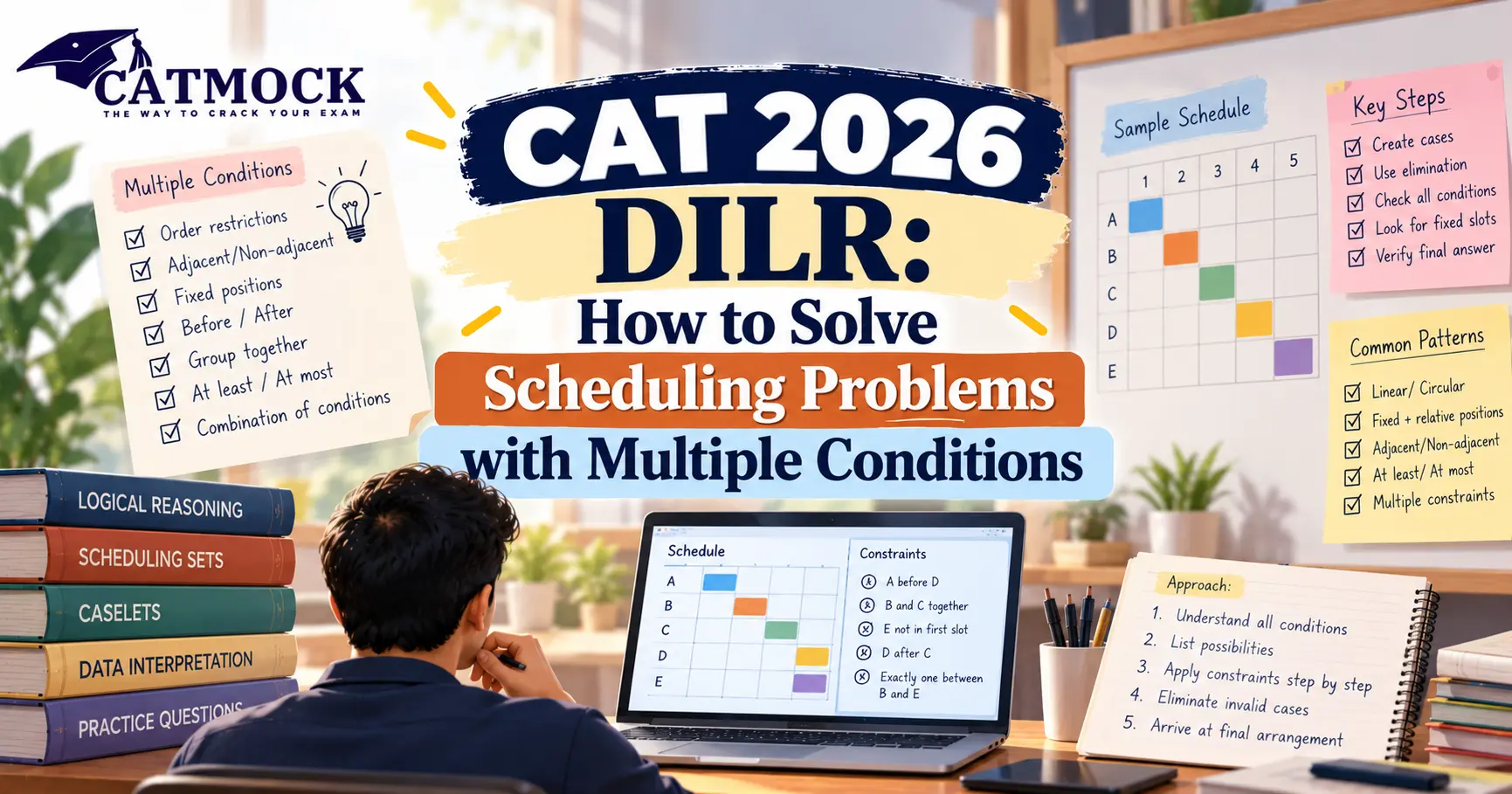
You open a DILR set and see six speakers, five time slots, two rooms and eleven conditions. Your heart sinks. Half the conditions say “if this, then that”, and the other half say “not before” or “exactly one gap”.
That reaction is normal, and it is also the reason this set type is worth mastering. CAT 2026 DILR scheduling problems with multiple conditions look intimidating, but they are among the most systematic sets in the paper. They reward process over genius. If you build the right grid and apply conditions in the right order, a set that scares 90% of test-takers becomes a clean, 100% accurate set for you.
This guide gives you that process: the condition types, a seven-step method, two fully worked examples, a time budget and a four-week practice plan.
What Are Scheduling Problems in CAT DILR?
A scheduling problem asks you to assign people, tasks or events to time slots (hours, days, weeks or rooms) while obeying a list of rules. Other names for the same family are timetabling sets, time-slot arrangement and sequencing puzzles.
Typical settings include:
- Interviews or presentations across several days
- Machines or employees assigned to shifts
- Exams, lectures or matches placed into a timetable
- Tasks that must be completed in a particular order
The core challenge is that the answer is rarely stated. You must deduce it from many interlocking conditions. In formal terms this is a constraint satisfaction problem, and the same logic that solves a logic puzzle solves your CAT set.
Why This Topic Deserves Your Attention in CAT 2026
- It recurs. Many preparation reviews list scheduling among the “new-age” problem types that show up regularly alongside routes and networks and games and tournaments.
- It is learnable. Unlike a purely creative puzzle, scheduling follows repeatable patterns.
- It is hybrid-friendly. CAT often mixes scheduling with ranking or distribution, so skill here pays off in other sets too.
- It is rewarding. The DILR section runs 40 minutes and the official CAT website publishes the exam pattern, so one fully solved set can lift your section score noticeably.
Candidates who treat scheduling as a method, not a mystery, tend to clear these sets faster and with fewer errors.
The Six Types of Conditions You Will Meet
Every scheduling set is built from a small family of condition types. Recognising them instantly is the first skill to build.
Table 1: Condition Types and How to Handle Them
| Condition type | Example wording | How to record it |
|---|---|---|
| Fixed placement | “P is in slot 3” | Write directly into the grid |
| Relative order | “A is before B” | Chain: A … B |
| Exact gap | “Exactly one session between P and Q” | Pattern: P _ Q |
| Adjacency | “S is immediately followed by R” | Treat SR as a single block |
| Exclusion | “T is not in the first or last slot” | Cross out those cells in T’s row |
| Conditional (if-then) | “If C is on Monday, D is on Tuesday” | Note the rule and its contrapositive |
| Capacity / count | “Two people per day” | Add a running count beside each day |
Priority tip: Fixed placements and blocks reduce the possibilities most, so use them first. Exclusions are weaker and conditionals can be conditional on unknowns, so use those last.
The 7-Step Method to Solve Scheduling Sets
Follow these steps in order, every time.
Step 1: Read the Whole Set Before Touching a Pen
Spend 60–90 seconds scanning the setup, conditions and question types. Judge two things: how many variables are involved, and how many conditions give direct information. A set with several fixed placements is a good sign. A set made entirely of “if-then” rules is usually a time sink.
Step 2: Build the Master Grid
Draw rows for entities (people, tasks) and columns for time slots, or the reverse. A table gives you a place to eliminate options visually. Keep it large and neat.
Step 3: Transcribe Conditions in Shorthand
Rewrite each condition in one compact symbol line, for example U < P, Q = P+2, [SR], T ≠ 1, 6. Long English sentences slow you down and hide contradictions.
Step 4: Place the Anchors
Enter every direct placement and every block that has only one position. These are your anchors, and every later deduction leans on them.
Step 5: Combine Overlapping Conditions
Look for entities that appear in more than one condition. Merge them into longer chains such as U < P _ Q. This is where hidden restrictions show up.
Step 6: Split into Cases Only When Needed
If a condition leaves two or three positions for one entity, branch into separate, labelled cases. Work each case to a full arrangement or a contradiction. Keep the branches visually apart so you never mix their deductions.
Step 7: Verify Against Every Condition
Before answering, run the final arrangement against the complete list. A single missed condition is the most common source of lost marks.
Worked Example 1: A Single-Line Sequencing Set
Set: Six sessions (P, Q, R, S, T, U) are scheduled in six consecutive slots numbered 1 to 6, one per slot.
- P is scheduled before Q, with exactly one session between them.
- R is held immediately after S.
- T is not in slot 1 or slot 6.
- U is held earlier than P.
- Q is not held in the last slot.
Shorthand
Q = P + 2[S R]as a blockT ∈ {2, 3, 4, 5}U < PQ ≠ 6
Reasoning
Step A: find P’s possible slots. Since Q = P + 2, P can be 1, 2, 3 or 4. But U must come before P, so P cannot be 1. Also Q ≠ 6, so P ≠ 4. That leaves P = 2 or P = 3.
Step B: Case 1, P = 3, Q = 5. U must be in slot 1 or 2. The free slots are 1, 2, 4 and 6, for U, S, R and T. The block SR needs two consecutive free slots, and the only pair is (1, 2). But U needs one of those two slots. Contradiction, so Case 1 is out.
Step C: Case 2, P = 2, Q = 4. U must be in slot 1. The free slots are 3, 5 and 6, for S, R and T. The block SR fits only in (5, 6), so S = 5 and R = 6. That leaves T = 3, which satisfies T ∈ {2, 3, 4, 5}.
Final schedule: U (1), P (2), T (3), Q (4), S (5), R (6).
Verification:
- P in slot 2 and Q in slot 4, with T in between ✓
- S in 5 and R in 6 ✓
- T in 3 ✓
- U in 1, before P ✓
- Q is not last ✓
Lesson: Notice how the block idea and the adjacent free slots check killed an entire case in seconds. Without condition 5, three arrangements would be possible, which is exactly the kind of “what-if” question CAT likes to ask.
Worked Example 2: A Multi-Day, Multi-Slot Set (Table Method)
Set: Six employees (A–F) present over three days (Monday, Tuesday, Wednesday). Exactly two employees present each day.
- A and B present on the same day.
- C does not present on Monday.
- D presents on an earlier day than E.
- F presents on Wednesday.
Reasoning
Where can A and B go? They share a day, which uses up both slots on that day. They cannot be on Wednesday, because F is already there and only two slots exist. So A and B are on Monday or Tuesday.
Case 1: A and B on Monday. Monday is full. The other four (C, D, E, F) share Tuesday and Wednesday, two each. F is on Wednesday. D must be earlier than E, so D is on Tuesday and E is on Wednesday. That leaves C for Tuesday. ✓ (C is not on Monday.)
Case 2: A and B on Tuesday. Tuesday is full. C, D, E, F share Monday and Wednesday. C cannot be on Monday, so C is on Wednesday, and with F that fills Wednesday. D and E are both left for Monday, which violates “D earlier than E”. Contradiction.
Final schedule
| Day | Slot 1 | Slot 2 |
|---|---|---|
| Monday | A | B |
| Tuesday | C | D |
| Wednesday | E | F |
(Within a day, the order of the two people is not specified, so either order works.)
Lesson: In capacity-based sets, count slots constantly. Many contradictions come from a day running out of space.
Handling “If-Then” and Contrapositive Conditions
Conditional rules cause the most mistakes. Remember this:
- “If X, then Y” means that whenever X happens, Y must follow.
- Its logical equal is the contrapositive: “If not Y, then not X.”
- It does not mean “If Y, then X.”
Example: “If the budget review is on Tuesday, the audit is on Thursday.”
- Contrapositive: “If the audit is not on Thursday, the budget review is not on Tuesday.”
- Nothing is said about what happens if the audit is on Thursday.
Practical tip: When you write a conditional, write its contrapositive right beside it. Then, whenever you eliminate a slot for Y, you instantly know X’s restriction.
The Elimination Matrix: Your Fastest Visual Tool
For sets with many “not” conditions, draw a simple matrix and mark ✗ for impossible cells and ✓ for confirmed ones.
| Slot 1 | Slot 2 | Slot 3 | Slot 4 | Slot 5 | |
|---|---|---|---|---|---|
| A | ✗ | ||||
| B | ✗ | ||||
| C | ✗ | ✗ |
When a row has a single open cell, that entity is placed. When a column has a single open cell, that slot belongs to that entity. Repeat until the grid fills, and use this at every stage of the 7-step method.
Handling Multiple Resources: Rooms, Machines and Days
Some CAT sets add a second dimension, such as two rooms or three machines. Do not treat each room as a separate problem. Instead:
- Use one master table with time on one axis and resource on the other.
- Mark simultaneous events vertically and sequential events horizontally.
- Track totals at the edges (events per room, events per day).
Table 2: Choosing a Visual Tool by Set Type
| Set type | Best visual | Reason |
|---|---|---|
| Single sequence of slots | Number line with blocks | Shows order and gaps clearly |
| People × days | Grid with counts | Capacity checks become easy |
| Rooms × time slots | Two-way table | Prevents double-booking |
| Tasks with dependencies | Chain or arrow diagram | Reveals the earliest completion order |
| Mixed with ranking or distribution | Master table + side list | Keeps both layers visible |
Special Situations You Should Prepare For
Case A: “What-If” Questions
Many CAT questions begin, “If X is moved to slot 3, then…”. Treat the new condition as temporary. Redraw only the affected part of your grid, answer the question, then return to your original grid. Never overwrite the master.
Case B: Questions Asking “Which Must Be True?”
Check each option against all valid arrangements. If you found three arrangements, an option must hold in all three to qualify. If you found only one, any consequence of it holds.
Case C: Questions Asking “Maximum” or “Minimum” Slots Used
These ask how compact or spread-out a schedule can be. Build the tightest and loosest valid arrangements and compare them, rather than testing every possibility.
Case D: Hybrid Sets (Scheduling + Ranking or Distribution)
Run the schedule first. Then layer ranking or counts on top, because the timetable usually shrinks the possibilities for the second layer.
How to Decide Whether to Attempt a Scheduling Set
CAT rewards set selection as much as set solving. Use this quick filter during your first 90 seconds.
Table 3: Attempt or Skip: Quick Decision Guide
| Signal | Verdict |
|---|---|
| Several fixed placements given directly | Attempt |
| 4–6 entities, one slot each, clear chain conditions | Attempt |
| Mostly “if-then” rules with no anchors | Skip or attempt last |
| Two or more resources plus more than 8 conditions | Think twice; test an anchor first |
| You cannot make any placement after 3 minutes | Leave it and move on |
Time budget (a flexible guide): Spend about 1.5 minutes reading, about 5 minutes building the grid and anchors, and the rest on the questions. In recent years the section has had roughly 20 questions across four to five sets, so about 8 to 9 minutes per set is realistic. If a set has consumed far more than that without progress, switch.
Common Mistakes That Cost Marks
- Reading conditions as stronger than they are. “Before” does not mean “immediately before”.
- Forgetting the contrapositive. This leads to missed eliminations.
- Mixing cases. Deductions from Case 1 leak into Case 2 and wreck the answer.
- Starting with weak conditions. Exclusions give little. Anchors and blocks give a lot.
- Skipping verification. One unchecked condition invalidates an entire arrangement.
- Over-investing in a bad set. Pride is expensive in DILR.
- Not reading the question types first. Sometimes the questions need only a partial deduction.
Your 4-Week Practice Plan for CAT 2026
Table 4: Four-Week Scheduling Practice Plan
| Week | Focus | Daily target |
|---|---|---|
| Week 1 | Single-line sequencing and block building; condition types | 2 small sets/day, with a written shorthand |
| Week 2 | Multi-day and capacity-based sets; elimination matrices | 2 sets/day, unseen conditions first |
| Week 3 | If-then and contrapositive; hybrid sets; what-if questions | 2 sets/day plus 1 timed |
| Week 4 | Timed mixed sets from previous-year papers and mocks | 1 full DILR sectional + review |
Pro tips
- Keep a mistake log listing the condition type that tripped you.
- After each set, ask: “Which anchor should I have found sooner?”
- Combine this topic with CAT previous year DILR set and a full CAT mock test series.
Summary
- Scheduling sets assign people, tasks or events to time slots under many rules. They are systematic, not random.
- Learn the seven condition types: fixed, relative, gap, adjacency, exclusion, conditional and capacity.
- Follow the 7-step method: scan, grid, shorthand, anchors, combine, case-split, verify.
- Use blocks for adjacency, chains for order, and contrapositives for if-then rules.
- Keep each case separate, and use an elimination matrix to confirm placements.
- Choose sets wisely. A set with direct anchors beats a set of vague conditionals.
- Practise in four stages, from basic sequences to timed mixed sets.
Frequently Asked Questions (FAQs)
1. What are scheduling problems in CAT DILR?
Scheduling problems ask you to assign people, tasks or events to time slots (hours, days, rooms) based on a set of conditions. They are also called timetabling or sequencing sets, and they test logical deduction and organised case analysis.
2. How should I start a scheduling set with many conditions?
Scan the whole set first, then draw a master grid and rewrite each condition in shorthand. Place the anchors, meaning fixed positions and blocks, before touching weaker conditions such as exclusions or if-then rules.
3. What is the contrapositive and why does it matter in DILR?
For “If X, then Y”, the contrapositive is “If not Y, then not X”. It is always true, so writing it down gives you extra eliminations without extra effort. The reverse, “If Y, then X”, is not guaranteed.
4. How long should I spend on one scheduling set in CAT?
A realistic target is roughly 8 to 9 minutes per set, including reading. If you cannot place a single anchor after about three minutes, skip the set and return later if time allows.
5. How many scheduling sets should I practise before CAT 2026?
Aim for at least 30 to 40 well-reviewed sets, starting with simple sequences and ending with timed, mixed ones. Quality of review matters more than quantity, so log each error and the condition type behind it.
Conclusion
Scheduling sets reward calm structure. When you meet CAT 2026 DILR scheduling problems with multiple conditions, remember that the condition list is not a wall of chaos. It is a set of clues arranged by importance. Find the anchors, build the blocks, keep your cases clean and verify before you answer.
Start with the seven-step method, practise the two worked examples until the logic feels natural, and follow the four-week plan. By the time CAT 2026 arrives, a scheduling set will look less like a threat and more like a gift of reliable marks.
You May Also Like : CAT MOCK, CAT MOCK PYQ
Follow Us On : Facebook, Instagram, Youtube