
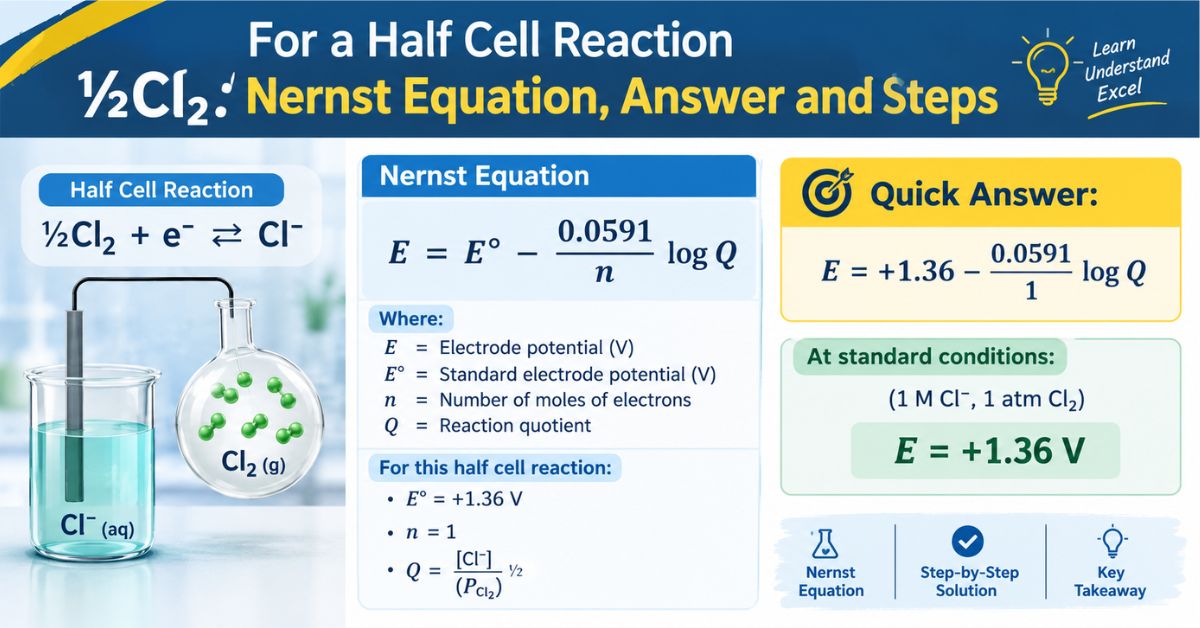
For a half cell reaction ½Cl₂ + e⁻ → Cl⁻, the Nernst equation at 298 K is E = 1.36 − 0.0591 log ([Cl⁻] / P(Cl₂)^½) volts. Here n = 1, E° = +1.36 V and Q = [Cl⁻] / √P(Cl₂). A higher [Cl⁻] lowers E, while a higher chlorine pressure raises it.
Quick Answer: E = E° − (0.0591/n) log Q, with E° = +1.36 V, n = 1 and Q = [Cl⁻] / (P_Cl₂)^½. At standard conditions (1 M Cl⁻, 1 atm Cl₂), E = +1.36 V.
Key Takeaways
- The half-cell reaction ½Cl₂(g) + e⁻ → Cl⁻(aq) describes reduction at the Cl₂/Cl⁻ electrode.
- Its standard electrode potential is about +1.36 V at 298 K.
- The number of electrons is n = 1, because only half a mole of Cl₂ is written.
- The reaction quotient is Q = [Cl⁻] / (P_Cl₂)^½.
- Writing ½Cl₂ or Cl₂ changes n and Q, but never the electrode potential E.
What does the half-cell reaction ½Cl₂ + e⁻ → Cl⁻ mean?
It means half a mole of chlorine gas gains one electron to form one mole of chloride ions. This is a reduction reaction, so the electrode acts as a cathode when connected to a weaker oxidising half-cell.
A half-cell is one electrode dipped in its electrolyte. In this case, an inert platinum wire sits in a chloride solution while chlorine gas bubbles over it. Platinum only carries electrons. It does not take part in the reaction.
How is the chlorine electrode written?
The cell notation is Pt | Cl₂(g, P) | Cl⁻(aq, c). The vertical bars show phase boundaries. The gas and the ions meet at the platinum surface, where electrons move in or out.
Why is the reaction written with ½?
Writing ½Cl₂ gives exactly one electron per chloride ion formed. Many textbooks and exam questions use this form because it keeps n = 1 and makes the Q expression short. It is the same chemistry as Cl₂ + 2e⁻ → 2Cl⁻, only scaled down.
What is the standard electrode potential of the Cl₂/Cl⁻ electrode?
The standard electrode potential of the Cl₂/Cl⁻ electrode is about +1.36 V at 298 K, 1 M Cl⁻ and 1 atm Cl₂. Textbook tables list 1.36 V, and some precise tables give 1.358 V.
A standard electrode potential (E°) is the reduction potential measured against the standard hydrogen electrode (SHE) under standard conditions. The SHE is assigned 0.00 V.
A large positive E° means chlorine is a strong oxidising agent. It grabs electrons easily. That is why chlorine can oxidise bromide and iodide ions.
Does E° change when the equation is multiplied?
No. E° is an intensive property. It does not depend on how much substance is written in the equation. So E° stays +1.36 V for both ½Cl₂ + e⁻ → Cl⁻ and Cl₂ + 2e⁻ → 2Cl⁻.
Assumptions used in this article: temperature is 298 K, chlorine behaves as an ideal gas, and concentrations replace activities. The values given are standard-condition values.
What is the Nernst equation for ½Cl₂ + e⁻ → Cl⁻?
The Nernst equation for the half-cell ½Cl₂ + e⁻ → Cl⁻ at 298 K is E = 1.36 − 0.0591 log ([Cl⁻] / P_Cl₂^½). It links the actual electrode potential to the concentration of chloride ions and the pressure of chlorine gas.
The Nernst equation tells you how the electrode potential shifts when conditions move away from standard.
What is the general form?
The general form is:
E = E° − (RT / nF) ln Q
Here, R is the gas constant, T is temperature in kelvin, n is the number of electrons, F is the Faraday constant and Q is the reaction quotient.
What is the form at 298 K?
At 298 K, the factor 2.303RT/F equals about 0.0591 V. Converting ln to log gives:
E = E° − (0.0591 / n) log Q
What is Q for this half cell?
Q is the products over the reactants, each raised to its coefficient. Pure solids and liquids are left out. For ½Cl₂ + e⁻ → Cl⁻:
Q = [Cl⁻] / (P_Cl₂)^½
Substituting n = 1 and E° = 1.36 V gives the final working equation:
E = 1.36 − 0.0591 log ([Cl⁻] / √P_Cl₂)
This can also be written as E = 1.36 + 0.02955 log P_Cl₂ − 0.0591 log [Cl⁻]. Both forms give the same answer.
Nernst equation variables
| Symbol | Meaning | Value or unit |
|---|---|---|
| E | Electrode potential under the given conditions | Volts (V) |
| E° | Standard electrode potential of Cl₂/Cl⁻ | +1.36 V |
| R | Universal gas constant | 8.314 J K⁻¹ mol⁻¹ |
| T | Absolute temperature | 298 K (25 °C) |
| F | Faraday constant | 96,485 C mol⁻¹ |
| n | Electrons transferred in the written equation | 1 for the ½Cl₂ form |
| Q | Reaction quotient | [Cl⁻] / (P_Cl₂)^½ |
| 2.303RT/F | Combined factor at 298 K | About 0.0591 V |
| P_Cl₂ | Partial pressure of chlorine | Atmospheres (atm) |
Note: IUPAC now defines the standard pressure as 1 bar. The difference from 1 atm is tiny, so exam problems treat them as equal.
Why does the coefficient ½ matter?
The ½ matters because it sets n = 1 and puts a square root on the chlorine pressure in Q. It does not change E° or the final potential E.
Students often lose marks here. They write Q with P_Cl₂ to the power 1 but use n = 1, or the reverse. Both errors give wrong answers.
The rule for coefficients
- Each coefficient in the balanced half-reaction becomes an exponent in Q.
- The number of electrons n must match the same written equation.
- E and E° are unchanged when you multiply the equation.
- ΔG and the log Q term scale together with n, so the final E is the same.
Does ΔG change?
Yes. Since ΔG = −nFE, doubling the equation doubles n and doubles ΔG. But E stays the same. This is the clearest way to see why E is independent of the way you write the equation.
Comparing the two ways of writing the chlorine half-cell
| Feature | ½Cl₂ + e⁻ → Cl⁻ | Cl₂ + 2e⁻ → 2Cl⁻ |
|---|---|---|
| n (electrons) | 1 | 2 |
| Q expression | [Cl⁻] / (P_Cl₂)^½ | [Cl⁻]² / P_Cl₂ |
| E° | +1.36 V | +1.36 V |
| Nernst form at 298 K | E = 1.36 − 0.0591 log Q | E = 1.36 − (0.0591/2) log Q |
| ΔG° | −F(1.36) | −2F(1.36) |
| Final E for the same conditions | Same | Same |
What changes: n, Q and ΔG. What does not change: E° and E.
Step-by-step answer to the typical question
A commonly asked version of this question asks for the electrode potential of the Cl₂/Cl⁻ half cell at a given [Cl⁻] and chlorine pressure. The exact wording differs between books and exams, so the values below are chosen for illustration.
Problem: Calculate the electrode potential of the half cell Pt | Cl₂(10 atm) | Cl⁻(0.1 M) at 298 K for the reaction ½Cl₂ + e⁻ → Cl⁻. Take E° = +1.36 V.
Solution
- Write the half-reaction. ½Cl₂(g) + e⁻ → Cl⁻(aq). So n = 1.
- Write Q. Q = [Cl⁻] / (P_Cl₂)^½.
- Substitute the values. Q = 0.1 / (10)^½ = 0.1 / 3.162 = 0.03162.
- Find log Q. log(0.03162) = −1.5.
- Apply the Nernst equation. E = E° − (0.0591 / 1) log Q = 1.36 − 0.0591 × (−1.5).
- Calculate. E = 1.36 + 0.0887 = 1.4487 V.
Answer: E ≈ 1.449 V.
Quick check using the other form
Write the reaction as Cl₂ + 2e⁻ → 2Cl⁻. Then n = 2 and Q = (0.1)² / 10 = 0.001. So E = 1.36 − (0.0591 / 2) × log(0.001) = 1.36 + 0.0887 = 1.4487 V. The same answer. This proves that the ½ form and the full form agree.
A second solved example
Problem: Find E for the Cl₂/Cl⁻ half cell when [Cl⁻] = 0.010 M and P_Cl₂ = 4 atm at 298 K.
- Reaction and n. ½Cl₂ + e⁻ → Cl⁻, n = 1.
- Q. Q = 0.010 / (4)^½ = 0.010 / 2 = 0.005.
- log Q. log(0.005) = −2.301.
- E. E = 1.36 − 0.0591 × (−2.301) = 1.36 + 0.1360.
Answer: E ≈ 1.496 V.
What does the result tell us?
The potential is higher than 1.36 V. Both changes push it up: a lower [Cl⁻] and a higher chlorine pressure. Low [Cl⁻] means less product, so the reduction is more favourable. High pressure means more reactant.
What if the cell is at standard conditions?
If [Cl⁻] = 1 M and P_Cl₂ = 1 atm, then Q = 1 and log Q = 0. So E = E° = 1.36 V. Use this as a quick sanity check in any problem.
How do [Cl⁻] and P(Cl₂) change the potential?
A higher [Cl⁻] lowers the electrode potential, and a higher P(Cl₂) raises it. This follows from Le Chatelier’s principle and from the sign in the Nernst equation.
Chloride is a product, so more of it makes the forward reduction less favourable. Chlorine gas is a reactant, so more of it makes reduction more favourable.
Table 2: Effect of changing concentration or pressure on E
| Change (other factors constant) | Effect on Q | Effect on log Q | Effect on E |
|---|---|---|---|
| [Cl⁻] increases | Q increases | Increases | E decreases |
| [Cl⁻] decreases | Q decreases | Decreases | E increases |
| P(Cl₂) increases | Q decreases | Decreases | E increases |
| P(Cl₂) decreases | Q increases | Increases | E decreases |
| [Cl⁻] ×10 | Q ×10 | +1 | E falls by 0.0591 V |
| P(Cl₂) ×100 | Q ÷10 | −1 | E rises by 0.0591 V |
Which factor has a bigger effect?
Chloride concentration has a stronger effect per tenfold change. A tenfold change in [Cl⁻] shifts E by 0.0591 V. A tenfold change in pressure shifts E by only 0.02955 V, because of the square root.
Common mistakes students make
The most common mistake is using the wrong n or the wrong exponent for chlorine pressure. Here is how students usually get this wrong, and how to avoid it.
- Using n = 2 with the ½ equation. If the equation has ½Cl₂, n is 1.
- Forgetting the square root. With ½Cl₂, the pressure term is P^½, not P.
- Inverting Q. For reduction, Q = products / reactants, so [Cl⁻] goes on top.
- Using 0.059 for everything. The factor 0.0591 is only valid at 298 K.
- Mixing up the sign. The Nernst equation has a minus sign before the log term when Q is products over reactants.
- Putting the solid or platinum in Q. Pure solids and the inert electrode are left out.
- Using Celsius. Always convert temperature to kelvin when using the general RT/nF form.
Practical tip: Before you finish any Nernst problem, ask one question. Should E move up or down compared with E°? If your answer goes the wrong way, recheck Q.
How this concept appears in competitive exams
Exams test this concept through direct calculations, concentration effects and links between E, ΔG and K. It is a regular topic in the electrochemistry chapter of Class 12, JEE, NEET and CUET preparation.
Typical question patterns include:
- Finding E of a chlorine electrode at a given [Cl⁻] and pressure.
- Finding the emf of a full cell that pairs the Cl₂/Cl⁻ electrode with another half cell.
- Using E° values to find the E° of a related couple, such as OCl⁻/Cl⁻ and Cl⁻/½Cl₂, by adding half-reactions.
- Finding K or K_sp from E° using E° = (0.0591/n) log K.
- Judging how E changes when pressure or concentration is varied.
In problems that reverse the reaction (Cl⁻ → ½Cl₂ + e⁻), the sign of E° flips to −1.36 V. Be careful to keep the equation direction consistent with your Q.
Tips for solving faster
- Write both half-reactions as reductions first.
- Pick n from the equation exactly as written.
- Build Q straight from the coefficients.
- Estimate the direction of change before you calculate.
- Round only at the final step.
PDF-style quick revision notes
Use this section as a printable formula sheet. Save the page as PDF from your browser, or copy these notes into your own revision file.
Formula sheet
- Reaction: ½Cl₂(g) + e⁻ → Cl⁻(aq)
- E° (Cl₂/Cl⁻) = +1.36 V
- n = 1
- Q = [Cl⁻] / (P_Cl₂)^½
- E = E° − (0.0591/n) log Q (298 K)
- E = 1.36 − 0.0591 log ([Cl⁻] / √P_Cl₂)
- ΔG = −nFE and ΔG° = −nFE°
- E° = (0.0591/n) log K (at equilibrium)
Memory aids
- Chloride up, potential down.
- Chlorine pressure up, potential up.
- Coefficient in the equation becomes the exponent in Q.
- n follows the equation as written. E does not.
Five-line summary
- The Cl₂/Cl⁻ electrode is a gas electrode on inert platinum.
- Its standard potential is +1.36 V.
- The ½ form has n = 1.
- Q uses the square root of chlorine pressure.
- The final E is the same for any way of writing the equation.
FAQs
What is the half-cell reaction ½Cl₂ + e⁻ → Cl⁻?
It is the reduction of chlorine gas to chloride ions at the Cl₂/Cl⁻ electrode. Half a mole of Cl₂ takes up one mole of electrons to give one mole of Cl⁻. It is a reduction reaction with n = 1.
What is the standard electrode potential of the chlorine electrode?
The standard electrode potential of the Cl₂/Cl⁻ electrode is about +1.36 V at 298 K. This is measured against the standard hydrogen electrode under 1 M Cl⁻ and 1 atm Cl₂. A large positive value shows chlorine is a strong oxidising agent.
What is the Nernst equation for ½Cl₂ + e⁻ → Cl⁻?
At 298 K it is E = 1.36 − 0.0591 log ([Cl⁻] / P_Cl₂^½). The general form is E = E° − (RT/nF) ln Q. Here n = 1 and Q = [Cl⁻] / (P_Cl₂)^½.
Why is n equal to 1 in this half reaction?
The equation shows one electron on the reactant side. Since only half a mole of Cl₂ is written, one chloride ion forms per electron gained. So n = 1. In the Cl₂ + 2e⁻ → 2Cl⁻ form, n would be 2.
Does the ½ coefficient change the electrode potential?
No. The electrode potential E is an intensive property, so it does not depend on how the equation is scaled. The ½ changes n, Q and ΔG, but E and E° stay the same.
What happens to E if the chloride concentration increases?
E decreases. Chloride is a product, so a higher [Cl⁻] increases Q and makes log Q larger. Because the Nernst equation subtracts this term, the electrode potential falls. A tenfold rise lowers E by 0.0591 V at 298 K.
What happens to E if chlorine pressure increases?
E increases. Chlorine gas is a reactant, so higher pressure lowers Q, which makes log Q smaller. The Nernst equation then gives a higher potential. A hundredfold rise in pressure raises E by 0.0591 V in the ½Cl₂ form.
Why is the value 0.0591 V used?
It comes from 2.303RT/F at 298 K. Using R = 8.314 J K⁻¹ mol⁻¹, T = 298 K and F = 96,485 C mol⁻¹ gives about 0.0591 V. Some books round it to 0.059 V. Use the value your exam specifies.
Is there a downloadable PDF for this topic?
This page includes a printable formula sheet and revision notes. You can save the page as PDF from your browser’s print menu and keep it for quick revision before tests.
What is the difference between E° and E?
E° is the potential under standard conditions (1 M, 1 atm, 298 K). E is the potential under any actual conditions. The Nernst equation connects the two, and they are equal only when Q = 1.
Conclusion
For a half cell reaction ½Cl₂ + e⁻ → Cl⁻, remember three facts: E° = +1.36 V, n = 1 and Q = [Cl⁻] / √P_Cl₂. Put these into E = E° − (0.0591/n) log Q, and you can solve most problems on the chlorine electrode.
The best next step is practice. Try changing the values in the two solved examples and check that the ½ form and the full form agree every time.
Reliable sources for further reading
- Nernst equation overview (Wikipedia)
- NPTEL: Electrode potentials and applications (PDF)
- NCERT textbooks (Class 12 Chemistry, Electrochemistry chapter)
- IUPAC Gold Book
- LibreTexts Chemistry