
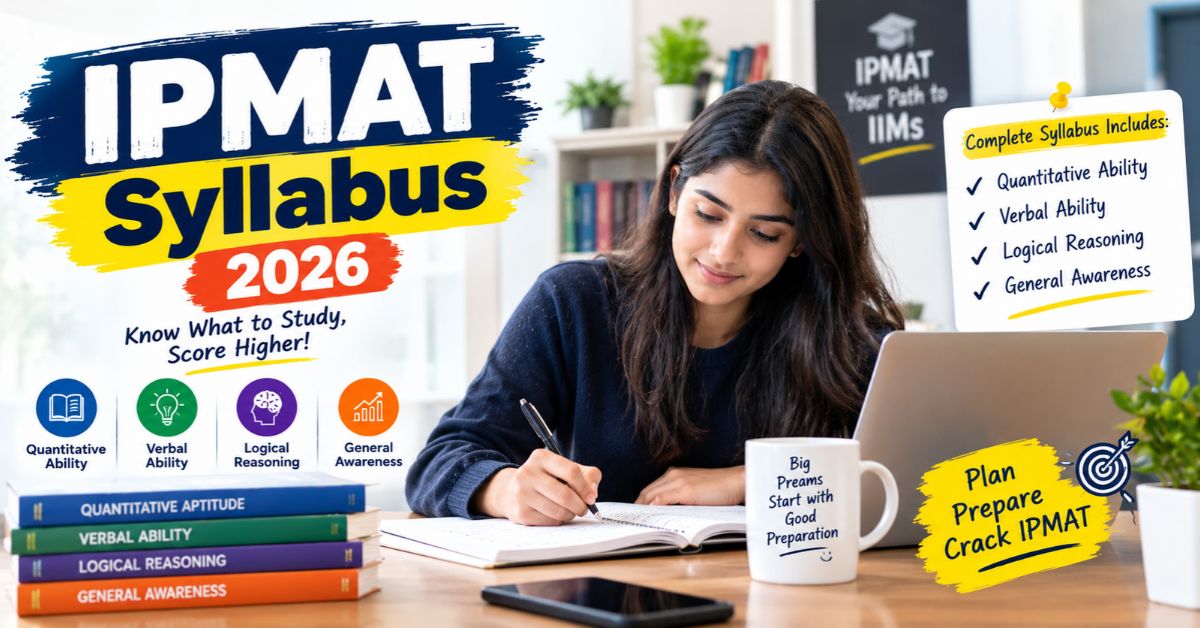
The IPMAT syllabus covers Quantitative Ability and Verbal Ability for IIM Indore, and Quantitative Ability, Logical Reasoning and Verbal Ability for IIM Rohtak. It rests on school-level maths and English, so PCM, PCB, commerce and arts students can all prepare. IIM Indore does not release a chapter-wise list, so the topics below are commonly tested ones.
Quick Summary
- Two separate exams: IPMAT Indore (Quant and Verbal) and IPMAT Rohtak (Quant, Logical Reasoning and Verbal).
- No stream-wise syllabus: PCM and PCB students study the same IPMAT syllabus as commerce and arts students.
- Level: school maths and English, tested with speed and accuracy.
- 2026 pattern (reported): Indore had 90 questions and Rohtak had 120, both in 120 minutes.
- Next cycle: the IPMAT 2027 notification had not been announced at the time of writing.
Students ask the same question again and again: what exactly do I need to study? This guide answers it section by section, shows where the PCM and PCB paths differ, and gives a clear order to start in.
What Is IPMAT?
IPMAT, the Integrated Programme in Management Aptitude Test, is the entrance exam for the five-year Integrated Programme in Management (IPM) offered by IIM Indore and IIM Rohtak. Each IIM runs its own IPMAT with its own pattern. JIPMAT is a different exam.
You apply after Class 12, or while appearing in it, and the programme leads to a management degree without a separate MBA entrance later. Selection also includes an interview stage, and IIM Indore has been reported to add a written ability test.
So your syllabus depends on which IIM you target. Most serious aspirants prepare for both, because the core skills overlap.
IPMAT Syllabus 2026 at a Glance
The IPMAT 2026 syllabus is built on Quantitative Ability and Verbal Ability, with Logical Reasoning added for IIM Rohtak. The level is school maths and English, but questions are timed and often need careful reasoning. The table summarises each paper.
IPMAT syllabus 2026 overview
| Exam | Sections | Question types | Subjects tested | Base level |
|---|---|---|---|---|
| IPMAT Indore | Quant (Short Answer), Quant (MCQ), Verbal Ability | Short answer with typed numbers, plus MCQs | Maths and English | School-level maths and English |
| IPMAT Rohtak | Quantitative Ability, Logical Reasoning, Verbal Ability | All MCQs | Maths, reasoning and English | School-level maths, reasoning and English |
The exam dates for the 2026 cycle were 4 May 2026 for IIM Indore and 10 May 2026 for IIM Rohtak.
Is there an official IPMAT syllabus?
IIM Indore describes the paper by sections and question types, but it does not publish a detailed chapter list as far as I could verify. Topic lists on the web, including the ones here, are compiled from past papers. Treat them as a strong guide, not as a legal syllabus.
IPMAT Syllabus for IIM Indore
The IPMAT Indore syllabus has three sections: Quantitative Ability (Short Answer), Quantitative Ability (MCQ) and Verbal Ability. Quant carries 45 questions and Verbal carries 45 in the 2026 pattern. The topics below are commonly tested, based on past papers.
Quantitative Ability (Short Answer and MCQ)
- Arithmetic: percentages, profit and loss, ratio and proportion, averages, time and work, time, speed and distance, mixtures, simple and compound interest.
- Number system: divisibility, remainders, factors, HCF and LCM, indices and surds.
- Algebra: linear and quadratic equations, inequalities, progressions, functions, logarithms.
- Geometry and mensuration: triangles, circles, polygons, areas, volumes, coordinate geometry.
- Modern maths: permutations and combinations, probability, sets.
- Data interpretation: tables and charts.
In the Short Answer section you type a number, so there are no options to guess from. Precision matters here.
Verbal Ability
- Reading Comprehension: passages followed by inference and main-idea questions. This area usually has the largest weight.
- Vocabulary: synonyms, antonyms, analogies, odd one out, idioms.
- Grammar: error spotting, sentence correction, fill in the blanks.
- Sentence arrangement: para-jumbles and summaries.
IIM Indore has no separate logical reasoning section, though reasoning skill still helps in quant and in reading.
IPMAT Syllabus for IIM Rohtak
The IPMAT Rohtak syllabus has three equal sections: Quantitative Ability, Logical Reasoning and Verbal Ability. In the 2026 pattern each section had 40 MCQs. The quant and verbal topics overlap with Indore, and reasoning is the key addition.
Logical Reasoning (Rohtak)
- Seating arrangements and puzzles
- Blood relations and direction sense
- Syllogisms and critical reasoning
- Coding and decoding, number and letter series
- Input and output, and data sufficiency
- Data interpretation, where it appears
Quantitative Ability and Verbal Ability (Rohtak)
The quant topics are the same arithmetic, algebra, geometry and modern maths areas listed above. Verbal covers reading comprehension, vocabulary, grammar and para-jumbles. All questions are MCQs, so accuracy and the minus-one penalty shape your strategy.
IPMAT Exam Pattern: Indore vs Rohtak
The pattern decides how you spend your time, so read it alongside the syllabus. The figures below are as reported for the 2026 cycle. Confirm them in the official brochure before you plan.
IPMAT 2026 pattern (as reported)
| Exam | Section | Questions | Marks | Marking | Time |
|---|---|---|---|---|---|
| Indore | Quant (Short Answer) | 15 | 60 | +4, no negative marking | 40 min |
| Indore | Quant (MCQ) | 30 | 120 | +4, −1 | 40 min |
| Indore | Verbal Ability | 45 | 180 | +4, −1 | 40 min |
| Indore total | 90 | 360 | 120 min | ||
| Rohtak | Quantitative Ability | 40 | 160 | +4, −1 | Combined |
| Rohtak | Logical Reasoning | 40 | 160 | +4, −1 | Combined |
| Rohtak | Verbal Ability | 40 | 160 | +4, −1 | Combined |
| Rohtak total | 120 | 480 | 120 min |
- Indore sectional limit: each section has its own 40-minute timer.
- Rohtak sectional limit: reports for 2026 mostly say there was no sectional limit, but a few pages mention 40 minutes per section. This point is disputed, so check the Rohtak brochure.
- Question count: a few pages show about 100 questions for Indore. Most reports and the 2026 paper analyses show 90, which is the figure used here.
IPMAT Syllabus for PCM Students
There is no separate IPMAT syllabus for PCM students. The exam is common to all streams. What PCM students have is a head start in maths, and a gap in language and reading speed.
Where PCM students are strong
- Comfort with algebra, geometry and number work
- Practice with problem solving under time pressure
- Familiarity with reasoning-style questions
Where PCM students often slip
- Reading Comprehension and vocabulary, which carry the most marks in Indore
- Grammar and sentence correction
- Over-reliance on school methods when shortcuts would save time
A PCM student should protect the quant lead and spend the extra hours on verbal. Short Answer questions also reward exactness, which suits maths-minded students.
IPMAT Syllabus for PCB Students
There is no separate IPMAT syllabus for PCB students either. The paper is the same for everyone. The common gap for PCB students is maths practice, since many drop maths after Class 10, while verbal skills are often a strength.
Where PCB students are strong
- Reading speed and comprehension
- Careful, patient reasoning
- Comfort with data from charts and tables
Where PCB students need work
- Algebra, geometry, and permutations and combinations
- Calculation speed and number sense
- The Short Answer section, where there are no options to fall back on
Start with Class 9 and 10 maths, then move to the IPMAT-level topics. Build a weekly quant habit first. Eligibility rules, including any stream condition, are in the official brochure, so check them each year.
IPMAT Syllabus After 12th: Commerce, Arts and Droppers
Students who finish Class 12 can prepare for IPMAT from any stream. Recent brochures have set minimum marks in Class 10 and Class 12 and an age limit, with relaxation for reserved categories. Read the current brochure for exact numbers.
Here is a simple starting point by background.
- Commerce students: use your familiarity with percentages, ratio and data. Strengthen algebra and geometry.
- Arts students: build a quant base from Class 9 and 10 maths. Use your reading habit to win verbal marks.
- Droppers: you have time, so run a full syllabus pass, then a mock cycle. Do not skip reasoning if you target Rohtak.
If you also consider other routes after Class 12, you can compare them. The SET colleges list covers Symbiosis options, and the IIMB UG exam centres guide covers another IIM entry route.
For the cost side of planning, see this explainer on IPMAT fees 2026.
IPMAT Indore vs IPMAT Rohtak vs JIPMAT
Three exams are often grouped under the IPMAT name. They share a core but differ in structure. Choose based on the institutes you want.
IPMAT Indore, IPMAT Rohtak and JIPMAT compared
| Factor | IPMAT Indore | IPMAT Rohtak | JIPMAT |
|---|---|---|---|
| Conducting institute | IIM Indore | IIM Rohtak | National Testing Agency, for IIM Jammu and IIM Bodh Gaya (in recent cycles) |
| Sections | Quant (SA), Quant (MCQ), Verbal | Quant, Logical Reasoning, Verbal | Quant, Data Interpretation and Logical Reasoning, Verbal |
| Logical reasoning section | No | Yes | Yes |
| Question types | Short answer and MCQ | MCQ only | MCQ |
| Selection stages (reported) | Exam, written ability test, interview | Exam, interview | Check each institute’s notice |
| Best for | Strong quant and verbal students | Students who like reasoning | Students targeting IIM Jammu or Bodh Gaya |
The JIPMAT details above are as reported, and they can change by year. Confirm them on the official source for that year.
Stream-Wise IPMAT Preparation Plan (Suggestion)
This is a suggested weekly split, not an official rule. Adjust it to your strengths after your first diagnostic mock.
Suggested weekly plan by stream
| Student background | Quant | Verbal | Reasoning | Focus first |
|---|---|---|---|---|
| PCM | 35% | 45% | 20% | Reading Comprehension and grammar |
| PCB | 55% | 30% | 15% | Maths foundations, then speed |
| Commerce | 45% | 35% | 20% | Algebra and geometry |
| Arts | 55% | 30% | 15% | Maths basics from Class 9 and 10 |
If you target only IIM Indore, move the reasoning share to quant and verbal. If you target Rohtak, keep reasoning in the plan every week.
IPMAT Syllabus: Where to Start (Topic Priority Guide)
Use this order. It puts high-value, easy-to-fix areas first.
- Read the official brochure. Note the pattern, marking and eligibility rules.
- Take a diagnostic mock. Find your starting point before you plan.
- Fix arithmetic. Percentages, ratio, averages, time and work, and speed and distance.
- Build reading habit. Read one or two passages daily and summarise them.
- Cover algebra and number system. These feed both MCQ and Short Answer.
- Learn geometry and mensuration. Keep formulas in a revision sheet.
- Add permutations, probability and sets. Spend time here after the basics.
- Practise grammar and vocabulary. Do short daily sets.
- Add logical reasoning if you target Rohtak. Start with puzzles and arrangements.
- Move to timed full papers in the last phase.
How to Prepare the IPMAT Syllabus with Mocks and Previous Papers
Syllabus knowledge becomes marks only through timed practice. Learn a topic, test it the same week, then review mistakes in a log.
CATMOCK is an MBA-exam platform and does not offer IPMAT papers or IPMAT mocks as far as I could verify. Its practice material still builds the same core skills in quant, verbal and timed solving.
- Use daily practice sets to keep a steady habit.
- Keep a formula book for quick quant revision.
- Start with free sets on the mock tests page to practise timed solving.
- Browse the previous year question papers (PYQ) hub to see how real papers frame reading and quant questions.
Common IPMAT Syllabus Mistakes to Avoid
- Treating a third-party topic list as an official syllabus
- Studying only quant and ignoring verbal
- Skipping Short Answer practice, then losing marks to typing errors
- Ignoring the difference between Indore and Rohtak
- Starting full mocks before covering the basics
- Believing PCM or PCB students have a separate paper
- Studying without an error log
- Missing the brochure when it is released
Expert tip: In Indore, the Short Answer section rewards exactness, because you type a number and there are no options to check against. Practise solving a question, then asking one extra question: does this answer make sense? A quick sanity check often catches a slip that a multiple-choice option would have exposed.
After Your Syllabus: Related Management Exams
IPMAT is a five-year route taken after Class 12. Some students later also look at MBA entrance exams after graduation. These are separate and not part of the IPMAT syllabus. If that interests you, read about the SNAP exam and try SNAP mock tests. You can also study CAT PYQs and XAT PYQs. Focus on IPMAT first.
IPMAT Syllabus FAQs
What is the IPMAT syllabus?
IPMAT covers Quantitative Ability and Verbal Ability for IIM Indore, and Quantitative Ability, Logical Reasoning and Verbal Ability for IIM Rohtak. It is based on school-level maths and English. Check the official brochure for the final structure.
Is the IPMAT syllabus different for PCM students?
No. There is one IPMAT paper for all streams. PCM students usually have an edge in maths, so they should spend extra time on reading comprehension, grammar and vocabulary.
Is the IPMAT syllabus different for PCB students?
No. PCB students take the same paper. Their usual gap is maths, so they should rebuild arithmetic, algebra and geometry first, then add speed and Short Answer practice.
What is the IPMAT syllabus after 12th?
After Class 12, you prepare the same IPMAT syllabus whatever your stream. It covers school-level quant and verbal, plus reasoning for Rohtak. Check eligibility marks and age limits in the current brochure.
Is there an IPMAT syllabus for 2026?
Yes. The 2026 cycle used Quant and Verbal for Indore and Quant, Logical Reasoning and Verbal for Rohtak. Both exams are over, and IPMAT 2027 may update the details, so check the new brochure.
Does IPMAT have a logical reasoning section?
IIM Rohtak does, with 40 questions in the 2026 pattern. IIM Indore does not have a separate reasoning section. Reasoning skills still help both exams indirectly.
How many questions are in IPMAT?
In the 2026 cycle, IPMAT Indore had 90 questions and IPMAT Rohtak had 120, as reported. Both ran for 120 minutes. Confirm the numbers in the official brochure.
Is there negative marking in IPMAT?
Yes for MCQs: minus one mark for a wrong answer. IPMAT Indore’s Short Answer section has no negative marking. Each correct answer earns four marks.
Is IPMAT maths based on Class 12 syllabus?
Mostly school-level maths from Class 9 to 12 is used. Questions are framed to test speed and reasoning, not advanced theory. Focus on fundamentals and problem solving.
Which is tougher, IPMAT Indore or Rohtak?
The two test different skills. Indore’s Short Answer section and sectional timers add pressure, while Rohtak adds reasoning. Your strengths decide which one feels easier.
Can commerce or arts students attempt IPMAT?
Yes, IPMAT is open to students from any stream who meet the brochure’s eligibility rules. Commerce and arts students should build a maths base and keep their language edge.
Conclusion
The IPMAT syllabus is simpler than it looks. Quantitative Ability and Verbal Ability form the core, with Logical Reasoning added for Rohtak. There is no separate syllabus for PCM or PCB students, only different starting points.
Begin with the official brochure, fix your weaker area first, and practise under a timer. Take one diagnostic mock this week, review it, and build your plan from the result.
Disclaimer: This article is for guidance only. Patterns, dates and eligibility can change each year. Always confirm details on the official sites of IIM Indore and IIM Rohtak, and read the latest brochure. The Class 11 and 12 maths base follows the NCERT curriculum. No study plan can guarantee a score or an IIM seat.