
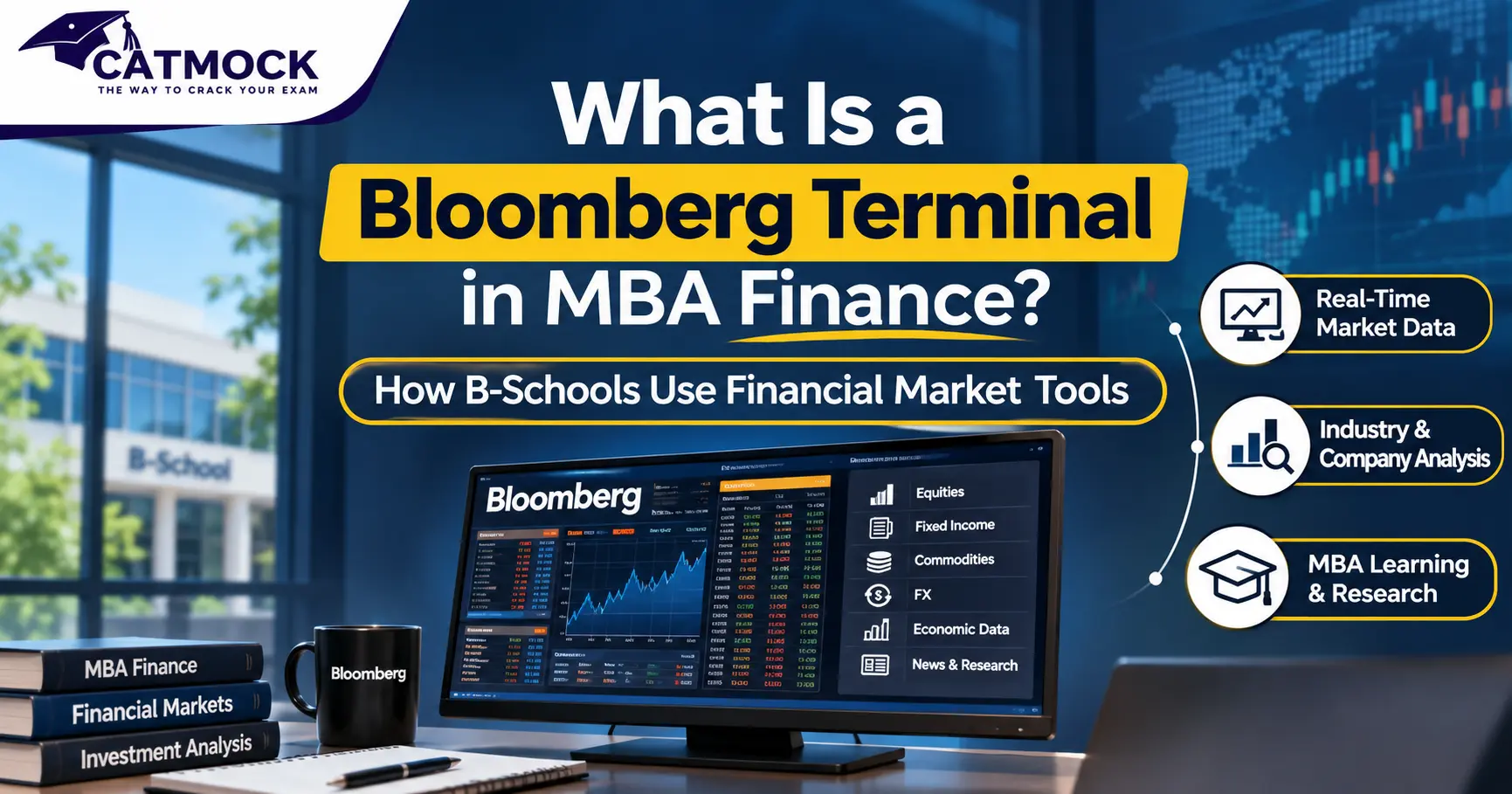
If you are aiming for an MBA in finance, sooner or later you will hear a senior say, “Go and practise on the Bloomberg.” That sentence can feel intimidating when you have never seen the machine. So, what is a Bloomberg Terminal in MBA finance, and why do business schools spend so much money to install it on campus?
In simple words, the Bloomberg Terminal is a professional market data and analytics platform that traders, analysts, bankers and portfolio managers use every day. In an MBA classroom, it turns textbook concepts such as valuation, yield curves, currency risk and portfolio theory into live, clickable data. This guide explains the Bloomberg Terminal from scratch, shows how B-schools use financial market tools in teaching, lists the certifications you can earn, and tells you how to prepare even before you join a program.
In this article:
- What a Bloomberg Terminal is
- Why it matters in MBA finance
- Key features and function codes
- How B-schools use it in labs, courses and investment funds
- Bloomberg certifications
- Indian B-schools and finance labs
- Bloomberg vs free market tools
- Career benefits, learning tips, FAQs and conclusion
What Is a Bloomberg Terminal?
The Bloomberg Terminal is a subscription-based software platform developed by Bloomberg L.P. It gives users real-time and historical market data, breaking financial news, company analytics, research and a secure messaging network in one place. Professionals call it “the Terminal” or simply “Bloomberg.”
The product was introduced in 1982 as dedicated hardware. Today it runs as software on a regular computer, and it integrates with Excel, which is a big reason analysts love it. The classic setup still includes a special colour-coded keyboard and two or more monitors, and you will see the same look in most B-school finance labs.
What data does it cover?
The platform covers almost every major asset class: equities, bonds, currencies, commodities, derivatives, money markets and economic indicators. You can pull up a company’s financial statements, compare its valuation with peers, read the latest news, view a bond’s yield, or check a central bank’s rate decision within seconds.
How much does it cost?
A full professional subscription is expensive. Campus news reports over the years have put the cost at more than $20,000 per terminal per year, and the price varies by contract and institution. This high cost is exactly why a Bloomberg Terminal is a premium facility and why students value the access that their business school provides. Always check current pricing and access rules with your institute, because they change.
Why Does the Bloomberg Terminal Matter in MBA Finance?
An MBA in finance is not only about formulas. Recruiters in investment banking, equity research, treasury, asset management and consulting want graduates who can handle real data under time pressure. The Bloomberg Terminal helps in three clear ways.
1. It brings real-time market data into the classroom
Textbook examples are often years old. On the Terminal, a professor can ask the class to study today’s bond yields, this morning’s currency moves or the latest quarterly results of a listed company. Students then see how theory behaves in live conditions.
2. It bridges theory and practice
Concepts like discounted cash flow, beta, duration, Sharpe ratio and the capital asset pricing model feel abstract on paper. With market data tools, students can calculate them for real companies and compare the output with the theory. Faculty members at several business schools have said that quick data access lets students spend their time on valuation and analysis instead of data collection.
3. It acts as a signal to recruiters
Finance employers expect graduates to be comfortable with professional platforms. A resume line that shows Terminal practice and a Bloomberg certification tells the recruiter that you will need less onboarding. It does not replace skills or grades, but it supports your profile.
Key Features of the Bloomberg Terminal Every MBA Student Should Know
The Terminal works through function codes. You type a code, press the green Go key, and the screen opens the related tool. Here are some beginner-friendly examples.
| Function / Code | What It Does | Where MBA Students Use It |
|---|---|---|
| WEI | Shows world equity indices and their live movement | Market overview, economics and macro classes |
| FXC | Displays currency rates and cross rates | International finance and forex risk |
| ECO | Economic calendar with upcoming data releases | Macroeconomics, policy and market reaction studies |
| DES | Gives a security or company description | First step in any company research |
| FA | Financial analysis with statements and ratios | Corporate finance, valuation, equity research |
| GP | Price graph with technical studies | Technical analysis and event studies |
| EQS | Equity screening based on your criteria | Stock selection and portfolio projects |
| TOP | Top global financial headlines | Daily market tracking and case discussion |
Apart from codes, three broader capabilities make the platform special.
- News and research: a continuous stream of market-moving news, company updates and analyst content.
- Analytics and Excel integration: download live data into spreadsheets and build models that update automatically.
- Instant messaging: a chat network that connects market participants, which is why professionals say that you will likely sit in front of a Terminal at some point in a finance career.
How B-Schools Use the Bloomberg Terminal and Financial Market Tools
Business schools worldwide use finance labs, trading rooms and market data platforms to give students experience close to a real trading desk. The usage generally falls into five areas.
Finance labs and trading rooms
A finance lab is a dedicated room with multiple Terminal workstations. Some schools describe it as a trading-floor environment where students access live company data for coursework, run financial models, analyse market trends and build investment strategies. In many institutes, students from other programs can also join scheduled drop-in sessions to explore the platform.
Course integration
Smart B-schools do not leave the lab as a showpiece. They embed the Terminal into specific courses. The table below shows common examples.
| MBA Course | Typical Terminal Activity | Skill Students Build |
|---|---|---|
| Corporate Finance | Pull financial statements and ratios of listed companies | Ratio analysis, capital structure study |
| Security Analysis & Portfolio Management | Screen stocks, compare returns and risk | Portfolio construction, risk measurement |
| Fixed Income & Derivatives | Study yield curves, bond pricing and option data | Duration, convexity, pricing logic |
| International Finance | Track currency pairs and central bank news | Forex exposure and hedging decisions |
| Business Analytics | Download data into Excel for modelling | Data cleaning, forecasting |
| Strategic Management | Benchmark competitors using company and industry data | Industry analysis and strategy formulation |
Student-managed investment funds
Several schools run a student-managed fund where learners research stocks, debate the risk-reward and decide the investment. The Terminal supplies the data for these decisions. Some Indian institutes have reported giving students a notional amount to invest in financial markets under a managed investment course, which makes learning highly practical.
Research, dissertations and faculty work
The platform is not only for students. Professors use it to support research, and students use it for projects, capstone work and dissertations. The historical data depth helps with event studies, back-testing and market behaviour analysis.
Certifications and workshops
Many schools run introductory sessions and encourage students to complete Bloomberg’s e-learning programs. This brings us to the certification part.
Bloomberg Market Concepts and Other Certifications
Bloomberg offers self-paced learning programs that students often complete alongside their MBA. The best known is Bloomberg Market Concepts (BMC). Business schools and student communities frequently mention BMC, Bloomberg Finance Fundamentals and ESG-related learning as employability boosters.
| Program | Focus Area | Who Benefits Most |
|---|---|---|
| Bloomberg Market Concepts (BMC) | Economic indicators, currencies, fixed income and equities | Every finance MBA student, especially beginners |
| Bloomberg Finance Fundamentals | Core finance basics and market understanding | Non-finance backgrounds entering finance electives |
| Bloomberg ESG learning | Environmental, social and governance data and concepts | Students targeting sustainable finance and research roles |
| Terminal workshops by the institute | Hands-on navigation, function codes, Excel add-in | Students preparing for internships and summer projects |
BMC is usually described as an eight-hour, self-paced course covering four core areas: economic indicators, currencies, fixed income and equities. Some students have reported completing it at no cost through their school, but access rules differ, so confirm the current terms with your institute or Bloomberg’s official education page.
Bloomberg Terminals in Indian B-Schools
For Indian MBA aspirants, the question is natural: “Do Indian B-schools have this facility?” The answer is yes, though not every institute has it. Over the years, a number of Indian business schools have announced Bloomberg-equipped finance labs. Press coverage has mentioned labs in Mumbai, Hyderabad, Manipal, Bengaluru, Delhi and Rohtak, with terminal counts ranging from around a dozen to over twenty in some larger setups.
An Indian business school leader once pointed out that India has thousands of management institutes but only a small number offered Bloomberg-based finance labs at that time. That scarcity is why a school with a well-run lab often highlights it in admissions material. Terminal counts and lab availability change as contracts are renewed, so treat any number as a snapshot and check the official website of the institute before you decide.
Indian schools use the facility in familiar ways:
- Banking and financial services programs use it for treasury, credit and markets modules.
- Equity research and investment banking clubs train students on the platform before internships.
- Faculty use it for market-linked case discussions and research publications.
- Students use it to research companies before placement interviews and to find alumni who also use the platform.
Bloomberg Terminal vs Free Financial Market Tools
Not every learner has Terminal access, and that is okay. Free tools can teach a lot. But it is important to understand what you gain and what you lose.
| Factor | Bloomberg Terminal | Free Market Tools (finance portals, exchange websites) |
|---|---|---|
| Data depth | Very deep, across asset classes and countries | Basic to moderate, mostly equities and news |
| Real-time data | Professional-grade, fast | Often delayed or limited |
| Analytics | Advanced analytics, screening and Excel integration | Limited charting and simple ratios |
| Messaging network | Built-in professional chat | Not available |
| Cost | High subscription cost | Free or low cost |
| Best use | Serious finance labs, research, trading simulation | Learning basics, daily market reading, early practice |
A smart approach is to start with free tools to understand the vocabulary, and then move to Terminal practice when your institute provides it. For example, official exchange websites such as the National Stock Exchange of India and the Reserve Bank of India publish rich public data that you can practise with today.
Career Benefits of Learning the Bloomberg Terminal
Let us connect the platform to jobs, because that is what most MBA aspirants care about.
- Investment banking and equity research: analysts use the Terminal for company data, comparables and news flow.
- Treasury and corporate finance: teams track currencies, interest rates and commodity prices.
- Asset and wealth management: portfolio managers monitor risk, performance and market events.
- Consulting and strategy: consultants benchmark industries and competitors.
- Fintech and analytics: professionals combine market data with modelling and automation.
Even if you do not use the Terminal daily in your first job, the habit of thinking with data is valuable. Interviewers often ask candidates how they track markets. A student who can say, “I follow the economic calendar, compare yield movements and read company filings,” sounds far more prepared than one who only says, “I read the newspaper.”
How to Prepare Even Before You Get Terminal Access
You do not have to wait for the first day of your MBA. Here is a simple plan.
- Learn the basics of markets. Understand equities, bonds, currencies and commodities. Read market news daily.
- Practise Excel. Terminal data often flows into spreadsheets, so formulas, pivot tables and charts matter.
- Study financial statements. Know how to read a balance sheet, income statement and cash flow statement.
- Follow macro indicators. Inflation, GDP, interest rates and exchange rates drive markets.
- Use public data sources. Practise on exchange and central bank websites.
- Join the finance club. Once on campus, attend Terminal workshops early.
- Complete a certification. Take BMC or another recognised program when available.
If you are at the exam stage, remember that your first step is cracking the entrance test. Practising with realistic papers on CATMock mock tests can help you build accuracy and speed so that you reach the B-school where such facilities are waiting for you. You can also explore more preparation resources on the CATMock blog.
Common Mistakes Students Make
- Treating the Terminal as a magic tool. It gives data, not decisions. Your analysis still matters.
- Skipping fundamentals. Without finance basics, the screens look confusing.
- Using it only before placements. Regular use over months builds real comfort.
- Ignoring data quality. Always check the source, date and definition before using a number in a project.
- Forgetting access rules. Institutes set time limits and licence terms, so follow them.
Summary: Key Takeaways
- The Bloomberg Terminal is a professional platform for real-time market data, news, analytics and messaging.
- In MBA finance, it connects theory with live market behaviour.
- B-schools use it in finance labs, course projects, student-managed funds, research and certifications.
- Bloomberg Market Concepts is a popular entry point for students.
- Several Indian B-schools have Bloomberg-equipped finance labs, but availability varies, so verify before you apply.
- Free tools are a good start, while Terminal practice adds depth and professional familiarity.
- The Terminal supports your profile, but strong fundamentals, Excel skills and clear thinking remain essential.
Frequently Asked Questions (FAQs)
1. What is a Bloomberg Terminal in MBA finance?
It is a professional financial data and analytics platform that business schools provide so students can practise with real-time market data, news and analytics. It helps convert finance theory into hands-on skills.
2. How do B-schools use the Bloomberg Terminal?
They use it in finance labs, trading rooms, course assignments, student-managed funds, research projects and certification workshops. Faculty also use it for academic research.
3. Is the Bloomberg Terminal necessary for an MBA in finance?
It is not mandatory, but it is highly useful. Many recruiters value familiarity with professional market data tools, so it can strengthen your profile, especially for markets-related roles.
4. Can MBA students get Bloomberg certification?
Yes. Students commonly take Bloomberg Market Concepts and related programs, often through their institute. Access conditions vary, so check the latest rules with your school or Bloomberg’s education resources.
5. How much does a Bloomberg Terminal cost?
Reported figures from campus news are above $20,000 per terminal per year, but pricing depends on contracts. Students usually do not pay directly because the institute holds the licence.
6. Do Indian B-schools have Bloomberg Terminals?
Some do. Several Indian institutes have announced Bloomberg finance labs, but facilities differ in size and access. Confirm current details on the college website or by contacting the admissions office.
7. Are there free alternatives to the Bloomberg Terminal for students?
Free finance portals, exchange websites and central bank data pages can help beginners learn markets. They lack the depth, speed and integrated tools of a professional terminal, but they are a good starting point.
Conclusion
So, what is a Bloomberg Terminal in MBA finance? It is the classroom bridge between theory and the real market, a tool that helps you read data, test ideas and speak the language of finance professionals. B-schools use it in labs, courses, investment funds, research and certifications to prepare students for roles in banking, markets, corporate finance and beyond.
If you are planning an MBA, treat this as one more factor while shortlisting colleges, along with curriculum, faculty, placements and fees. Start building your fundamentals now with free market tools, Excel practice and daily news reading, and prepare strongly for your entrance exam through regular mocks. The earlier you build the habit of data-driven thinking, the more you will gain when you finally sit in front of that two-screen Terminal.
You May Also Like : CATMOCK, CATMOCK PYQ
Follow Us On : Facebook, Instagram, Youtube