
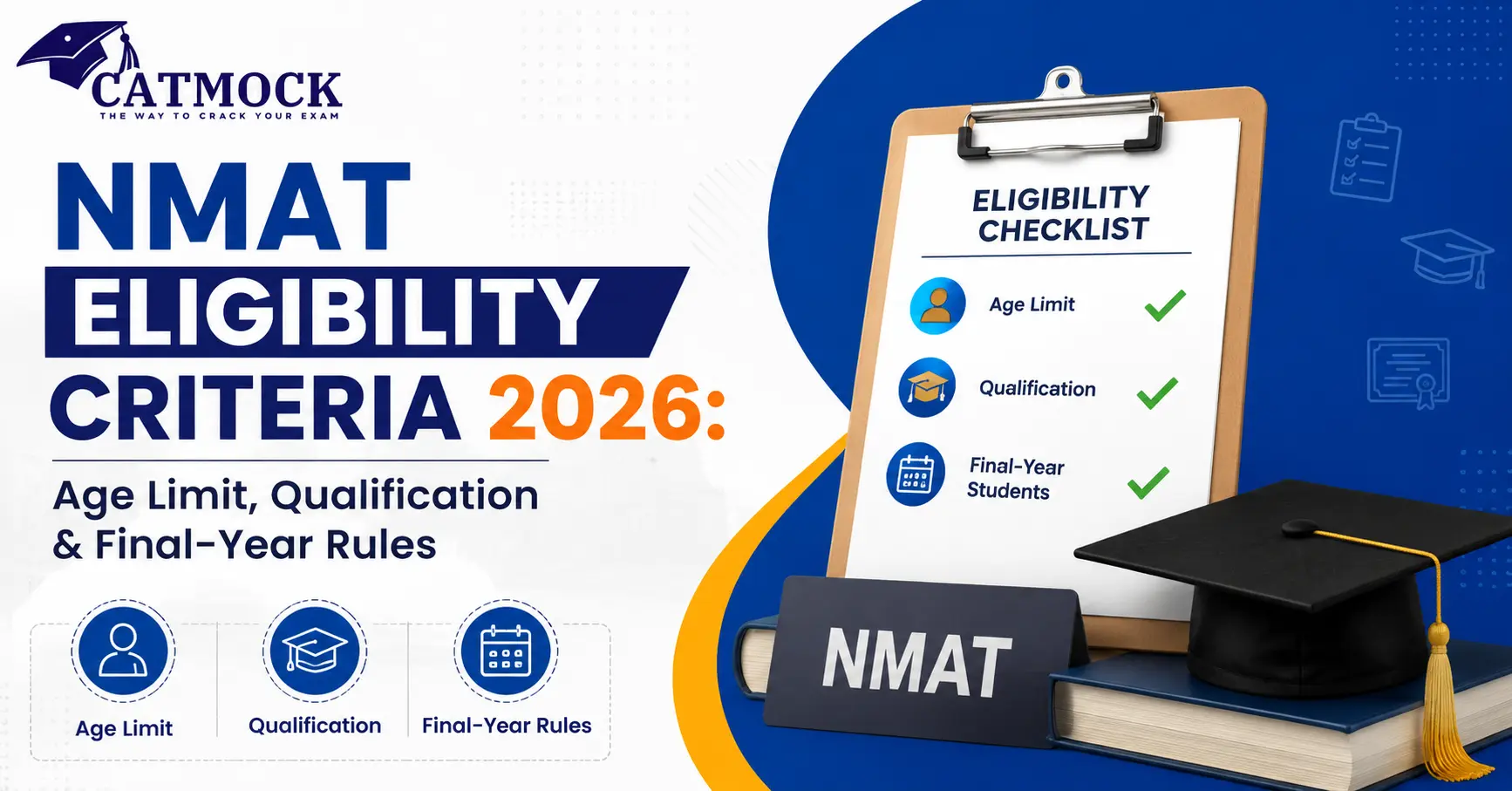
Who is eligible for NMAT 2026? Any candidate can register and sit for the exam by completing NMAT registration and paying the fee — GMAC itself does not impose a qualification, marks, or age-based gate to take the test. What actually determines whether your NMAT score is useful to you is the admission eligibility set by the specific B-schools you’re targeting, and that’s where degree, percentage, and other requirements come in. This guide walks through both layers clearly, so you know exactly what to check before you register.
NMAT Eligibility Criteria 2026 — Quick Overview
Confirmed directly from the official NMAT by GMAC exam page:
| Eligibility Factor | Requirement |
|---|---|
| To sit for the exam | Complete NMAT registration and pay the fee — GMAC does not itself set a qualification or marks bar to register |
| Educational qualification (institute-level) | Most NMAT-accepting institutes require a bachelor’s degree in any discipline from a recognised university |
| Minimum marks (institute-level) | Commonly around 50% aggregate at many institutes (some cite 45% for SC/ST) — this varies by institute, not by GMAC |
| Age limit | No age limit imposed by GMAC |
| Final-year students | Can register and appear; admission offers are provisional pending final results |
| Work experience | Not required to register; some institutes weigh it during admission shortlisting |
| Attempts | Up to 3 per testing cycle (1 first attempt + 2 retakes); best score is considered |
NMAT Exam Eligibility vs. B-School Admission Eligibility
This is the single most important distinction in this guide, and it’s one many aspirants miss.
NMAT exam eligibility — i.e., what lets you register and sit for the test — is set by GMAC. According to the official NMAT by GMAC, any test taker who completes registration and pays the fee within the specified time may sit for the exam. GMAC does not itself publish a qualification, percentage, or age requirement as a condition of registering.
B-school admission eligibility is a separate layer, set independently by each NMAT-accepting institute. This is where you’ll actually encounter requirements like a bachelor’s degree, a minimum aggregate percentage, category-based relaxations, work-experience preferences, or programme-specific rules (for example, a Pharmaceutical Management or Law specialisation requiring a related undergraduate degree).
In practice, this means: you can register for and take NMAT with almost no restriction, but whether your score is usable depends entirely on meeting the admission criteria of the specific institutes and programmes you apply to. Always check the eligibility page of each target B-school directly — don’t assume the exam-level flexibility extends to admission.
Educational Qualification for NMAT 2026
Because GMAC doesn’t set a qualification bar for registration itself, “educational qualification” is really a question about what B-schools expect. Across NMAT-accepting institutes, the pattern is consistent enough to describe as a norm, even though it isn’t a GMAC rule:
- A bachelor’s degree (typically 10+2+3 or 10+2+4 pattern) from a recognised university, in any discipline — most institutes don’t restrict by stream.
- A minimum aggregate percentage, most commonly cited around 50%, with some institutes (NMIMS among them) applying a relaxed 45% for SC/ST candidates as part of their own admission policy.
- Candidates with professional degrees (CA, CS, ICWA) or those awaiting final results are generally still able to apply.
Because these figures come from individual institutes rather than a single GMAC-wide rule, treat them as a strong general expectation to plan around — and verify the exact percentage on your specific target institute’s admission page before you finalise your B-school preferences during registration.
Is There an NMAT Age Limit in 2026?
No — GMAC does not impose an age limit for NMAT. There is no minimum or maximum age specified to register or sit for the exam, which is why NMAT is equally accessible to fresh graduates and working professionals returning to academics later in their careers. As with the qualification requirements above, an individual B-school could in theory set its own age-related preference as part of admission (this is uncommon for NMAT-accepting institutes), so it’s still worth a quick check on your target institute’s page if you’re an older or non-traditional candidate — but this isn’t something GMAC restricts at the exam level.
NMAT Eligibility for Final-Year Students
Can Final-Year Students Apply?
Yes. Candidates still completing their final year of graduation can register for and appear in NMAT 2026, even before their final results are declared. This lets final-year students apply for MBA admission in the same cycle they graduate, rather than losing a year waiting.
What Happens If Results Are Still Pending?
Any admission offer you receive as a final-year candidate is provisional. To convert it into a confirmed seat, you’ll typically need to:
- Complete your final semester/year and receive your results.
- Submit your final marksheet and a provisional or original degree certificate by the deadline your admitting institute sets (usually around enrollment time).
- Meet that institute’s minimum aggregate percentage requirement.
If you don’t meet the required percentage, or can’t submit the documents in time, the provisional offer can be cancelled. Final-year students should track their specific institute’s document deadline closely — this is where otherwise-qualified candidates most often run into avoidable trouble.
Is Work Experience Required for NMAT?
No — work experience isn’t required to register for or sit for NMAT. Fresh graduates with zero professional experience are fully eligible. That said, a number of NMAT-accepting institutes (NMIMS among them, for some programmes) give positive weight to candidates with roughly two to three years of relevant experience during their own admission evaluation — this affects your competitiveness at that institute, not your ability to register for the exam itself.
NMAT Attempts and Testing Cycle Rules
Candidates can appear for NMAT up to three times within a single testing cycle — one first attempt plus two retakes — and the best score across attempts is the one considered for admission. Each attempt is registered and paid for separately, and that fee is non-refundable even if a candidate later turns out to be ineligible for their target programme on some other ground — so it’s worth confirming your target institute’s admission requirements before committing to multiple attempts. Full fee and scheduling details are on the official NMAT dates and fees page.
If you’re also mapping NMAT attempts against other MBA entrance exams this season, our MBA exam dates 2026-27 calendar lays out every major registration and exam window in one place.
NMAT Eligibility for NRI and Foreign National Candidates
Both Indian nationals and NRI/foreign national candidates can apply for NMAT. Documentation requirements differ slightly — NRI and foreign candidates are generally expected to hold an equivalent recognised bachelor’s degree and may need additional identity or nationality documentation during registration. Outside India, the exam is available only as an Online Proctored Exam at Home, per GMAC’s official exam-day terms. Because specific document requirements can vary by testing region and by institute, NRI and foreign national aspirants should review the official NMAT registration portal’s documentation checklist directly before applying.
Institute-Specific Eligibility Variations to Watch For
Since GMAC’s own registration bar is minimal, institute-level variation is where most real eligibility differences live. Common areas to check on your target institute’s page:
| Area of Variation | What to Check |
|---|---|
| Minimum aggregate percentage | Some institutes set a higher cutoff than the commonly-cited 50%/45% figures |
| Subject or stream preference | A few specialised programmes (Pharma, Law) require a related undergraduate degree |
| Work experience weightage | Some institutes weigh prior experience more heavily during shortlisting |
| Additional rounds | Group discussions, personal interviews, or written ability tests may carry their own conditions |
| Category-based relaxation | Reservation policy is set independently by each institute, not by GMAC |
Documents You’ll Likely Need
At registration, you’ll typically need a valid email and phone number, a recent passport-size photograph, valid photo ID, and basic academic details. At the admission stage — particularly for final-year students — institutes will additionally ask for your final marksheet, provisional or original degree certificate, and category certificate where applicable. Keeping digital copies ready in advance avoids last-minute scrambling.
Once your documents are sorted, you can start practicing right away with free NMAT PYQs — no need to wait until registration is complete.
Common NMAT Eligibility Mistakes
- Assuming GMAC applies a stream restriction where none exists, and delaying registration out of unnecessary caution.
- Treating a commonly-cited percentage figure (like 50% or 45%) as a universal NMAT rule instead of checking the specific target institute’s actual requirement.
- Final-year students forgetting to track their institute’s document submission deadline, risking cancellation of a provisional offer.
- Assuming an age limit applies, based on rules from other, unrelated entrance exams.
- Skipping institute-specific eligibility checks entirely and assuming exam registration alone is sufficient for admission.
Does Meeting NMAT Eligibility Guarantee Admission?
No. Being able to register for and take NMAT does not guarantee admission anywhere. Admission depends on your score, the specific institute’s cutoff for that cycle, your profile, and any additional selection rounds such as group discussions or interviews. Treat NMAT eligibility as the entry ticket to the process, not the outcome.
Also read: Top MBA Colleges Accepting NMAT 2026: Full List, Cutoffs, Fees & Placements
Frequently Asked Questions
What is the NMAT Eligibility Criteria 2026?
GMAC itself only requires completing registration and paying the fee to sit for NMAT. Actual admission eligibility — degree, minimum percentage, and other requirements — is set independently by each NMAT-accepting B-school.
What is the minimum percentage required for NMAT?
GMAC does not mandate a specific percentage to register. Most NMAT-accepting institutes commonly expect around 50% aggregate in your qualifying degree (some cite 45% for SC/ST candidates as their own policy), so check your target institute’s exact figure.
Is there an NMAT age limit?
No. GMAC does not impose any age limit for NMAT, making it equally accessible to fresh graduates and working professionals.
Can final-year students apply for NMAT 2026?
Yes. Final-year students can register and appear for NMAT while their results are pending; any admission offer received is provisional until final marksheets and degree certificates are submitted.
Can students from any graduation stream apply for NMAT?
Yes, generally — most NMAT-accepting institutes don’t restrict by undergraduate stream, though a small number of specialised programmes (like Pharmaceutical Management or Law) expect a related degree.
Is work experience required for NMAT?
No, it’s not required to sit for the exam. Some institutes give positive weight to 2-3 years of relevant experience during their own admission shortlisting.
How many attempts are allowed in NMAT?
Up to three within a single testing cycle — one first attempt plus two retakes — with the best score considered for admission.
Are NRI and foreign national candidates eligible for NMAT?
Yes, with slightly different documentation requirements. Outside India, the exam is available only as an Online Proctored Exam at Home.
Does NMAT eligibility differ by college?
Yes — significantly. GMAC’s registration bar is minimal; actual admission eligibility (percentage, stream, work-experience weightage) is set independently by each institute.
Does meeting NMAT eligibility guarantee admission?
No. It only qualifies you to register and take the exam. Admission depends on your score, the institute’s cutoff, your profile, and any additional selection rounds.
Once you’re eligible and ready to register, avoid common booking hiccups — check what to do if your NMAT slot is not available.
Final Takeaway
NMAT’s actual registration bar, set by GMAC, is deliberately minimal — complete registration, pay the fee, and you can sit for the exam regardless of age, and largely regardless of stream or work experience. The real eligibility question that matters is at the B-school level: the specific degree, percentage, and documentation each institute expects from its NMAT-based applicants. Confirm the exam-level basics here, then check your target institutes’ admission pages directly before you finalise your B-school preferences during registration.
Once your eligibility picture is clear, the real differentiator becomes preparation. If you’re ready to start practicing, CatMock’s NMAT Test Series offers full-length and sectional mocks built to the current NMAT pattern, and our NMAT Registration 2026 guide walks through the exact dates, fee, and application steps once you’re ready to apply.
You May Also Like : CATMOCK / CATMOCK PYQ
Follow Us On : Facebook / Instagram