
Most MBA aspirants think admission starts with a CAT score. At S P Jain Institute of Management & Research, it starts with your profile. The SPJIMR admission process 2027–29 begins evaluating you before CAT 2026 results exist, and that single design choice changes how you should plan your autumn.
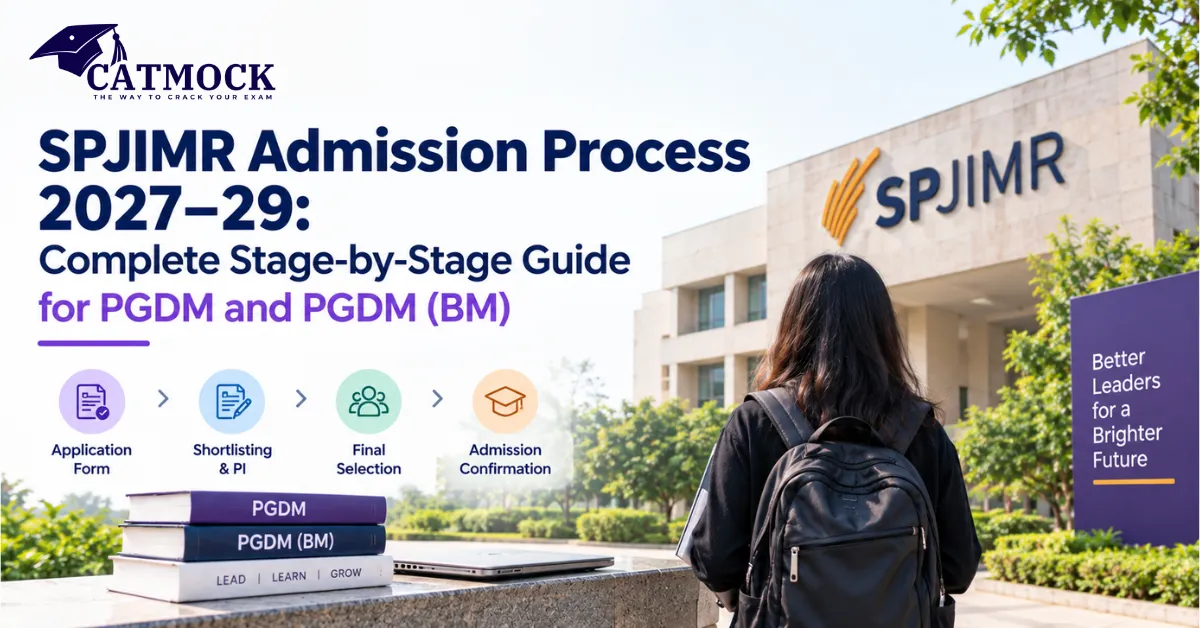
This guide takes you through every stage of the SPJIMR PGDM admission process: how SPJIMR scores applications, how the two shortlisting routes work, what happens during the group interviews, how the institute builds the final selection list, and what you must do after receiving an offer. SPJIMR’s own admissions page and its 2027–29 programme document provide all the factual information below. We label any information based only on patterns from earlier years accordingly.
SPJIMR Admission Process 2027–29 at a Glance
| Detail | What SPJIMR states |
|---|---|
| Programmes | PGDM and PGDM (Business Management), both two-year, full-time, residential |
| Batch | 2027–29, programme starts June 2027 |
| Entrance exams | CAT 2026 or GMAT |
| Seats | PGDM: 240 seats plus 36 additional seats for international candidates. PGDM (BM): 120 seats |
| Selection basis | Profile, qualifying entrance score and interviews |
| Quota | None. Admission is strictly merit-based |
| Application window | 15 September 2026 to 27 November 2026 |
Key Dates in the SPJIMR Selection Timeline
| Milestone | Date | Status |
|---|---|---|
| Application opens | 15 September 2026 | Confirmed by SPJIMR |
| Application closes | 27 November 2026 | Confirmed by SPJIMR |
| CAT 2026 exam | 29 November 2026 | Two days after the SPJIMR deadline |
| Phase 1 (profile-based) interviews | Informed to shortlisted candidates | Date not published in advance |
| Phase 2 (profile-cum-score) interviews | After CAT/GMAT scores are available | Date not published in advance |
| Programme begins | June 2027 | Confirmed by SPJIMR |
In recent cycles, interviews have run across the winter months, roughly January to February. Treat that as a planning pattern, not a promise. SPJIMR says it communicates directly with shortlisted candidates.
Want the step-by-step form walkthrough? Read our SPJIMR Application Form 2027–29 guide.
Stage 1: Application and Profile Scoring
Your journey begins when you submit the online form on SPJIMR’s admissions portal. Because the deadline falls before CAT 2026, SPJIMR’s process is built so that candidates can apply before their scores are out.
Once applications arrive, SPJIMR scores each profile. According to the institute, the overall profile considers:
- Academic background: strong and consistent performance in Class 10, Class 12 and every year of graduation.
- Work experience: relevance to the chosen specialisation, if you have any. Freshers are welcome.
- Entrance scores: meeting the minimum qualifying cut-off is mandatory.
- Versatility and achievements: endeavours in diverse fields and noteworthy past accomplishments.
Notice the word consistent. The institute is not only looking at a final graduation percentage. Admissions teams read a steady academic record across school and every year of college as a positive signal.
Not sure you qualify? Check the SPJIMR Eligibility Criteria 2027–29 before you apply.
Stage 2: Two Shortlisting Routes (Phase 1 vs Phase 2)
After profile scoring, applicants are sorted into two groups. This is the most distinctive part of the SPJIMR selection process.
| Feature | Phase 1: Profile-based | Phase 2: Profile-cum-score based |
|---|---|---|
| When it happens | Before entrance scores are available | After CAT/GMAT scores are available |
| Shortlisting factors | Academic consistency, work experience, versatility and achievements | The same profile factors plus entrance-test performance |
| Entrance score role | You must still meet the minimum cut-off to appear for the interview | Score performance directly influences the interview call |
| Who it suits | Candidates with very strong profiles | Candidates whose profile plus score makes the cut |
Two practical lessons follow:
- A Phase 1 call is not a free pass. The minimum qualifying score is still mandatory to attend the interview. The qualifying benchmark is 85 overall with 75 in each section for CAT or GMAT.
- A Phase 2 call is not a consolation prize. It is a second, equally valid route into the same interviews.
Stage 3: Group Interviews
SPJIMR invites shortlisted candidates for interviews. Its programme document states that the final selection considers candidates’ performance across two rounds of group interviews. SPJIMR shares the detailed requirements with shortlisted applicants after it announces the lists.
What past candidates commonly report (older cycles, not official guidance):
- Small groups face a panel, and only some candidates move from the first round to the second.
- Questions explore values, goals, academics and interests rather than textbook definitions.
- Before the pandemic, an essay test and psychometric test were also part of the process. Do not assume they apply now. Wait for your interview communication.
How to prepare
- Be able to explain every line of your form, including each score drop and each gap.
- Prepare to speak about your work, projects and activities with specifics, not adjectives.
- Practise listening in group settings. A group interview rewards contribution and composure.
- Rehearse why SPJIMR and why your chosen programme, using your own story.
Stage 4: The Composite Score and the Selection List
SPJIMR does not rank candidates on one number. Its selection list is built on a composite score that takes into account:
- Your profile
- Your academic record
- Entrance test scores (CAT or GMAT)
- Work experience, if any
- Your performance in the two group-interview rounds
SPJIMR does not publish an official percentage weightage for these components. Be cautious with any website that quotes exact weightages as official.
Stage 5: Verification, Offer and Joining Rules
Being on the list is not the end. These conditions come from SPJIMR’s 2027–29 programme document:
| Rule | What it means for you |
|---|---|
| Document verification | Shortlisted candidates must furnish proof such as grade-to-percentage conversion certificates and work-experience evidence |
| GMAT scores | Only scores from in-person test-centre exams are accepted, and official scores must be sent through GMAC if you are shortlisted |
| Provisional admission | If you are awaiting final degree results, you must submit the degree by 31 December 2027, or the registration is cancelled |
| No deferment | An admission offer cannot be deferred to later years |
| Single full-time programme | You cannot be enrolled in any other full-time programme while studying the PGDM at SPJIMR |
| Misrepresentation | Any false or suppressed information leads to immediate disqualification, at any stage |
| Right to modify | SPJIMR reserves the right to change its selection criteria if required |
PGDM vs PGDM (BM): Does the Process Differ?
Both programmes follow the same profile-based and profile-cum-score selection logic, and candidates can apply to either or both. The differences sit elsewhere.
| Aspect | PGDM | PGDM (BM) |
|---|---|---|
| Seats | 240 plus 36 for international candidates | 120 |
| Who can apply | Domestic and international applicants | Domestic applicants only |
| Programme character | Two-year residential PGDM | General-management focus with flexibility to choose a mix of courses |
| Selection logic | Profile, score and interviews | Profile, score and interviews |
How to Strengthen Your Profile at Every Stage
- Before the form closes: build an honest, evidence-backed profile. Leadership roles, projects, social work, sports, certifications and publications all count as “versatility and achievements” only if you can document them.
- Before CAT 2026: do not treat the deadline as permission to relax your preparation. Phase 2 shortlisting and the composite score both depend on your entrance performance.
- Between shortlist and interview: audit your academic story. Know the reason behind any dip.
- After the offer: collect your conversion certificates, experience letters and provisional certificates early so verification does not become a deadline scramble.
Mistakes That Quietly Hurt Applicants
- Assuming a strong CAT percentile alone will secure a call, when SPJIMR also reads profile consistency.
- Ignoring the minimum qualifying score because a profile-based call arrived.
- Exaggerating work experience. Unpaid work and curriculum-linked internships are not counted as work experience under SPJIMR’s rules, and proof is required.
- Waiting for the final degree result before planning documents for the 31 December 2027 deadline.
- Trusting unofficial weightage tables as if they were SPJIMR policy.
Beware of Admission Agents
SPJIMR states that it never appoints any intermediary to approach candidates with claims of confirmed admission, for a fee or otherwise, and recommends that you do not get involved in such transactions. For admission-related grievances, the institute points to its Grievance Redressal Committee at grc@spjimr.org.
Sources used to write this article: SPJIMR PGDM (BM) admissions page and the SPJIMR PGDM (BM) 2027–29 programme document.
Summary
- The SPJIMR admission process 2027–29 runs from 15 September to 27 November 2026 for the application, with the programme starting in June 2027.
- Admission is merit-based, with no quota, using CAT 2026 or GMAT plus profile and interviews.
- Applicants are sorted into Phase 1 (profile-based) or Phase 2 (profile-cum-score) shortlists.
- Final selection uses a composite of profile, academics, entrance score, work experience and two group-interview rounds.
- Provisional admits must submit their degree by 31 December 2027. Deferment is not allowed.
- SPJIMR does not publish interview or component weightages. Treat third-party percentages with caution.
Frequently Asked Questions
1. What is the SPJIMR admission process for 2027–29?
It has five stages: application and profile scoring, shortlisting through the profile-based or profile-cum-score route, two rounds of group interviews, a composite-score selection list, and document verification before joining.
2. Does SPJIMR shortlist candidates before CAT results?
Yes. Phase 1 shortlisting is profile-based and happens before entrance scores are available. Phase 2 happens after scores are out. Meeting the minimum cut-off is still mandatory in the profile-based route.
3. Which entrance exams does SPJIMR accept?
CAT 2026 and GMAT. For GMAT, only scores from in-person test-centre exams are accepted.
4. Are the SPJIMR interviews personal interviews or group interviews?
SPJIMR’s 2027–29 programme document refers to two rounds of group interviews. Details are shared with shortlisted candidates.
5. Is there an official weightage for CAT, profile and interview?
No official weightage is published. SPJIMR only lists the components of the composite score.
6. Can freshers get through the SPJIMR admission process?
Yes. Work experience is not mandatory. Relevant work experience is considered where it exists.
7. Can I defer my SPJIMR admission offer?
No. SPJIMR does not allow deferment of an admission offer to subsequent years.
8. Is there a management quota at SPJIMR?
No. SPJIMR states that admission is strictly merit-based and there is no quota of any kind.
9. Can I apply to both PGDM and PGDM (BM)?
Yes, the institute’s document specifies a combined fee when you apply to both programmes together. Choose based on seat structure and programme focus.
Conclusion
The SPJIMR admission process 2027–29 rewards candidates who think beyond a single exam score. Your academic consistency, your achievements, your entrance performance and your composure in group interviews are all weighed together. Start with an honest profile audit, keep your CAT or GMAT preparation on track, prepare your documents early, and rely only on official SPJIMR communication. Do that, and you will walk into each stage knowing exactly what is being evaluated.
You May Also Like : CAT MOCK, CAT MOCK PYQ