

- The Mock Test Problem Nobody Admits
- Scared of the Score
- “I Am Not Ready Yet”
- Fear of Comparison
- Confirming the Worst
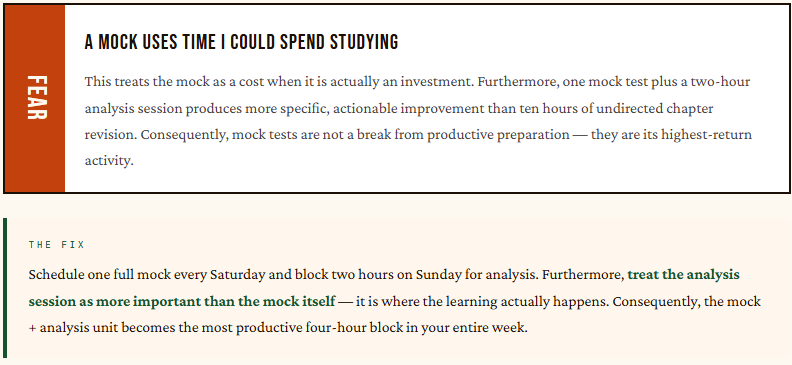
- Treating Mocks as Wasted Time
- What a Mock Test Actually Is
- Before and After the Mock Mindset Shift
- How to Start Taking Mocks Without Fear
- How CATMock Makes Mocks Less Scary
- 15 Frequently Asked Questions
The Mock Test Problem Nobody Admits
The Student Who Prepares But Never Tests
Every year, thousands of CAT aspirants spend six months studying and take fewer than five mock tests before the actual exam. They read, they practise, they solve topic drills – but they avoid the one activity that produces the most improvement. Furthermore, this avoidance feels logical to the student experiencing it, which makes it so much more dangerous.
Additionally, mock avoidance is not laziness. Most mock-avoiders study harder than mock-takers in terms of total hours. Consequently, this makes mock fear a mindset problem – not a preparation problem – and mindset problems require different solutions than study problems.
The Real Cost of Avoiding Mocks
Every mock test a student skips represents 5 to 8 hours of potential preparation insight they never receive. Furthermore, each skipped mock leaves at least two to three specific weaknesses undiagnosed and unaddressed. Consequently, by exam day, mock-avoiders face a brutal reality: their preparation covered topics but never trained the complete exam-day performance the actual CAT demands.
Additionally, skipping mocks preserves a comfortable illusion of potential. As long as a student never tests themselves, they can believe their score could be anything. Therefore, mock avoidance is fundamentally a strategy for protecting hope – at the direct expense of performance.

Scared of the Score
The Number That Feels Like a Verdict
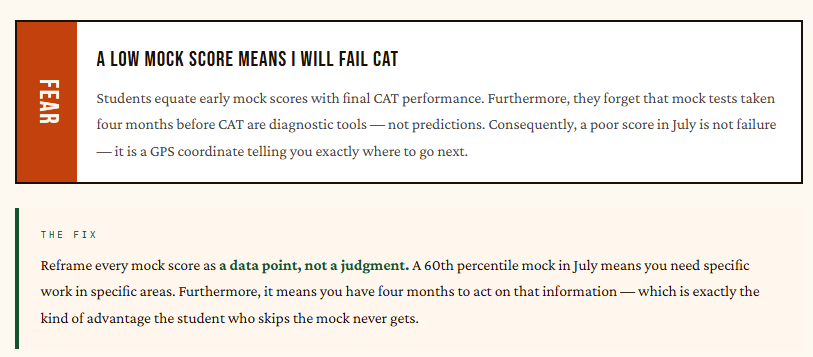
The most common mock fear is simple: students dread seeing a low score. Furthermore, they treat a mock result as a direct measure of their worth as a candidate – as if a 65th percentile mock score today predicts a 65th percentile on the actual CAT. Consequently, the fear of seeing a “bad” number becomes powerful enough to prevent them from sitting for the test at all.
Additionally, this fear intensifies as the exam approaches. Students who avoided mocks in July still avoid them in October, because now the stakes feel even higher. Therefore, mock fear compounds over time – the longer you avoid, the more each skipped test increases the emotional weight of the next one.
“I Am Not Ready Yet”
The Perpetual Almost-Ready Trap
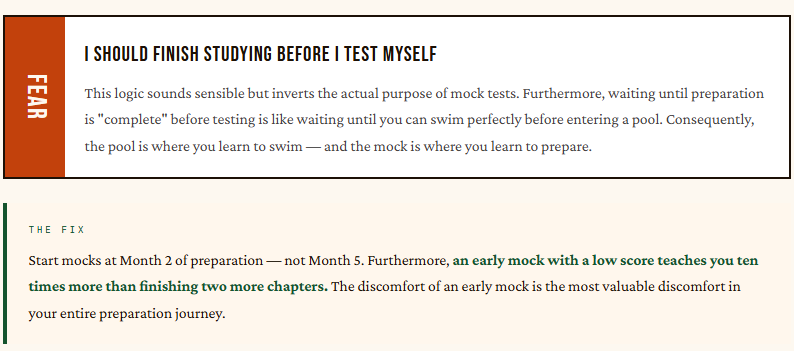
The second most common mock fear hides behind a perfectly reasonable-sounding excuse: “I’ll give the mock once I finish Geometry” or “once I’ve revised Number Systems.” Furthermore, this readiness condition migrates constantly – every time one topic gets finished, another incomplete topic replaces it as the new prerequisite. Consequently, the student remains perpetually one topic away from being “ready” to take a mock.
Additionally, this pattern reveals a fundamental misunderstanding of what mock tests do. You do not take mocks to display your current knowledge – you take them to discover your gaps. Moreover, the gaps you discover in a mock test tell you precisely which topics to revise next, making mocks the most efficient revision-planning tool available.
Fear of Comparison
The Leaderboard That Keeps Students Away
Many students avoid mock tests specifically because they dread being compared to peers. Seeing a friend score in the 90th percentile while you sit at the 55th feels crushing – even when both numbers carry exactly the same improvement potential. Furthermore, this social comparison anxiety turns mock tests from diagnostic tools into performance theatres, shifting the focus from growth to status.
Additionally, the comparison trap intensifies inside coaching groups, WhatsApp study circles, and online forums where mock scores circulate freely. Consequently, students who might take a mock in private start avoiding it entirely once scores become socially visible. Therefore, protecting yourself from comparison anxiety requires a deliberate decision to measure only against your own previous performance.

Confirming the Worst
The Fear Beneath the Fear
Under every mock-avoidance excuse sits a deeper, rarely spoken fear: the terror of discovering that you are not good enough. Furthermore, as long as the test goes untaken, the dream remains intact. Consequently, students protect their self-belief by simply refusing to put it to the test – which is the psychological definition of avoidance.
Additionally, this fear is the most honest of all mock fears, and the most important to address directly. The mock test does not create your current level of preparation – it reveals it. Moreover, knowing your level is power, because knowledge of a problem is the first and most critical step toward solving it.

Treating Mocks as Wasted Time
The Productivity Illusion
Many students avoid mocks because sitting for a three-hour test feels unproductive compared to studying three more chapters. Furthermore, this calculation seems rational – more content covered in the same time. Consequently, mocks get systematically deprioritised in favour of the comfortable feeling that comes from ticking off topics.
Additionally, this thinking produces the most dangerous outcome in CAT preparation: a student who knows the syllabus but cannot perform under exam conditions. Solving 50 QA practice questions at your own pace is categorically different from solving 22 in 40 minutes while managing cognitive fatigue from the previous VARC section. Therefore, exam-condition practice is not replaceable by any form of topic study – it trains a completely different set of skills.
What a Mock Test Actually Is
A Mirror, Not a Judge
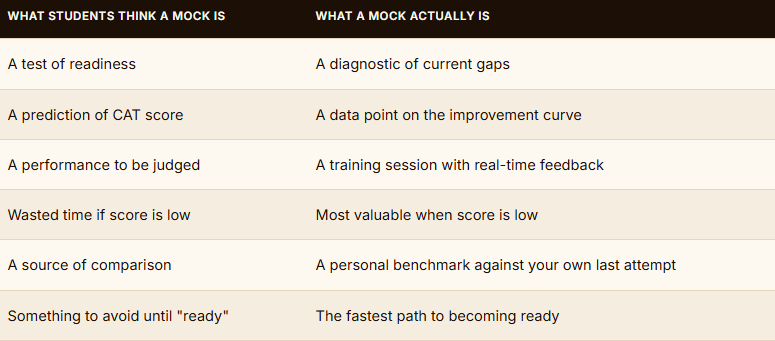
A mock test does not measure your worth as a student. It reveals your current strengths, your current weaknesses, and your current exam-day habits – all three of which change with preparation. Furthermore, every single piece of information a mock test produces is information you can act on. Consequently, a mock test with a poor result is a rich resource, while a skipped mock test is a resource you threw away.
Additionally, mock tests train skills that no amount of topic revision can develop: time pressure management, section-switching mental speed, question-selection instinct, and exam-day emotional regulation. These skills exist only in real exam conditions and build only through repeated practice. Therefore, every mock is an irreplaceable training session that topic study simply cannot replicate.
Before and After the Mock Mindset Shift
Two Students, Same Preparation Level, Different Outcomes
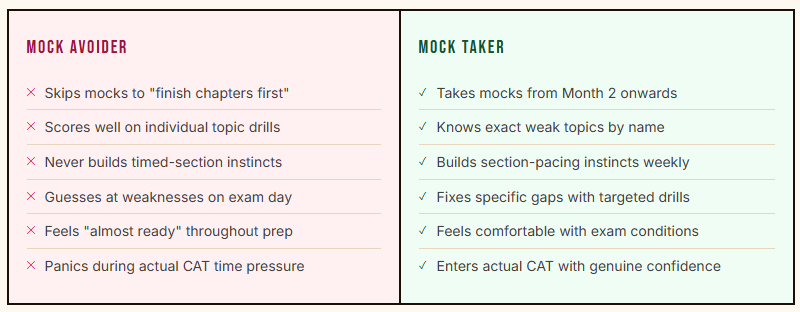
Consider two CAT aspirants who start preparation in June with identical baselines. Student A avoids mocks through July and August, sticking to topic drills and feeling productive. Student B takes one mock every two weeks and spends Sunday analysing the results. Furthermore, by October, Student A has covered more content topics – but Student B has built actual exam-day performance.
Additionally, Student B knows exactly which three topics cost them marks in every mock. Consequently, their October preparation targets those specific gaps with surgical precision. Student A studies everything broadly and hopes it shows up on exam day – a strategy that consistently produces the same result: a score that frustrates without a clear explanation.

How to Start Taking Mocks Without Fear
The First Mock Is Always the Hardest
The first mock feels most frightening because it converts abstract fear into concrete information. Furthermore, the very quality that makes it scary – it produces a real result – is the quality that makes it invaluable. Consequently, the single most powerful preparation action any mock-avoider can take is to schedule their first mock for tomorrow and treat it as an experiment, not an exam.
Additionally, reframing the first mock as a “baseline measurement session” removes the performance pressure from the equation entirely. You are not trying to score well. Moreover, you are mapping your starting point so that every subsequent session has a clear direction. Therefore, approaching the first mock with curiosity rather than dread transforms it from a threat into a tool.
A Six-Step System for Fear-Free Mock Taking
- Schedule the Mock Now – Not “Later This Week” – Open your calendar and block a specific date and time for your next mock. Furthermore, treat it like a non-cancellable appointment. Consequently, scheduling removes the daily decision-making cost that keeps mock-avoiders perpetually “about to start.”
- Use a “Baseline, Not Performance” Label – Tell yourself before every mock: “This is a measurement session, not a performance.” Furthermore, you are gathering data, not proving anything. Consequently, this framing reduces emotional stakes and lets you attempt questions without the paralysis of performance anxiety.
- Simulate Real Exam Conditions Every Time – Take every mock at the same time of day as the actual CAT. Additionally, remove all distractions, use no reference material, and honour each section’s 40-minute timer strictly. Consequently, only real conditions build the exam-day performance instincts the actual test demands.
- Analyse Before You Move On – Block two hours the day after every mock for analysis. Furthermore, review every wrong answer, every skipped question, and every section’s time allocation. Consequently, the analysis session – not the mock itself – is where the learning and improvement actually happen.
- Track One Improvement Metric Per Mock – Choose one specific metric to improve between each mock – Arithmetic accuracy, RC passage speed, or DILR set-selection time. Moreover, tracking one concrete number gives your preparation direction. Therefore, each mock feeds directly into the next through a specific, measurable improvement loop.
- Never Skip More Than One Week Between Mocks – Mock-taking frequency matters as much as mock quality. Furthermore, the exam-day performance instincts built through mocks decay quickly without regular reinforcement. Consequently, taking at least one full mock per week from Month 3 onwards keeps these instincts sharp and improving continuously.
How CATMock Makes Mocks Less Scary
Practice in a Pressure-Free Environment First
CATMock builds the path to full mock confidence gradually – starting with section-wise timed drills before moving to full-length tests. This progression lets students build familiarity with timed CAT conditions section by section, rather than facing the complete 120-minute format cold. Furthermore, each section drill produces a score, an analysis report, and specific improvement recommendations.
Additionally, CATMock’s mock test series mirrors the actual CAT interface, difficulty calibration, and section structure precisely. Consequently, students who practise on CATMock mocks consistently report feeling far more comfortable during the actual exam because the environment feels familiar. Therefore, CATMock mocks do not just measure preparation – they actively build the exam comfort that fear-prone students most urgently need.
Post-Mock Analysis That Turns Data into Direction
CATMock’s analysis reports break down every mock result by section, topic, question type, and time spent. Students see exactly which topics produced errors, which questions were skipped unnecessarily, and where time management failed. Furthermore, this level of analysis converts the emotional experience of a “bad mock” into a specific, actionable preparation list for the following week.
Additionally, the progress tracking across multiple CATMock mocks makes improvement visible – which is the most powerful antidote to mock fear available. Watching your VARC percentile move from 62 to 75 to 84 across ten mocks proves concretely that the process works. Consequently, students who track their CATMock progress consistently report that mock fear diminishes naturally as the improvement data accumulates.
15 Frequently Asked Questions
About Mock Test Fear and Why It Happens
Students fear mock tests primarily because they treat a mock score as a direct judgment of their ability – not as a diagnostic tool. Furthermore, the fear of seeing a low number, being compared to peers, or confirming self-doubt feels too threatening to face voluntarily. Consequently, avoidance feels protective in the short term, even though it causes significant preparation damage over the longer preparation cycle.
Yes, mock test anxiety is extremely common among CAT aspirants and affects students across all preparation levels. Furthermore, research on test anxiety confirms that high-stakes exam fear activates the same stress response as real threats, making avoidance a psychologically natural response. Consequently, the goal is not to eliminate the fear entirely but to act despite it – and to gradually reduce it through repeated mock exposure.
The “not ready yet” trap is a perpetual postponement pattern where students always find one more topic to finish before they consider themselves ready to take a mock. Furthermore, this condition migrates endlessly – every completed topic gets replaced by a new “must finish first” prerequisite. Consequently, students remain perpetually one chapter away from their first mock test, sometimes until October when it is too late to benefit from regular mock practice.
Comparison anxiety turns mock tests from private diagnostic tools into public performance events. Students who fear being ranked below friends avoid mocks specifically to prevent that comparison from becoming concrete. Furthermore, this social dimension intensifies in group chat environments where mock scores circulate freely. Consequently, the most effective defence against comparison anxiety is a strict personal policy of measuring only against your own previous score – never against peers.
Yes, significantly and measurably. Each skipped mock represents a lost diagnostic session that leaves specific weaknesses unidentified and unaddressed. Furthermore, skipping mocks means never building the timed-section instincts, question-selection habits, and cognitive endurance that only real exam-condition practice develops. Consequently, mock-avoiders consistently underperform their preparation level on the actual CAT – often dramatically so.
About Mock Strategy, Timing, and How to Approach Them
Most preparation coaches recommend taking the first mock at Month 2 of preparation – not Month 5. Furthermore, an early mock with a poor score is significantly more valuable than a later mock with a slightly better score, because early feedback provides more preparation time to act on it. Therefore, the ideal rule is: take your first mock within 60 days of starting preparation, regardless of how “incomplete” the preparation feels.
Most experts recommend at least 20 to 25 full-length mock tests across the six-month preparation cycle. Additionally, section-wise timed mocks – covering VARC, DILR, and QA individually – should supplement full mocks throughout the preparation period. Furthermore, the frequency should increase as the exam approaches: at least one full mock per week from Month 4 onwards is widely considered the minimum standard for serious CAT preparation.
First, resist the urge to study immediately as an emotional reaction to a low score. Furthermore, spend two hours in structured analysis – reviewing every wrong answer, identifying the root cause of each error, and noting which topics and question types contributed most to the score drop. Consequently, a bad mock followed by good analysis produces more improvement than three good mocks followed by no analysis.
Replace the label “performance test” with “measurement session” before every mock. Furthermore, remind yourself that the mock’s only job is to reveal current reality – not to judge it. Additionally, commit to treating any result as useful information regardless of the number. Consequently, most students who consistently apply this reframing report that mock anxiety reduces noticeably after just three to four attempts.
Yes, always. Take every mock at the same time of day as the actual CAT, in a distraction-free environment, with all 40-minute section timers honoured strictly. Furthermore, avoid using reference material, pausing the timer, or revisiting questions between sections. Consequently, only mocks taken under real conditions build the cognitive and emotional exam-day performance that the actual test demands.
About CATMock and Overcoming Fear in Practice
CATMock builds mock confidence gradually through a progression from section-wise timed drills to full-length tests. This step-by-step exposure reduces the emotional shock of the first full mock significantly. Furthermore, CATMock’s detailed post-mock analysis converts scary scores into specific improvement lists – transforming fear into a clear, actionable next step rather than a diffuse feeling of inadequacy.
CATMock’s analysis reports break down performance by section, topic, question type, time spent, and accuracy rate. Furthermore, the reports identify which specific errors were conceptual, which were time management failures, and which were careless mistakes – each requiring a different preparation response. Consequently, students leave each analysis session with a concrete, prioritised list of actions for the following week’s preparation.
Retaking the exact same mock test carries limited value because familiarity with the questions inflates the score artificially. Furthermore, retaking is only useful if the purpose is to verify a specific skill improvement – not to chase a better number on a test you already know. Consequently, the better practice is to address the specific weaknesses revealed by a bad mock through targeted drilling and then measure the improvement on a fresh, unseen mock.
Schedule the next mock test right now – before closing this blog. Open your calendar, pick a specific date and time within the next seven days, and block it. Furthermore, label it “Baseline Session” to remove performance pressure. Consequently, this one scheduling act breaks the avoidance cycle that no amount of intention alone has managed to break – because it converts a vague decision into a concrete commitment.
No, two months is enough time for significant mock-driven improvement if you act immediately and consistently. Eight full mocks across two months, each followed by proper analysis, deliver more preparation value than two more months of topic study alone. Furthermore, the exam-day performance skills – time management, question selection, and cognitive endurance – build surprisingly fast once regular mock practice begins. Therefore, start today regardless of how much time remains.