

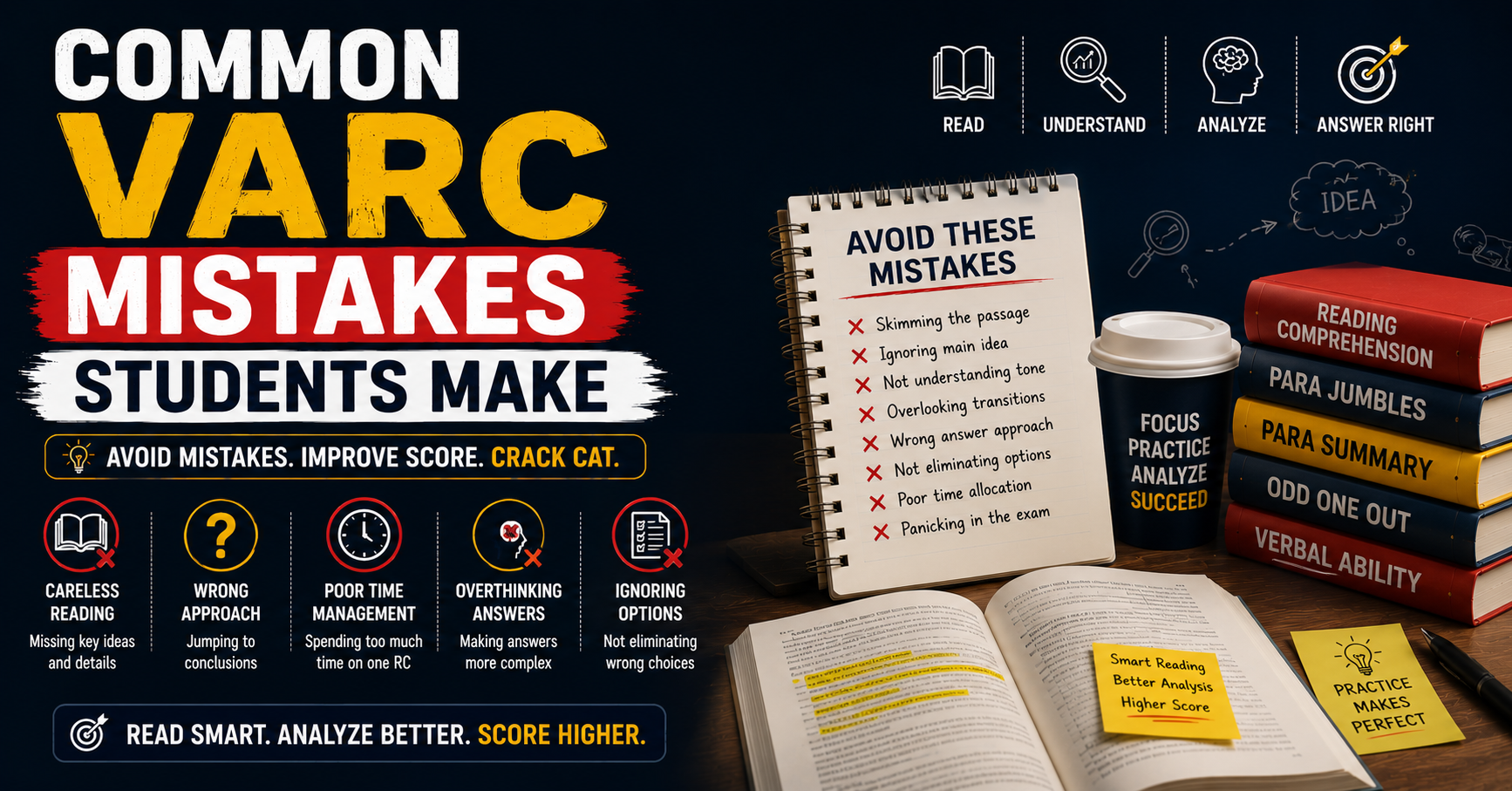
Why VARC Trips Up Even Smart Students
Every year, thousands of students sit for competitive exams like CAT, XAT, and GMAT with solid quantitative skills – yet their overall scores suffer because of one section: VARC. Surprisingly, many of these students are fluent English speakers. So, why does this section continue to be a stumbling block for so many aspirants?
The answer lies not in language ability, but in approach. Most VARC mistakes are systematic and entirely avoidable. By understanding what typically goes wrong, students can recalibrate their strategy and dramatically improve their scores.

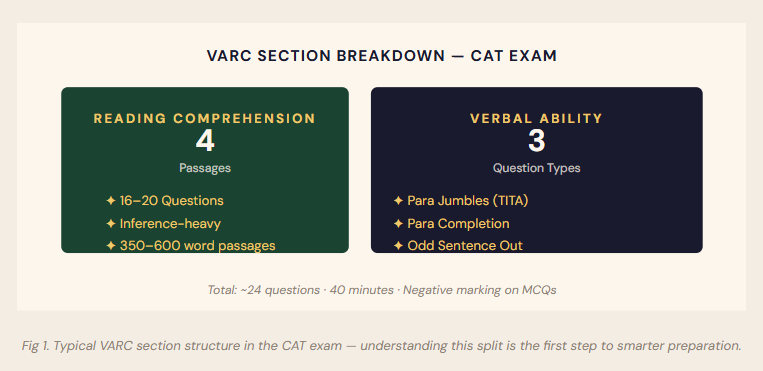
Reading Comprehension Mistakes
Reading Comprehension forms the backbone of the VARC section, carrying the highest weight among all question types. Nevertheless, students repeatedly fall into the same traps while attempting RC passages. Recognising these patterns early can save both time and marks.
Mistake 1 – Reading Without a Purpose
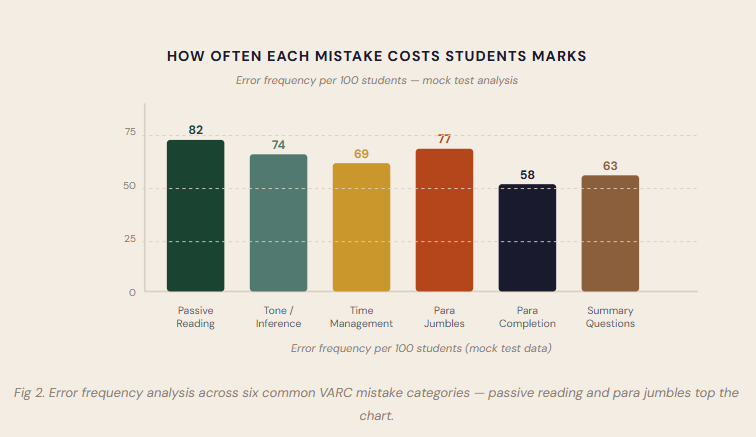
Many students read RC passages the way they would browse a social-media feed – casually and without a clear objective. Consequently, key arguments, paragraph relationships, and authorial intent are entirely missed. Active reading, by contrast, involves asking “what is this paragraph doing?” with every line.
Furthermore, students often highlight or mentally note random facts instead of tracking the central argument. However, RC questions rarely test isolated facts; they test understanding of the author’s position. Therefore, mapping the passage structure while reading is far more effective than passive absorption.

Mistake 2 – Ignoring Tone, Stance, and Inference
A significant portion of RC marks comes from tone-based and inference-based questions. Yet, most students focus exclusively on explicit information in the passage. As a result, questions like “the author would most likely agree that…” are routinely answered incorrectly.
Additionally, over-inference is equally problematic. Students frequently bring outside knowledge into their answers instead of staying within the passage’s logical universe. Accordingly, the golden rule is: stay grounded in what the text says or strongly implies – nothing beyond that.
Mistake 3 – Poor Time Allocation Across Passages
Not all RC passages carry equal difficulty. Spending 12 minutes on a dense philosophical passage while rushing through a straightforward business-economics piece is a costly error. Instead, smart students quickly assess each passage’s difficulty in the first 30 seconds and allocate time accordingly.
Moreover, attempting all four passages in a fixed order regardless of comfort is another frequent mistake. Selective reading – attempting the easiest passages first – often yields a higher net score than strictly following the question order.
Verbal Ability Mistakes
Verbal Ability questions in the VARC section are entirely TITA-based in CAT, meaning there is no negative marking. Despite this advantage, students consistently underperform here. The core issue is treating these questions as vocabulary tests rather than logic puzzles.
Mistake 4 – Mishandling Para Jumbles
Para jumbles require students to arrange shuffled sentences into a coherent paragraph. Most students attempt this by reading each sentence in isolation. Instead, the far more reliable method involves identifying mandatory sentence pairs – two sentences that must logically follow each other regardless of position.
Furthermore, students frequently ignore pronoun references, article usage (a vs. the), and discourse connectors like “however,” “therefore,” and “additionally.” These small linguistic signals are actually the most reliable tools for sequencing sentences correctly. Consequently, paying attention to these micro-signals makes para jumbles significantly more tractable.

Mistake 5 – Rushing Para Completion
Para completion asks students to choose the most appropriate sentence to complete a given paragraph. However, many aspirants answer based on topical similarity rather than tonal and argumentative consistency. Therefore, a sentence that sounds related but does not match the paragraph’s conclusion style will always be incorrect.
Notably, the correct option should feel like a natural continuation – it must maintain the writer’s voice, respect the logical progression, and avoid introducing completely new ideas. Practising this question type by reading quality opinion journalism is one of the most effective preparation strategies.
Mistake 6 – Misreading Summary Questions
Summary questions require identifying the sentence that best captures the central argument of a short paragraph. A very common mistake here is selecting a sentence that covers a detail rather than the main point. Additionally, overly broad or overly specific answer choices are both traps worth watching out for.
In short, the correct summary should be neither a direct quote from the passage nor a distortion of the central idea. Rather, it should capture the essence of the argument in precise, neutral language – mirroring the kind of analytical compression that good critical thinking requires.
Strategy & Mindset Errors
Beyond content-level errors, a whole category of strategic and psychological mistakes significantly damages VARC performance. These mistakes are particularly tricky because they are invisible during practice, they tend to surface only under exam pressure.
Mistake 7 – Attempting Questions in a Fixed Order
Attempting every RC question sequentially – exactly as it appears on screen – is a rigid strategy that works against the student’s strengths. Instead, briefly scanning question stems before reading the passage allows students to read purposefully and locate relevant sections faster. As a result, both accuracy and speed improve simultaneously.
Additionally, skipping a genuinely difficult question and returning to it later is a sign of maturity, not weakness. Importantly, spending four minutes on a single stumping question while unattempted easy questions sit idle is one of the costliest mistakes in the entire exam.
Mistake 8 – Over-Relying on Vocabulary
Many students prepare for VARC almost entirely by memorising word lists. However, modern competitive exams like CAT rarely test direct vocabulary recall. Rather, they test contextual understanding – the ability to infer meaning from surrounding text even when a specific word is unfamiliar.
Therefore, building reading speed and comprehension through sustained daily reading is far more productive than rote vocabulary drills. Moreover, wide reading across genres – economics, philosophy, science, and literary criticism – builds the contextual agility that these exams truly reward.
Mistake 9 – Anxiety-Driven Re-Reading
Reading the same sentence multiple times out of anxiety wastes precious time and rarely improves comprehension. Trust the first read and move forward.
Mistake 10 – Ignoring TITA Advantage
TITA questions carry no negative marks, yet students often skip them due to uncertainty. Attempting all TITA questions is always the correct strategy.
Mistake 11 – Overthinking Answer Choices
Spending excessive time debating between two answer choices usually means the student has lost sight of the question. Returning to the passage resets the thinking process.
Mistake 12 – Neglecting Elimination Method
Many RC answer choices contain subtle distortions – absolute language, out-of-scope claims, or reversed logic. Actively eliminating wrong answers is often faster than finding the right one.
Preparation Pitfalls That Silently Hurt Scores
Even among students who practise regularly, certain preparation habits create hidden weaknesses that only become apparent during the actual exam. Addressing these pitfalls is just as important as learning the right techniques.
Mistake 13 – Not Reviewing Incorrect Answers
Completing mock tests without a thorough review is arguably the single most wasteful preparation habit. Yet, a large share of students move on to the next mock immediately after seeing their score. Consequently, the same mistakes are repeated across test after test, reinforcing incorrect thinking patterns.
Instead, spending at least 30–40 minutes reviewing every single error – particularly understanding why the wrong option was chosen – yields disproportionately large score improvements. Furthermore, maintaining an error log categorised by mistake type allows students to identify personal weakness patterns over time.
Mistake 14 – Inconsistent Reading Habits
VARC is, at its core, a test of reading stamina and interpretive speed. However, many students read only during their exam preparation phase, which is far too short a timeline for meaningful improvement. By contrast, students who read quality non-fiction content for even 20–25 minutes daily over six months develop significantly stronger passage comprehension than those who binge-read during the final weeks.
Mistake 15 – Ignoring Sectional Mocks
Full-length mock tests are important, but sectional mocks for VARC alone build a different kind of focused stamina. Students who skip sectional practice often find their concentration dipping sharply in the second half of the VARC section during the real exam. Therefore, alternating between full mocks and sectional mocks is the recommended approach for comprehensive preparation.

Final Thoughts
VARC is one of the most intellectually rewarding sections in competitive exams once it is approached correctly. Ultimately, every mistake discussed in this article is correctable through awareness and deliberate practice. The first step, however, is honest self-assessment – identifying which of these 15 patterns you personally fall into.
Moreover, improvement in VARC does not happen overnight. Nevertheless, students who commit to active reading, strategic mock practice, and rigorous error review consistently outperform those who rely on raw language ability alone. Begin with one change this week, and build systematically from there.
15 Frequently Asked Questions
VARC stands for Verbal Ability and Reading Comprehension. It is primarily tested in the CAT (Common Admission Test), XAT, IIFT, SNAP, and GMAT. Each exam has a slightly different format, but all of them assess the same core skills – reading speed, comprehension depth, logical inference, and verbal reasoning.
Ideally, aim to spend 8–10 minutes per RC passage, including reading and answering questions. However, difficulty levels vary significantly across passages. A useful strategy is to spend 3–4 minutes reading and 1.5–2 minutes per question. If a passage feels unusually dense, it is smarter to attempt easier passages first and return to the difficult one later.
Yes, skimming the question stems (but not the answer choices) before reading the passage is a highly effective technique. It allows you to read with purpose – mentally flagging relevant sections as you go. However, reading full answer choices beforehand can create bias, so keep your pre-read limited to understanding what each question is broadly asking.
CAT typically features four RC passages. Most high-scorers attempt three passages thoroughly and either partially attempt or skip the most difficult one. Attempting all four passages hastily is often counterproductive. Quality of comprehension matters far more than the quantity of passages attempted.
The most effective approach involves three steps. First, identify the mandatory opening sentence – it introduces a concept without reference to anything prior. Second, look for pronoun-antecedent pairs, since “it” or “this” must refer to something specific in an earlier sentence. Third, track discourse markers like “however,” “consequently,” and “in addition” – these signal logical relationships and reveal sequence.
While a strong vocabulary is helpful, it is not the primary driver of VARC scores in modern exams. CAT in particular has largely moved away from direct vocabulary questions. The focus is now on contextual understanding and logical reasoning through language. Developing these skills through wide reading is far more valuable than memorising word lists.
One effective technique is to mentally summarise each paragraph in one sentence as you finish reading it. Another method involves annotating – on paper or mentally – whether each paragraph is supporting, contrasting, or concluding the central argument. These active reading habits dramatically improve both retention and question-answering speed.
TITA questions (Type in the Answer, applicable in CAT for Para Jumbles, Para Completion, and Odd Sentence Out) are generally considered harder because there are no options to use as hints. However, since there is no negative marking for TITA questions, the risk-reward ratio strongly favours attempting all of them. Even a partially reasoned answer can be correct, while an MCQ wrong answer deducts marks.
The most recommended sources include long-form journalism from The Atlantic, The Economist, Aeon, and The New Yorker. For Indian-context preparation, articles from The Hindu’s opinion pages and EPW (Economic & Political Weekly) are especially useful. Importantly, variety matters – read across philosophy, science, economics, and literary criticism to build the contextual breadth that VARC passages demand.
Start by reviewing every question you answered incorrectly, and try to articulate in writing why your answer was wrong. Then review questions you answered correctly but were uncertain about – these are equally important. Finally, look at questions you skipped and evaluate whether they were actually skippable. Categorising errors by type builds a personalised improvement roadmap.
Yes, absolutely – but it requires a longer, more structured preparation timeline. Students who start one year before the exam with consistent daily reading and a strong mock review process have successfully crossed the 90-percentile threshold even from initial VARC scores in the 50–60 percentile range. The key insight is that VARC rewards analytical thinking more than native language fluency.
Tone misidentification usually happens for two reasons. Either the student is reading too quickly to pick up on subtle hedging language – words like “arguably,” “ostensibly,” or “paradoxically” signal a careful, qualified stance – or they are projecting their personal opinion onto the author. Practising tone-identification exercises on editorial articles is an excellent way to sharpen this skill.
The quantity of mocks matters far less than the quality of review. That said, most coaching experts recommend attempting at least 20–25 full-length mocks, with sectional mocks interspersed. The final six weeks before the exam should ideally include at least two full mocks per week, with comprehensive post-mock analysis sessions that are as long as the test itself.
Odd Sentence Out presents five sentences, and the task is to identify the one that does not logically belong. The correct approach is to first identify the central theme shared by four sentences, then check which sentence introduces an unrelated or contradictory idea. Sentences that shift topic or use contradictory logic are typically the odd ones out. Avoid being misled by topical similarity – the connection must be logical, not just thematic.
Self-study is entirely sufficient for VARC improvement, provided you follow a structured plan. Coaching institutes are valuable primarily for mock test infrastructure, peer competition, and guided review sessions. However, the core skill-building in VARC – reading daily, practising question types, and reviewing errors – can be done independently through freely available resources. What matters most is consistency and the honesty to address your recurring mistakes.