

- Why DILR Mistakes Are Different
- Picking the Wrong Sets
- Skipping the 3-Minute Scan
- Rushing the Data Setup Phase
- The Sunk Cost Trap
- Solving Without a Diagram
- Wrong MCQ vs TITA Strategy
- Practising Only Pure DI or Pure LR
- Never Practising Under Real Time Pressure
- Skipping Post-Mock DILR Analysis
- 15 Frequently Asked Questions
Why DILR Mistakes Are Different
The Section Where Small Errors Cause Large Damage
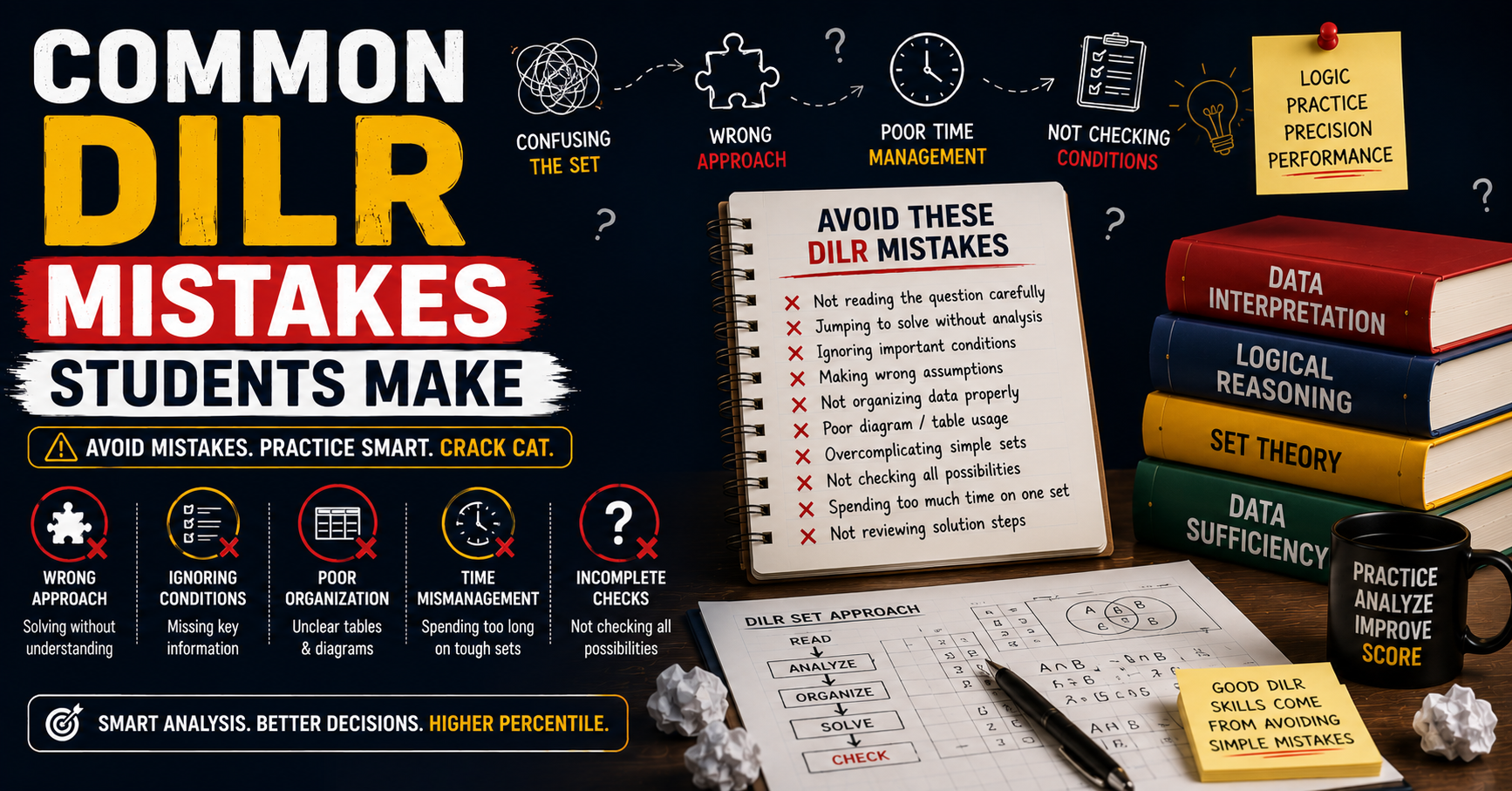
DILR mistakes carry a uniquely high cost compared to errors in QA or VARC. One wrong set selection in DILR can consume 12 minutes and produce zero marks – a double punishment of lost time and no return. Furthermore, a single careless MCQ error in DILR triggers both the missed +3 and the charged −1 – a net swing of 4 marks from one mistake.
Additionally, DILR mistakes tend to cluster and cascade. One poor decision – staying too long on a hard set – leads to another poor decision – rushing through an easy set with insufficient care. Consequently, understanding why each mistake happens is far more important than simply knowing that it happens.
Who These Mistakes Affect
These mistakes affect candidates at every preparation level – not just beginners. Even students who score 85th percentile in mocks consistently make three or four of these errors on actual exam day. Furthermore, the most dangerous mistakes are the ones that feel completely rational in the moment – which is exactly why they persist despite repeated experience.
Additionally, most of these errors share a single root cause: the absence of a pre-built DILR strategy that runs automatically under pressure. Therefore, the solution to almost every DILR mistake is not more practice – it is building the right habits through deliberate, structured practice with clear rules.
Picking the Wrong Sets
The Most Expensive Decision in DILR
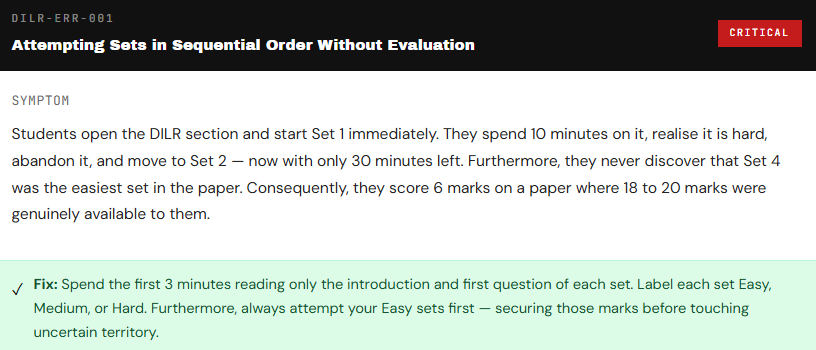
Set selection is the highest-stakes decision in the entire DILR section. Choosing a hard set over an easy one costs the same time – 10 minutes – but produces radically different outcomes. Furthermore, students who pick sets randomly or in the order they appear consistently underperform their actual ability by 15 to 20 percentile points.
Skipping the 3-Minute Scan
The Three Minutes That Change Everything
The 3-minute scan at the start of DILR is not optional – it is the strategic foundation of the entire section. Students who skip it and dive directly into Set 1 remove their only chance to know what the whole section contains. Furthermore, they commit to solving a set without knowing whether a far easier one sits two sets later.
Additionally, the scan trains a skill that improves dramatically with mock test practice: the ability to quickly estimate a set’s difficulty from its data structure and question types. Consequently, students who practise the scan consistently in mocks develop a fast, reliable instinct for solvable sets that feels automatic by exam day.

Rushing the Data Setup Phase
The Speed That Costs More Time Than It Saves
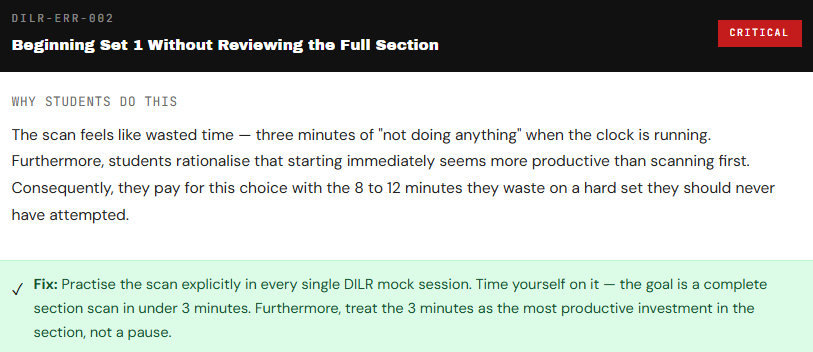
Most students understand DILR sets conceptually but rush the data setup phase – the first 2 to 3 minutes of engaging with a set’s data before answering any question. Furthermore, this rushing produces incomplete tables, misread conditions, and wrong assumptions that generate cascading errors across all four to six questions in the set. Consequently, rushing saves 2 minutes but costs 8 to 12 minutes in re-reading, correcting, and re-solving.
Additionally, the most common symptom of rushed data setup is answering the first question quickly – then getting stuck on the second because the first answer was built on a flawed data interpretation. Therefore, slowing down the setup phase actually accelerates the question-answering phase, making “slow is fast” the most counterintuitive but reliable DILR rule.

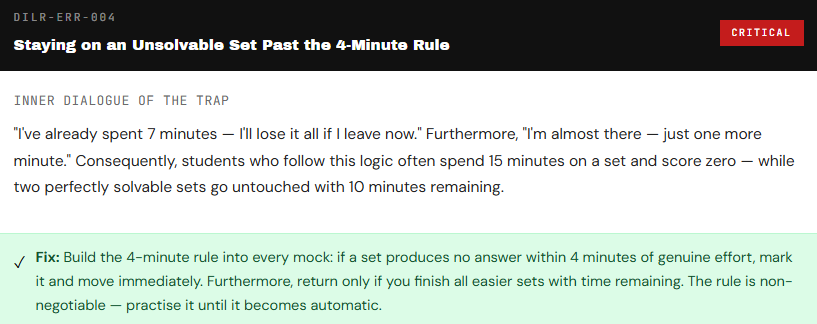
The Sunk Cost Trap
The Mistake That Has a Name in Economics
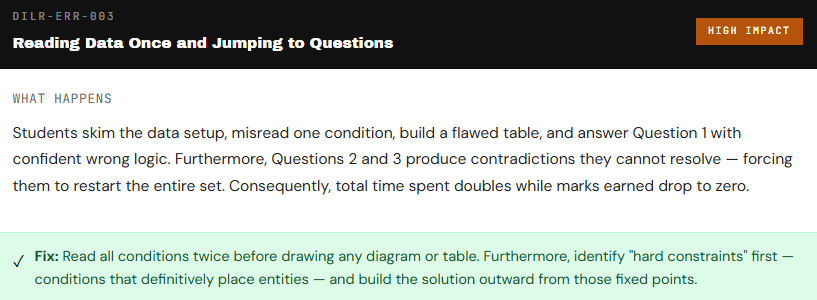
The sunk cost trap occurs when a student refuses to abandon a hard set because they have “already spent 8 minutes on it.” Furthermore, this logic is economically irrational – those 8 minutes are gone regardless of whether the student continues or leaves. Consequently, the only question that matters is: “What is the best use of my remaining time?” – not “How do I justify the time I have already spent?”
Additionally, this trap worsens as preparation advances. Experienced students feel even more reluctant to abandon sets because their pride ties completion to competence. Moreover, the sunk cost trap costs more marks than almost any other DILR mistake – because it often destroys 15 to 20 minutes before the student finally leaves a set with nothing to show.
Solving Without a Diagram
Mental Solving Is for Mathematics — Not for DILR
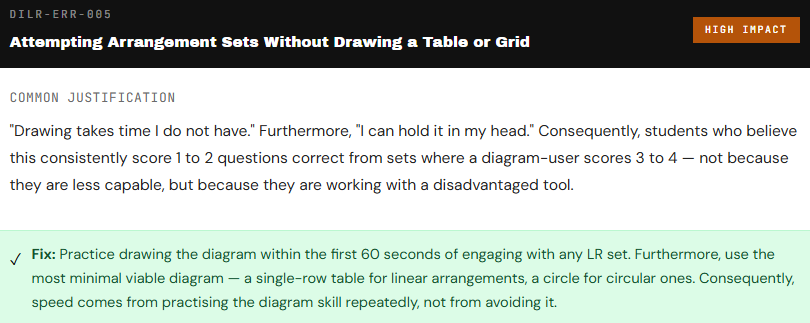
DILR LR sets involve complex multi-entity arrangements that exceed working memory capacity when attempted mentally. Students who try to solve arrangements without a diagram consistently make placement errors, miss constraint implications, and spend 50% longer per set than students who draw immediately. Furthermore, every experienced DILR solver confirms the same rule: if it involves more than three entities, draw it.
Additionally, diagram-less solving creates fragile, unverifiable solutions. When a contradiction appears in Question 3, a student without a diagram must rebuild the entire mental model from scratch. Consequently, the few seconds saved by skipping a diagram cost minutes of confused re-reading further into the set.
Wrong MCQ vs TITA Strategy
Treating Both Question Types the Same Way
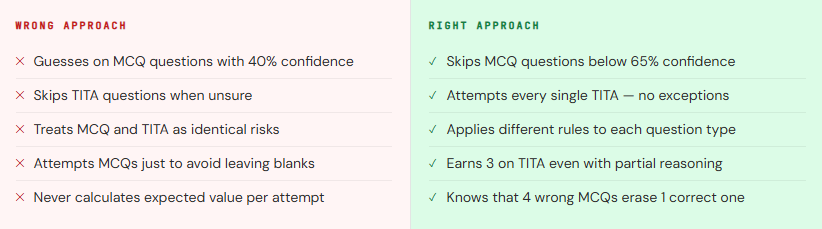
MCQ and TITA questions demand fundamentally different strategies, yet most students apply the same approach to both. MCQ questions carry −1 for wrong answers – making low-confidence attempts actively harmful. Furthermore, TITA questions carry zero penalty – making every TITA skip a guaranteed lost 3-mark opportunity.
Additionally, the most common TITA mistake is skipping them because the answer feels uncertain. Consequently, students voluntarily surrender the only risk-free opportunities in the entire DILR section. Therefore, building a clear rule – always attempt TITA, apply strict accuracy discipline to MCQ – directly improves DILR scores without requiring any additional solving skill.
Practising Only Pure DI or Pure LR
The Hybrid Set Gap Nobody Talks About
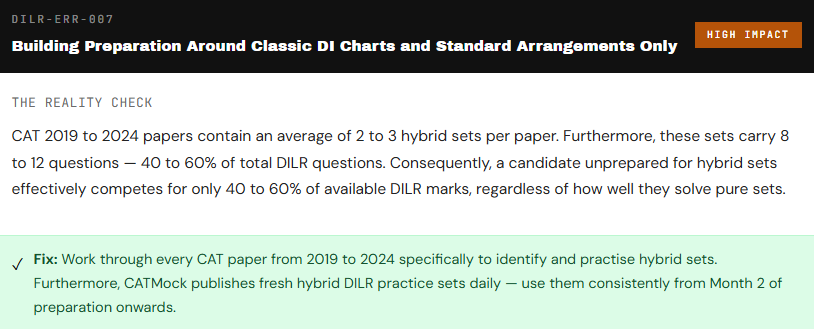
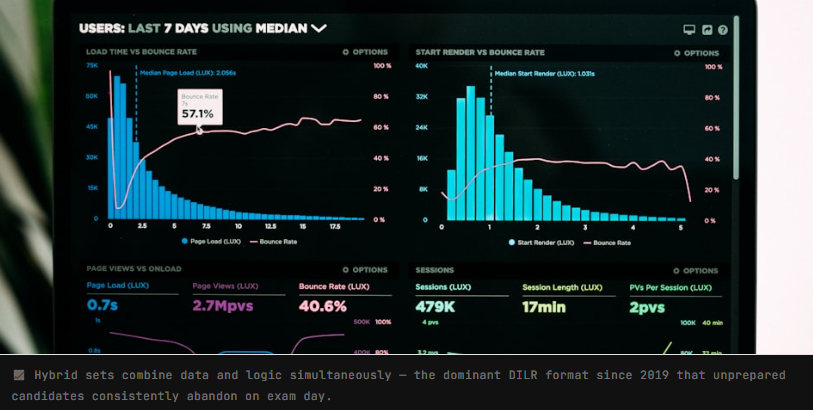
Modern CAT papers feature hybrid sets – questions that combine quantitative data with logical conditions in a single set. These sets have appeared in every CAT paper since 2017 and now account for roughly 30 to 40% of DILR questions. Furthermore, students who practise only pure DI (charts and tables) or pure LR (arrangement puzzles) arrive at the exam unable to handle the most common set type.
Additionally, hybrid sets require simultaneous switching between quantitative computation and logical constraint checking – a skill that develops only through specific practice. Consequently, students who never train with hybrid sets consistently abandon them on exam day as “unfamiliar” – forfeiting a third of the section’s available marks. Therefore, including hybrid set practice from Month 2 of preparation is not optional for any serious CAT aspirant.
Never Practising Under Real Time Pressure
The Open-Ended Practice Trap
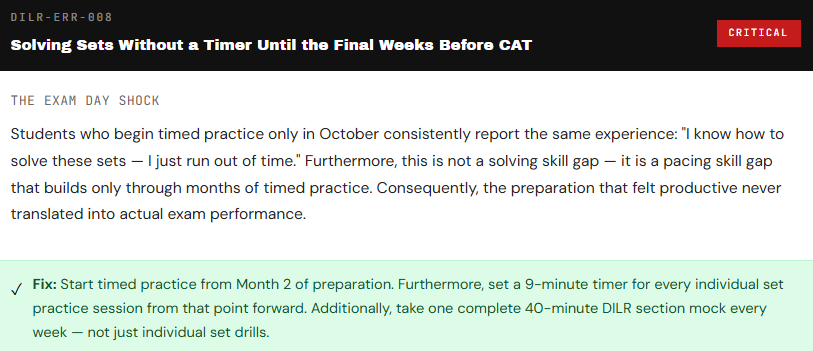
Solving DILR sets without a timer is useful for learning – but it produces a false confidence that collapses under real exam conditions. Students who practise open-endedly often solve sets correctly in 18 to 25 minutes that the exam gives them 8 to 10 minutes for. Furthermore, this gap never reveals itself until the actual exam, where it manifests as section-wide time collapse.
Additionally, open-ended practice never trains the most critical DILR skill: the decision to abandon a set. Consequently, students who train without timers never build the psychological habit of cutting and moving – because open-ended practice always lets them “eventually solve it.” Therefore, timed practice is not just more effective – it trains categorically different skills than untimed practice does.

Skipping Post-Mock DILR Analysis
The Learning That Happens After the Mock – Not During
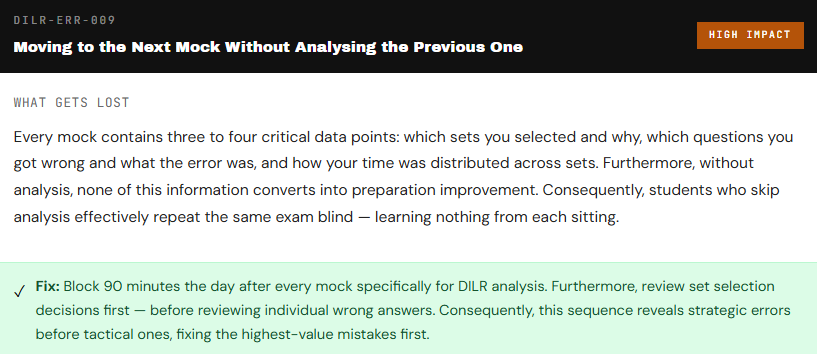
Taking a mock and skipping the analysis session wastes half the preparation value of that mock. The analysis is where every set selection error, sunk cost decision, and rushed diagram mistake becomes visible. Furthermore, without analysis, the same mistakes repeat across every subsequent mock because the student never identifies their specific pattern of errors.
Additionally, post-mock DILR analysis reveals a specific, actionable improvement agenda for the following week – something that no amount of new practice alone produces. Consequently, students who analyse every mock consistently improve their DILR percentile at twice the rate of students who only practise without reviewing. Therefore, scheduling the analysis session before the mock – not as an afterthought – ensures it actually happens.
15 Frequently Asked Questions
Q1. What is the most common and damaging DILR mistake?
Picking the wrong sets – attempting hard or unfamiliar sets while easy, solvable sets go untouched – is the single most damaging DILR mistake. Furthermore, it compounds into a time disaster that leaves no opportunity to recover within the 40-minute section window. Consequently, developing strong set selection instincts through the 3-minute scan is the highest-return skill improvement any DILR aspirant can make.
Q2. Why do students stay stuck on hard DILR sets even when they should move on?
The sunk cost trap drives this behaviour – students feel that abandoning a set wastes the time already spent on it. Furthermore, pride and the belief that “I almost have it” make continuation feel logical even when it is strategically catastrophic. Consequently, practising an explicit cut-and-move rule – abandoning any set that yields no answer after 4 minutes – is the only reliable antidote to this trap.
Q3. How does rushing the data setup phase hurt DILR performance?
Rushing the setup phase produces incomplete data tables, misread conditions, and wrong constraint assumptions. Furthermore, errors made in the setup phase cascade into every subsequent question – producing wrong answers that are confidently derived from a flawed foundation. Consequently, a 2-minute investment in thorough data setup almost always saves 5 to 8 minutes of confused re-reading and re-solving later in the same set.
Q4. Why do students skip TITA questions in DILR?
Most students skip TITA questions because they feel uncertain about the exact numerical answer – and associate uncertainty with risk. Furthermore, this fear is entirely misplaced, since TITA questions carry zero negative marking – making any attempt better than skipping. Consequently, skipping a TITA question is never the safe choice; it is always the costly choice, representing a guaranteed missed opportunity for 3 marks.
Q5. What is the 3-minute scan, and why does it matter so much?
The 3-minute scan is the practice of reading only the introduction and first question of every DILR set at the start of the section – before attempting any questions. Furthermore, it allows candidates to label each set as Easy, Medium, or Hard before committing time to any one of them. Consequently, the scan is the single decision that separates strategic DILR performers from reactive ones – and it takes less than 3 minutes to deliver a lifetime of percentile improvement.
Q6. Why is open-ended DILR practice not enough?
Open-ended practice builds solving skills but never builds the pacing, abandonment, and time-allocation instincts that real exam performance requires. Furthermore, the exam gives each set 8 to 10 minutes – a constraint that fundamentally changes which questions are worth attempting and which should be skipped. Consequently, students who only practise without timers consistently experience time collapse on exam day, even when their conceptual knowledge is strong.
Q7. What are hybrid DILR sets, and why must I practise them specifically?
Hybrid sets combine quantitative data – tables, charts, or scores – with logical conditions in the same question set. They have appeared in every CAT paper since 2017 and now account for roughly 30 to 40% of DILR questions. Furthermore, they require simultaneous quantitative and logical reasoning – a skill that pure DI or pure LR practice never develops. Consequently, students who do not train with hybrid sets consistently under-score on the dominant DILR question format.
Q8. How should I analyse a DILR mock after completing it?
Analyse your set selection decisions first – before reviewing individual wrong answers. Ask: “Which sets should I have picked instead?” Furthermore, for every wrong answer, identify whether the error was a data misread, a constraint oversight, a calculation mistake, or a time-pressure decision. Consequently, this layered analysis reveals both strategic and tactical errors – the two different types of DILR mistake that require two different preparation responses.
Q9. What is the right confidence threshold for attempting MCQ questions in DILR?
Most DILR coaches recommend attempting MCQ questions only when confidence exceeds 65%. Furthermore, four wrong MCQ answers in DILR erase the net value of one correct answer – making careless guessing a negative-expected-value strategy. Consequently, disciplined question selection – attempting fewer questions with higher accuracy – consistently outperforms high-volume, low-accuracy attempting in DILR’s MCQ format.
Q10. How many DILR mock tests should I take before CAT?
Most experts recommend at least 20 complete CAT mocks – with each including a full 40-minute DILR section – before the actual exam. Furthermore, section-wise DILR timed drills should supplement full mocks throughout preparation. Consequently, the combination of weekly full mocks and daily set-level practice builds the dual skills that DILR performance demands: individual set-solving speed and section-level strategic management.
Q11. How quickly can I fix these DILR mistakes?
Strategic mistakes – set selection and the sunk cost trap – improve within 3 to 4 mocks of conscious, deliberate rule application. Furthermore, technical mistakes – rushed setup and diagram-less solving – improve within 2 to 3 weeks of specific daily drill practice. Consequently, a candidate who identifies and targets all the mistakes covered here typically sees a measurable DILR percentile improvement within 6 to 8 weeks of focused correction.
Q12. Does diagram drawing really make a significant difference in LR performance?
Yes – research on LR solving consistently shows that diagram users solve sets 30 to 40% faster than mental-solving counterparts, with significantly fewer errors. Furthermore, diagrams externalise working memory – freeing cognitive resources for deduction rather than retention. Consequently, the 60 seconds spent drawing a clear table or grid at the start of a set almost always returns 3 to 5 minutes of faster, more accurate question answering.
Q13. What is the biggest difference between students who score 80th percentile and 95th percentile in DILR?
The primary difference is set selection discipline – not solving speed. Students at the 95th percentile pick the right sets and secure their marks efficiently. Furthermore, they abandon unsolvable sets faster, waste less time on TITA questions, and apply strict MCQ accuracy discipline. Consequently, the percentile gap is mostly a strategic gap – not a knowledge gap – making it far more correctable than most students assume.
Q14. How does CATMock help students fix these specific DILR mistakes?
CATMock provides daily DILR practice sets – including hybrid sets – calibrated to current CAT difficulty, allowing aspirants to practise all set types under timed conditions. Furthermore, CATMock’s post-mock analysis reports break down performance by set selection, question type, and error category – providing the exact diagnostic data needed to identify and fix each specific mistake. Consequently, students who use CATMock consistently receive both the practice and the analysis that DILR improvement requires.
Q15. Is DILR a skills problem or a strategy problem for most students?
For most students above the 70th percentile, DILR is primarily a strategy problem – not a skills problem. They can solve the sets; they simply lose marks through wrong selection, sunk cost thinking, and MCQ over-attempting. Furthermore, fixing these strategic mistakes alone – without changing their underlying solving speed – consistently produces 10 to 20 percentile improvements. Consequently, the most efficient DILR improvement path focuses on strategy correction before skill development, not after it.