

- Why QA Mistakes Are So Costly
- Skipping Arithmetic to Study Advanced Topics First
- Memorising Shortcuts Without Conceptual Understanding
- Ignoring TITA Questions
- Spending Too Long on One Question
- Over-Attempting with Low Accuracy
- Practising Without an Error Log
- Severely Unbalanced Topic Coverage
- Practising QA Without Time Pressure
- Relying on Formula Lists Over Deep Understanding
- Fixing All These Mistakes: A 6-Week Plan
- 15 Frequently Asked Questions
Why QA Mistakes Are So Costly
The Section That Punishes Patterns
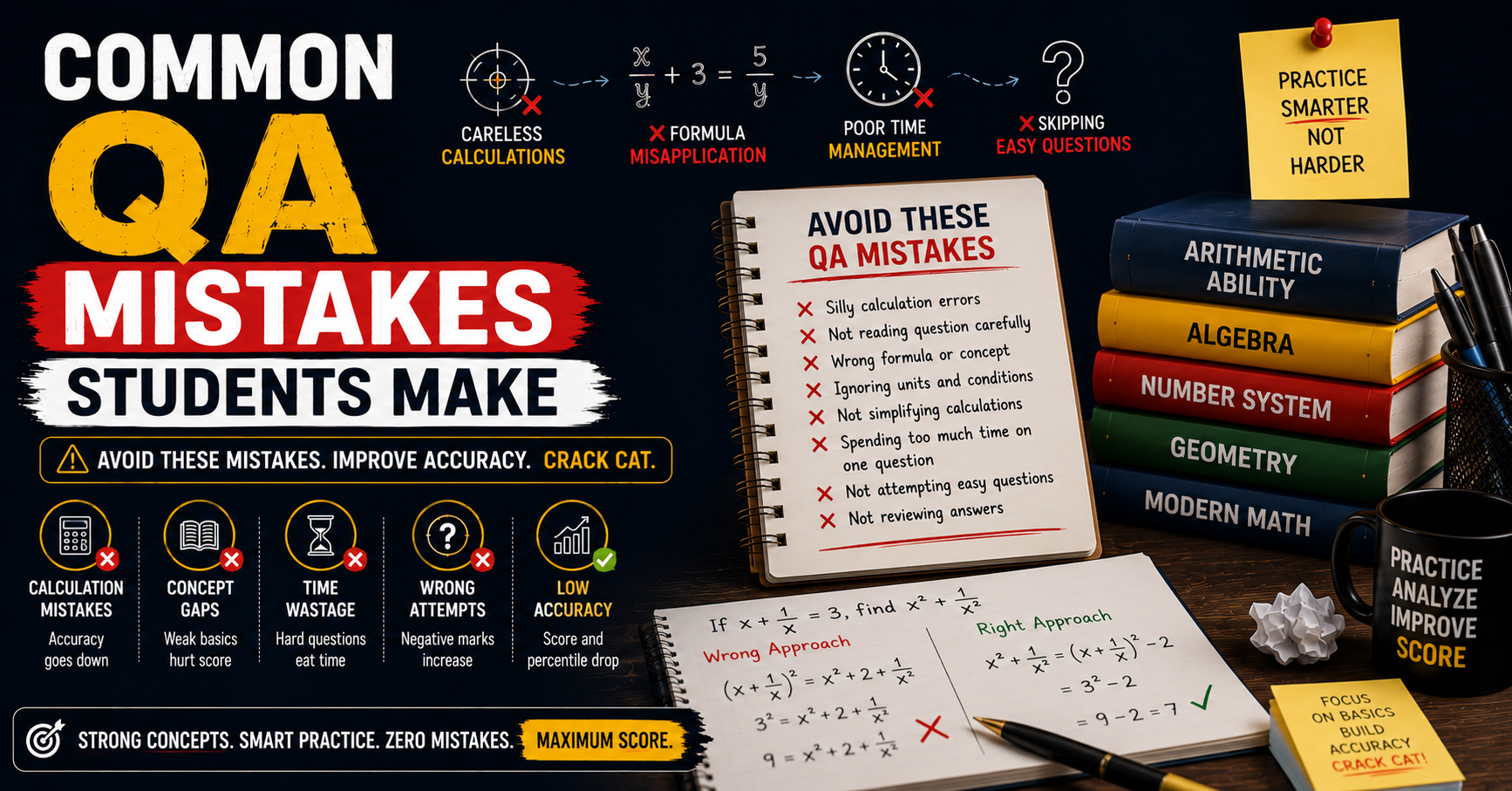
QA mistakes are expensive in a very specific way. Each wrong MCQ answer costs four marks in net impact – you miss the +3 and pay the −1. Furthermore, QA has 22 questions and a strict 40-minute timer. Consequently, one bad habit repeated across 10 questions can silently destroy a score.
Additionally, QA mistakes are rarely random. They cluster around specific habits that repeat identically across every mock. Therefore, identifying your pattern of errors is more valuable than solving 100 extra practice questions.
Why Most Students Keep Making the Same Errors
Most students review wrong answers after a mock but never ask why the error happened. They check the solution, understand it, and move on. Furthermore, this review process fixes the specific question but never fixes the underlying habit. Consequently, the same mistake reappears in the next mock – dressed in a different question.
Additionally, QA errors typically fall into two buckets: conceptual errors and strategic errors. Conceptual errors stem from incomplete topic understanding. Moreover, strategic errors – over-attempting, ignoring TITA, poor time management – persist regardless of topic knowledge. Therefore, fixing both layers simultaneously is the only path to a consistent QA improvement.
Skipping Arithmetic to Study Advanced Topics First
The Wrong Starting Point
Most students start QA preparation with Number Systems, Geometry, or Algebra. Furthermore, they find Arithmetic “too basic” and deprioritise it. Consequently, they build an advanced structure on a weak foundation — and the structure collapses on exam day.


Memorising Shortcuts Without Conceptual Understanding
When Tricks Become Traps
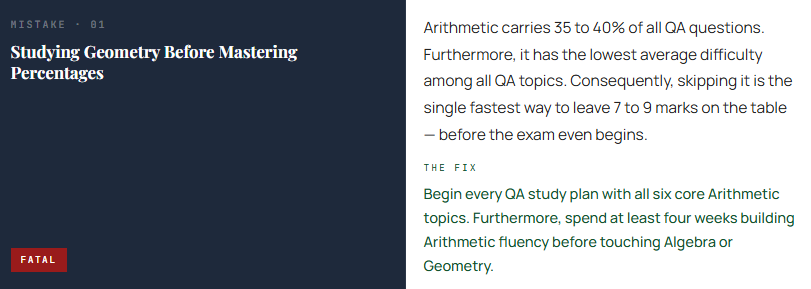
Shortcuts work on standard question formats. However, CAT regularly modifies familiar formats by one or two steps. Furthermore, a student who memorised a shortcut without understanding its logic cannot adapt to the modified version. Consequently, the shortcut fails at precisely the moment the student most needs it to work.
Ignoring TITA Questions
The Risk-Free Marks Nobody Claims
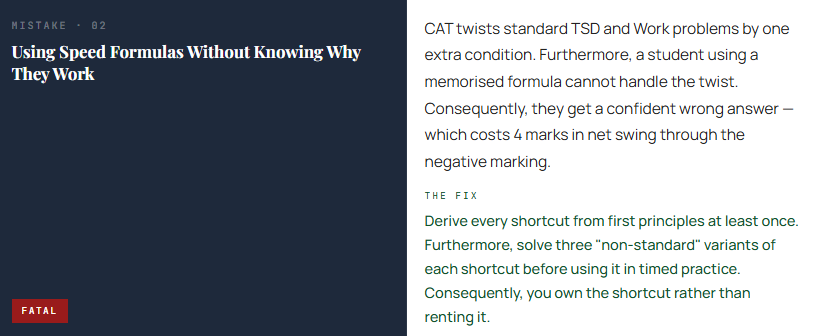
TITA questions carry +3 for a correct answer and zero penalty for a wrong one. Furthermore, CAT QA includes 6 to 8 TITA questions per paper. Consequently, skipping all of them surrenders up to 24 marks with zero justification.

Spending Too Long on One Question
The Two-Minute Rule Most Students Break
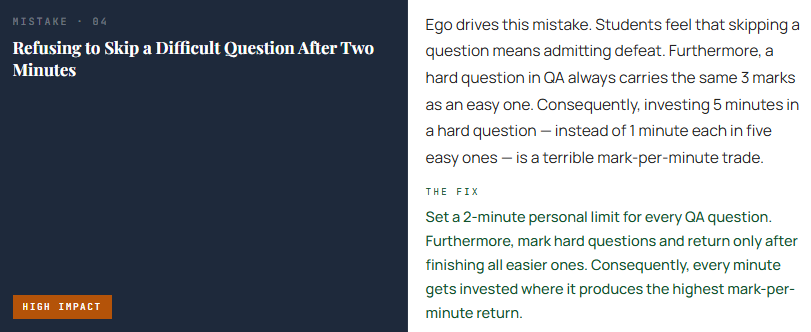
QA gives 40 minutes for 22 questions. That averages to under 2 minutes per question. Furthermore, spending 4 to 5 minutes on one hard question leaves too little time for three easier ones. Consequently, the student scores zero on the hard question and misses the easy marks entirely.
Over-Attempting with Low Accuracy
Volume Is Not a Strategy
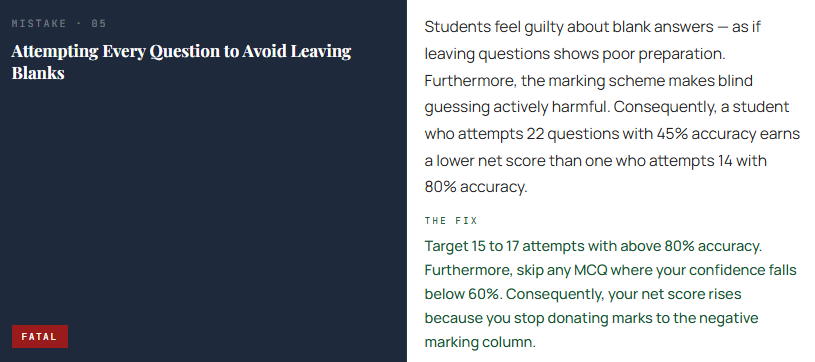
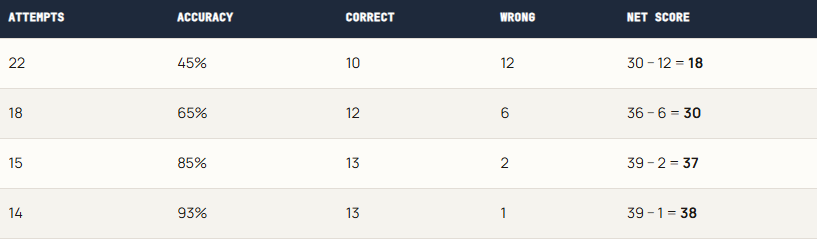
Many students try to attempt 20+ questions in QA and end up with 9 to 10 wrong answers. Furthermore, each wrong MCQ triggers a net 4-mark swing. Consequently, attempting 20 questions with 50% accuracy produces a lower score than attempting 14 with 85% accuracy.
Practising Without an Error Log
The Missing Tool Most Students Have Never Used
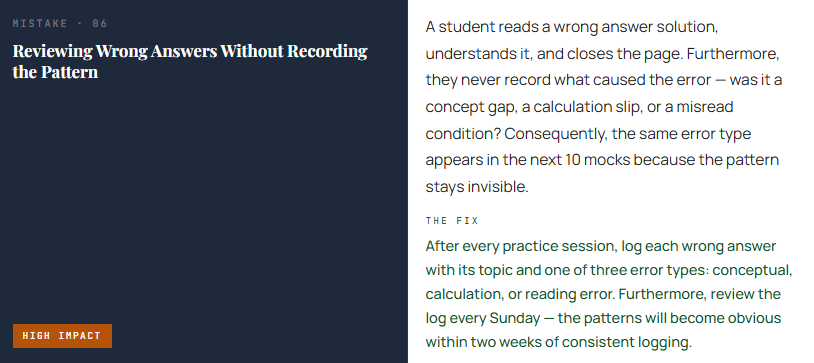
An error log tracks every wrong QA answer – the topic, the error type, and the root cause. Furthermore, it converts isolated practice mistakes into a visible pattern over time. Consequently, a student with a 30-session error log knows exactly which three topics destroy their score on every mock.
Severely Unbalanced Topic Coverage
Strength in Two Topics Cannot Cover Weakness in Three
Many students excel at Algebra and Number Systems but never practise Data Interpretation or Mensuration. Furthermore, CAT draws questions from all five QA topic areas without exception. Consequently, a student strong in two areas but weak in three cannot score above the 75th percentile – because 40 to 50% of the paper covers their weak zones.

Practising QA Without Time Pressure
Open Practice Builds False Confidence
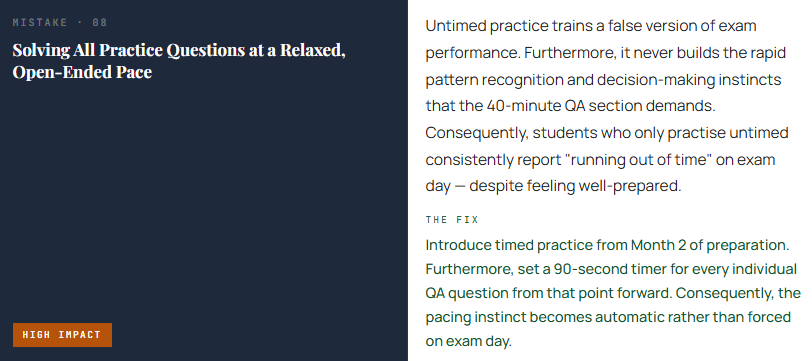
Students who solve QA problems without a timer often complete them correctly in 4 to 6 minutes each. Furthermore, the exam gives under 2 minutes per question on average. Consequently, their “mastery” of a topic exists only at a comfortable pace — and disappears under real exam pressure.

Relying on Formula Lists Over Deep Understanding
The Formula Sheet That Fails at the Worst Moment
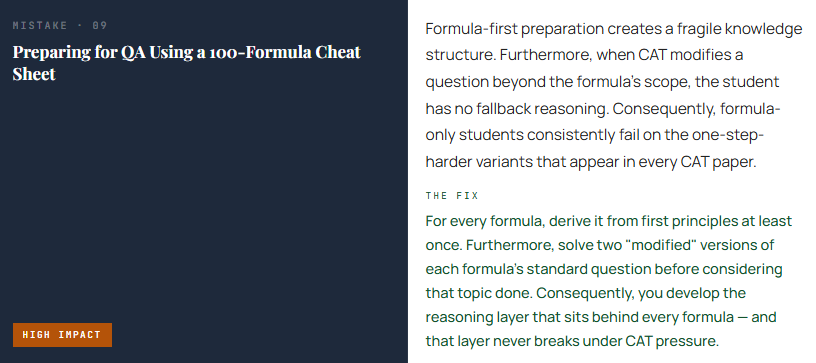
Formula sheets help when questions match standard formats exactly. However, CAT routinely adds one extra condition that makes direct formula application incorrect. Furthermore, a student with deep conceptual understanding adapts the formula to fit the twist. Consequently, the student with only a formula list gets a confident wrong answer.
Fixing All These Mistakes: A 6-Week Plan
From Error Identification to Score Improvement
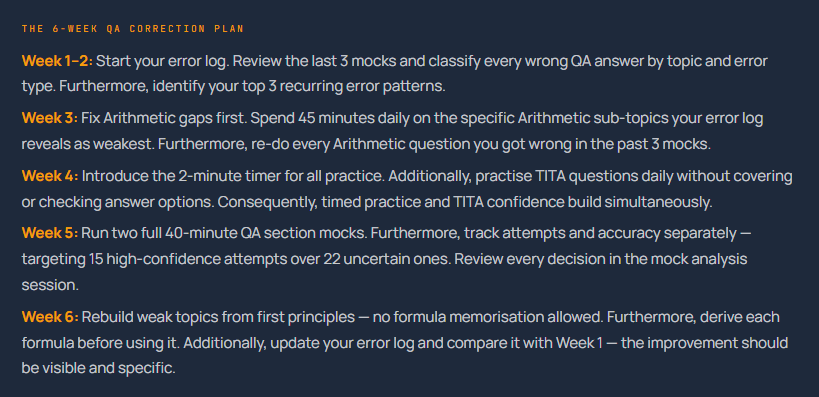
Identifying these mistakes is the first step. Furthermore, acting on them in a structured sequence is what produces the score improvement. Consequently, the following six-week correction plan addresses the most impactful mistakes first – in order of their mark-per-fix return.
15 Frequently Asked Questions
Q1. What is the single most damaging QA mistake in CAT?
Over-attempting with low accuracy is the most destructive single QA mistake. Furthermore, each wrong MCQ creates a net 4-mark swing – costing the missed +3 plus the −1 penalty. Consequently, a student attempting 22 questions with 45% accuracy consistently scores lower than one attempting 14 with 90% accuracy, regardless of topic knowledge.
Q2. Why should I study Arithmetic before other QA topics?
Arithmetic carries 35 to 40% of all QA questions – the highest share of any topic area. Furthermore, it has the lowest average difficulty, making it the most reliable source of marks in the section. Consequently, mastering Arithmetic first builds the highest-scoring floor possible before adding harder topics on top.
Q3. How do shortcuts hurt QA performance?
Shortcuts work only on standard question formats – and CAT regularly modifies formats by one step. Furthermore, a student who memorised a shortcut without understanding its logic cannot adapt it to a modified version. Consequently, they produce a confidently wrong answer, which costs 4 marks in net swing rather than the 0 marks from simply skipping.
Q4. Why is ignoring TITA questions such a significant mistake?
TITA questions carry no negative marking – every attempt has positive expected value regardless of confidence level. Furthermore, CAT QA includes 6 to 8 TITA questions per paper, representing up to 24 marks of risk-free opportunity. Consequently, skipping all TITA questions surrenders these marks with absolutely no strategic justification whatsoever.
Q5. What is the right number of questions to attempt in QA?
Most candidates targeting the 90th percentile should aim for 15 to 17 attempts with above 80% accuracy. Furthermore, attempting fewer questions with higher accuracy consistently produces better net scores than chasing higher attempt counts with poor accuracy. Consequently, tracking accuracy rate per session – not attempt count – is the more useful performance metric for QA improvement.
Q6. What is a QA error log, and how do I build one?
A QA error log records every wrong practice answer with its topic and error type – conceptual, calculation, or reading error. Furthermore, reviewing the log weekly reveals which three specific error types repeat most frequently across all practice sessions. Consequently, targeted remediation of those patterns produces faster score improvement than random additional practice does.
Q7. How does untimed practice hurt QA performance?
Untimed practice builds solving ability at a comfortable pace – but CAT gives under 2 minutes per question. Furthermore, students who only practise without timers never develop the rapid pattern recognition and decision-making instincts that real time pressure requires. Consequently, their performance under actual exam conditions consistently falls 20 to 30 percentile points below their practice expectations.
Q8. What is the 2-minute rule in QA?
The 2-minute rule states that any QA question not solved within 2 minutes should be marked and skipped immediately. Furthermore, a hard question always carries the same 3-mark reward as an easy one – making time-per-mark efficiency the key metric. Consequently, returning to skipped questions after easier ones are finished often produces better total scores than grinding through hard questions sequentially.
Q9. How does unbalanced topic coverage affect QA scores?
Students who focus on two favourite topics build depth in 30 to 40% of the paper and leave the rest undertrained. Furthermore, comfort-zone topics quickly reach ceiling performance – meaning additional time invested there produces diminishing returns. Consequently, the fastest QA score improvement almost always comes from improving weakest topics, not strengthening already-strong ones.
Q10. Why do formula sheets fail in CAT QA?
Formula sheets work when questions match standard formats exactly – but CAT adds one extra condition to familiar question types. Furthermore, a student without the reasoning behind a formula cannot adapt it to a modified version. Consequently, formula-only preparation produces confident wrong answers on the question variants that appear most frequently in actual CAT papers.
Q11. How quickly can I fix these QA mistakes?
Strategic mistakes – over-attempting and TITA avoidance – improve within 3 to 4 mocks of conscious rule application. Furthermore, conceptual mistakes – formula-only preparation and Arithmetic gaps – improve within 3 to 4 weeks of targeted daily drilling. Consequently, a candidate who identifies and addresses both layers simultaneously typically sees a 10 to 15 percentile improvement in QA within six weeks.
Q12. How many QA mock tests should I take before CAT?
Most experts recommend at least 20 full-length CAT mocks with a complete 40-minute QA section before the exam. Furthermore, section-wise timed QA drills – 22 questions in 40 minutes – should supplement full mocks throughout preparation. Consequently, the combination builds both individual topic speed and full-section strategic management simultaneously.
Q13. What is the most effective way to practise TITA questions?
Practise TITA questions by covering all answer options and working to a solution independently. Furthermore, this replicates the exact exam condition – where no choices exist to guide or eliminate. Consequently, students who practise TITA this way consistently report higher confidence and accuracy on real exam TITA questions than those who always see answer choices during practice.
Q14. Does CATMock help identify specific QA mistakes?
Yes, CATMock’s post-mock analysis reports break down QA performance by topic, question type, time spent, and accuracy rate. Furthermore, these reports identify which specific error types – conceptual, calculation, or reading – drove each wrong answer. Consequently, students who review CATMock analysis reports consistently fix their QA mistakes faster than those who only count wrong answers without classifying them.
Q15. What is the biggest difference between 80th and 95th percentile QA scorers?
The primary difference is accuracy discipline – not solving speed or topic breadth. Students at the 95th percentile attempt fewer questions with higher confidence. Furthermore, they apply strict skip rules, claim every TITA mark, and never let negative marking erode their net score. Consequently, the percentile gap is mostly a strategic gap – one that targeted habit change fixes far faster than additional topic study does.