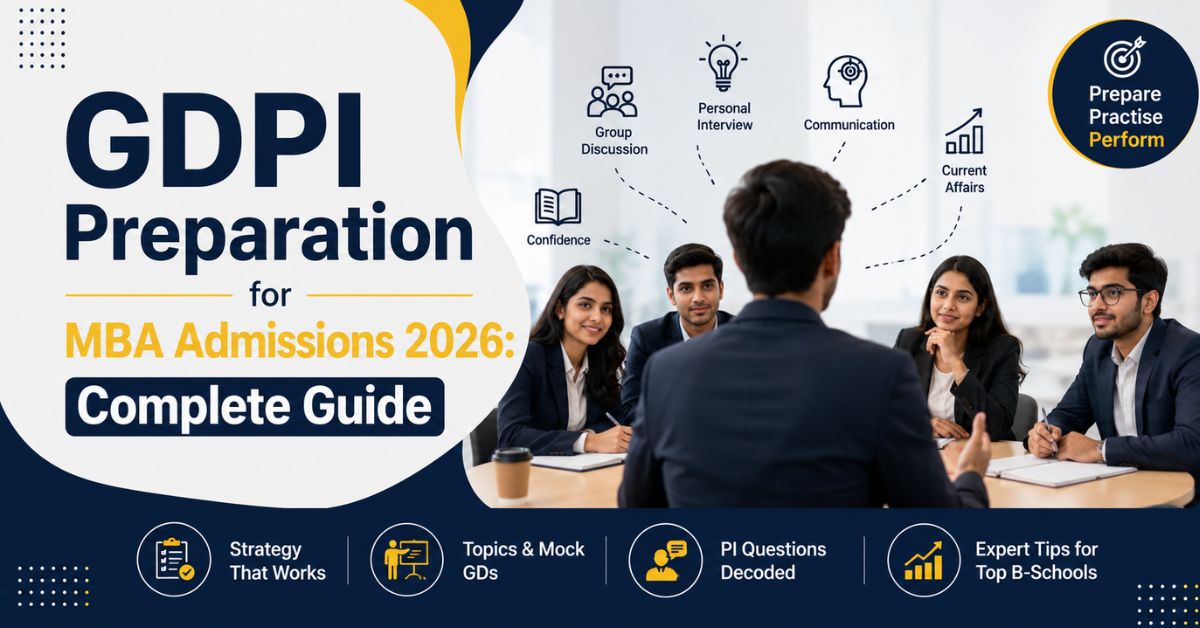
MBA entrance exams such as CAT, XAT, SNAP, and NMAT are only the first hurdle. After achieving a competitive percentile, candidates move toward the GDPI round, where final selections are heavily influenced by communication skills, personality, awareness, and clarity of thought.
Therefore, preparing for GDPI in 2026 has become equally important as scoring well in entrance examinations. Many aspirants with excellent percentiles fail to convert calls, while candidates with relatively lower scores secure admissions because of strong interview performance.
This complete guide explains every stage of GDPI preparation for MBA admissions in India, including strategies, common questions, current affairs preparation, interview mistakes, and FAQs.
📋 Table of Contents
- Understanding the GDPI-WAT Process
- Group Discussion — Types & Formats
- How to Perform Well in a GD
- Written Ability Test (WAT)
- Personal Interview — Foundation
- Cracking the “Why MBA?” Question
- Knowledge Base & Current Affairs
- GDPI Patterns at Top Colleges
- Body Language & Presentation
- Mock Sessions & Practice Plan
- Common Mistakes to Avoid
- Final Preparation Checklist
- 15 Frequently Asked Questions
Section 01: Understanding the GDPI-WAT Process in India
- GDPI stands for Group Discussion and Personal Interview, two evaluation rounds used by virtually every top business school in India after shortlisting candidates on the basis of entrance exam scores.
- In addition, most premier institutes including all 20 IIMs also include a Written Ability Test, making the full process a three-pronged assessment.
- Together, these rounds evaluate communication, reasoning, self-awareness, and leadership potential in ways that a written exam simply cannot.
- Furthermore, GDPI rounds are not just about what you say they are equally about how you think, listen, and respond under pressure.
- Therefore, understanding the structure of each round before you begin preparing saves enormous time and energy.
- The process differs significantly across institutes, which makes school-specific preparation an absolute necessity rather than a luxury.
Section 02: Group Discussion — Types & Formats
- Group Discussions across Indian B-schools typically fall into four broad categories: topic-based GDs, case study GDs, abstract GDs, and fish-bowl GD.
- Notably, IIM Ahmedabad is known for case-based GDs, while institutes like XLRI and MDI frequently use fact-based or policy-oriented topics.
- Hence, knowing which format your target school prefers gives you a meaningful head start in preparation.
Topic-Based GD
- Topic-based GDs are the most common format, covering current affairs, social issues, business topics, and government policy.
- For instance, topics like “India’s role in the G20,” “AI regulation in emerging economies,” or “Gig economy workers and labour rights” have been commonly used in recent seasons.
- Therefore, broad awareness of national and global events is your first and most foundational preparation task.
Abstract & Case-Based GD
- Abstract GDs test creative thinking by presenting open-ended themes like “A blank canvas” or “The road not taken.”
- In contrast, case-based GDs present a business problem for the group to collectively analyse and solve within a fixed time frame.
- Both formats test entirely different cognitive muscles and most serious aspirants must be comfortably prepared for all variations.
Section 03: How to Perform Well in a Group Discussion
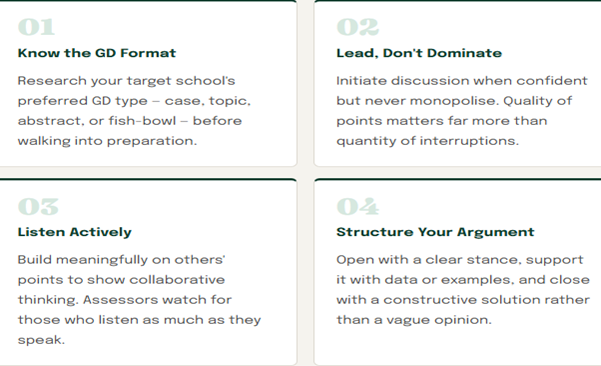
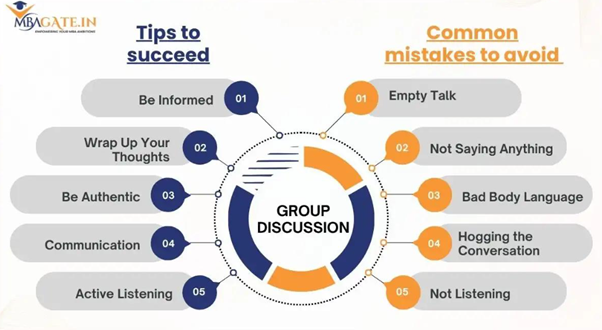
Strong GD performance is built on three pillars: content quality, communication clarity, and group dynamics management. First and foremost, entering a GD with zero preparation on the topic is one of the most damaging things a candidate can do.
Therefore, reading three to four newspapers daily: The Hindu, Economic Times, and Business Standard are strongly recommended builds the factual depth required for confident participation.
Initiating vs. Summarising
- Initiating a GD is a high-reward, high-risk move that requires a clear opening statement backed by a structured framework.
- On the other hand, summarising the discussion at the end if given the opportunity is often underrated as an assessment moment.
- Accordingly, preparing both an opening and a closing statement for any anticipated topic is a tactic that gives you two distinct chances to shine within a single round.
Handling Disagreements Gracefully
- Disagreements in a GD are completely natural and even desirable assessors want to see how you handle conflicting views.
- However, attacking a person rather than their argument is an immediate red flag for any evaluator.
- Instead, use phrases like “I see your point, though data from X suggests an alternative perspective” to keep the conversation professional, data-driven, and respectful throughout the round.
Section 04: Written Ability Test (WAT) — Often Overlooked, Always Important
What is WAT?
- The Written Ability Test requires candidates to write a structured essay of 200–300 words on a given topic within 15–20 minutes.
- Notably, WAT topics in 2025 included themes like “India’s climate commitments vs. industrial growth,” “the ethics of AI in hiring,” and “should social media platforms be regulated?” all requiring both opinion and evidence in a tightly structured format.
- Additionally, each WAT essay must follow a clear three-part structure: an introduction that contextualises the issue, a middle section that presents both sides with evidence, and a conclusion that offers a reasoned personal stance.
- As a result, candidates who practise this structure religiously produce far more coherent and evaluable writing than those who write instinctively without structure under time pressure.
Weightage of GDPI in Final MBA Selection
Approximate weightage across institutes:
| Component | Weightage |
| Entrance Exam | 30–60% |
| GD/WAT | 10–20% |
| PI | 20–40% |
| Academics/Profile | Variable |
Interview performance can significantly influence final conversion.
Section 05: Personal Interview — Building the Foundation
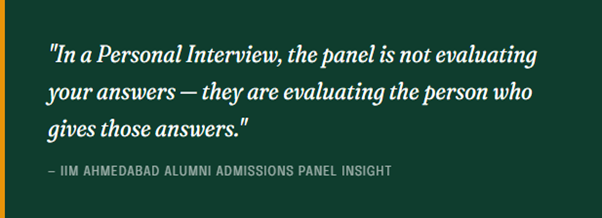
The Personal Interview is where the admissions committee finally meets the human being behind the CAT scorecard and application form.
Consequently, your preparation must go far deeper than rehearsing a polished “Tell me about yourself” answer.
Instead, every line on your resume, every project, every gap year, every achievement, and every stated career goal must be understood and defensible at a level of detail that withstands ten to fifteen minutes of probing cross-examination.
The “Tell Me About Yourself” Answer
- This is always the opening question and almost always the most important one in the entire interview. Therefore, craft a 90-second answer that moves logically from your background, to your key professional experience, to your MBA goal without reading like a resume summary.
- Critically, end with a sentence that naturally bridges into the school’s specific strengths, so the interviewer is immediately drawn into the rest of the conversation.
Handling Stress Questions
- Stress interviews deliberately designed to make you uncomfortable are practised at institutes like IIM Calcutta, FMS Delhi, and IIFT.
- For example, interviewers may bluntly challenge your chosen career path, question the relevance of your degree, or push back hard on an opinion you expressed.
- Nevertheless, the goal is never to win the argument, it is to demonstrate composure, intellectual honesty, and the ability to think clearly under genuine pressure.
Section 06: Cracking the “Why MBA?” and “Why This College?” Questions
These two questions appear in virtually every MBA interview conducted in India, and yet remain poorly answered by the majority of shortlisted candidates. Specifically, “Why MBA?” must explain why the degree is necessary for your particular career goal right now not why MBAs are generally valuable or prestigious.
Therefore, your answer must link your past experience to your future goal, and position the MBA as the most logical bridge between the two.
Equally important, “Why this college?” is not an invitation to recite the school’s NIRF ranking or annual placement figures. Rather, your answer must reference specific clubs, faculty research areas, batch diversity, live projects, or alumni networks that directly serve the career you have described.
Accordingly, visiting campuses, attending open days, and speaking with current students are investments that transform a generic answer into a genuinely compelling one.
Section 07: Knowledge Base & Current Affairs Preparation
A strong knowledge base is the invisible backbone of both GD performance and PI depth. Notably, interview panels at IIM Bangalore, XLRI Jamshedpur, and FMS Delhi are known to discuss Union Budget provisions, RBI monetary policy decisions, and geopolitical developments with remarkable specificity.
Hence, maintaining a daily reading habit particularly around Indian economy, business news, science and technology, and international affairs is non-negotiable for any candidate in the 2026 admission season.
Tools for Effective Current Affairs Prep
- Candidates who prepare well typically follow a weekly editorial digest from The Hindu or Indian Express, listen to podcasts like “The IVM Podcast” or BBC Global News, and maintain a personalised notes document.
- Additionally, following credible X (formerly Twitter) accounts of economists, policy analysts, and international journalists provides a real-time layer of awareness that newspaper reading alone cannot fully replicate.
- Over time, these habits build a mental database of examples and data points that you can deploy naturally and fluently in any GD or PI setting.
Academic & Technical Knowledge
- Your undergraduate degree subject is almost always explored in depth during a PI, particularly if it is a technical field like engineering, medicine, or law.
- Therefore, refreshing your fundamentals, operating systems for a CS graduate, thermodynamics for a mechanical engineer, or corporate law for an LLB holder is a critical preparation task.
- Furthermore, being able to draw connections between your technical background and your MBA goals makes for an exceptionally cohesive and memorable interview narrative.
Section 08: GDPI Patterns at Top Indian B-Schools
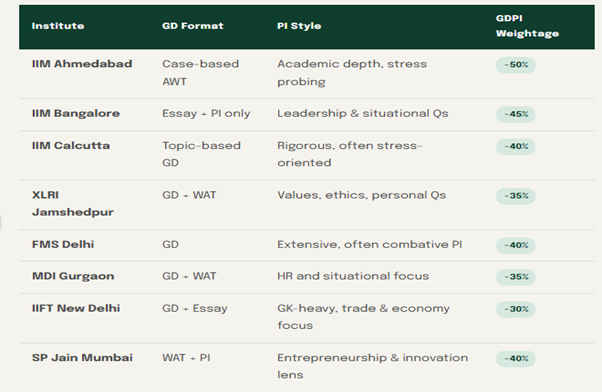
Each business school has its own distinctive GDPI style, and treating all institutes identically is one of the most common and costly preparation mistakes. Therefore, the table below provides a school-by-school breakdown of what to expect in the 2026 admissions cycle.
Section 09: Body Language, Appearance & Professional Presence
- Non-verbal communication accounts for a significant portion of the impression formed by a panel within the first 90 seconds of an interview.
- Therefore, formal business attire a well-ironed shirt and trousers for men, and formal western or Indian business wear for women is the standard expectation across all top Indian business schools.
- Equally important, your posture, eye contact, and the firmness of your handshake all signal confidence and professionalism before a single word is spoken.
- Furthermore, maintaining consistent eye contact with all panel members rather than fixating on one interviewer is a subtle but powerful marker of social intelligence.
- Additionally, nodding occasionally while listening, sitting upright without rigidity, and keeping hand gestures calm and purposeful all contribute to an impression of composure under evaluation.
- Conversely, fidgeting, avoiding eye contact, and speaking with a monotone voice can undermine even the most intellectually impressive content.
Section 10: Mock Sessions & a Structured Practice Plan
Mock GDs and PIs are the single most effective preparation tool available yet a significant number of candidates neglect them until the week before their actual round.
Instead, a structured eight-week practice plan should begin immediately after receiving your shortlist. Specifically, the first two weeks should focus on knowledge building and WAT practice, weeks three through five on mock GDs with peers, and weeks six through eight on daily PI mock sessions with a mentor, coach, or senior professional.
Moreover, recording your mock interview sessions, either video or audio and reviewing them critically is a habit that delivers disproportionate improvement in a short period.
Additionally, taking feedback from people who are honest rather than encouraging is invaluable, because genuine blind spots about communication patterns rarely reveal themselves through self-assessment alone.
Section 11: Common GDPI Mistakes to Avoid in 2026
Over-talking in GDs drowning out other participants and contributing noise rather than insight remains the single most penalised behaviour observed by assessors at Indian B-schools.
Similarly, entering a Personal Interview without having researched the specific school’s programme, faculty, or placement data signals a lack of genuine interest that is immediately apparent to any experienced panel.
Therefore, every interview preparation session must include at least thirty minutes of dedicated school-specific research.
Another common mistake is memorising rehearsed answers and reciting them verbatim, which produces a robotic delivery that experienced interviewers find off-putting.
Instead, prepare themes and talking points rather than scripts, so your answers feel fluid and conversational.
Section 12: Final GDPI Preparation Checklist
Before your actual GDPI date, every item below should be thoroughly addressed and practised. Specifically, any area marked incomplete should receive focused attention at least two weeks before the scheduled round.
🗂️ GDPI Readiness Checklist — 2026
- ✓Current Affairs: Daily newspaper reading habit established for at least 8 weeks before GDPI economy, policy, international affairs.
- ✓GD Practice: Minimum 10–15 mock GDs across all format topic-based, case-based, and abstract.
- ✓WAT Practice: At least 12 timed essays written and reviewed for structure, grammar, and argument quality.
- ✓PI Preparation: Resume mapped and every entry defended; SOP reviewed; technical subject refreshed.
- ✓Why MBA / Why This School: School-specific answers prepared after research, campus visits, and student conversations.
- ✓Mock PI Sessions: Minimum 5 full-length mock PIs with recorded feedback and documented improvement.
- ✓Stress Interview Prep: Practised responding to challenging and combative questions calmly and clearly.
- ✓Appearance & Body Language: Interview outfit decided; posture, eye contact, and handshake practised.
Section 13: 15 Frequently Asked Questions
Every common GDPI doubt — answered with precision for the 2026 admissions season in India.
1. What does GDPI stands for and which colleges use it?
GDPI stands for Group Discussion and Personal Interview. Virtually all top Indian B-schools including all IIMs, XLRI, FMS, MDI, IIFT, and SP Jain use this combination as a final selection stage after written entrance exam shortlisting.
2. How much weightage does GDPI carry in the final selection at IIMs?
Weightage varies by institute and year, but GDPI typically accounts for 35–50% of the final composite score at most IIMs. Academic profile, work experience, and gender diversity also factor into composite scores, so a strong GDPI performance can significantly offset a borderline CAT percentile.
3. How early should I start GDPI preparation?
Ideally, daily newspaper reading and current affairs habits should begin 3–4 months before the expected GDPI season, which typically runs from January to March for the 2026 admissions cycle. Dedicated mock GD and PI sessions should begin immediately after receiving your shortlist call.
4. Is it better to initiate a group discussion or to summarize it?
Both are high-visibility opportunities, but initiation carries more risk. If you open with a well-structured, fact-backed statement, it immediately establishes your credibility. Summarising effectively demonstrates synthesis skills and requires you to capture all perspectives fairly which is equally impressive if done well.
5. What topics are likely to be asked in GDs for the 2026 MBA season?
Based on recent trends, expect topics around AI and job displacement, India’s semiconductor push, climate finance, gig economy regulation, electoral politics and governance, women in leadership, and India’s global trade positioning. Abstract topics like “The value of silence” or “Two roads diverged” are also common at certain institutes.
6. How do I handle a topic I know nothing about in a GD?
Listen carefully in the first minute and take structured notes as others speak. Build your first contribution around a general framework cause and effect, pros and cons, or a stakeholder analysis that you apply to whatever information the group has already surfaced. Never fabricate facts; vague but structured reasoning is always safer than confident misinformation.
7. What is the WAT and how is it compared to GD and PI?
WAT – Written Ability Test is a 15–20 minutes timed essay used by IIMs and several other institutes instead of or alongside the GD. It is often underweighted in candidates’ preparation but can serve as a meaningful differentiator, especially at institutes where GD groups are large and individual speaking time is limited.
8. How should I answer the “Tell me about yourself” question in a PI?
Structure your answer in 90 seconds using a past-present-future framework: where you come from, what you have accomplished professionally, and where you want to go with the MBA as the logical bridge. Always end with a sentence that invites the interviewer deeper into your story, rather than closing with a full stop.
9. What should I do if I don’t know the answer to a PI question?
Say so clearly and without embarrassment. Saying “I’m not certain of the specific answer, but my reasoning would lead me toward X because…” is far better than guessing and being caught wrong. Intellectual honesty is treated as a sign of maturity and confidence by most PI panels at Indian B-schools.
10. Do I need a coaching centre for GDPI preparation?
A coaching centre can provide structured mock sessions and expert feedback, which is genuinely valuable. However, it is not a strict requirement if you have access to a strong peer group for mock GDs, a professional mentor for PI practice, and the discipline to build a consistent knowledge base independently.
11. How important is English fluency in a GD or PI?
Fluency matters, but clarity of thought matters more. A candidate who speaks moderately accented but logically structured English almost always scores higher than one who speaks fluently but says very little of substance. Focus on structure, vocabulary precision, and confidence rather than imitating a particular accent or delivery style.
12. Can a strong GDPI performance compensate for a low CAT percentile?
To a meaningful degree, yes particularly at institutes where GDPI carries 40–50% weightage. However, most top IIMs set firm minimum percentile cutoffs that determine whether you even receive a shortlist call, which means the written exam remains your entry ticket and GDPI is where the real selection happens.
13. How should I prepare for IIM Ahmedabad’s AWT-PI specifically?
IIM Ahmedabad uses an Academic Writing Test instead of a GD. A case is provided for written analysis followed by a rigorous PI focused on academic depth, analytical reasoning, and intellectual consistency. Preparation should prioritise analytical essay writing, revisiting your academic subjects in depth, and preparing for long-form intellectual discussions rather than rapid GD point-making.
14. How do I prepare for a stress interview specifically?
Ask a mentor or peer to explicitly challenge, dismiss, or pressure-test your answers during mock sessions. The goal is to become genuinely comfortable with disagreement and pushback, so that when it happens in a real panel, it registers as a familiar challenge rather than a destabilising surprise. Practise pausing before responding a two-second pause reads as composure, not weakness.
15. What is the single most important thing to do the night before my GDPI?
Stop preparing new material. Review your resume and key talking points one final time, lay out your clothes and documents, and get seven to eight hours of sleep. Your best performance comes from a rested, alert mind not from cramming a seventh newspaper article at midnight. Trust the preparation you have already done.
You may also visit: CATMOCK INDIA|CATMOCK