


MBA Exam Prep · Strategy Guide
A field guide for the ambitious MBA aspirant navigating India’s two most demanding entrance exams simultaneously.
⏱ 12 min readCATXATMBA Prep
Table of Contents
- Understanding the Two Exams
- Exam Structure at a Glance
- Key Differences That Actually Matter
- Where the Two Exams Overlap
- Strategising for CAT
- Strategising for XAT
- Running Both Preps Simultaneously
- A Realistic Study Timeline
- Common Mistakes to Avoid
- 15 Frequently Asked Questions
Understanding the Two Exams
Every year, hundreds of thousands of MBA aspirants across India grapple with a pivotal decision: should CAT alone be pursued, or should XAT be added to the preparation list? Both exams are conducted separately — CAT by the IIMs on a rotating basis, and XAT by XLRI Jamshedpur — yet they are frequently taken by the same pool of candidates.
Although both serve as gateways to India’s premier B-schools, the philosophy underpinning each exam is quite distinct. CAT leans toward measuring quantitative aptitude, logical reasoning, and verbal ability. XAT, on the other hand, places considerable emphasis on decision-making and general awareness, skills that are rarely tested in CAT.
Consequently, a candidate who performs brilliantly in CAT may still struggle in XAT without deliberate, targeted preparation. Understanding this distinction early is what separates smart candidates from overworked ones.INDIA’S TOP MBA ENTRANCE LANDSCAPECATConducted by IIMs (Rotational)~2.4 Lakh Registrations3 Sections · 2 Hours200+ Accepting InstitutesXATConducted by XLRI Jamshedpur~1 Lakh Registrations5 Sections · 3.5 Hours150+ Accepting InstitutesVS

Exam Structure at a Glance
CAT: The IIM Gateway
CAT is divided into three sections: Verbal Ability and Reading Comprehension (VARC), Data Interpretation and Logical Reasoning (DILR), and Quantitative Ability (QA). Each section is time-bound, meaning that candidates cannot move freely between sections mid-test. This sectional time constraint has long been one of CAT’s defining challenges.
The scoring uses a +3/–1 scheme for MCQs, while non-MCQ questions carry no negative marks. As a result, strategic guessing is only rewarded when deployed thoughtfully, particularly in the DILR section, where entire sets can be left unattempted without penalty if approached with TITA (Type in the Answer) questions.
XAT: The XLRI Benchmark
XAT is notably longer and more complex in structure. It contains Decision Making (DM), Verbal and Logical Ability (VLA), Quantitative Ability and Data Interpretation (QADI), and General Awareness (GA) — the last of which is not scored as part of the main percentile but is used directly in the XLRI interview shortlisting process. Additionally, an Essay Writing component has been included in recent years.
The Decision Making section is unique to XAT and arguably the most challenging section to crack. It tests ethical reasoning, situational judgment, and business acumen — none of which can be mastered through formula-based preparation alone. Unlike CAT, XAT does not restrict movement within a section, which offers slightly more flexibility to candidates.
CAT Structure:
Sections 3 – VARC, DILR, QA
Duration – 2 Hours
Questions – 68 Qs Note: The number of questions in CAT can change from year to year.
Negative Marking -1 for MCQs
Sectional Limit – Yes (40 min each)
Essay – No
Refrence: Wikipedia
XAT Structure:
Sections 4+Essay – DM, VLA, QADI, Gk
Duration- 3 Hours
Questions – 95 Qs
Negative Marking – 0.25 + unattempted penalty
Sectional Limit – No
EssayYes (30 min)
Source: XAT
Key Differences That Actually Matter
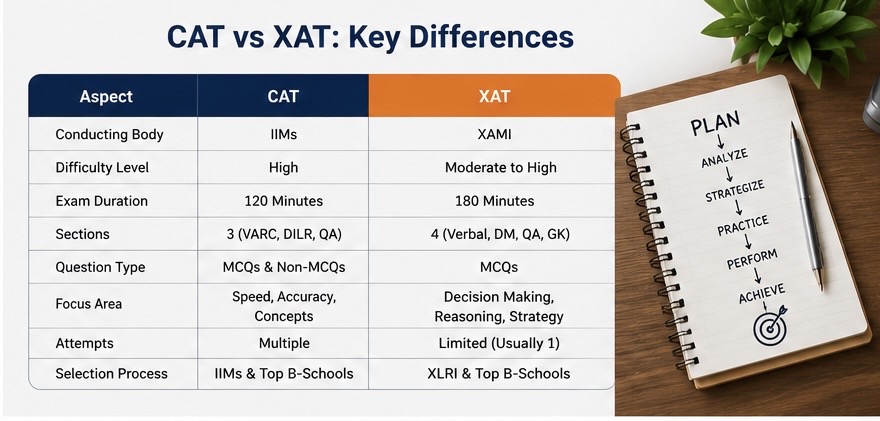
Beyond structure, the philosophical differences between the two exams shape how preparation must be approached. CAT rewards speed, precision, and the ability to work under tight time constraints. XAT, however, rewards analytical depth — particularly in Decision Making, where there are rarely straightforward “correct” answers and where nuanced reasoning is being assessed.
Furthermore, XAT penalises unattempted questions beyond a threshold (typically more than 8 unattempted questions lead to an additional penalty), which changes the entire test-taking strategy. Meanwhile, CAT allows candidates to leave TITA questions unattempted with zero risk. These mechanics fundamentally alter how time should be allocated in each exam.
The General Awareness section in XAT is another unique feature. Business news, current economic events, and static GK related to management, geography, and society are frequently tested — a domain that CAT completely ignores. Consequently, a candidate cannot succeed in XAT through quantitative and verbal preparation alone.
“Preparing for XAT without addressing Decision Making is like training for a marathon while skipping leg day — technically possible, but the outcome is predictable.”
Where the Two Exams Overlap
Despite their differences, both exams share significant common ground. Quantitative ability forms the backbone of both — topics such as number systems, algebra, geometry, arithmetic, and permutations and combinations are fair game in both CAT QA and XAT QADI. Additionally, Reading Comprehension is central to both CAT VARC and XAT VLA, meaning that any candidate who builds strong reading habits benefits across both exams simultaneously.
Data Interpretation also appears in both exams, although the style and complexity differ slightly. Logical reasoning, particularly arrangements, syllogisms, and critical reasoning, is tested in both formats — albeit with XAT often embedding logical elements within its Decision Making sets as well. This overlap is precisely why combined preparation, when structured correctly, is both practical and efficient.
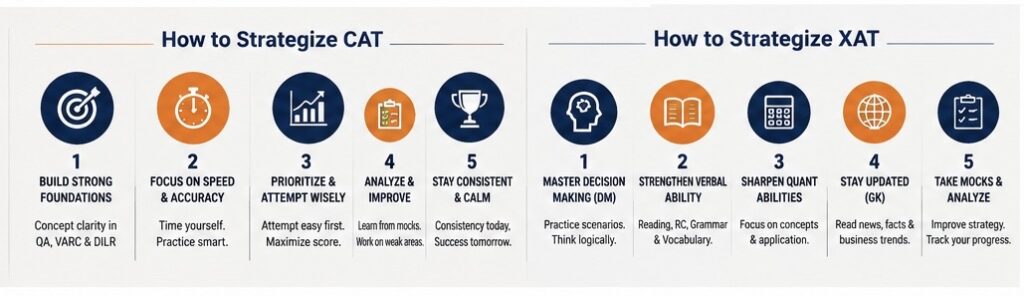
Strategising for CAT
Quantitative Ability — Build Foundations First
Most aspirants underestimate how much time QA demands. Rather than jumping into mock tests immediately, a solid 8–10 week foundation phase should be prioritised — covering all arithmetic topics, basic algebra, and geometry before moving to advanced topics like progressions and coordinate geometry. After that, daily practice of 15–20 questions becomes non-negotiable.
Speed improvement in QA is almost always a byproduct of conceptual clarity, not rote practice. Additionally, maintaining an error log — where every wrong question is revisited within 48 hours — is one of the most underused yet powerful habits among top scorers.
VARC — Reading is the Foundation
VARC is both the most rewarding and the most humbling section for engineering-background candidates. The single most impactful habit that can be built is daily reading — not of textbooks, but of long-form articles from publications such as The Hindu, The Economist, or Aeon. Over time, this builds the reading speed and inference skills that RC questions demand.
Verbal Ability questions — particularly para-jumbles and odd-sentence-out — follow predictable structural patterns. Therefore, practising these with a focus on sentence connectors and logical sequencing rather than grammar alone is advisable.
DILR — Crack the Puzzle Within the Puzzle
DILR is widely regarded as the most volatile section in CAT, as the difficulty varies dramatically between papers. The most effective strategy here is set selection — spending the first 3–4 minutes of the section reading all sets and committing only to those that appear solvable. An entire set left unattempted due to poor selection costs far fewer marks than a half-solved complex set in which time was wasted.
1. Mock-Test Discipline
Attempt 1 full mock every weekend from October onwards. Analyse every wrong answer before the next mock.
2. Sectional Time Trials
Practice each section under its 40-minute limit independently at least 3x per week.
3. Error Log Habit
Maintain a categorised error log. Revisit all errors within 48 hours and note the conceptual gap.
4. Attempt Optimisation
Target 45–50 attempts with 85%+ accuracy rather than attempting 60+ questions recklessly.
Strategising for XAT
Decision Making — The Heart of XAT
Decision Making cannot be cracked by memorising frameworks, because XLRI intentionally designs questions with no universally correct answer. Instead, the approach is to develop a consistent ethical and managerial lens — one that prioritises stakeholder welfare, long-term consequences, and organisational values over short-term gains. Practising past XAT DM papers and carefully studying the official answer keys helps calibrate this lens over time.
Moreover, it is worth noting that DM often contains data-based caselets, mathematical reasoning sets, and condition-based puzzles alongside the ethical scenarios. Consequently, this section requires both analytical and ethical preparation — neither alone is sufficient.
General Awareness — Start Early, Stay Consistent
General Awareness for XAT covers business current affairs, Indian economy, management personalities, geography, and occasional static knowledge. The most pragmatic approach is to dedicate 15–20 minutes daily to reading business news — The Economic Times, Business Standard, and monthly current affairs compilations are reliable sources. Starting this habit at least six months before the exam is strongly recommended, since cramming GK in the final weeks yields limited results.
Essay Writing — Often Ignored, Never Forgiven
The XAT essay is evaluated during the interview stage and significantly influences the XLRI shortlisting decision. Although it does not contribute to the main percentile, a poorly written essay can undermine an otherwise strong XAT score. Topics are typically abstract or philosophical — practice writing structured, 300-word essays on socio-economic and management themes at least once a week from August onwards.
Running Both Preps Simultaneously
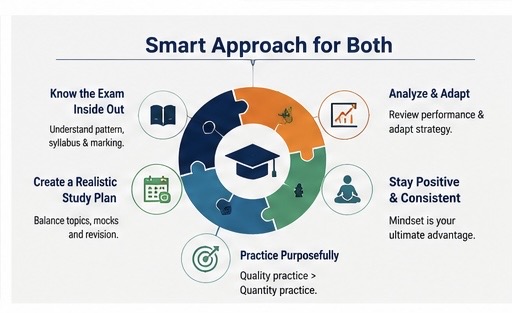
Preparing for CAT and XAT at the same time is entirely viable — in fact, it is the default path for most serious MBA aspirants. The key is to treat the shared syllabus as one unified block and layer the XAT-specific components on top. Specifically, quantitative ability and reading comprehension preparation should be conducted without distinction between the two exams. Only from October onwards should XAT-specific practice — decision making sets, GK revision, and essay writing — be scheduled as separate weekly modules.
Mock test scheduling is where many candidates stumble. Ideally, CAT mocks should be taken every Sunday, while XAT mocks are scheduled on alternate Saturdays from November onwards. This prevents cognitive overlap and ensures that XAT’s unique section dynamics are practised distinctly from CAT’s tighter time structure.DUAL-EXAM PREPARATION — SYLLABUS OVERLAP MAPCAT-OnlyDILR (set-based)Sectional Time LimitsCOMMONQA · RC · LRData InterpretationXAT-OnlyDecision MakingGK · Essay Writing
A Realistic Study Timeline
January – April
Concept-building phase. Cover all Quant, LR, and Verbal basics from scratch. Begin daily reading habit. No mocks yet.
May – July
Sectional practice phase. Work through topic-wise DI, RC, and DILR sets. Begin GK for XAT — 15 minutes daily. Start error logging.
August – September
Begin CAT sectional mocks. Add XAT Decision Making practice (2 sets per week). Essay writing practice begins — once weekly.
October – November
Full-length mocks: CAT every Sunday, XAT on alternate Saturdays. Aggressive error analysis. GK revision intensifies for XAT.
December (CAT) → January (XAT)
Final revision only. No new topics. Revise formulas, error logs, and DM frameworks. Rest well before each exam day.
Common Mistakes to Avoid
Perhaps the single most common mistake is treating XAT as merely a harder version of CAT. Because both exams test QA and verbal ability, many candidates assume that CAT preparation is sufficient for XAT as well — an assumption that consistently costs candidates their XLRI calls. XAT’s Decision Making and General Awareness sections require dedicated, standalone preparation irrespective of CAT performance.
Another frequently observed mistake is neglecting mock test analysis in favour of taking more mocks. Ten thoroughly analysed mocks deliver far more improvement than thirty hurriedly taken and abandoned ones. After each mock, at least as much time should be spent reviewing wrong answers as was spent taking the test itself.
Finally, the XAT unattempted question penalty is routinely underestimated. Unlike CAT, where leaving questions unattempted is a legitimate and often optimal strategy, XAT penalises excessive non-attempts. Therefore, a different approach to question selection and risk management must be adopted when practising XAT-specific mocks.
15 Frequently Asked Questions:
1. What is the major difference between CAT and XAT?
CAT mainly focuses on Quantitative Aptitude, Data Interpretation & Logical Reasoning, and Verbal Ability & Reading Comprehension. XAT, however, includes an additional Decision Making (DM) section and often has slightly different question patterns and difficulty levels.
2. Which exam is tougher: CAT or XAT?
The difficulty depends on individual strengths. CAT is generally considered challenging due to time pressure and unpredictable patterns, while XAT can feel tougher because of Decision Making and lengthy verbal sections.
3. Can CAT preparation help in XAT preparation?
Yes, CAT preparation covers around 70–80% of XAT syllabus, especially Quant, Verbal Ability, and Logical Reasoning. However, Decision Making and specific XAT question styles require separate practice.
4. Should I prepare for CAT and XAT together?
Yes, preparing together is recommended because the syllabi overlap significantly. A separate strategy for XAT Decision Making and mock tests should be added after building CAT fundamentals.
5. How much extra preparation is needed for XAT after CAT?
Usually, 4–8 weeks of focused preparation on Decision Making, XAT verbal questions, and previous year papers can help bridge the gap after CAT.
6. What is the best strategy to prepare for CAT and XAT simultaneously?
Start with common topics such as Quant, VARC, and LRDI. Later, dedicate weekly sessions to XAT Decision Making, essay writing (if applicable), and XAT-specific mocks.
7. Is the Quantitative Aptitude section similar in CAT and XAT?
The concepts overlap, but XAT Quant may include a broader range of arithmetic, geometry, and advanced topics. Question framing can also differ.
8. How important is Decision Making in XAT?
Decision Making is one of the most important sections in XAT and can significantly affect percentile. Regular practice with previous XAT papers is essential.
9. Are CAT and XAT mock tests necessary?
Yes, mocks are crucial for both exams. They improve time management, identify weak areas, and help candidates adapt to different exam patterns.
10. Which exam should I prioritize first: CAT or XAT?
CAT is usually prioritized because it occurs earlier and forms the foundation for XAT preparation. After CAT, preparation can shift toward XAT-specific sections.
11. Does XAT have negative marking?
Yes, XAT generally includes negative marking for incorrect answers and may penalize excessive unanswered questions. Candidates should verify the latest exam pattern each year.
12. How many months are sufficient for CAT and XAT preparation?
A preparation period of 6–12 months is often considered sufficient, depending on current aptitude levels and target percentile.
13. Can working professionals prepare for CAT and XAT together?
Yes, many working professionals prepare successfully by following structured study schedules, taking sectional tests, and focusing on consistency.
14. Which colleges accept CAT and XAT scores?
CAT scores are accepted by IIMs and many top B-schools, while XAT scores are accepted by institutions including XLRI Xavier School of Management and several other management institutes.
15. Is solving previous year papers enough for CAT and XAT?
Previous year papers are highly useful but not enough on their own. Candidates should combine them with concept building, mock tests, sectional practice, and performance analysis.
For More information about please visit: CAT|XAT
© 2026 CAT vs XAT: MBA Guide · For informational and educational purposes only.
You may also visit: CATMOCK INDIA|CATMOCK