


A definitive, data-backed comparison of India’s two most important business school entrance exams — so you can make the right call.
📋 Table of Contents
- Introduction
- GMAT vs CAT: Quick Overview
- Exam Pattern & Structure
- Syllabus & Skills Tested
- Difficulty Level & Competition
- Scoring System & Percentiles
- Attempt Flexibility & Timeline
- Colleges & Career Opportunities
- Fees & ROI Consideration
- Preparation Strategy Differences
- Which Exam Should You Choose?
- Conclusion
- Frequently Asked Questions (FAQs)
Introduction
Every year, hundreds of thousands of MBA aspirants in India face the same high-stakes crossroads: GMAT or CAT? Both exams open doors to world-class business education, yet they serve fundamentally different paths. Choosing the wrong one can cost you time, money, and — most importantly — the right career trajectory.
Furthermore, the lines between these two exams have blurred in recent years. Several Indian IIMs now accept GMAT scores, while top global schools have begun recognising CAT for their international programmes. Consequently, the decision is no longer as black-and-white as it once appeared.
In this comprehensive guide, every major dimension of GMAT vs CAT is covered — from exam structure and syllabus to fees, ROI, and preparation strategy. Whether you are a fresh graduate or a working professional, this blog will help you make a confident, informed decision.
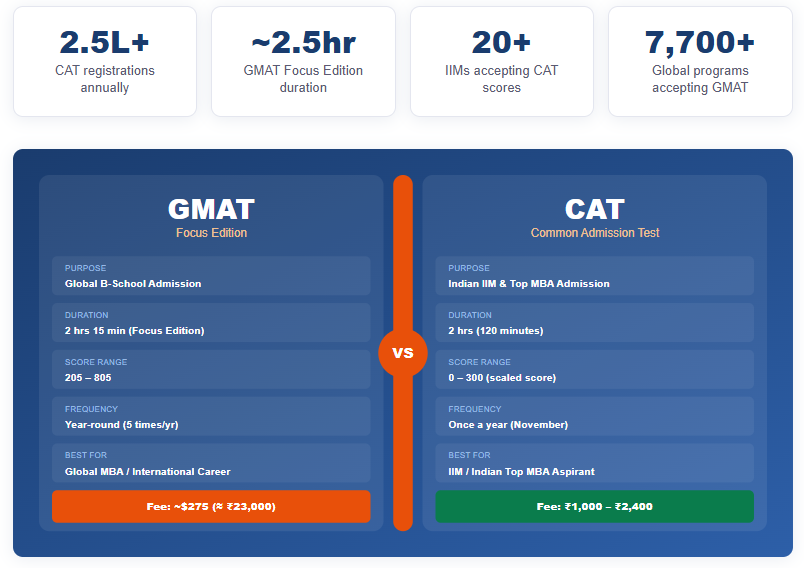
Fig. 1 — GMAT vs CAT: At-a-Glance Comparison (Key Parameters). | Infographic for illustrative purposes.
GMAT vs CAT: Quick Overview
Before diving deeper, it is helpful to understand what each exam fundamentally represents. The Graduate Management Admission Test (GMAT) is a globally administered, computer-adaptive exam that is conducted by the Graduate Management Admission Council (GMAC). It is primarily designed to assess readiness for graduate-level management education worldwide.
The Common Admission Test (CAT), on the other hand, is an Indian national-level entrance exam that is administered by one of the IIMs on a rotational basis. It serves as the gateway to India’s most prestigious business schools, including all 20 IIMs, the IITs, and hundreds of other top management institutes.
In summary, both exams test similar cognitive skills — quantitative reasoning, verbal ability, and data analysis — yet they differ considerably in format, purpose, frequency, and global reach.
| Parameter | GMAT Focus Edition | CAT 2024 |
|---|---|---|
| Full Name | Graduate Management Admission Test | Common Admission Test |
| Conducting Body | GMAC (USA) | IIMs (rotational) |
| Mode | Computer-Adaptive Test (CAT) | Computer-Based Test (CBT) |
| Duration | 2 hrs 15 min | 2 hrs (120 min) |
| Frequency | Year-round (up to 5/yr) | Once a year (November) |
| Score Validity | 5 years | 1 year |
| Sections | 3 (Quant, Verbal, DI) | 3 (VARC, DILR, QA) |
| Negative Marking | No | Yes (−1 for MCQs) |
| Registration Fee | ~$275 (≈ ₹23,000) | ₹1,000–₹2,400 |
| Accepts Scores | 7,700+ programs globally | IIMs + 1,000+ Indian institutes |
Exam Pattern & Structure
Understanding the structure of each exam is, therefore, the first critical step in choosing your preparation path.
GMAT Focus Edition — Structure
The GMAT Focus Edition was launched in 2023 as a leaner, more strategic version of the classic GMAT. It comprises three sections of 45 minutes each:
🎯 GMAT Focus Edition
- Quantitative Reasoning — 21 questions, 45 min
- Verbal Reasoning — 23 questions, 45 min
- Data Insights — 20 questions, 45 min
- Total: 64 questions | 2 hrs 15 min
- Computer-adaptive per section
- No Integrated Reasoning/AWA
- Bookmark & review allowed
🎯 CAT 2024
- VARC — 24 questions, 40 min
- DILR — 20 questions, 40 min
- QA — 22 questions, 40 min
- Total: 66 questions | 120 min
- Mixed MCQ + TITA (non-MCQ)
- Sectional time limits apply
- Negative marking for MCQs
Notably, the GMAT Focus Edition removed the Analytical Writing Assessment (AWA) and the original Integrated Reasoning section. Instead, a revamped Data Insights section has been introduced, which combines elements of both. Additionally, test-takers are now permitted to bookmark questions and revisit them within the same section — a flexibility that was not available previously.
CAT, meanwhile, strictly enforces sectional time limits. Consequently, no time can be borrowed from one section to supplement another, making time management an equally tested skill alongside aptitude.
Syllabus & Skills Tested
Both exams test core cognitive abilities, though the emphasis and depth differ meaningfully.
GMAT Focus Syllabus Highlights
The Quantitative Reasoning section tests problem-solving with arithmetic, algebra, and geometry — however, Data Sufficiency questions, long a GMAT hallmark, have now been moved to the Data Insights section. Verbal Reasoning focuses on Critical Reasoning and Reading Comprehension; Sentence Correction has been removed entirely. The Data Insights section is uniquely analytical, blending multi-source reasoning, table analysis, graphics interpretation, and two-part analysis questions.
CAT Syllabus Highlights
VARC (Verbal Ability & Reading Comprehension) is heavily reading-comprehension-driven and also tests para-jumbles, para-summary, and odd-sentence-out questions. DILR (Data Interpretation & Logical Reasoning) is widely regarded as the most unpredictable section, with novel puzzle types appearing every year. QA (Quantitative Ability) covers a broader arithmetic and higher-mathematics syllabus than GMAT, including topics such as number theory, permutation & combination, and advanced geometry.
💡 Key InsightThe GMAT’s verbal section is significantly more critical-reasoning-heavy than CAT’s. Conversely, CAT’s QA section demands broader and deeper mathematical knowledge. If your verbal strength lies in grammar rather than argumentation, CAT may suit you better.
Difficulty Level & Competition
Both exams are genuinely challenging, yet they differ in the nature and source of their difficulty.
CAT’s difficulty stems primarily from time pressure and unpredictability. With roughly 33 seconds per question across sections, and with novel puzzle types appearing each year in DILR, the exam rewards both speed and cognitive agility. Moreover, the sheer competition is staggering — over 2.5 lakh candidates compete for roughly 4,500–5,000 seats across all IIMs. Accordingly, a 99th percentile score typically requires answering only about 60–65% of questions correctly.
The GMAT, by contrast, derives its difficulty from conceptual depth and precision. Its computer-adaptive format means the exam continuously adjusts question difficulty based on your performance. Furthermore, the Data Insights section demands a form of analytical thinking — integrating information from multiple sources — that many Indian students find unfamiliar at first.
⚠️ Important NoteA GMAT score of 700+ (≈ 87th percentile) is generally competitive for top global schools. In comparison, a CAT percentile of 99+ is typically required for the older IIMs. The competition pool differs significantly in size and nature.
Overall, neither exam can be declared universally harder. Instead, your individual strengths — speed vs. depth, pattern recognition vs. precision reasoning — should guide your choice.
Scoring System & Percentiles
GMAT Focus Edition Scoring
The GMAT Focus Edition uses a total score range of 205 to 805, in 10-point increments. Each of the three sections is scored from 60 to 90. Importantly, there is no negative marking, and the score reflects both accuracy and the difficulty level of questions attempted. Scores remain valid for five years, offering significant flexibility for working professionals.
CAT Scoring System
CAT scores are reported as raw scores and scaled scores, followed by percentile ranks. The scaled score is typically in the range of 0–300. Each correct MCQ earns +3 marks; each incorrect MCQ incurs −1 mark, making answer selection a strategic decision. Non-MCQ (TITA) questions carry no negative marking. Percentile scores, rather than raw or scaled scores, are what IIMs use for shortlisting — meaning your relative performance against all test-takers determines your fate.
| Parameter | GMAT Focus | CAT |
|---|---|---|
| Score Range | 205–805 | 0–300 (scaled) |
| Negative Marking | None | –1 per wrong MCQ |
| Adaptive | Yes (per section) | No |
| Score Validity | 5 years | 1 year (cycle-specific) |
| Top School Benchmark | 720+ for M7 schools | 99%ile for IIM-A/B/C |
| Sectional Scores? | Yes (60–90 each) | Yes (raw + %ile) |
Attempt Flexibility & Timeline
This dimension is where the two exams diverge most sharply — and where working professionals will find the GMAT particularly attractive.
The GMAT can be taken up to five times per year, with at least 16 days required between attempts. Furthermore, the score is valid for five years, meaning a strong score achieved today remains useful well into your career. Tests are available year-round at authorised test centres or online, making scheduling highly flexible.
CAT, however, is a one-shot-per-year opportunity. Held typically in late November, it leaves no room for retakes within the same admission cycle. Consequently, thorough preparation must be completed well before the exam date, with no safety net. Additionally, registration typically opens in August, making the preparation window roughly three to six months for most aspirants.
✅ Pro Tip for Working ProfessionalsIf you are currently employed, the GMAT’s flexible scheduling and multi-attempt policy make it significantly more manageable. CAT’s fixed November window, on the other hand, requires a sustained preparation commitment that can be harder to maintain alongside a demanding job.
Colleges & Career Opportunities
Ultimately, the exam you choose is determined by the colleges you wish to attend — and vice versa.
Colleges Accepting CAT
CAT scores are accepted by all 20 IIMs, as well as leading institutes such as FMS Delhi, MDI Gurgaon, SPJIMR, IIT Bombay (SJMSOM), IIT Delhi (DMS), NITIE, and over 1,000 other MBA programmes across India. An IIM degree — particularly from IIM-A, IIM-B, or IIM-C — remains among the most prestigious and highest-returning management qualifications in Asia.
Colleges Accepting GMAT
GMAT scores open doors at over 7,700 programmes across 110 countries. Notably, these include Harvard Business School, INSEAD, London Business School, Wharton, MIT Sloan, and the full range of the Financial Times’ top 100 global MBA programmes. Closer to home, ISB Hyderabad, IIM-A (for PGPX), IIM-B (for EPGP), and several other premium Indian programmes also accept GMAT scores.
🏛️ Top GMAT Schools (India + Global)
- Harvard Business School
- INSEAD, Wharton, MIT Sloan
- ISB Hyderabad (PGP)
- IIM-A (PGPX), IIM-B (EPGP)
- London Business School
- NUS, HKUST, NTU Singapore
🏛️ Top CAT Schools (India)
- IIM Ahmedabad, Bangalore, Calcutta
- IIM Lucknow, Kozhikode, Indore
- FMS Delhi, MDI Gurgaon
- SPJIMR, IIT Bombay (SJMSOM)
- XLRI (via XAT, but similar)
- NITIE, DoMS IIT Delhi
Fees & ROI Consideration
Beyond the exam registration cost, the overall investment in MBA education differs vastly between the two routes — and so does the potential return.
Cost of the Exam
The GMAT Focus Edition costs approximately USD 275 (roughly ₹23,000) per attempt, with additional costs for rescheduling, score sending, and preparatory materials. CAT registration, by contrast, costs between ₹1,000 and ₹2,400, making it extraordinarily affordable by comparison.
Programme Fees & ROI
A two-year MBA at IIM Ahmedabad costs approximately ₹24–28 lakhs in total tuition. Global top-10 schools, however, charge between USD 100,000–180,000 (roughly ₹85–150 lakhs) for a two-year programme. Furthermore, living expenses abroad substantially add to that figure.
Nevertheless, global MBA programmes offer salary packages that frequently justify the investment. Harvard MBA graduates report median starting salaries of USD 175,000+, while IIM-A PGP graduates typically earn ₹25–35 LPA as a median at placement. Therefore, both paths offer strong ROI — but over markedly different timelines and geographies.
💰 ROI SummaryCAT → IIM offers exceptional value-for-money with lower investment and strong domestic returns. GMAT → Global MBA offers a higher absolute salary ceiling but requires a significantly larger upfront investment and a longer payback period.
Preparation Strategy Differences
Preparing for GMAT and CAT requires distinctly different strategies, even though the underlying skills overlap.
How to Prepare for GMAT
Most test-takers invest 100–200 hours over 3–6 months for GMAT preparation. Official GMAC materials — particularly the GMAT Official Guide and GMAT Focus Edition practice exams — are considered the gold standard. Verbal preparation should emphasise Critical Reasoning and Reading Comprehension, as these question types are highly logic-driven. Additionally, the Data Insights section warrants dedicated practice, since it blends multiple question formats in unfamiliar ways. Considering the exam’s adaptive nature, weaknesses in any section can significantly impact the overall score and should therefore be addressed early.
How to Prepare for CAT
CAT preparation typically spans 6–12 months and 300–600 hours, depending on your baseline proficiency. Speed and accuracy must be trained simultaneously — particularly in QA and DILR. Mock tests are, therefore, non-negotiable; most successful CAT takers complete 30–50 full-length mocks before the exam. Coaching institutes such as TIME, IMS, and CL have developed structured programmes that many aspirants find helpful. However, DILR’s unpredictability means that no preparation can fully eliminate surprises — adaptability is itself a tested skill.
| Aspect | GMAT Prep | CAT Prep |
|---|---|---|
| Total Hours | 100–200 hrs | 300–600 hrs |
| Duration | 3–6 months | 6–12 months |
| Key Focus | CR, RC, Data Insights | DILR sets, VARC speed, QA breadth |
| Mock Tests | 6–10 official mocks | 30–50 full-length mocks |
| Primary Resources | GMAC Official Guide, TTP, e-GMAT | TIME, IMS, CL, Arun Sharma books |
| Adaptive Strategy | Critical — score adapts per question | Important for section-level decisions |
Which Exam Should You Choose?
Given everything covered so far, the answer ultimately comes down to three core questions: Where do you want to study? Where do you want to work? And how much time and money can you invest?
✅ Choose GMAT if you…
- Aspire to study at a global top-50 MBA programme
- Want to work internationally (USA, UK, Europe, Singapore)
- Are a working professional who needs scheduling flexibility
- Prefer a shorter, more focused preparation window
- Have 5+ years of work experience and target executive MBA programmes
✅ Choose CAT if you…
- Aim for IIM Ahmedabad, Bangalore, Calcutta, or other top Indian B-schools
- Plan to build your career primarily in India
- Are a fresh graduate (0–2 years experience) targeting a 2-year PGP
- Want exceptional value-for-money on your MBA investment
- Are strong in quantitative reasoning and enjoy competitive environments
Furthermore, it is worth noting that both exams are not mutually exclusive for all aspirants. Several candidates — particularly those targeting ISB Hyderabad or newer IIM executive programmes — successfully prepare for both and leverage whichever score performs better. Consequently, if your profile is borderline for top Indian schools and you have global ambitions, preparing for both simultaneously can be a viable, albeit demanding, strategy.
Conclusion
The GMAT vs CAT debate ultimately resolves to a question of career vision. Both exams are rigorous, both are respected, and both can open transformative doors — provided you choose the right one for your goals.
CAT is undeniably the smarter choice for aspirants who dream of IIM campuses, domestic consulting powerhouses, and India-centric career growth. It is affordable, annually scheduled, and intensely competitive in the most stimulating way possible.
GMAT, on the other hand, is the definitive gateway to a global MBA experience — one that offers wider geographic reach, more flexible scheduling, and a longer score validity. For working professionals and internationally-minded aspirants, therefore, the GMAT presents a compelling, pragmatic option.
Regardless of which path you choose, start early, prepare strategically, and remember: the exam is only the first step. The real MBA journey begins the day you step onto campus.
Frequently Asked Questions (FAQs)
1.Is GMAT harder than CAT?
Neither exam is universally harder. CAT is more difficult in terms of time pressure and unpredictability, especially in the DILR section. GMAT, in contrast, is conceptually more precise and demands deep logical reasoning in its Verbal and Data Insights sections. Your individual strengths — speed vs. depth — will determine which feels harder to you personally.
2.Can I use a GMAT score to apply to IIMs?
Yes, several IIMs now accept GMAT scores — primarily for their one-year executive MBA programmes (PGPX, EPGP, PGPpro). IIM Ahmedabad’s PGPX, IIM Bangalore’s EPGP, and ISB’s PGP are notable examples. However, for the flagship two-year PGP programmes at most IIMs, CAT remains the required entrance exam
3.How many times can GMAT be attempted in a year?
The GMAT can be attempted up to five times per calendar year, with a mandatory gap of at least 16 days between consecutive attempts. Additionally, there is a lifetime limit of eight total attempts. This flexibility makes GMAT significantly more forgiving than CAT, which allows only one attempt per year.
4.What is a good GMAT score for Indian candidates targeting ISB or IIM?
For ISB Hyderabad’s PGP programme, a GMAT score of 700 or above is generally considered competitive. The average GMAT score for ISB’s incoming class typically hovers around 710–720. For IIM executive programmes, the threshold varies — a score of 680–700+ is broadly recommended. That said, a strong application profile (work experience, essays, recommendations) carries significant weight alongside the score.
5.Is CAT valid for international colleges outside India?
Very few international business schools outside India currently accept CAT scores. Historically, some universities in Europe and Australia have experimented with CAT recognition, but this remains uncommon. For international MBA programmes, GMAT (or GRE) is the universally accepted standard. Therefore, if your goal is a global programme, GMAT is the appropriate choice.
6.How long should I prepare for CAT vs GMAT?
CAT preparation typically requires 6–12 months of dedicated effort, especially if you are targeting IIM-A/B/C. Most successful candidates invest 300–600 hours over this period. GMAT preparation, on the other hand, generally requires 100–200 hours spread over 3–6 months. Working professionals often find GMAT’s shorter preparation window more manageable within their schedules.
7.Which exam is better for working professionals?
GMAT is generally better suited for working professionals, for several reasons. First, the exam can be scheduled year-round on dates that fit your calendar. Second, preparation requires fewer total hours compared to CAT. Third, GMAT scores remain valid for five years, giving you ample time to apply to multiple programmes across admission cycles. CAT’s single annual window and high competition intensity make it more demanding for those juggling full-time jobs.
8.Does work experience matter more for GMAT or CAT admissions?
Work experience carries considerably more weight in GMAT-based admissions. Most top global MBA programmes seek candidates with 3–7 years of professional experience, and your career narrative is a core part of the application. In contrast, CAT’s flagship IIM PGP programmes are designed primarily for fresh graduates or early-career professionals (0–3 years), and academic performance plays a more significant role in shortlisting.
9.What is the registration fee for CAT 2024?
The CAT registration fee for general category candidates is ₹2,400. For SC/ST/PwD category candidates, the fee is ₹1,200. This makes CAT one of the most affordable national-level management entrance exams. In comparison, the GMAT Focus Edition costs approximately USD 275 (around ₹22,000–24,000), making it significantly more expensive per attempt.
10.Can I prepare for both GMAT and CAT simultaneously?
Yes, simultaneous preparation is possible and even recommended for aspirants with overlapping ambitions — particularly those targeting ISB, IIM executive programmes, or newer global schools. The quantitative and verbal foundations overlap significantly. However, the depth and breadth required for CAT’s DILR section and the logical precision demanded by GMAT’s Critical Reasoning require separate, focused preparation modules. Most dual-preparers begin with a common foundation, then split their mock-test practice eight to ten weeks before each respective exam.
11.Which exam offers better career ROI in the long run?
Both exams offer excellent ROI, but across different dimensions. CAT-based IIM programmes offer outstanding value for money — low fees, strong domestic placements, and median salaries of ₹25–35 LPA at top IIMs. GMAT-based global programmes require higher investment but offer the potential for significantly higher absolute salaries (USD 150,000–200,000+), international exposure, and global alumni networks. The “better” ROI depends entirely on your financial situation, risk tolerance, and long-term career geography.
You may also visit: CATMOCK INDIA|CATMOCK