
SNAP 2026 is the gateway exam for 17 Symbiosis institutes, including SIBM Pune, SCMHRD, and SIIB — and this year it comes with the biggest structural change the exam has seen in years: a brand-new fourth section, a revised fee, and a confirmed three-session December schedule. If you’re starting your SNAP 2026 preparation from scratch, this guide is built to be your single starting point.
Rather than repeating everything in one giant scroll, this page gives you a fast, accurate overview of every part of the SNAP 2026 process — pattern, syllabus, dates, registration, percentile, cutoffs, and preparation — and links out to a dedicated, deep-dive guide for each topic. Bookmark this page and come back to it as your checklist as you move through each stage.
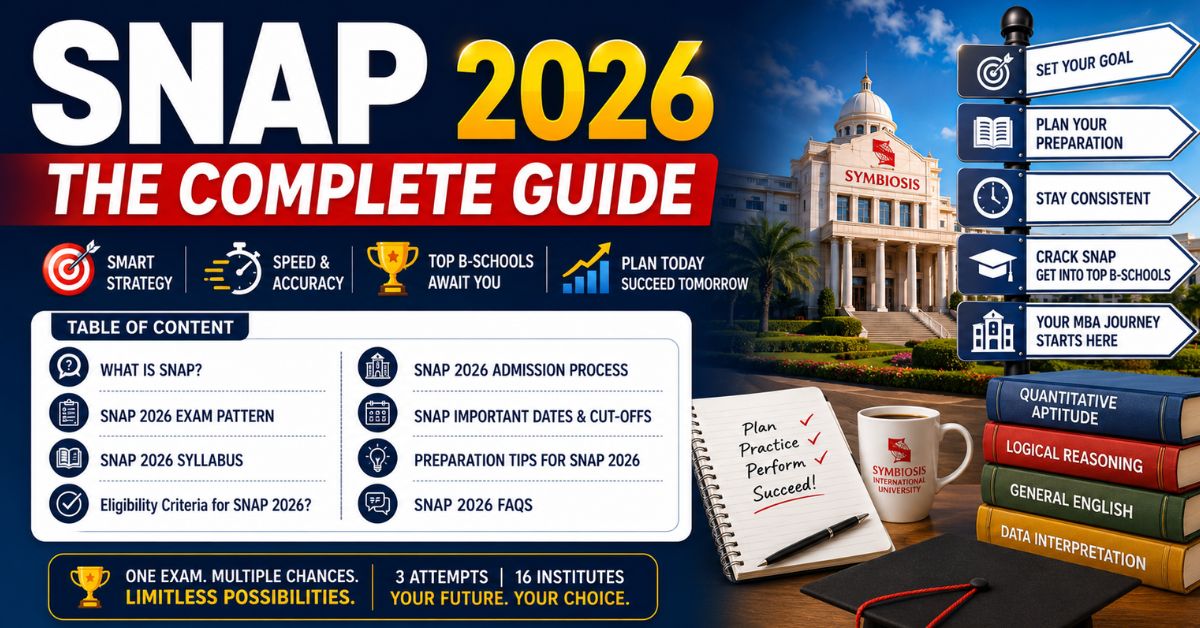
Table of Contents
- What Is SNAP 2026?
- SNAP 2026 Exam Pattern
- SNAP 2026 Syllabus & Important Topics
- SNAP 2026 Ethics, Morality and Values Section
- SNAP 2026 Exam Dates
- SNAP 2026 Registration: Fees & Eligibility
- SNAP Percentile vs Marks
- SNAP 2026 Expected Cutoffs
- SNAP Mock Test Analysis
- SNAP vs Other MBA Entrance Exams
- Top Symbiosis Instittes Accepting SNAP
- How to Prepare for SNAP 2026
- Summary
- FAQs
SNAP 2026 at a Glance
| Particular | Detail |
|---|---|
| Conducting Body | Symbiosis International (Deemed University) |
| Exam Mode | Computer-Based Test (CBT) |
| Sections | 4 (General English, Reasoning, Quant/DI/DS, Ethics — new) |
| Total Questions / Marks | 60 / 60 |
| Duration | 60 minutes, no sectional time limit |
| Marking Scheme | +1 correct, −0.25 incorrect |
| Attempts | Up to 3 (best score considered) |
| Registration Window | 21 August – 25 November 2026 |
| Test Sessions | 13, 19 & 26 December 2026 |
| Result Date | 12 January 2027 |
| Institutes Accepting Score | 17 Symbiosis institutes |
| Source: Official SNAP 2026 notification, snaptest.org |
What Is SNAP 2026?
SNAP (Symbiosis National Aptitude Test) is a national-level MBA entrance exam conducted by Symbiosis International (Deemed University) for admission into MBA and PGDM programmes at its 17 constituent institutes — SIBM Pune, SCMHRD, SIIB, SIBM Bengaluru, and others. It’s known for being the shortest MBA entrance test on the circuit (60 minutes), for offering candidates up to three attempts in a single season, and for being comparatively more speed-driven than concept-heavy.
If Symbiosis institutes are on your MBA shortlist, SNAP is the one exam you can’t skip — and unlike CAT, a single off day doesn’t have to define your outcome, since your best score across three attempts is what counts.
SNAP 2026 Exam Pattern
SNAP 2026 now runs across 4 sections instead of 3 — General English (10 questions, down from 15), Analytical & Logical Reasoning (20, down from 25), Quantitative Ability/DI/DS (unchanged at 20), and a brand-new Ethics, Morality and Values section (10 questions). The overall shape of the exam — 60 questions, 60 marks, 60 minutes, +1/−0.25 marking, no sectional time limit — stays exactly the same.
This shift matters because it changes where your marks come from: English and Reasoning have both given up questions to make room for the new section, so accuracy in those two areas now matters more than sheer volume of attempts.
👉 For the full section-wise breakdown, the old-vs-new comparison table, and a suggested time-allocation plan, read the complete SNAP 2026 New Pattern guide.
SNAP 2026 Syllabus & Important Topics
SNAP doesn’t publish a rigid, itemised syllabus document the way CAT does — its syllabus is derived from the exam pattern and an analysis of previous years’ papers. Broadly, General English tests vocabulary, grammar, and verbal reasoning; Quantitative Ability leans on Class VIII–X arithmetic and algebra along with Data Interpretation; and Analytical & Logical Reasoning covers puzzles, seating arrangements, and coding-decoding.
Not every topic carries equal weight, and knowing which ones to prioritise first — rather than studying the syllabus end to end — is what typically separates a 90-percentile attempt from a 98-percentile one.
👉 For the complete section-wise topic list and a free downloadable checklist, see the SNAP Syllabus 2026 PDF guide.
👉 For a ranked, weightage-based breakdown of exactly which topics to study first, see SNAP 2026 Important Topics.
SNAP 2026 Ethics, Morality and Values Section
This is the one part of the SNAP 2026 syllabus with no previous-year question bank to lean on. Worth 10 questions and 10 marks, it tests applied ethical judgement — business ethics fundamentals, workplace values, CSR basics, and situational “most appropriate response” scenarios — rather than abstract philosophy or fixed formulas. Because it’s brand new, early and steady exposure matters far more here than last-minute cramming closer to December.
👉 For the expected topic list, likely question types, and a structured 30-day study plan, read the full SNAP 2026 Ethics, Morality and Values guide.
SNAP 2026 Exam Dates
SIU has officially confirmed the SNAP 2026 calendar. Applications opened on 21st August 2026 and registration closes on 25th November 2026. The three test sessions fall on 13th, 19th, and 26th December 2026, with admit cards releasing separately about a week before each session. Results are scheduled for 12th January 2027, after which institute-level Group Exercise (GE), Written Ability Test (WAT), and Personal Interview (PI) rounds begin.
👉 For the full date-wise schedule, admit card windows, and a year-on-year comparison with SNAP 2025, see the complete SNAP 2026 Exam Dates guide.
SNAP 2026 Registration: Fees & Eligibility
Registering for SNAP 2026 requires a bachelor’s degree with at least 50% aggregate marks (45% for SC/ST/PwD candidates); final-year students can also apply. The registration fee has risen this cycle to ₹2,550 per attempt, plus a separate ₹1,000 programme fee for every Symbiosis institute you apply to. Keep in mind there’s no form correction facility once you submit, so double-check every field before payment.
👉 For the complete step-by-step registration process, document checklist, and common mistakes to avoid, read the full SNAP 2026 Registration guide.
SNAP Percentile vs Marks
Symbiosis institutes never publish cutoffs in raw-score terms — only in percentile. Your SNAP score is simply your total out of 60 (+1 per correct answer, −0.25 per wrong one), while your SNAP percentile reflects your rank relative to every other candidate who appeared that year. Because SNAP runs across multiple sessions, an equalisation process adjusts raw scores for slot difficulty before final percentiles are calculated — which is why the same raw score can convert differently across years.
👉 For the exact percentile formula, year-wise score-to-percentile tables, and section-wise benchmarks for top percentiles, see the full SNAP Percentile vs Marks 2026 guide.
SNAP 2026 Expected Cutoffs
Cutoffs aren’t centralised — each of the 17 Symbiosis institutes sets its own shortlisting percentile after results are declared, based on that year’s applicant pool and difficulty. Based on the last five admission cycles, here’s a directional snapshot for the two most competitive institutes:
| Institute | 2025 Actual Cutoff (General) | 2026 Expected Range |
|---|---|---|
| SIBM Pune | 98.0–98.5 percentile | 98.5+ percentile |
| SCMHRD Pune | 97 percentile | 96–98 percentile |
Note that SNAP score is only 50% of the final merit list at most institutes — Group Exercise and Personal Interaction together make up the other half, so clearing the cutoff gets you a call, not a seat.
👉 For the full 5-year trend, category-wise percentile ranges, and programme-wise breakdown, read Expected SNAP Cutoff for SIBM Pune 2026 and SCMHRD Cutoff 2026: Expected SNAP Cutoff & Previous Trends.
SNAP Mock Test Analysis: Turning Practice Into Percentile
Taking mock after mock without analysing them rarely moves your score. What separates a plateauing candidate from one who climbs steadily is a structured post-mock routine: reviewing section-wise accuracy, auditing your time budget per question, and classifying every wrong answer as a concept gap, a silly mistake, a misread, or an avoidable negative-marking guess.
👉 For the complete 7-step framework toppers use after every mock, read How to Analyze a SNAP Mock Test Like a Topper.
SNAP vs Other MBA Entrance Exams
If you’re also considering CAT, XAT, or NMAT this season, it helps to see how SNAP stacks up before you commit your prep hours.
| Parameter | SNAP | CAT | XAT | NMAT |
|---|---|---|---|---|
| Duration | 60 min | 120 min | 180 min | 120 min |
| Sectional Time Limit | No | Yes | Partial | No |
| Attempts | Up to 3 | 1 | 1 | Up to 3 |
| Negative Marking | −0.25 | −1 (MCQ) | −0.25 | None |
| Colleges Accepting | 17 (SIU only) | 1,000+ | 250+ | 78+ |
| Source: catmock.com analysis, official exam pattern notifications |
SNAP’s biggest structural advantages are its short duration and multiple-attempt safety net; its biggest limitation is that your score only opens doors at Symbiosis institutes. If your target list includes even one IIM or non-IIM B-school outside the Symbiosis network, CAT preparation remains essential alongside SNAP.
👉 For a detailed syllabus, eligibility, and difficulty-level comparison, read CAT vs SNAP: Exam, Syllabus, Eligibility & Difficulty. 👉 For a full four-way comparison including XAT and NMAT, see CAT vs XAT vs SNAP vs NMAT.
Top Symbiosis Institutes Accepting SNAP Scores
SNAP is the single entry point to 17 Symbiosis institutes across India. The most sought-after among them are:
- Symbiosis Institute of Business Management (SIBM), Pune — the flagship, most competitive institute
- Symbiosis Centre for Management and Human Resource Development (SCMHRD), Pune — strong in HR and Operations
- Symbiosis Institute of International Business (SIIB), Pune — best for International Business
- SIBM Bengaluru — a strong, growing alternative to SIBM Pune
- SIOM Nashik, SIBM Nagpur, SIDTM, SICSR, SIMC, SSBF, and SIBM Hyderabad — a mix of specialised and comparatively more accessible options across operations, IT, media, banking, and general management
Each institute sets its own shortlisting percentile and runs its own GE-PI process independently, so it’s worth applying to a realistic spread of 3–4 institutes rather than just your top choice.
How to Prepare for SNAP 2026: A Quick Roadmap
- Understand the revised pattern first. Don’t build a study plan around last year’s 3-section structure — the new Ethics section and the trimmed English/Reasoning question counts change your time allocation.
- Map the syllabus by weightage, not by section name. Prioritise high-frequency topics over exhaustive coverage.
- Give the new Ethics section early, steady exposure rather than a last-minute cram, since there’s no previous-paper history to fall back on.
- Register early and get your documents in order — there’s no form correction window once you submit.
- Take full-length mocks under real time pressure, and analyse every single one using a structured framework rather than just checking your score.
- Track your percentile, not just your raw score, against your target institutes’ historical cutoffs.
Each of these steps is covered in far more depth in the dedicated guides linked throughout this page — use this roadmap as your checklist, and click through wherever you need the full detail.
Summary: Key SNAP 2026 Facts to Remember
- SNAP 2026 has 4 sections (60 questions, 60 marks, 60 minutes) — English (10), Reasoning (20), Quant/DI/DS (20), and the new Ethics, Morality and Values section (10).
- Registration runs 21 August – 25 November 2026; the registration fee has increased to ₹2,550 per attempt.
- The three test sessions are 13, 19, and 26 December 2026, with results on 12 January 2027.
- Candidates get up to 3 attempts, and the best score is used for percentile calculation.
- SIBM Pune’s expected 2026 cutoff sits around 98.5+ percentile, and SCMHRD’s around 96–98 percentile, for General category.
- SNAP scores are accepted only at the 17 Symbiosis institutes — unlike CAT, which is accepted at 1,000+ B-schools.
Frequently Asked Questions (FAQs)
1. What is SNAP 2026?
SNAP (Symbiosis National Aptitude Test) 2026 is a national-level MBA entrance exam conducted by Symbiosis International (Deemed University) for admission into MBA/PGDM programmes at its 17 constituent institutes, including SIBM Pune and SCMHRD.
2. What is the SNAP 2026 exam pattern?
SNAP 2026 has 4 sections — General English (10 questions), Analytical & Logical Reasoning (20), Quantitative Ability/DI/DS (20), and a newly introduced Ethics, Morality and Values section (10) — totalling 60 questions and 60 marks in a 60-minute, no-sectional-limit format.
3. When is SNAP 2026?
SNAP 2026 will be held across three sessions: 13th, 19th, and 26th December 2026. Registration is open from 21st August to 25th November 2026, and results are expected on 12th January 2027.
4. What is the SNAP 2026 registration fee?
The SNAP 2026 registration fee is ₹2,550 per attempt, plus a separate ₹1,000 programme fee for every Symbiosis institute you apply to.
5. How many times can I attempt SNAP 2026?
Candidates can appear for all three SNAP 2026 sessions, and the highest score among the attempts is used for the final percentile calculation.
6. What percentile do I need for SIBM Pune or SCMHRD?
Based on recent trends, SIBM Pune’s expected General category cutoff for 2026 is around 98.5+ percentile, and SCMHRD’s is around 96–98 percentile — though official cutoffs are only confirmed after results are declared.
7. Is SNAP easier than CAT?
SNAP is generally considered less difficult than CAT in terms of question complexity and negative marking severity, though it still demands dedicated, speed-focused preparation given its tight 60-minute format.
8. Which colleges accept SNAP scores?
SNAP scores are accepted only by the 17 Symbiosis institutes, including SIBM Pune, SCMHRD, SIIB Pune, and SIBM Bengaluru — unlike CAT, which is accepted at 1,000+ B-schools including all IIMs.
Conclusion
SNAP 2026 isn’t the same exam most aspirants prepared for last year — a new section, a revised fee, and a confirmed three-session December calendar all mean your prep plan needs a genuine update, not just a quick skim of the notification. Use this page as your master checklist: start with the exam pattern and syllabus, lock in your registration and dates early, build a realistic percentile target using the cutoff data above, and work through each linked guide as you reach that stage of your preparation.
You May Also Like : CATMOCK / CATMOCK PYQ
Follow Us On : Facebook / Instagram