
The SNAP 2026 notification is officially out, and it brings with it the most significant SNAP pattern change the exam has seen in recent years. If you’ve already started your prep — or you’re about to — this is the update you cannot afford to skim past. The SNAP 2026 exam pattern now looks meaningfully different from what aspirants prepared for in previous cycles, and understanding exactly what’s changed will directly shape how you divide your study hours over the next few months.
This guide walks through the entire SNAP 2026 new pattern in plain language: what the notification confirms, how the section-wise structure has shifted, what the marking scheme looks like, and — just as importantly — the mistakes aspirants commonly make when a familiar exam format changes under them.
If you're looking at the bigger picture, our SNAP 2026: The Complete Guide brings exam pattern, syllabus, dates, registration, percentile, and cutoffs together in one place — a good starting point before you dive into the specifics on this page.Summary / Key Takeaways
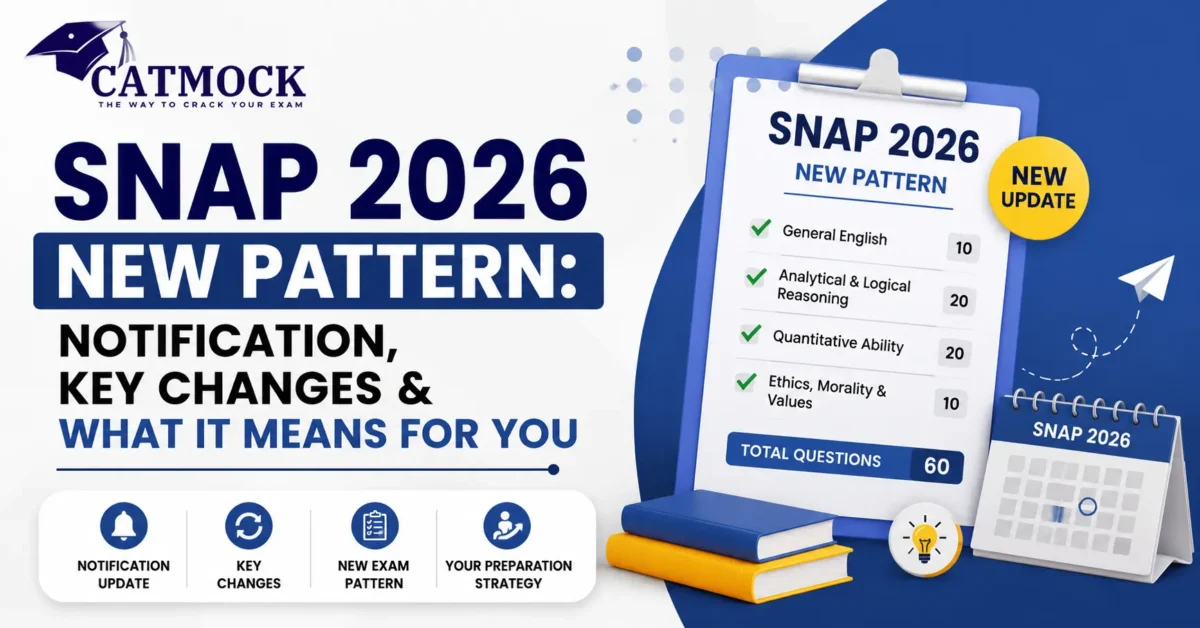
- The SNAP 2026 notification confirms a pattern change: the exam now has 4 sections instead of the earlier 3.
- Total structure remains 60 questions, 60 marks, 60 minutes — only the internal distribution has shifted.
- General English questions have reduced from 15 to 10; Analytical & Logical Reasoning has reduced from 25 to 20; Quantitative, DI & DS stays at 20.
- A new section — Ethics, Morality and Values — now accounts for the remaining 10 questions. (For its full syllabus, question types, and a day-by-day prep plan, see our dedicated SNAP 2026 Ethics, Morality and Values guide.)
- Marking scheme is unchanged: +1 for a correct answer, −0.25 for an incorrect answer, with no sectional time limit.
- SNAP 2026 registration is open from August 21, 2026 to November 25, 2026.
- Candidates get up to 3 attempts, and the best score across attempts is used for percentile calculation.
SNAP 2026 Notification Highlights
The official notification is the single most important document for any SNAP aspirant this year, and it does more than just confirm dates — it formally locks in the SNAP 2026 exam pattern that will apply across all three test sessions in December 2026.
Here’s what the notification confirms at a glance:
| Particular | Detail |
|---|---|
| Conducting Body | Symbiosis International (Deemed University) |
| Exam Mode | Computer-Based Test (CBT) |
| Total Sections | 4 |
| Total Questions | 60 |
| Total Marks | 60 |
| Duration | 60 minutes |
| Sectional Time Limit | None |
| Number of Attempts | Up to 3 (best score considered) |
| Registration Window | August 21, 2026 – November 25, 2026 |
| Test Sessions | Three sessions in December 2026 |
| Test Cities | 79 across India |
Source: Official SNAP 2026 Notification
Before you plan your prep calendar around any of these numbers, it’s worth cross-checking the live notification yourself on the official SNAP website, since bulletins can carry minor clarifications after the initial release.
SNAP Pattern Change 2026: Old vs New at a Glance
If you started preparing before this year’s notification, this table is the fastest way to see exactly what’s different.
| Parameter | Old SNAP Pattern (Till 2025) | SNAP 2026 New Pattern |
|---|---|---|
| Total Sections | 3 | 4 |
| General English | 15 questions | 10 questions |
| Analytical & Logical Reasoning | 25 questions | 20 questions |
| Quantitative, DI & DS | 20 questions | 20 questions |
| Ethics, Morality and Values | Not present | 10 questions (newly introduced) |
| Total Questions | 60 | 60 |
| Total Marks | 60 | 60 |
| Duration | 60 minutes | 60 minutes |
| Marking Scheme | +1 / −0.25 | +1 / −0.25 |
| Sectional Time Limit | None | None |
Source: catmock.com analysis, based on Official SNAP 2026 Notification
The headline takeaway: your overall exam experience (timing, marks, negative marking) hasn’t changed — what has changed is where your marks come from. Both General English and Reasoning have given up five questions each to accommodate the new Ethics, Morality and Values section, so your section-wise scoring plan needs a genuine update, not just a mental note. If you’re new to this section specifically, our Ethics, Morality and Values prep guide covers its expected syllabus and a 30-day study plan in detail.
SNAP 2026 Exam Pattern: Section-Wise Breakup
Here’s the complete, verified section-wise structure for SNAP 2026.
| Section | Number of Questions | Marks per Question | Total Marks | Weightage |
|---|---|---|---|---|
| General English | 10 | +1 | 10 | ~16.7% |
| Analytical & Logical Reasoning | 20 | +1 | 20 | ~33.3% |
| Quantitative, Data Interpretation & Data Sufficiency | 20 | +1 | 20 | ~33.3% |
| Ethics, Morality and Values (Newly Introduced) | 10 | +1 | 10 | ~16.7% |
| Total | 60 | — | 60 | 100% |
Source: Official SNAP 2026 Notification
A few quick observations that matter for your strategy:
- Analytical & Logical Reasoning and Quantitative-DI-DS together still make up two-thirds of the paper — they remain your primary scoring zones.
- General English has shrunk, meaning fewer chances to recover from a slow start there — accuracy now matters more than volume in this section.
- Ethics, Morality and Values is new and untested, with no multi-year previous-paper history to lean on. For its expected topic list, question types, and a structured prep plan, read the full SNAP 2026 Ethics, Morality and Values guide — keep this article focused on the overall pattern.
If you want to internalise this exact structure rather than just read about it, attempting a few SNAP full-length mock tests built around the updated four-section format will tell you far more than any table can.
SNAP 2026 Marking Scheme: What Stays the Same
Despite the structural shake-up, SIU has kept the scoring rules completely unchanged, which is genuinely good news — one less variable to relearn.
| Marking Rule | Detail |
|---|---|
| Correct Answer | +1 mark |
| Incorrect Answer | −0.25 mark (25% negative marking) |
| Unattempted Question | 0 marks (no penalty) |
| Question Type | Objective MCQs, 4 options each |
| Sectional Cut-off | None specified |
Source: Official SNAP 2026 Notification
The 25% negative marking means guessing recklessly still carries real risk. As a rough working rule: if you can eliminate at least two of the four options with confidence, an educated guess is usually worth the risk; if you can’t, skipping is statistically safer. This logic applies uniformly across all four sections, including Ethics, Morality and Values — the marking scheme doesn’t treat the new section any differently, so your risk calculus there should stay the same too.
Time Management Strategy for the New SNAP Pattern
With one more section competing for the same 60 minutes, a plan beats improvisation. Use this as a starting template and adjust after a couple of mock attempts based on your personal strengths.
| Section | Questions | Suggested Time (Minutes) | Priority Tip |
|---|---|---|---|
| General English | 10 | 8–9 | Attempt early for quick, confidence-building marks |
| Quantitative, DI & DS | 20 | 18–19 | Pick easier sets first; don’t get stuck on one set |
| Analytical & Logical Reasoning | 20 | 18–19 | Scan all sets before committing time to any one |
| Ethics, Morality and Values | 10 | 9–10 | Read each question fully before answering; avoid rushing |
| Buffer / Review | — | 2–3 | Revisit flagged or skipped questions |
Source: catmock.com analysis
Since there’s no sectional time limit, you can attempt sections in any sequence — many aspirants find it useful to start with their strongest section to build early momentum, then move to the newer, less familiar section once they’re in rhythm rather than at the very end when fatigue sets in.
Common Mistakes to Avoid With the SNAP 2026 New Pattern
Pattern changes tend to trip up even well-prepared aspirants — not because the syllabus got harder, but because old habits don’t automatically adjust. Watch out for these:
- Sticking to an old time-allocation plan. If your mental “X minutes for English, Y minutes for Reasoning” plan is based on the previous 15/25/20 split, it’s now miscalibrated — rebuild it around the current 10/20/20/10 structure.
- Ignoring the new Ethics section until the last few weeks. Since it has no long previous-paper history, it needs steady, early exposure — not a last-minute cram. See our Ethics section prep guide for a structured plan.
- Over-preparing for Reasoning at the cost of everything else. It’s still high-weightage, but with five fewer questions, marginal extra prep here now yields diminishing returns compared to shoring up weaker sections.
- Treating negative marking differently across sections. The −0.25 penalty is identical everywhere, including the new section — don’t get more (or less) conservative there without reason.
- Skipping full-length mocks in favour of only topic-wise practice. Section-wise drilling won’t reveal how the combined 60-minute, four-section pressure actually feels — only full-length attempts will.
- Not tracking official updates. Bulletins can carry clarifications after the initial release, so periodically checking the official SNAP notification page is worth the two minutes it takes.
Working through a few SNAP previous year papers alongside updated practice sets is one of the simplest ways to catch these habits before exam day, rather than during it.
SNAP 2026 Preparation Checklist
Use this as a quick self-audit before you finalise your last-mile prep plan.
| Checklist Item | Status |
|---|---|
| Reviewed the full SNAP 2026 notification | ☐ |
| Rebuilt time-allocation plan around the new 4-section split | ☐ |
| Attempted at least 2–3 full-length mocks in the new format | ☐ |
| Practised the Ethics section separately, not just full-lengths | ☐ |
| Solved recent previous year papers for English & Quant | ☐ |
| Registered before the November 25, 2026 deadline | ☐ |
| Bookmarked the official notification page for updates | ☐ |
Source: catmock.com analysis
Why the Pattern Change Matters
A pattern change this significant usually signals what SIU wants to assess going forward — moving beyond the traditional English-Reasoning-Quant mix toward dimensions that matter once you’re inside a B-school classroom. It’s also worth checking your target list of institutes against updated cutoff expectations, since a pattern change can subtly shift score distributions in the first year it’s implemented.
For a deeper look at why the Ethics, Morality and Values section was added and how to prepare for it specifically, read the full SNAP 2026 Ethics, Morality and Values guide. Reviewing which B-schools accept SNAP scores — and how their historical cutoffs have trended — helps you calibrate how much of a safety margin you actually need this cycle.
Frequently Asked Questions (FAQs)
1. What is the SNAP 2026 new pattern?
SNAP 2026 now has 4 sections instead of 3, with a total of 60 questions across General English (10), Analytical & Logical Reasoning (20), Quantitative-DI-DS (20), and a newly introduced Ethics, Morality and Values (10) — all within a 60-minute window.
2. What does the SNAP 2026 notification say about the exam pattern?
The official notification confirms the shift to a four-section format, a total of 60 questions worth 60 marks, a 60-minute duration, and an unchanged +1/−0.25 marking scheme.
3. What exactly changed in the SNAP pattern for 2026?
General English dropped from 15 to 10 questions, Analytical & Logical Reasoning dropped from 25 to 20 questions, Quantitative-DI-DS stayed at 20 questions, and a new 10-question Ethics, Morality and Values section was introduced — the total question count and duration remain the same.
4. Is the marking scheme different for SNAP 2026?
No. The marking scheme is unchanged: +1 for every correct answer and −0.25 for every incorrect answer, applied uniformly across all four sections.
5. Is there a sectional time limit in the SNAP 2026 exam pattern?
No. As in previous years, there’s no sectional time limit — candidates can attempt all four sections in any order within the overall 60-minute duration.
6. Does the SNAP 2026 pattern change make the exam harder?
Not necessarily harder, but the skill mix tested has broadened. With fewer English and Reasoning questions, accuracy in those sections matters more, and the new Ethics, Morality and Values section adds an additional, less-practised skill area. (For that section specifically, see our dedicated Ethics guide.)
7. How many attempts are allowed for SNAP 2026, and how is the final score calculated?
Candidates can attempt SNAP up to three times (SNAP 01, 02, 03) in December 2026, and the highest score across all attempts is used for percentile calculation, without normalisation.
8. When does SNAP 2026 registration close?
SNAP 2026 registration opened on August 21, 2026, and the last date to complete registration and payment is November 25, 2026.
Conclusion: Your Next Steps
The SNAP 2026 notification makes one thing clear: this isn’t a “business as usual” year for the exam. The SNAP pattern change reshapes where your marks come from, even though the total structure — 60 questions, 60 marks, 60 minutes — stays familiar on the surface. Aspirants who adapt their strategy early, rather than discovering the shift mid-mock in November, will have a real head start.
Here’s what to do next:
- Attempt a SNAP sectional mock test to see exactly how the revised section-wise split affects your current strategy.
- Work through recent SNAP previous year papers to keep your English and Quant fundamentals sharp under the new weightage.
- Build a realistic time-allocation plan around the updated 10/20/20/10 structure — and stress-test it on full-length mocks before December.
- For the Ethics, Morality and Values section specifically, follow the 30-day plan in our SNAP 2026 Ethics, Morality and Values guide.
- Keep the official SNAP notification page bookmarked so you’re never blindsided by a late clarification.
With the notification now public and the pattern locked in, the only variable left in your control is how deliberately you prepare for it — and that’s entirely doable with the months you still have on the clock.
You May Also Like : CAT MOCK / CAT MOCK PYQ
Follow Us On : Facebook / Instagram