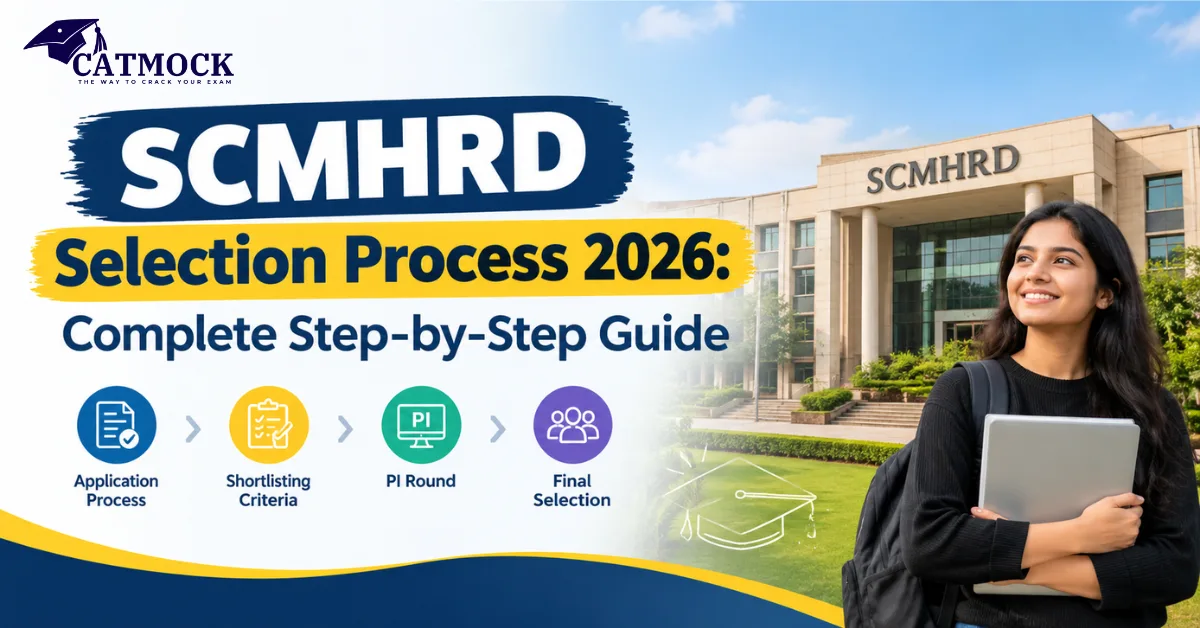
If SCMHRD is on your SNAP 2026 preference list, clearing a good percentile is only half the battle. The SCMHRD selection process 2026 is a multi-stage journey — registration, SNAP shortlisting, a Group Exercise, a Personal Interaction, and a final composite merit list — and every stage carries its own weight in deciding whether you actually get that admission offer. A lot of aspirants assume a strong SNAP score is enough, then get caught off guard when the GE-PI round decides the outcome almost as much as the exam itself.
This guide walks through the entire SCMHRD admission process 2026 stage by stage: how shortlisting works, what happens in the Group Exercise and Personal Interaction rounds, the exact weightage breakdown, the documents you’ll need on interview day, the expected timeline, and the mistakes that quietly cost candidates their seat. Whether you’re still waiting for your SNAP 2026 result or you’ve already been shortlisted, this is the process map you need before you walk into GE-PI.
Also read: SNAP Syllabus 2026 PDF: Complete Section-Wise Topics, Weightage & Free Download Guide
SCMHRD Selection Process 2026: Key Highlights
| Parameter | Details |
|---|---|
| Entrance Exam | SNAP (SNAP Test) |
| Selection Rounds | SNAP Score → Shortlisting → Group Exercise (GE) → Personal Interaction (PI) |
| Selection Basis | Composite score across SNAP, GE and PI |
| Total Composite Score | 100 marks |
| Shortlisting Mode | Merit-based, no sectional cutoff |
| GE-PI Mode | In-person / hybrid (institute-notified) |
| Final Outcome | Merit list, waitlist, or rejection based on composite score |
| Programs Covered | MBA (Flagship), MBA-HR, MBA-IDM, MBA-BA, Executive MBA |
| Official Website | scmhrd.edu |
How the SCMHRD Selection Process 2026 Works: Stage by Stage
The SCMHRD admission process 2026 is not a single filter — it’s a funnel with four distinct checkpoints. Understanding each one helps you allocate your prep time correctly instead of over-indexing on just the SNAP exam.
Stage 1: SNAP Registration and Exam
Everything starts with SNAP registration, typically opening in August and closing around early December. During registration, candidates must actively select SCMHRD as one of their preferred institutes — simply appearing for SNAP doesn’t automatically put you in SCMHRD’s applicant pool. SNAP itself is conducted across multiple sessions in December, and candidates can attempt the exam more than once, with the best score across attempts counting toward the final percentile used for shortlisting.
Stage 2: SNAP-Based Shortlisting
Once SNAP results are declared in January, SCMHRD releases its own shortlist based on the percentile scored. There’s no sectional cutoff in SNAP for SCMHRD — the college works purely off the overall percentile. Shortlisted candidates receive a call or email notification, along with a window to confirm participation and pay the requisite selection-round fee (where applicable). If you don’t hear back after results, it usually means the percentile fell short of that year’s shortlisting band for your chosen program.
Stage 3: Group Exercise (GE)
Shortlisted candidates are then invited for the Group Exercise, usually conducted in late January or early February. A GE places a small group of candidates together to solve a business case, debate a topic, or arrive at a group decision within a fixed time. Evaluators aren’t scoring the “right answer” — they’re watching how you contribute, whether you listen, whether you build on others’ points instead of talking over them, and whether you can move a group toward a decision under time pressure.
Stage 4: Personal Interaction (PI)
The Personal Interaction is a one-on-one (or panel) interview that digs into your academic background, work experience, career motivation, and general awareness. This is typically the single highest-weighted individual component in the entire selection process, which is why candidates who prepare only for SNAP and treat the interview as an afterthought often see their final rank slip even after a strong written score.
Stage 5: Final Merit List Preparation
After GE and PI scores are in, SCMHRD computes a composite score combining SNAP percentile, GE performance, and PI performance to generate the final merit list. This list decides who gets a direct offer, who lands on the waitlist, and who doesn’t convert.
SCMHRD Selection Weightage Breakdown 2026
Here’s how the 100-mark composite score is typically distributed across the three components:
| Selection Component | What It Evaluates | Approximate Weightage |
|---|---|---|
| SNAP Score | Quantitative ability, verbal reasoning, logical reasoning, and general awareness | 50 marks |
| Group Exercise (GE) | Teamwork, communication, structured thinking, group dynamics | 10 marks |
| Personal Interaction (PI) | Profile depth, clarity of thought, motivation, career direction | 40 marks |
| Total Composite Score | 100 marks |
The important pattern here: GE and PI combined (50 marks) carry exactly as much weight as the SNAP score itself. This single fact explains why candidates with a slightly lower percentile sometimes convert their SCMHRD offer while a marginally higher scorer doesn’t — the interview stage is a genuine equalizer, not a formality. If you’re still calibrating what percentile you need to even reach this stage, our detailed SCMHRD Cutoff 2026 guide breaks down the expected program-wise and category-wise cutoff bands for this cycle.
SCMHRD Selection Process 2026: Expected Timeline
Exact dates are notified by SCMHRD closer to each stage, but based on the recurring admission cycle pattern, here’s a realistic timeline to plan around:
| Stage | Expected Timeline (2026 Cycle) |
|---|---|
| SNAP Registration Opens | August 2026 |
| SNAP Registration Closes | Early December 2026 |
| SNAP Exam Window | December 2026 (multiple sessions) |
| SNAP Result Declaration | January 2027 |
| SCMHRD Shortlist Release | Mid-to-late January 2027 |
| Group Exercise & Personal Interaction | Late January – Early February 2027 |
| Final Merit List Release | Late February 2027 |
| Fee Payment Deadline (First List) | Within 5–7 days of merit list release |
| Waitlist Movement | March 2027 (rolling basis) |
Because SNAP is conducted in December for the following academic year’s intake, always cross-check the latest official notification on the SNAP portal — timelines can shift by a week or two depending on the exam calendar.
Also read: SCMHRD Cutoff 2026: Expected SNAP Cutoff & Previous Trends
Documents Required for SCMHRD GE-PI 2026
Carrying the right documents to your Group Exercise and Personal Interaction round isn’t optional — incomplete documentation can delay or jeopardize your candidature on the spot. Keep the following ready, in both original and photocopy format:
| Document Category | Specific Documents Needed |
|---|---|
| Identity Proof | Aadhaar card / Passport / Voter ID / Driving License |
| Academic Records | 10th, 12th, graduation mark sheets and degree certificate |
| Entrance Exam Proof | SNAP 2026 admit card and scorecard |
| Work Experience | Offer letter, relieving letter, salary slips (if applicable) |
| Category Certificate | Caste/category certificate for SC/ST/OBC candidates (if applicable) |
| Photographs | 4–6 recent passport-size photographs |
| SOP/Resume | Updated resume and Statement of Purpose (recommended, not always mandatory) |
Missing even one document rarely disqualifies you outright, but it does create friction on interview day — get everything organized and photocopied at least a week in advance.
Eligibility Criteria for SCMHRD Selection Process 2026
Before you even reach the GE-PI stage, you need to clear the baseline eligibility bar:
- A minimum of 50% marks (45% for SC/ST candidates) in graduation from a recognized university
- Final-year graduation students can apply provisionally, subject to meeting the minimum marks before the program commencement
- A valid SNAP 2026 score is mandatory — there is no alternative route through CAT, XAT, GMAT, or any other exam
- The marks concession for SC/ST candidates does not extend to international applicants
- No direct admission route exists outside the SNAP-based selection process, regardless of profile strength
How to Prepare for the SCMHRD GE-PI Round
Since GE and PI together carry as much weight as your SNAP score, it’s worth treating this stage with the same seriousness as your written exam prep.
Group Exercise: What Actually Gets Evaluated
- Listen before you speak. Evaluators consistently rate candidates who build on others’ points higher than those who simply push their own view.
- Aim for airtime, not dominance. Speaking 3–4 times with sharp, relevant input beats speaking 10 times without adding value.
- Practice structuring an argument fast. A quick “situation → options → recommendation” framework helps you sound organized under time pressure.
- Stay aware of the group’s time limit and gently help steer toward a conclusion if the discussion is running long — this signals leadership without dominating.
Personal Interaction: What to Expect
- Be ready to explain every line on your resume — unexplained gaps or vague achievements are the first thing interviewers probe.
- Have a clear, honest answer for “Why MBA?” and “Why SCMHRD specifically?” — generic answers stand out for the wrong reasons.
- Brush up on current affairs and basic business/economic awareness relevant to your work background or intended specialization.
- If you’re targeting a specific program like MBA-HR, MBA-BA, or MBA-IDM, be prepared to justify that choice with genuine reasoning, not just cutoff convenience.
Common Mistakes That Hurt Your SCMHRD Selection Chances
- Treating SNAP as the finish line. A high percentile only earns you a shortlist — it doesn’t guarantee conversion once GE-PI weightage kicks in.
- Walking into GE without a strategy. Candidates who haven’t practiced structured group discussions often freeze or over-talk, both of which cost marks.
- Generic, memorized PI answers. Interview panels can tell within minutes when a response is rehearsed rather than genuine.
- Incomplete or last-minute documentation. Scrambling for certificates on interview morning adds avoidable stress to an already high-stakes day.
- Ignoring the specialization-fit question. If you’re applying for MBA-BA or MBA-IDM, not being able to explain your interest in that specific field can weaken an otherwise strong interview.
SCMHRD Merit List and Waitlist Movement
Once GE-PI scores are finalized, SCMHRD releases a composite merit list combining all three components. Candidates who make the initial cut receive a formal offer and a fee payment deadline — typically within a week of the merit list release. Those on the waitlist aren’t out of the running; as candidates who received multiple offers (from SCMHRD and other Symbiosis or SNAP-accepting institutes) make their final choice, seats open up and the waitlist moves in rounds through March. If you’re weighing SCMHRD against another top Symbiosis option while you wait for waitlist movement, our comparison of SIBM Pune vs SCMHRD covers cutoffs, placements, and specialization differences to help you decide if both are on your list.
Frequently Asked Questions on SCMHRD Selection Process 2026
Q1. What is the SCMHRD selection process for 2026?
The SCMHRD selection process 2026 involves four stages: SNAP registration and exam, percentile-based shortlisting, a Group Exercise (GE), and a Personal Interaction (PI). The final admission decision is based on a composite score combining all three evaluated components.
Q2. Does SCMHRD have a Written Ability Test (WAT) in 2026?
SCMHRD has largely moved away from a separate WAT round in recent cycles, relying instead on SNAP score, GE, and PI for final selection. However, candidates should always confirm the exact round structure through the official SCMHRD notification before their selection cycle, since formats can be revised year to year.
Q3. What is the weightage of SNAP score in SCMHRD’s final selection?
SNAP score typically carries 50 out of the 100-mark composite score, with Group Exercise contributing 10 marks and Personal Interaction contributing 40 marks toward the final merit list.
Q4. Is a good SNAP percentile enough to secure SCMHRD admission?
No. A strong percentile only gets you shortlisted for GE-PI. Since GE and PI together account for half the final composite score, your performance in those rounds plays an equally decisive role in your final admission outcome.
Q5. What documents are required for the SCMHRD GE-PI round?
Candidates need identity proof, academic mark sheets, the SNAP admit card and scorecard, category certificates (if applicable), work experience proof, passport-size photographs, and an updated resume or SOP.
Q6. How does the SCMHRD waitlist movement work?
After the first merit list is released, seats vacated by candidates who accept offers elsewhere are filled from the waitlist in subsequent rounds, generally continuing through March until all seats are filled.
Q7. Can final-year students apply for SCMHRD’s 2026 admission process?
Yes, final-year graduation students are eligible to apply, provided they achieve the minimum required marks (50%, or 45% for SC/ST candidates) before the MBA program commencement.
Q8. Is there any direct admission route to SCMHRD without SNAP?
No. SCMHRD does not offer any direct admission route. A valid SNAP score is mandatory for every applicant, with no alternative entrance exam accepted in its place.
Key Takeaways
- The SCMHRD selection process 2026 runs through four checkpoints: SNAP exam, shortlisting, Group Exercise, and Personal Interaction.
- SNAP score, GE, and PI combine into a 100-mark composite score, with GE-PI together matching the SNAP score’s weightage.
- Shortlisting is purely percentile-based with no sectional cutoffs.
- Documentation, GE structure, and PI preparation matter as much as your written exam score in determining final conversion.
- The waitlist continues to move through March as seats are vacated by candidates accepting other offers.
Conclusion
The SCMHRD selection process 2026 rewards candidates who prepare for the entire funnel, not just the SNAP exam. Your percentile opens the door, but the Group Exercise and Personal Interaction decide whether you walk through it — together they carry exactly as much weight as your written score. Build your GE-PI readiness alongside your SNAP prep, keep your documentation organized well in advance, and go in with a genuine, well-reasoned answer for why SCMHRD fits your career direction. For the latest official updates on dates and notifications, always cross-check the SCMHRD official website and the SNAP Test official portal as your selection cycle progresses.
You May Also Like : CAT MOCK, CAT MOCK PYQ
Follow Us On : Facebook, Instagram, Youtube