
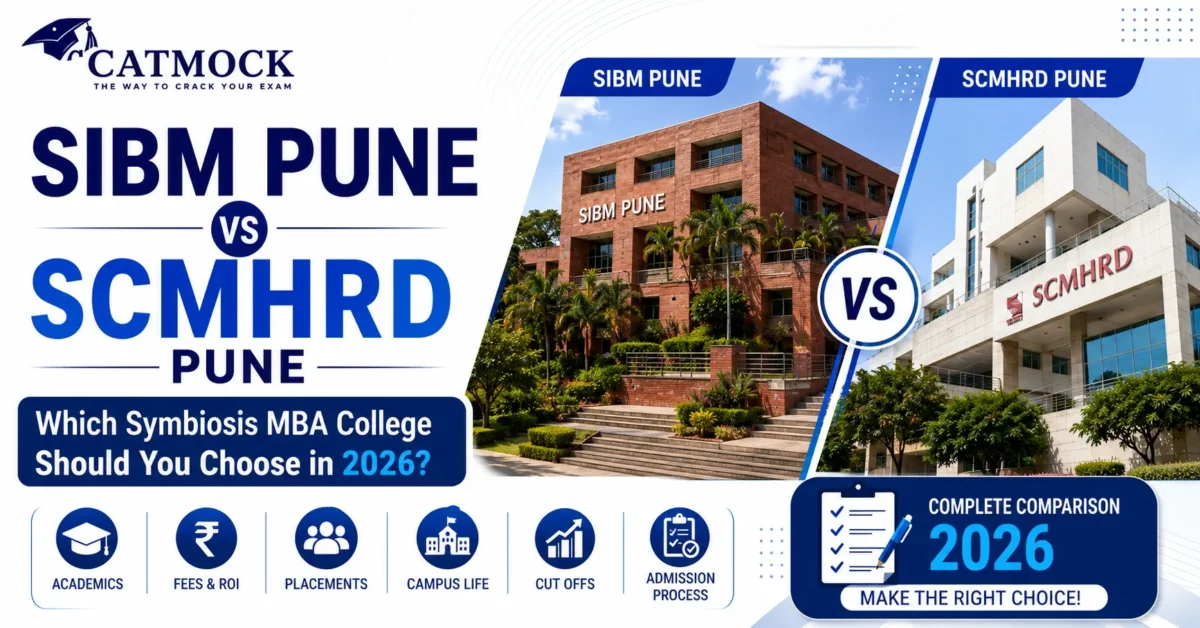
Every SNAP season, thousands of aspirants hit the same wall around results time: they’ve cleared a good percentile, they’ve got calls from more than one Symbiosis institute, and now they have to actually pick one. If SIBM Pune and SCMHRD are both sitting on your shortlist, you’re not alone — this is probably the single most-asked comparison among Symbiosis MBA aspirants, right after “what percentile do I need.”
And honestly, it’s a fair dilemma. Both institutes are constituents of Symbiosis International (Deemed University), both are based in Pune, both attract strong recruiters, and both will genuinely open doors for you. But if you look past the shared “Symbiosis” name, you’ll find two institutes with fairly different personalities — different strengths, different placement stories, and different kinds of students who thrive there. This article walks through the real differences: cutoffs, packages, rankings, fees, and — more importantly — which one actually fits your career direction, not just your percentile.
The Short Version
If you want the quick take before the details: SIBM Pune is the older, more broad-based institute with a slightly tougher cutoff, the highest average and top packages among the two, and a reputation built around Finance, Marketing, and general management. SCMHRD is younger, has a marginally more forgiving cutoff, and has carved out a genuinely strong identity in HR, Business Analytics, and Infrastructure Management — areas where it arguably outperforms SIBM Pune in depth, even if its overall salary numbers are lower. Neither is “better” in an absolute sense. It depends on what you’re optimising for.
Now let’s get into why.
SIBM Pune vs SCMHRD: Quick Comparison Table
| Parameter | SIBM Pune | SCMHRD |
|---|---|---|
| Full Name | Symbiosis Institute of Business Management | Symbiosis Centre for Management and Human Resource Development |
| Established | 1978 | 1993 |
| NIRF Ranking 2025 (Management) | 11 | 13 |
| Expected SNAP Cutoff 2026 | 98 – 98.5 percentile | 95 – 97 percentile |
| Total MBA Fees (approx.) | ₹25 – 30 Lakhs | ₹24 – 27 Lakhs |
| Average Package | ₹28 – 29 LPA | ₹21 – 22 LPA |
| Highest Package | ₹53 – 75 LPA (batch-dependent) | ₹35.9 LPA |
| Known For | Marketing, Finance, General Management | HR, Business Analytics, Infrastructure Management |
| Selection Process | SNAP + Group Exercise + Personal Interview | SNAP + WAT + Group Exercise + Personal Interview |
Keep in mind these numbers move every year — placement figures especially can shift 10-15% batch to batch depending on the macro hiring environment. Treat this as a directional comparison, not a locked-in guarantee, and always cross-check the latest official placement report before finalising your decision.
A Quick Look at Where Each Institute Comes From
SIBM Pune was the very first institute set up under the Symbiosis Society, back in 1978, and it carries that legacy. For decades it’s been treated as the flagship Symbiosis B-school — the one people mean when they just say “Symbiosis” without specifying which institute. It runs a residential campus at Lavale, on the quieter, hillier outskirts of Pune, which gives it a self-contained, close-knit campus culture. Students describe it as intense but genuinely community-driven — everyone lives on campus, so the line between classroom and hostel life blurs fast.
SCMHRD came fifteen years later, in 1993, but it didn’t try to be a smaller version of SIBM Pune. Instead, it built its own identity around specialised, high-demand skill areas — HR, later expanding into Business Analytics and Infrastructure Development Management. It sits inside the Symbiosis Infotech Campus in Hinjawadi, Pune’s IT corridor, which puts it physically closer to corporate offices — genuinely useful when you’re trying to get recruiters to visit for internships or live projects. Over time, SCMHRD picked up AACSB accreditation and a Financial Times Global MBA ranking, credentials that matter a lot more if your ambitions extend beyond India.
This difference in origin story matters more than it sounds, because it explains almost everything else in this comparison — the cutoffs, the placement mix, and the kind of student each institute tends to attract.
Cutoffs: Why SIBM Pune Is (Slightly) Tougher to Crack
If you’ve been tracking SNAP trends, you already know that SIBM Pune’s cutoff has consistently sat a notch above SCMHRD’s. For 2026, expect SIBM Pune to shortlist from around 98 to 98.5 percentile for the General category, while SCMHRD typically opens up a little earlier, around 95 to 97 percentile.
| Category | SIBM Pune Expected Cutoff 2026 | SCMHRD Expected Cutoff 2026 |
|---|---|---|
| General | 98 – 98.5 percentile | 95 – 97 percentile |
| OBC | 90 – 93 percentile | 88 – 91 percentile |
| SC | 60 – 65 percentile | 55 – 60 percentile |
| ST | 50 – 55 percentile | 45 – 50 percentile |
The gap looks small on paper — sometimes just 1 to 3 percentile points — but at the very top of the SNAP percentile curve, where thousands of candidates are bunched within a fraction of a point, that gap can mean the difference between hundreds of rank positions. This is actually good news for a lot of aspirants: if you land somewhere in the 94–97 percentile zone and narrowly miss SIBM Pune’s shortlist, there’s a real, well-documented chance SCMHRD will still call you for GE-PI, since both institutes draw from the exact same SNAP applicant pool. Don’t treat a miss at SIBM Pune as the end of the road — check both, always.
For the complete, regularly updated percentile expectations, it’s worth reading our dedicated breakdowns on the SNAP cutoff for SIBM Pune and the SCMHRD cutoff 2026 expected trends — both go deeper into category-wise numbers and year-on-year movement than a quick comparison table can.
Placements: Where the Real Difference Shows Up
This is usually where the debate gets decided for most people, so let’s be precise about it.
| Placement Metric | SIBM Pune (2025-26) | SCMHRD (2025) |
|---|---|---|
| Average Package | ₹28 – 29 LPA | ₹21.47 LPA |
| Highest Package | ₹53 – 75 LPA | ₹35.90 LPA |
| Top 10% Average | ₹39.76 LPA | Not separately disclosed |
| Number of Recruiters | 110+ | 118+ |
| Dominant Sectors | Finance, Consulting, FMCG | HR, Analytics, BFSI |
SIBM Pune’s numbers are, frankly, hard to argue with — it consistently posts one of the highest average packages among non-IIM B-schools in the country, driven largely by strong Finance and Consulting placements. If your goal is to maximise your starting CTC and you’re aiming broadly at core finance or strategy roles, SIBM Pune’s placement record does a lot of the talking for you.
But here’s the nuance people often miss: SCMHRD actually has more recruiters visiting campus, not fewer. Its average package looks lower mainly because a large share of its roles are HR and analytics positions — which, as a category, tend to pay slightly less at the entry level than core finance or consulting roles, even at a strong institute. That’s not a weakness in SCMHRD’s placement machinery; it’s a reflection of the sector mix. If HR or people analytics is genuinely your target function, SCMHRD’s specialised recruiter relationships in that space will likely serve you better than a generalist MBA’s HR placements would, even from a marginally “higher-ranked” institute.
Rankings and Accreditation: Domestic Muscle vs International Reach
| Ranking Parameter | SIBM Pune | SCMHRD |
|---|---|---|
| NIRF 2025 (Management) | 11 | 13 |
| Accreditation | NAAC A++, AICTE | NAAC A, AACSB |
| International Recognition | EFMD Global Network member | Financial Times Global MBA Ranking (76th, 2024) |
| Domestic Reputation | Consistently top-15 private B-school | Top 5 private B-school in India |
SIBM Pune’s edge in NIRF is real and consistent — it reflects genuine strength in placements, research output, and faculty resources as measured by India’s official ranking framework. But if you’re the kind of candidate thinking about a global career, an international exchange semester, or even a future international MBA or PhD, SCMHRD’s AACSB accreditation and its Financial Times listing carry weight that NIRF simply doesn’t capture. AACSB is held by a small fraction of business schools worldwide, and it signals a level of curriculum and governance rigor that international employers and universities recognise instantly. So the “ranking winner” genuinely depends on which audience you’re trying to impress — Indian recruiters and domestic peers, or a more international one.
Fees and Return on Investment
| Cost Component | SIBM Pune | SCMHRD |
|---|---|---|
| Total Tuition Fees | ₹25 – 30 Lakhs | ₹24 – 27 Lakhs |
| Hostel Fees (per year) | ~₹2.47 Lakhs | Comparable, institute-dependent |
| Approx. ROI (Fees vs Avg. Package) | Under 1 year | Around 1.2 – 1.3 years |
The fee gap between the two is genuinely small — a couple of lakhs at most — so cost alone shouldn’t drive your decision either way. Where it does matter is in the ROI calculation: because SIBM Pune’s average package is meaningfully higher, its fee recovers faster on paper, purely as a financial metric. That said, ROI calculated on batch averages can be misleading at an individual level — your actual return depends entirely on the specific role, sector, and offer you land, not the institute’s aggregate number. Don’t let a spreadsheet override what actually excites you about the two years ahead.
Also Read: SIIB Cutoff 2026: Expected SNAP Percentile, Marks & Category-Wise Trends
Specializations: The Part Most People Underrate
This, more than cutoff or average package, is where your decision should really start.
SIBM Pune runs a broadly generalist MBA with clear strength in Marketing and Finance. If you’re not entirely sure yet which function you want to specialise in, or if you know you want to keep core finance, strategy, or FMCG marketing roles open, the generalist structure works in your favour — you get exposure across functions before committing.
SCMHRD, on the other hand, has deliberately built depth in Human Resource Management, Business Analytics, and Infrastructure Development Management. If you already know HR leadership or people analytics is your path, SCMHRD isn’t the “second choice” — for that specific goal, it’s arguably the stronger, more purpose-built institute of the two, with recruiter relationships and faculty expertise that a generalist program can’t fully replicate.
A common mistake aspirants make is treating this purely as a rankings-and-package exercise and ignoring specialization fit entirely. Two students with the same SNAP percentile can have genuinely different “right answers” here, depending on what they actually want to do for the next ten years.
Before locking in your final choice, it’s also worth widening your view slightly — our guide on MBA colleges accepting SNAP covers the full list of 16+ SNAP-affiliated institutes, so you can build a realistic shortlist of backups alongside SIBM Pune and SCMHRD, rather than treating this as a strict either-or decision.
So, Which One Should You Actually Pick?
If you’re still torn, here’s a more practical way to think about it than just comparing numbers:
Pick SIBM Pune if you want the broadest brand recognition among Symbiosis institutes, the strongest average and top-end packages, and you’re aiming at core Finance, Consulting, or Marketing roles without a fixed specialization preference yet.
Pick SCMHRD if HR, Analytics, or Infrastructure Management is already your target function, if you’re thinking about international career options where AACSB accreditation carries real weight, or if your SNAP percentile sits in a range where SIBM Pune’s cutoff feels like a stretch.
And if you genuinely can’t decide — apply to both. Given how close their SNAP registration pools overlap, there’s little downside to keeping both options open through the GE-PI-WAT stage and making your final call only once you have actual offers, campus visit impressions, and specialization details in hand, rather than deciding purely off a comparison article.
Getting Ready for Both: Preparation Strategy
Whichever institute ends up being your first choice, the SNAP preparation strategy to get there doesn’t really change — you need a high percentile to even get a look from either one. A few things worth focusing on as you prepare:
Track exactly how your practice scores translate into a realistic percentile using our SNAP percentile vs marks analysis — this helps you set an honest, data-backed target instead of guessing. Keep an eye on any structural or pattern changes for this year’s exam through our complete SNAP 2026 guide, which covers registration windows, exam pattern, and result timelines in one place. Use all three SNAP attempts deliberately — your best percentile across sessions is what counts for shortlisting at both institutes, so there’s no reason to hold back on attempting all three. And don’t treat GE-PI-WAT as an afterthought once you clear the cutoff — SCMHRD in particular still runs a Written Ability Test, a round some other Symbiosis institutes have dropped, so factor that into your prep timeline specifically if SCMHRD is on your list.
Summary Table: SIBM Pune vs SCMHRD
| Factor | Edge Goes To |
|---|---|
| SNAP Cutoff (Easier to Clear) | SCMHRD |
| Average & Highest Package | SIBM Pune |
| NIRF Domestic Ranking | SIBM Pune |
| International Recognition (AACSB, FT) | SCMHRD |
| HR / Analytics Specialization Depth | SCMHRD |
| Finance / Marketing Generalist MBA | SIBM Pune |
| Number of Recruiters on Campus | SCMHRD (marginally higher) |
| Overall Fees | SCMHRD (marginally lower) |
FAQs on SIBM Pune vs SCMHRD
Q1. Is SIBM Pune better than SCMHRD?
Not universally — it depends on your goals. SIBM Pune generally ranks higher on NIRF and offers a higher average package, but SCMHRD leads in HR and analytics specializations and holds stronger international accreditation through AACSB and the Financial Times ranking.
Q2. What is the SNAP cutoff difference between SIBM Pune and SCMHRD?
SIBM Pune’s expected cutoff for 2026 is around 98–98.5 percentile, while SCMHRD’s is slightly lower at 95–97 percentile. This gap makes SCMHRD a realistic option if you narrowly miss SIBM Pune’s shortlist.
Q3. Which college offers a higher average package, SIBM Pune or SCMHRD?
SIBM Pune offers a higher average package, typically around ₹28–29 LPA, compared to SCMHRD’s average of roughly ₹21.47 LPA, based on the most recent placement reports.
Q4. Is SCMHRD good for HR specialization compared to SIBM Pune?
Yes, genuinely so. SCMHRD is specifically built around Human Resource Management and has deeper recruiter relationships in HR and analytics roles than SIBM Pune’s more generalist curriculum offers.
Q5. Are SIBM Pune and SCMHRD fees similar?
Yes, both institutes charge fees in a similar range of roughly ₹24–30 Lakhs for the full two-year MBA program, with SIBM Pune marginally higher.
Q6. Can I get into SCMHRD if I miss the SIBM Pune cutoff?
Often, yes. Since both institutes draw shortlists from the same SNAP registration pool, candidates scoring in the 94–97 percentile range who miss SIBM Pune’s cutoff frequently still receive a GE-PI call from SCMHRD.
Q7. Which one has a better campus experience?
That’s genuinely subjective. SIBM Pune’s Lavale campus is residential and self-contained, giving it a tight-knit, always-on-campus culture. SCMHRD’s Hinjawadi location puts students closer to Pune’s IT corridor and corporate offices, which some students prefer for internship access and city connectivity.
Conclusion
At the end of the day, the SIBM Pune vs SCMHRD question isn’t really about which institute is objectively “better” — both are strong, well-placed, genuinely respected Symbiosis B-schools, and you won’t go wrong picking either one. The more useful question is which institute’s strengths line up with what you actually want out of your MBA. If you want the highest average salary, the strongest domestic ranking, and a flexible, generalist path toward Finance, Marketing, or Consulting, SIBM Pune is the stronger fit. If your interest lies specifically in HR, Business Analytics, or Infrastructure Management, or international accreditation matters more to you than NIRF rank, SCMHRD is arguably the better-aligned choice — and it comes with a marginally more forgiving SNAP cutoff too.
Either way, don’t let this decision distract you from the one thing that actually determines whether you get to make it at all: your SNAP percentile. Prepare for the higher of the two cutoffs, keep both institutes on your application list, and let your actual offers — not a comparison article — make the final call.
Official Sources: SIBM Pune – Official Website | SCMHRD – Official Website | SNAP Test – Official Website
You May Also Like : CAT MOCK, CAT MOCK PYQ
Follow Us On : Facebook, Instagram