

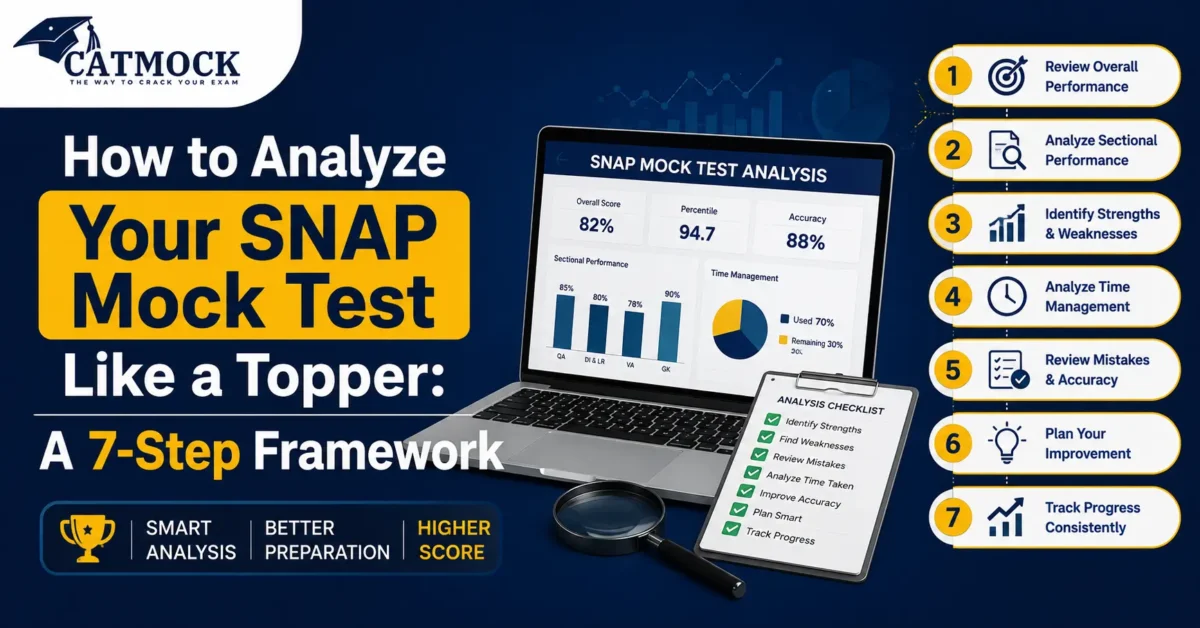
Most SNAP aspirants take mock test after mock test, but only a small percentage improve meaningfully with each attempt. Proper SNAP mock test analysis — not raw mock volume — is what separates an aspirant who plateaus at the same score for weeks from one who climbs steadily toward a strong percentile. This guide gives you the exact section-wise, step-by-step process toppers use to turn every SNAP mock into a measurable improvement cycle.
What Is SNAP Mock Test Analysis?
SNAP mock test analysis is the structured process of reviewing a completed mock — section-wise scores, topic-wise accuracy, time spent per question, and error types, including marks lost to negative marking — to identify specific, fixable gaps rather than just noting the final score. Done correctly, it converts each mock into a targeted revision plan instead of a one-time performance snapshot.
Taking a mock without analyzing it is like solving a practice paper and never checking the answer key — you get exam-day exposure but no real improvement.
Why SNAP Mock Test Analysis Matters More Than the Mock Itself
The SNAP exam pattern makes analysis unusually high-leverage. SNAP 2026 has 60 questions across four sections in 60 minutes — General English, Analytical & Logical Reasoning, Quantitative, Data Interpretation & Data Sufficiency, and the newly added Ethics, Morality & Values section — awarding +1 for a correct answer and deducting 0.25 marks for every incorrect one, and there is no sectional time limit — candidates can attempt any section in any order within the full 60 minutes. That combination means two things most aspirants underestimate: a time leak in one section can silently eat into every other section, and every careless guess has a direct, quantifiable cost.
Aspirants who follow a structured analysis routine after every mock typically see their score curve move upward attempt after attempt, while those who skip analysis often see a flat or declining trend, because unnoticed mistakes — and unnoticed negative marks — keep repeating. Candidates get three attempts, with the best-scoring attempt considered for admission, which makes a disciplined, mock-over-mock analysis habit directly tied to your final result, not just practice exposure.
The Topper’s 7-Step SNAP Mock Test Analysis Roadmap
Follow these seven steps, in order, every single time you complete a mock. A complete cycle takes roughly 90–100 minutes — well beyond the 60-minute mock itself, and that’s intentional.
| Step | Focus | Time Needed |
|---|---|---|
| 1 | First-impression review right after the mock | 10 minutes |
| 2 | Overall score & percentile check | 5 minutes |
| 3 | Section-wise deep analysis (English, Reasoning, Quant, Ethics) | 30–45 minutes |
| 4 | Time-budget audit — question-by-question pacing | 15 minutes |
| 5 | Error and negative-marking classification | 20 minutes |
| 6 | Update your error log | 10 minutes |
| 7 | Set 2–3 specific goals for the next mock | 5 minutes |
Source: CatMock SNAP Preparation Guide — catmock.com
Step 1 — The First 10 Minutes After Submitting
Before opening your score report, spend 10 minutes writing your immediate, unfiltered impressions while the exam is fresh:
- Which section felt toughest to sit through, regardless of score?
- Where did you feel rushed, and where did you have spare time left over?
- Did your chosen section-attempt sequence and time split feel right, or did you want to swap it midway?
- Were there moments you guessed out of habit rather than genuine partial knowledge?
This captures your felt experience of the exam — something the score report alone can’t show.
Step 2 — Overall Score & Percentile Check
Open your detailed score report and start at the top level before drilling down:
- Overall score out of 60 and percentile compared to your target institute’s expected cutoff.
- Section-wise scores across all four sections, to check whether performance is balanced or skewed toward one section.
- Marks lost to negative marking specifically, separate from marks lost to questions left unattempted.
- Comparison against your last three mocks, to see whether your trend is moving up, flat, or down.
Don’t judge a single mock in isolation. Consistent sectional performance across mocks is what tells you whether your prep is genuinely improving, or just fluctuating by chance. You can review the current SNAP exam pattern in detail on our SNAP exam overview page.
Step 3 — Section-Wise Deep Analysis
This is the core of the entire process. Go section by section before looking at the exam as a whole.
Quantitative, Data Interpretation & Data Sufficiency
- List every topic tested (Arithmetic, Algebra, Geometry, Modern Math, DI, DS) and mark accuracy for each, not just the section overall.
- Identify the 2–3 topics contributing the most incorrect or skipped questions — this is usually where the biggest score gains hide.
- Check whether Data Interpretation sets were attempted fully or partially; DI sets are time-heavy and often reveal pacing issues more than concept gaps.
General English
- Separate Reading Comprehension accuracy from grammar-based questions (sentence correction, para jumbles, fill-in-the-blanks) — these need very different fixes.
- For RC, note whether wrong answers came from misreading the passage or misreading the question itself.
- Track vocabulary-based losses separately, since these are usually fixed through daily reading rather than mock practice alone.
Analytical & Logical Reasoning
- Break performance down by question family: puzzles, seating arrangements, syllogisms, coding-decoding, and critical reasoning.
- Flag any puzzle or arrangement set that took over 6–7 minutes to solve, correct or not.
- This section now carries equal weightage with Quant (20 questions each) — check whether you attempted in order or picked easier sets first, since smart sequencing still matters even though it no longer carries the single-largest share of marks.
Ethics, Morality & Values (New in SNAP 2026)
- This is a newly introduced section — 10 questions for 10 marks — testing judgment on ethical dilemmas and values-based scenarios rather than a fixed syllabus or formula.
- Track accuracy separately from the other three sections, since revision here isn’t topic-based — most errors come from second-guessing an instinctive first read or misjudging what the “most reasonable” option is meant to be.
- Note down the type of scenario (workplace conflict, social dilemma, values trade-off) that repeatedly trips you up, so you build a consistent decision framework instead of guessing case by case.
Step 4 — Time-Budget Audit: Where Did the Minutes Go?
Most score-limiting mistakes in SNAP are pacing mistakes, not knowledge gaps — and because there’s no sectional clock forcing a move-on, a time leak in one section can silently consume the entire exam. Compare your actual time per question against a self-set target budget for each section.
| Section | Ideal Time / Question | Red Flag If |
|---|---|---|
| General English | ~60 seconds | RC passage takes over 6 minutes total |
| Analytical & Logical Reasoning | ~60 seconds | A single puzzle or arrangement set exceeds 7 minutes |
| Quantitative, DI & DS | ~60 seconds | Any question crosses 90 seconds, or a DI set exceeds 8 minutes |
| Ethics, Morality & Values | ~45 seconds | Any question crosses 90 seconds — these are judgment calls, not calculations, so lingering usually means second-guessing, not genuine difficulty |
Source: CatMock SNAP Preparation Guide — catmock.com
Mark every question that breached its budget, whether right or wrong. A correctly-solved question that ate three minutes is still a leak — it likely stole time from a later question, or an entirely different section, that you then had to rush, skip, or guess on.
Step 5 — Error and Negative-Marking Classification Framework
Not all wrong answers are the same, and treating them the same way is the biggest reason revision plans fail. Sort every incorrect or skipped question into one of four categories:
- Concept Gap — you didn’t know the underlying formula, rule, or method at all.
- Silly Mistake — you knew the method but made a calculation, sign, or reading error under pressure.
- Misread Question — you solved a different question than the one actually asked.
- Avoidable Negative-Marking Guess — you attempted a question you were genuinely unsure about and lost 0.25 marks, when skipping it would have cost nothing.
Each category needs a different fix: concept gaps need topic revision, silly mistakes need slower and more careful practice, misreads need active reading habits, and avoidable negative-marking guesses point back to Step 4’s discipline problem and your attempt-vs-skip threshold — your risk judgment, not your knowledge, is the problem.
Step 6 — Building and Using an Error Log
Maintain a single running error log across all your mocks, not a fresh sheet every time. A simple five-column format works well: mock number & date, section & topic, error type (from Step 5), correct approach (in your own words), and status (revised / re-attempted correctly / still weak).
After 4–5 mocks, sort this log by topic. Topics that keep reappearing with the same error type are your true priority list — far more reliable than guessing which topics to revise from memory.
Step 7 — Setting Goals for the Next Mock
End every analysis session by writing 2–3 specific, measurable goals. Vague goals like “do better in Quant” don’t work — specific ones do:
- “Improve Data Interpretation accuracy from 55% to 70%.”
- “Keep every Reasoning puzzle under 6 minutes.”
- “Cut avoidable negative-marking guesses from 4 per mock to under 1.”
Review these at the start of your next mock, and score yourself against them specifically during your next analysis session — this closes the feedback loop.
A 7-Day Post-Mock Review Cycle
Spread analysis and revision across the week following each mock so it doesn’t overwhelm your regular study schedule.
| Day | Activity |
|---|---|
| Day 1 | Take the mock + Step 1 & 2 (first impressions, score check) |
| Day 2 | Step 3 — full section-wise deep analysis |
| Day 3 | Step 4 & 5 — time-budget audit and error classification |
| Day 4 | Step 6 — update error log; revise flagged concept gaps |
| Day 5–6 | Targeted practice on weak topics identified in the log |
| Day 7 | Step 7 — set goals; light revision before next mock |
Source: CatMock SNAP Preparation Guide — catmock.com
This cycle lets you take one full-length mock per week while leaving time for focused revision — a pace that comfortably fits within a 4–6 week SNAP preparation runway. For weak-topic revision material, browse our SNAP study material page.
Tips to Increase Your SNAP Mock Score
- Attempt your strongest section first to bank marks early and build exam-day confidence.
- Cap time per question using the Step 4 budgets, and train yourself to skip and move on when a question crosses that limit.
- Prioritize accuracy over attempt count — under negative marking, 90% accuracy on 45 attempted questions usually beats 65% accuracy on 58 attempted questions.
- Revise your error log weekly, not just after each mock, so older mistakes don’t resurface closer to exam day.
- Simulate real exam conditions for at least your last 4–5 mocks — same time of day, no pauses, same environment as your booked SNAP slot.
Common SNAP Mock Analysis Mistakes to Avoid
- Only checking the overall score and skipping the section-wise and topic-wise breakdown entirely.
- Re-attempting wrong questions immediately after seeing the solution, which tests memory rather than understanding.
- Treating every wrong answer as a “concept gap” without separating silly mistakes and avoidable negative-marking guesses, leading to unnecessary re-learning.
- Not tracking trends across mocks, so the same weak topic keeps resurfacing unnoticed.
- Spending more time analyzing strong sections (because it feels good) than weak ones (because it doesn’t).
How CatMock’s SNAP Test Series Supports This Framework
Manually building error logs and time audits works, but it takes discipline and hours of extra effort after every mock. CatMock’s SNAP test series is designed to remove that manual burden so you can focus on revision instead of spreadsheet-building.
- 15 full-length mocks + 15 sectional tests — enough volume to run this entire roadmap multiple times before your actual exam.
- Performance tracking dashboard — auto-generates section-wise and topic-wise accuracy, so Step 3 takes minutes instead of an hour.
- Detailed mock analysis reports — highlight time spent per question and marks lost to negative marking, directly supporting the Step 4 and Step 5 audits.
- Expert support and guidance — mentors available to help interpret tricky patterns and suggest fixes.
- Mobile-friendly platform — review your error log and analysis on the go, between study sessions.
Explore the full SNAP test series, built specifically to support the exact analysis roadmap covered in this guide.
Summary
- SNAP mock test analysis is a structured, repeatable process — not just a glance at your final score.
- SNAP 2026’s 60-question, 60-minute, no-sectional-limit format — now spread across four sections including the newly added Ethics, Morality & Values section — makes both pacing discipline and negative-marking awareness uniquely important.
- Follow the 7-step roadmap: first impressions, score check, section-wise analysis, time-budget audit, error and negative-marking classification, error log, and goal-setting.
- Classify errors into four types — concept gap, silly mistake, misread, or avoidable negative-marking guess — since each needs a different fix.
- Track patterns across at least 4–5 mocks before making major strategy changes.
- A dashboard-driven test series can automate the number-crunching so you spend more time on revision.
For the full SNAP 2026 roadmap — pattern, syllabus, dates, registration, and cutoffs — see our SNAP 2026 Complete Guide.
Conclusion
The gap between a SNAP mock score that stays flat and one that climbs steadily comes down to what happens in the hour after you submit the test. Toppers don’t take more mocks than everyone else — they extract more information out of every single one through disciplined SNAP mock test analysis. Follow this roadmap after each attempt: capture your first impressions, check your score and percentile, go section by section, audit your time budget, classify your errors and negative marks, log everything, and set specific goals for next time. Done consistently over 4–6 weeks, this is what turns mock practice into a real, measurable climb toward your target percentile. Start your next mock and run this exact framework from day one.
FAQs
Q1. How can I analyze my SNAP mock test performance?
Go beyond your overall score — review section-wise and topic-wise accuracy, audit time spent per question, classify every error into a specific type including avoidable negative-marking guesses, and log the pattern across multiple mocks rather than judging any single attempt in isolation.
Q2. How much negative marking is there in SNAP?
SNAP deducts 0.25 marks for every incorrect answer, with +1 mark awarded for each correct answer and no penalty for questions left unattempted, across a 60-question, 60-minute paper.
Q3. What is a good attempt rate for SNAP given negative marking?
There’s no universal number, but prioritizing accuracy over attempt count generally pays off — a smaller number of confidently attempted questions with high accuracy often outscores a larger number of questions attempted with heavy guessing.
Q4. How soon after submitting the mock should I start analyzing it?
Start with Step 1 within 10 minutes of submitting, while the exam is still fresh. The detailed section-wise work can be spread across the 7-day review cycle, but the first-impressions capture loses value quickly if delayed.
Q5. What’s the real difference between a Concept Gap and a Silly Mistake?
Ask whether you could solve the question untimed, with no pressure. If you still couldn’t, it’s a Concept Gap needing topic revision. If you could solve it easily untimed but slipped under time pressure, it’s a Silly Mistake needing slower, deliberate practice on that question type.
Q6. How many SNAP mocks do I need before I can trust my trend line?
A single mock can swing on chance factors like an unfamiliar topic mix or an off day. Compare against your last three mocks, and treat your error log as genuinely reliable after 4–5 mocks, once recurring topics and error types show a clear pattern.
Q7. Is there a sectional time limit in SNAP?
No. SNAP has a single 60-minute overall timer with no sectional time limit, so candidates can attempt sections in any order and allocate time across them as they choose — which makes a personal time-budget audit especially important.
Q8. Does this analysis roadmap apply the same way to English, Reasoning, and Ethics as it does to Quant?
The seven-step structure stays the same, but what you look for within Step 3 differs by section — accuracy by topic for Quant, RC versus grammar accuracy for English, time-per-set flags for Reasoning, and pattern-tracking by dilemma type for the new Ethics, Morality & Values section.
Q9. What is the new Ethics, Morality & Values section in SNAP 2026?
It’s a newly added fourth section in the SNAP 2026 exam pattern, carrying 10 questions for 10 marks. It tests judgment on ethical and values-based scenarios rather than fixed syllabus knowledge, alongside the existing General English (10 questions), Analytical & Logical Reasoning (20 questions), and Quantitative, DI & DS (20 questions) sections — all within the same 60-question, 60-minute, no-sectional-limit format.