
Introduction
Are you a working professional looking to accelerate your career? If so, an Executive MBA might be exactly what you need. In India, the Executive MBA has grown remarkably popular among mid-career professionals, managers, and entrepreneurs. Therefore, understanding this program thoroughly before enrolling is absolutely essential.
An Executive MBA — commonly known as EMBA — is specifically designed for professionals with significant work experience. Unlike a regular MBA, it allows you to study while continuing your job. As a result, you gain advanced business knowledge without sacrificing your income or career momentum.
In this complete guide, therefore, we cover everything you need to know — from eligibility and top colleges to fees, career outcomes, and how to choose the best program for your goals.
Table of Contents
- What Is an Executive MBA?
- Executive MBA vs Regular MBA — Key Differences
- Who Should Pursue an Executive MBA in India?
- Eligibility Criteria for Executive MBA Programs
- Top Colleges Offering Executive MBA in India
- Fee Structure — What to Expect
- Admission Process — Step by Step
- Career Benefits After an Executive MBA
- Online vs On-Campus Executive MBA
- How to Choose the Right Executive MBA Program
- Conclusion
- FAQs
What Is an Executive MBA?
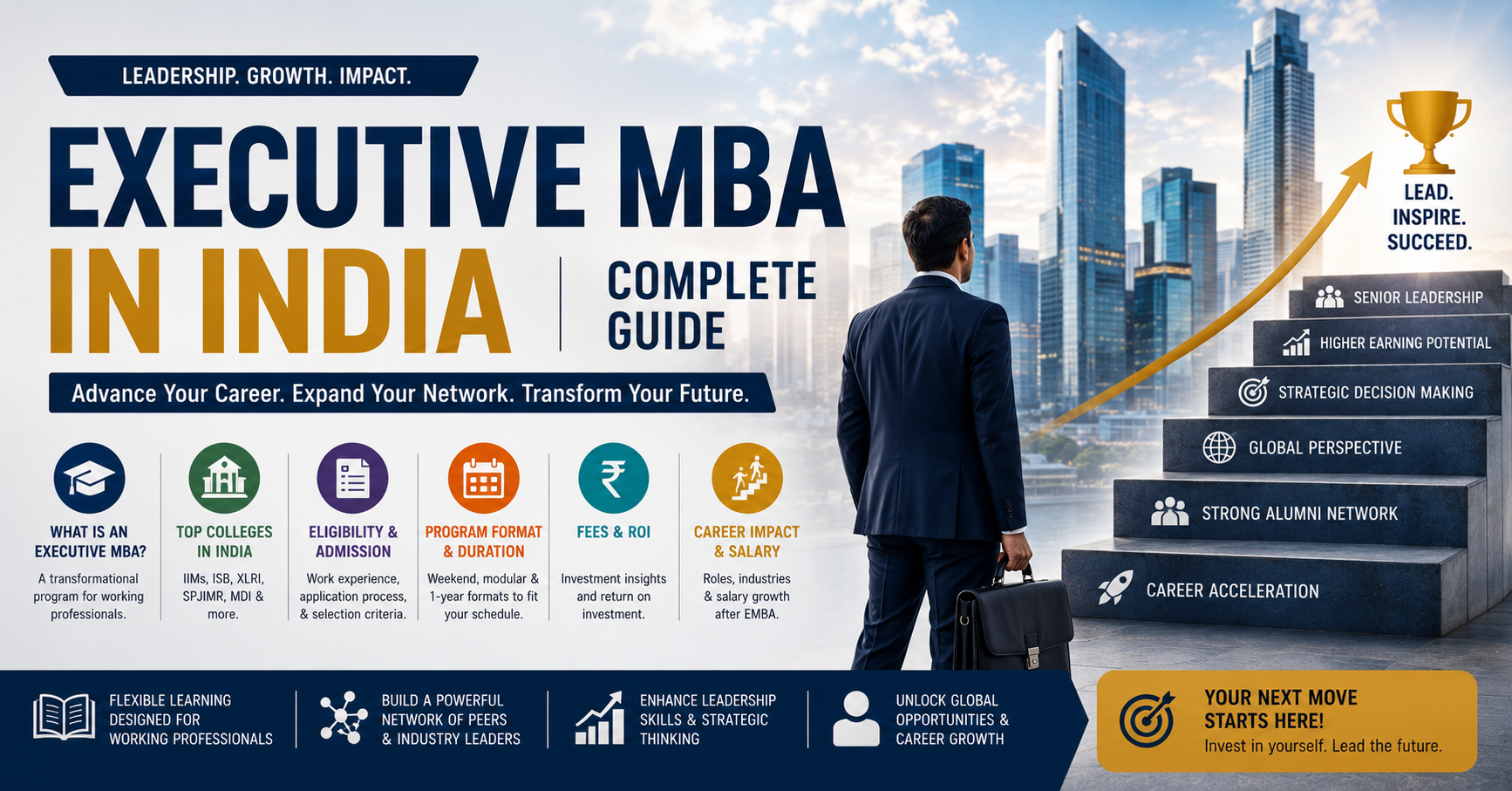
An Executive MBA is a postgraduate business management program tailored specifically for experienced professionals. Generally, it covers the same core subjects as a traditional MBA — strategy, finance, marketing, operations, and leadership. However, it is structured to fit around a working professional’s schedule.
Most Executive MBA programs in India run for 12 to 24 months. Furthermore, classes are typically held on weekends, during evenings, or in intensive modular formats. Consequently, you can continue working full-time while earning a prestigious business degree.
The program, therefore, bridges the gap between practical experience and formal business education. It equips professionals with strategic thinking, leadership skills, and a global business perspective.
Executive MBA vs Regular MBA —
Key Differences:
Many students and professionals often confuse an Executive MBA with a regular MBA. However, the two programs differ significantly in structure, audience, and purpose.
| Feature | Executive MBA | Regular MBA |
| Target Audience | Working professionals (5+ years exp.) | Fresh graduates or early-career professionals |
| Work Experience Required | Yes (typically 5–10 years) | Optional or minimal |
| Duration | 12–24 months | 2 years (full-time) |
| Class Schedule | Weekends / modular / online | Full-time weekdays |
| Average Age of Students | 30–45 years | 22–28 years |
| Cost (India) | ₹10 lakh – ₹35 lakh | ₹8 lakh – ₹25 lakh |
| Employer Sponsorship | Common | Rare |
| Networking Focus | Senior professionals & CXOs | Peers and alumni |
As the table clearly shows, therefore, each program serves a distinct audience. Choosing the right one depends entirely on your career stage and goals.
Who Should Pursue an Executive MBA in India?
Not every professional needs an Executive MBA. However, for the right candidate, it can be genuinely transformative. Here is who should seriously consider this program:
- Mid-career professionals with 5–15 years of experience looking for a senior role
- Entrepreneurs who want to add formal business acumen to their skillset
- Functional specialists (engineers, doctors, lawyers) who want to move into management
- Managers seeking a promotion to the C-suite or leadership roles
- Professionals changing industries who need credibility and a broader network
Furthermore, if your employer is willing to sponsor your education, then an Executive MBA becomes even more financially accessible.
Eligibility Criteria for Executive MBA Programs
Before applying, you must first confirm that you meet the basic eligibility requirements. Although criteria vary across institutions, the general requirements are as follows:
Academic Qualification
- A bachelor’s degree (any discipline) from a recognized university
- Minimum 50%–60% aggregate marks at graduation level
Work Experience
- Typically, 5 to 10 years of full-time professional experience is required
- Some premier institutions, such as IIMs, may require 8–10 years minimum
- Managerial or leadership experience is additionally preferred
Entrance Exams (Where Applicable)
- Some colleges accept CAT, GMAT, or XAT scores
- Several institutions, however, conduct their own entrance tests or interviews
- A few programs waive the entrance exam for highly experienced professionals
Therefore, always check specific institutional requirements before beginning your application.
Top Colleges Offering Executive MBA in India
India is home to several world-class institutions that offer excellent Executive MBA programs. Consequently, professionals have a wide range of quality options to choose from.
Premier Government Institutions
- IIM Ahmedabad — PGPX (1-year full-time Executive MBA, globally ranked)
- IIM Bangalore — EPGP (Executive Post Graduate Programme)
- IIM Calcutta — PGPEX (Executive MBA with global immersion)
- IIM Lucknow — iPMX (International Programme in Management for Executives)
Top Private Business Schools
- ISB Hyderabad — PGPpro (Part-time Executive MBA)
- XLRI Jamshedpur — PGDM (Business Management) for Executives
- SP Jain School of Global Management — Executive MBA
- Great Lakes Institute of Management — PGPM (Post Graduate Programme in Management)
Online & Distance Executive MBA
- Symbiosis Centre for Distance Learning (SCDL)
- IGNOU — MBA for working professionals
- Amity University Online
- Manipal University Online
💡“top MBA colleges in India” to your college ranking or comparison article.
Fee Structure — What to Expect
One of the most critical factors, naturally, is the cost of the program. Executive MBA fees in India vary widely depending on the institution’s reputation, location, and program format.
- IIM PGPX / EPGP programs: ₹28 lakh – ₹35 lakh
- ISB PGPpro: ₹22 lakh – ₹27 lakh
- XLRI / Great Lakes programs: ₹12 lakh – ₹20 lakh
- Private universities (mid-tier): ₹6 lakh – ₹12 lakh
- Online/distance EMBA programs: ₹1.5 lakh – ₹5 lakh
Fortunately, most top institutions offer education loans, scholarships, and EMI payment plans. Additionally, many employers sponsor part or all of the fee as part of talent retention strategies. Therefore, financing your Executive MBA is more achievable than it may initially seem.
Admission Process — Step by Step
The admission process for an Executive MBA program is generally straightforward. However, it does require careful preparation and timely submission.
- Research programs — Shortlist colleges based on reputation, fee, and format
- Check eligibility — Confirm you meet the experience and academic requirements
- Prepare for entrance exams — Register for CAT, GMAT, or institution-specific tests if required
- Submit application — Fill out the application form and upload required documents
- Write Statement of Purpose (SOP) — Clearly articulate your career goals and motivations
- Appear for interviews — Most top programs conduct personal interviews or group discussions
- Receive admission offer — Accept the offer and complete fee payment
- Begin orientation — Start your Executive MBA journey!
Therefore, starting your research at least 6–12 months before the desired intake is strongly advisable.
Career Benefits After an Executive MBA
Pursuing an Executive MBA in India offers substantial career advantages. Professionals who complete the program consistently report meaningful career growth.
- Salary hike: On average, EMBA graduates report a 25%–40% increase in salary post-completion
- Promotions: Many professionals move into senior management or C-suite roles within 1–2 years
- Career pivot: The degree provides credibility when switching industries or functions
- Entrepreneurship: Furthermore, it equips aspiring founders with business strategy and finance skills
- Global network: EMBA programs connect you with a powerful peer group of senior professionals
Online vs On-Campus Executive MBA
With digital education rapidly evolving, professionals now have a genuine choice between online and on-campus formats. Both options, however, offer distinct advantages.
On-Campus Executive MBA:
- Richer peer interaction and networking
- Access to campus facilities, mentors, and placement cells
- Greater brand value from tier-1 institutions
- However, requires travel and time commitment on weekends
Online Executive MBA:
- Highly flexible — study from anywhere at any time
- Generally more affordable
- Ideal for professionals in smaller cities or with heavy travel schedules
- However, networking opportunities may be comparatively limited
Therefore, your choice should depend on your priorities — if brand value and networking matter most, choose on-campus. If flexibility and cost are primary concerns, an online EMBA is an excellent alternative.
How to Choose the Right Executive MBA Program
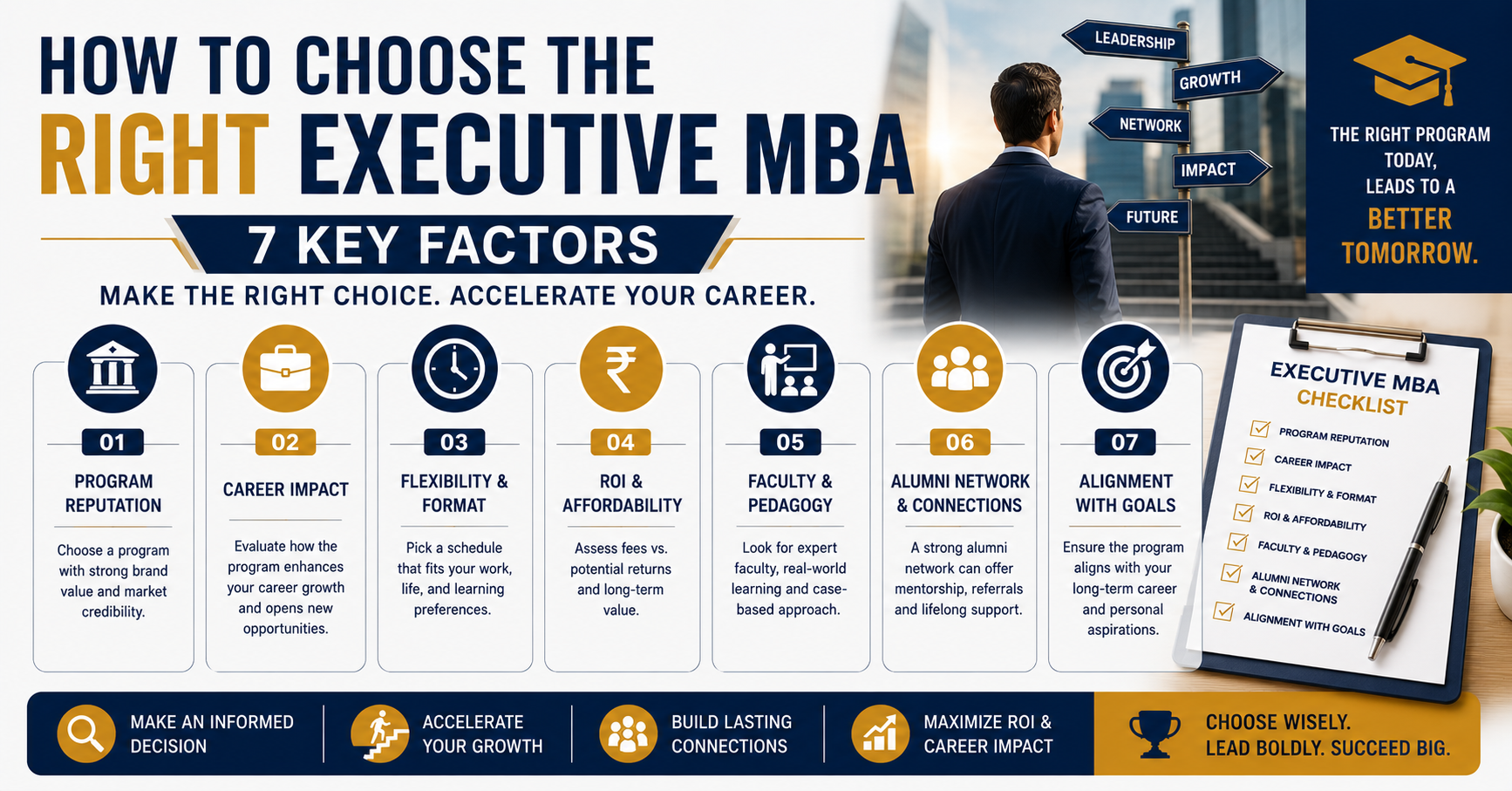
Choosing wisely is, ultimately, the most important step in your EMBA journey. Therefore, consider these key factors before making a final decision:
- Accreditation: Look for programs approved by AICTE, UGC, or internationally by AACSB/AMBA
- Reputation & Rankings: Check NIRF rankings and international B-school rankings
- Alumni network: A strong alumni base significantly enhances career outcomes
- Faculty quality: Research faculty profiles and their industry experience
- ROI: Compare the fee against the average salary increase post-program
- Flexibility: Ensure the format suits your professional and personal schedule
- Specializations: Choose programs offering relevant electives (Finance, Marketing, Strategy, etc.)
Conclusion
An Executive MBA is, without doubt, one of the most powerful investments a working professional can make in India today. It combines academic rigor with real-world applicability, making it ideal for professionals ready to take the next big leap in their careers. Therefore, whether you are aiming for a C-suite role, planning to launch a startup, or simply want to broaden your business perspective, an Executive MBA can be the catalyst you need.
Take time to evaluate your options carefully, compare programs thoroughly, and choose the institution that best aligns with your career goals and lifestyle. Your next chapter starts with the right decision today.
FAQs
1. What is the minimum work experience required for an Executive MBA in India?
Generally, most Executive MBA programs require at least 5 years of full-time work experience. However, premier institutes like the Indian Institutes of Management typically prefer candidates with 8–10 years of experience. Therefore, it is important to carefully review the specific eligibility criteria of each institute.
2. Can I pursue an Executive MBA while working full-time?
Yes, you can pursue an Executive MBA while working full-time. In fact, these programs are specifically designed for working professionals. Moreover, classes are usually conducted on weekends or in modular formats, so you can effectively balance work and study.
3. Is GMAT required for Executive MBA admission in India?
Not necessarily, as GMAT is not mandatory for all programs. For instance, some top programs at the Indian Institutes of Management and Indian School of Business do require GMAT scores. However, many other institutions accept CAT scores or conduct their own entrance tests, thereby offering flexibility to applicants.
4. What is the average salary after an Executive MBA in India?
On average, professionals report a 25%–40% increase in salary after completing an Executive MBA. Furthermore, many candidates move into senior management or leadership roles within 1–2 years. Therefore, the program often delivers strong career progression.
5. Is an online Executive MBA valid and recognized in India?
Yes, an online Executive MBA is valid, provided the institution is approved by the All India Council for Technical Education or the University Grants Commission. Additionally, programs from recognized universities are generally well-accepted by employers. Hence, accreditation plays a crucial role in program credibility.
6. What is the difference between an Executive MBA and a PGPM?
Both programs are designed for experienced professionals; however, there is a key difference. An Executive MBA is a degree program, whereas a PGPM is typically a diploma. Nevertheless, PGPMs from reputed institutes like the Indian School of Business are widely respected in the industry.
7. How much does an Executive MBA cost in India?
The cost of an Executive MBA varies significantly depending on the institute and format. For example:
- ₹1.5 lakh–₹5 lakh for online programs
- ₹10 lakh–₹35 lakh for top-tier programs
Therefore, your final choice will depend on your budget, preferred format, and target institutes.
8. Which is the best Executive MBA program in India
Several programs offered by the Indian Institutes of Management and the Indian School of Business are consistently ranked among the best. However, the “best” program ultimately depends on your career goals, experience level, and budget. Thus, it is important to evaluate options carefully.
9. Can I get an education loan for an Executive MBA?
Yes, you can obtain an education loan for an Executive MBA. In general, most banks and NBFCs offer such loans. Additionally, many institutes have tie-ups with financial institutions, which makes the loan process smoother and more accessible.
10. Is an Executive MBA worth it for entrepreneurs in India?
Yes, an Executive MBA can be highly valuable for entrepreneurs. Specifically, it provides structured knowledge in finance, strategy, marketing, and operations. Moreover, it offers access to peer networks and alumni connections, which can create significant business opportunities.
You may also visit: CATMOCK INDIA|CATMOCK