
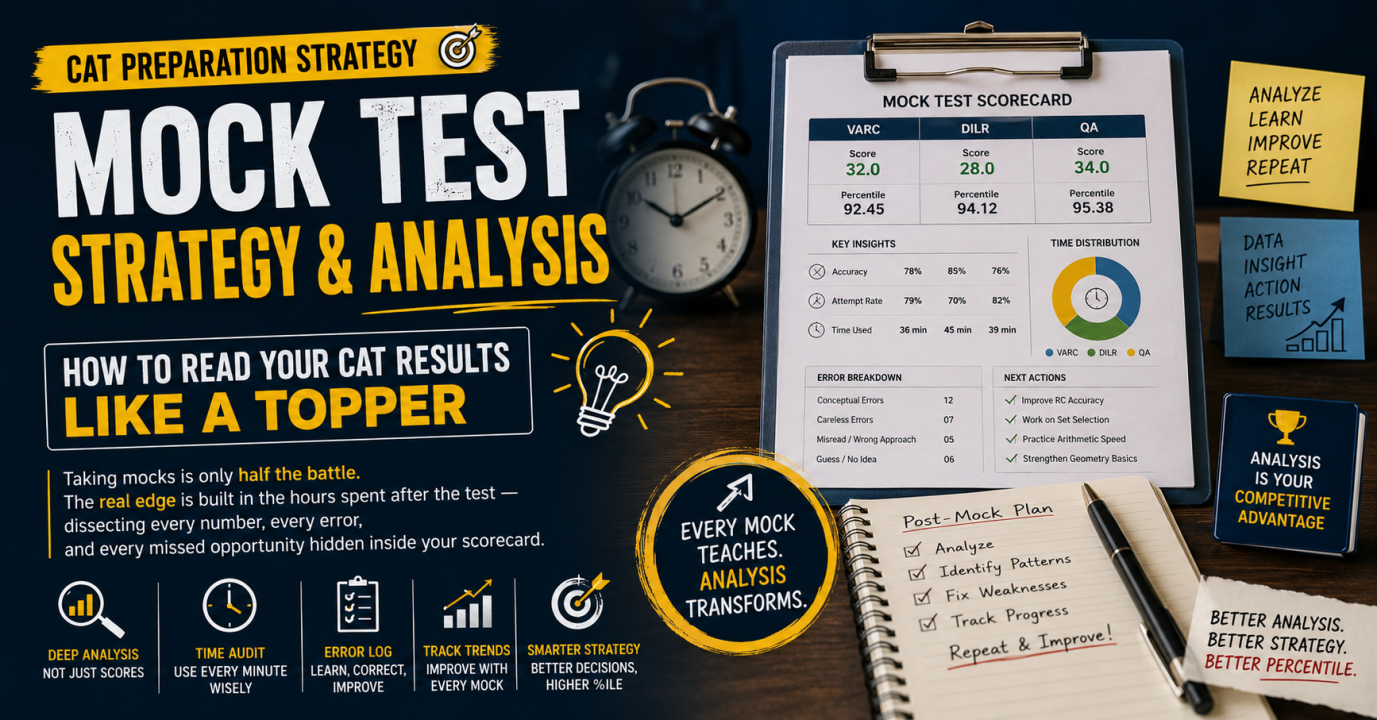
CAT Preparation · Strategy
How to Read Your CAT MOCK Results Like a Topper
Taking mocks is only half the battle.The hours after the test create the real edge. Use them to analyse every number, every error, and every missed opportunity in your scorecard.
Published for CAT aspirants · Estimated reading time: 14 min
📋 Table of Contents
- Why Post-Mock Analysis Is Non-Negotiable
- Before You Open the Answer Key
- Breaking Down Your Section-Wise Scores
- The Time Audit: Where Did Your Minutes Go?
- Building a Personal Error Log
- Evaluating Your Attempt Strategy
- Tracking Trends Across Multiple Mocks
- Percentile vs Raw Score: Understanding the Difference
- Turning Analysis Into an Action Plan
- Common Analysis Mistakes to Avoid
- Frequently Asked Questions
Every serious CAT aspirant knows the ritual. They attempt a gruelling 120-minute mock and check the score nervously. Too often, they move straight to the next mock without analysing the results. That single habit, more than any content gap, is what separates the 85th percentiler from the 99th. Systematic analysis of every mock you take is not supplementary; it is the actual preparation.
Furthermore, the process of analysis need not feel overwhelming. Once you adopt a structured framework, every mock transforms from a mere performance indicator into a detailed diagnostic report—one that tells you exactly what to fix, how to fix it, and when.
Section 01
Why Post-Mock Analysis Is Non-Negotiable
Students often treat mock tests as practice runs, but they should understand them as data-generation exercises.Each mock produces a rich dataset about your decision-making, time management, and conceptual gaps — none of which is visible from the score alone. Consequently, a student who takes 20 mocks and analyses each one thoroughly will consistently outperform someone who takes 40 mocks without any structured review.
Additionally, the CAT exam rewards intelligent selection — knowing which questions to attempt, skip, or return to later. You do not develop this skill by attempting questions; you develop it by studying your own patterns of success and failure across multiple attempts. Therefore, every minute invested in post-mock analysis generates a compounding return on your preparation effort.
Section 02
Before You Open the Answer Key
The most underrated step in mock analysis is what happens in the 10 minutes immediately after you submit a mock, before you open the answer key.During this window, you should write down — from memory — which questions felt uncertain, which felt like guesses, and which sections drained your confidence midway. When you compare this self-assessment with your actual performance, you can determine whether your metacognition—your sense of how well you are doing—accurately reflects reality.
If you consistently feel confident about questions you get wrong, you must address that pattern before you apply score-improvement strategies.Similarly, if anxiety is causing you to abandon correct attempts midway, that psychological insight is far more actionable than any topic-level correction could be.
The 10-Minute Reflection Protocol
Immediately after submitting your mock, spend exactly ten minutes doing three things: write the sections where you felt most in control, note the questions where you were genuinely unsure and chose to guess, and flag the moments when the pressure made you rush or freeze. This brief reflection forms the qualitative backbone of your subsequent quantitative analysis — and the combination of both is what produces genuine improvement.
Section 03
Breaking Down Your Section-Wise Scores
The overall score is largely irrelevant for analysis purposes. Instead, you should focus on three distinct numbers for each section: the accuracy rate (correct ÷ attempted), the attempt rate (attempted ÷ total questions), and the net score contribution (including negative marks). Together, these three figures tell a far more nuanced story than any single total.
For instance, a student who attempts 18 of 24 VARC questions with 78% accuracy is performing very differently from one who attempts 24 of 24 with 55% accuracy — even though their net scores might be similar. The first student needs to expand their attempt range; the second needs to slow down and improve selection discipline. Recognising this distinction is where meaningful strategy begins.
| Section | Healthy Attempt Rate | Target Accuracy | Red-Flag Zone |
| VARC (24 Qs) | 17 – 21 questions | 75 – 85% | Accuracy below 65% or attempts below 14 |
| DILR (20 Qs) | 12 – 16 questions | 80 – 90% | Attempting more than 18 Qs (over-attempting) |
| QA (22 Qs) | 14 – 19 questions | 75 – 85% | Attempting fewer than 10 or accuracy below 60% |
Section 04
The Time Audit: Where Did Your Minutes Go?
Time is the single most constrained resource in CAT—yet most aspirants spend no time analysing how they used it. A proper time audit requires you to reconstruct, as precisely as possible, how many minutes you spent on each question or set.Most modern mock platforms provide this data natively; if yours does not, a rough reconstruction by section is still valuable.
The goal is to identify your “time sinkholes” — those three or four questions that consumed disproportionate time and ultimately yielded no marks. Research across thousands of CAT toppers consistently shows that the biggest score improvements come not from learning new concepts but from eliminating time sinkholes. Consequently, each mock should end with a specific note on the longest-held questions that resulted in wrong answers or blanks.
Practical Tip: Mark every question where you spent more than 3 minutes. After the mock, go back and check: did those long attempts produce correct answers?If more than 40% of your longest attempts resulted in wrong answers or blanks, your exit strategy for tough questions needs immediate recalibration.
“The score tells you where you ended up. The time audit tells you why — and that is the only story worth reading.”
Section 05
Building a Personal Error Log
An error log is, without question, the most powerful tool available to a self-studying CAT aspirant. Log every wrong answer and every skipped question under one of four categories: conceptual gap (you did not know the concept), application error (you knew the concept but misapplied it), careless mistake (you knew the method but executed it incorrectly under time pressure), and trap question (the test-maker designed the question to mislead, and it succeeded).
This classification matters enormously because the remedy for each category is different. Conceptual gaps require content study. Application errors require solved examples under timed conditions. Careless mistakes require slowing down and building a verification habit. Trap questions require exposure to question types that test common misconceptions. Without a log, students treat all four categories identically—usually with another round of random problem-solving that fixes nothing systematically.
How to Maintain the Log Without Burning Out
The log need not be elaborate. A simple spreadsheet with five columns — date, section, question number, error type, and the concept tested — is sufficient and sustainable. Moreover, the log should be reviewed weekly, not just added to. Patterns will emerge within three to four mocks: you will notice, for instance, that 60% of your QA errors fall under “application error in Geometry,” which then becomes an immediate and specific target for the following week’s study plan.
Section 06
Evaluating Your Attempt Strategy
Beyond accuracy and time, every mock analysis should include a question-level review of your selection decisions. Specifically, you need to ask: did you skip easy questions that you should have attempted, and did you attempt difficult questions that you should have left unanswered? Both errors are costly, and you can identify both clearly in hindsight when you review the solution after the mock.
In DILR particularly, the choice of which sets to pick is often more consequential than performance within a set. Therefore, after each mock, you should review the skipped sets to determine whether any of them were actually more tractable than the ones you chose.Over time, this set-selection review sharpens your real-time judgment about which sets to open and which to pass — arguably the highest-leverage skill in the DILR section.
Section 07
Tracking Trends Across Multiple Mocks
A single mock’s analysis reveals problems. However, a comparison across five or ten mocks reveals patterns — and patterns are what drive structural improvement. A simple tracking sheet that records your accuracy, attempt rate, and net score for each section across every mock will quickly surface trends that no individual analysis could show: a steady decline in VARC accuracy after mock 8, for instance, might coincide with increased reliance on elimination rather than comprehension-based reading.
Furthermore, percentile trends are often more informative than raw score trends. Because CAT is a relative exam, your percentile reflects performance against the actual candidate pool sitting that mock. A raw score that stays flat but whose percentile drops suggests the candidate pool is improving faster — a critical signal that your preparation pace needs to increase. Consequently, you should track both numbers side by side rather than treat them as interchangeable.
Section 08
Percentile vs Raw Score: Understanding the Difference
Many aspirants fixate on raw scores and neglect percentile movement — or do the opposite and check percentile obsessively without understanding the normalisation process. The CAT raw score represents the absolute number of marks earned after accounting for negative marking.The percentile, however, derives from a scaled score that allows candidates to compare performance across different exam sessions, each of which may have had a different difficulty level.
What this means practically is that a student who scores 145 in a relatively easy slot may receive a lower percentile than one who scores 132 in a difficult slot. Accordingly, the goal during mocks is not to chase high raw scores on easier test series but to develop consistency and resilience across a range of difficulty levels — because the actual CAT may be easier or harder than your mock series.
Section 09
Turning Analysis Into an Action Plan
Analysis without action is the most expensive habit in CAT preparation. After every mock review, a written action plan of no more than three items should be created. These items need to be specific — not “improve VARC” but “spend 4 days solving RC passages from Hindu editorials focusing on tone-based inference questions.” This kind of specificity is only possible because the error log and time audit have already identified the exact problem that needs addressing.
Additionally, the action plan should include a re-test criterion: a small set of questions from the same error category that you can attempt after the study period to verify whether you have closed the targeted gap. Without this feedback loop, it is impossible to know whether the study sessions between mocks were effective or merely comfortable. The loop — mock, analyse, study, re-test, mock — is the engine of sustained improvement.
Weekly Rhythm Suggestion: Take a mock on Saturday morning. Spend Saturday afternoon on section-wise analysis and error logging. Study the flagged topics from Sunday through Wednesday. On Thursday, reattempt similar questions to verify improvement. Reserve Friday for light revision before the next mock. This rhythm keeps analysis and preparation tightly linked.
Section 10
Common Analysis Mistakes to Avoid
The most widespread mistake is emotional analysis — reviewing the mock while still feeling the frustration of a low score. Under these conditions, students mentally rationalise wrong answers (“I knew it but made a silly mistake”), and as a result, they under-populate the error log. Instead, students should conduct mock reviews at least two hours after the test ends, once the emotional reaction has settled and they have regained objectivity.
Another common error is analysing only the questions that were attempted. The skipped questions deserve equally serious attention, because they reveal whether the skipping decision was correct (the question was genuinely hard) or a missed opportunity (the question was moderate, and anxiety caused an unnecessary skip). Moreover, reviewing skipped questions costs zero marks risk while providing maximum learning return — which makes it one of the highest-ROI activities in the entire preparation process.
Frequently Asked Questions
Everything You’ve Been Wanting to Ask
Q1.How much time should be spent analysing each CAT mock?
A minimum of 90 minutes should be dedicated to post-mock analysis — ideally split across two sittings. The first sitting, done within 24 hours, focuses on error logging and time audit. A second sitting two days later reviews patterns and builds the action plan. Rushing the analysis to save time is the single most common cause of stagnant mock scores.
Q2.Is it better to take more mocks or analyse fewer mocks more deeply?
Deep analysis of fewer mocks is almost always more productive than shallow review of many mocks. Twenty fully analysed mocks will outperform forty casually attempted ones. A useful heuristic: if you cannot spend at least 90 minutes reviewing a mock, that mock’s time slot should instead be used for targeted practice based on your existing error log.
Q3.When should mock tests be started during CAT preparation?
The first sectional mocks should be started as soon as each section’s core concepts are covered — typically around the 8–10 week mark of structured preparation. Full-length mocks can begin around 12–16 weeks before the exam. Starting too early (before concepts are in place) leads to demoralising scores that reflect content gaps, not test-taking ability, and makes analysis less useful.
Q4.What is the ideal frequency for taking CAT mock tests?
During the initial phase, one mock per week with thorough analysis is optimal. In the final 6–8 weeks before the exam, frequency can increase to two per week — but only if the analysis quality is maintained. Taking a mock every day without review is one of the least effective preparation strategies available, regardless of how productive it may feel.
Q5.How should DILR set selection be evaluated after a mock?
After each mock, review every DILR set independently, including the ones you skipped. The key question is: did you skip the set because it was genuinely difficult, or because the opening lines appeared complex? Many strong DILR sets simplify considerably after the first minute of reading. Tracking this distinction over five to six mocks will sharpen the real-time selection instinct significantly.
Q6.My mock scores have plateaued. What does that mean?
A score plateau typically indicates one of three issues: you are not maintaining an error log and therefore keep repeating the same mistakes, your action plan lacks the specificity needed for targeted improvement, or your preparation between mocks does not address diagnosed gaps. View a plateau as a diagnostic signal rather than a motivational problem. Improving the analysis process—not simply attempting more questions—usually resolves it.
Q7.Should mocks from different providers be taken, or is one series sufficient?
Using two to three different mock series is advisable, as each provider has distinct question styles, difficulty calibrations, and interface formats. However, the first priority should always be fully mastering the analysis of each mock taken. Mixing series without completing a thorough analysis of each mock offers less benefit than deeply analysing mocks from a single high-quality series.
Q8.How should Reading Comprehension errors in VARC be classified?
Sub-classify RC errors within the four main error categories. Specifically, distinguish between inference-type errors (where the answer requires reading between the lines), tone-based errors (where you misread the author’s attitude), and detail-retrieval errors (where you mislocated or misread a fact in the passage). Each sub-type requires a different corrective reading strategy, so log them separately for maximum analytical clarity.
Q9.Is it worth reattempting the same mock test after analysis?
A full reattempt of the same mock is generally not recommended because you remember the answers, which skews accuracy. Instead, reattempt the questions from the error log in isolation—without time pressure—to verify your conceptual understanding. Then attempt similar questions from a different source under timed conditions to check whether the learning transfers to new problems.
Q10.How do I deal with anxiety that affects my mock performance?
You can address anxiety during mocks more effectively through the analysis process itself than through relaxation techniques alone.When patterns reveal that anxiety leads to specific behaviours — rushing the first ten minutes, abandoning partially-solved sets, skipping VARC passages that seem long — those behaviours become concrete targets. Each mock is then an opportunity to test one deliberate change in behaviour, which replaces the generalised experience of anxiety with a specific and manageable task.
Q11.Should negative marks be tracked separately in the error log?
Absolutely—and many aspirants overlook this. Track negative marks by question type, not just by section. If most negative marks come from a specific question format (say, inference-based RCs or number series in QA), that insight allows you to create a precise strategy: either improve your accuracy for that question type or adopt a stricter skip rule during mocks. Aggregate negative marks obscure this actionable information.
Q12.How important is the sectional time limit in mock strategy?
Sectional time limits are among the most underappreciated constraints in CAT strategy. Because you cannot transfer time between sections, a student who finishes VARC in 30 minutes has not “saved” time for DILR—instead, they forfeit the remaining time.Therefore, the time audit should always check whether the student left any time unused in a section, and the student should incorporate a specific plan for using that buffer (re-checking flagged answers, reattempting skipped questions) into the standard exam approach.
Q13.What is a healthy accuracy rate across sections, and how should it be balanced with attempt rate?
For most CAT aspirants targeting the 95th percentile, a healthy overall accuracy rate lies between 75% and 85% across sections, with an attempt rate that ensures they answer enough questions to reach their percentile target.The precise balance differs by section: DILR rewards high accuracy on fewer attempts, while VARC allows slightly lower accuracy across a broader attempt range. The table in Section 3 of this blog offers section-specific benchmarks as a starting reference point.
Q14.Can mock analysis replace conceptual study sessions?
Mock analysis cannot replace conceptual study, but it should direct it. Analysis identifies which concepts are weak; dedicated study sessions then address those concepts. The mistake many aspirants make is treating study and mocks as parallel tracks — in reality, they should be tightly sequential. Study fills the gaps that analysis reveals; the next mock then tests whether the gaps have been filled. Without this closed loop, both study and mock-taking become largely disconnected activities.
Q15.How should the final two weeks before CAT be used in terms of mocks and analysis?
In the final fortnight, the focus should shift from gap-filling to strategy consolidation. One or two mocks per week are sufficient; the emphasis should be on reinforcing the decisions that have consistently worked (question selection, time allocation, skip rules) rather than learning new content. During this phase, keep the analysis lighter. Focus primarily on checking for regression in areas you previously corrected and on building confidence through deliberate review of the questions you solved correctly throughout the preparation period.
You may also visit: CATMOCK INDIA|CATMOCK