

📋 Table of Contents
- Introduction — The Big Question
- The Online MBA Landscape in India 2026
- Understanding the Real ROI
- Salary Growth After an Online MBA
- Pros and Cons — A Balanced View
- Online MBA vs. Regular MBA: Which Wins?
- Top Colleges Offering Online MBA in India
- Specifically for CAT Aspirants
- The Verdict — Should You Invest?
- Frequently Asked Questions (FAQs)
Introduction — The Big Question Everyone Is Asking
Every year, lakhs of students across India sit for the CAT exam, dream of IIMs, and wonder whether an MBA degree is truly worth the time, money, and effort. However, not everyone can afford to leave their job, relocate to a campus, or clear the ultra-competitive IIM cutoff. Consequently, the Online MBA in India has emerged as one of the most debated topics of 2026.
Is it merely a shortcut that employers dismiss? Or is it, in fact, a genuinely valuable qualification that can transform your career trajectory? Furthermore, with so many institutions now offering online management degrees, how does a student — or a parent — separate the gold from the glitter?
The good news? The answer is increasingly — and confidently — yes. Moreover, when the investment is approached strategically, an online MBA can deliver extraordinary returns that rival even some full-time programs. Therefore, this comprehensive guide has been designed to help you make that critical decision with clarity, data, and confidence.
In this in-depth blog, we will break down everything you need to know — from actual ROI figures and salary hikes to comparisons with traditional MBA programs — so that you can make a truly informed decision.
The Online MBA Landscape in India in 2026
The Indian online education market has grown dramatically over the last three years. According to recent industry estimates, the online higher education segment in India is valued at over ₹8,000 crore, with management programmes leading the demand. Furthermore, the UGC (University Grants Commission) issued landmark guidelines that officially recognised online MBA degrees on par with full-time programmes — a development that has changed perceptions significantly.
Today, therefore, students can pursue online MBAs from premier institutions such as IIM Bangalore, IIM Calcutta, NMIMS, BITS Pilani, Amity, and Symbiosis. Additionally, platforms like Coursera, upGrad, and Simplilearn have partnered with globally accredited universities, making quality management education genuinely accessible.
Why Is the Online MBA Booming in 2026?
Several compelling factors are driving this boom. First and most importantly, the post-pandemic workforce has demonstrated that remote work and online collaboration are not only viable but often preferred. Employers, as a result, have revised their biases. Second, rising CAT competition means that thousands of talented students who score below 95 percentile — but are still extremely capable — are looking for credible alternative paths. Third, the cost differential between an Online MBA (₹1.5–4 lakh) and a full-time IIM MBA (₹20–25 lakh) is enormous, making ROI calculations far more favourable for the online route.
Understanding the Real ROI of an Online MBA in India
ROI, or Return on Investment, is ultimately the most important number in this entire debate. However, calculating it accurately requires you to consider multiple dimensions — not just the fee vs. the package.
The Financial ROI Formula
A straightforward way to measure financial ROI is: (Post-MBA Annual Salary – Pre-MBA Annual Salary) ÷ Total Programme Cost × 100. Let us apply this with realistic numbers.
For example, if you earn ₹5 LPA before the programme, invest ₹2.5 lakh in an Online MBA from a reputed institution, and subsequently receive a promotion that takes your salary to ₹8 LPA — your additional annual income is ₹3 lakh. Consequently, your investment is recovered in less than one year. Moreover, over a five-year horizon, this translates to a 600% return — a figure that most equity investments would struggle to match.
💡 Key Insight for Parents: Unlike stock market investments where losses are possible, an investment in a recognised Online MBA from a UGC/AICTE-approved institution is an asset that appreciates throughout your child’s entire career. Furthermore, no market crash can “devalue” the knowledge and networks gained.
The Non-Financial ROI — Often Ignored, Always Valuable
Beyond salary figures, an Online MBA delivers substantial non-monetary returns. First, it provides structured, globally benchmarked management knowledge that transforms how you think about problems. Additionally, it offers access to alumni networks, industry mentors, and peer learning groups that remain relevant for decades. Furthermore, many online MBA programmes now include live case studies, industry projects, and placement assistance — benefits that were previously exclusive to campus programmes.
Salary Growth After an Online MBA — Real Data Points
Numbers speak louder than promises. Below is a data-informed comparison of typical salary trajectories for online MBA graduates from reputed institutions in India in 2026:
| Profile / Industry | Pre-MBA Avg. CTC | Post-MBA Avg. CTC | Hike % |
|---|---|---|---|
| IT / Software Professional | ₹5.5 LPA | ₹9.5 LPA | +73% |
| Banking / Finance Executive | ₹4.8 LPA | ₹8.2 LPA | +71% |
| Sales & Marketing Professional | ₹4.2 LPA | ₹7.0 LPA | +67% |
| Healthcare Administrator | ₹3.8 LPA | ₹6.5 LPA | +71% |
| Government / PSU Employee | ₹5.0 LPA | ₹7.8 LPA | +56% |
| Fresh Graduate (Tier-2 City) | ₹2.5 LPA | ₹4.8 LPA | +92% |
Pros and Cons — A Genuinely Balanced View
Transparency matters. Therefore, rather than simply promoting the idea, let us honestly weigh both sides.
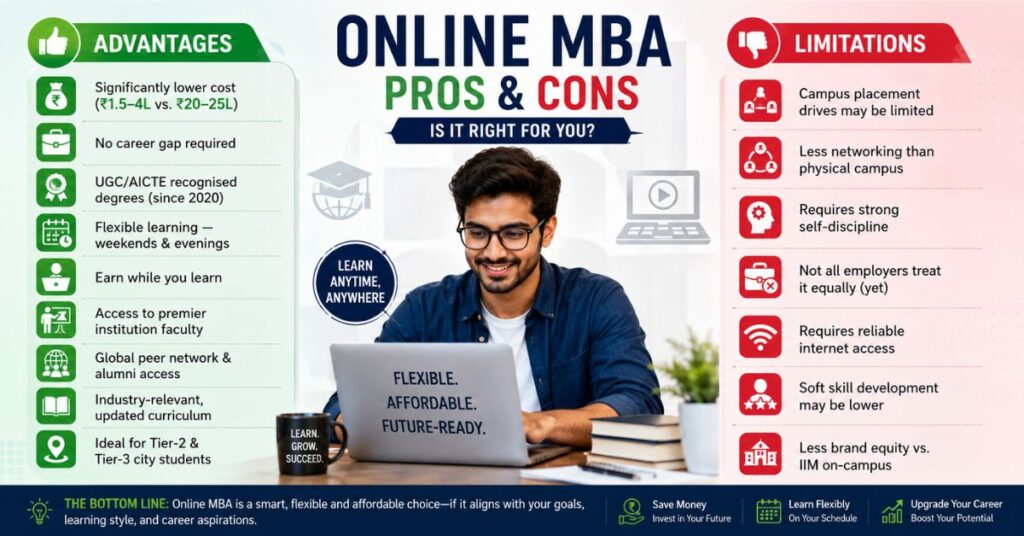
✅ Advantages
- Significantly lower cost (₹1.5–4L vs. ₹20–25L)
- No career gap required
- UGC/AICTE recognised degrees (since 2020)
- Flexible learning — weekends & evenings
- Earn while you learn
- Access to premier institution faculty
- Global peer network & alumni access
- Industry-relevant, updated curriculum
- Ideal for Tier-2 & Tier-3 city students
❌ Limitations
- Campus placement drives may be limited
- Less networking than physical campus
- Requires strong self-discipline
- Not all employers treat it equally (yet)
- Requires reliable internet access
- Soft skill development may be lower
- Less brand equity vs. IIM on-campus
Importantly, the gap between online and regular MBAs is narrowing rapidly. Furthermore, companies like Deloitte, TCS, Wipro, and HDFC Bank have actively hired online MBA graduates in 2024 and 2025 — a significant signal of changing industry norms.
Online MBA vs. Regular MBA — Which One Wins in 2026?
This comparison is not a simple one. Rather, it depends entirely on your personal situation, financial position, and career goals. Nevertheless, we can offer a structured perspective.
Best Value 2026💻
Online MBA
- Cost: ₹1.5L–4L total
- Duration: 1–2 years (flexible)
- No career break needed
- UGC recognised (2020+)
- Best for: Working professionals, budget-conscious students, Tier 2/3 city aspirants
- ROI break-even: 6–18 months
Regular (On-Campus) MBA
- Cost: ₹5L–25L+ total
- Duration: 2 years full-time
- Career gap of 2 years
- Strong brand equity (IIMs)
- Best for: Fresh graduates with strong CAT scores & family support
- ROI break-even: 3–7 years
Therefore, if you are a working professional earning ₹4–8 LPA, the online MBA route almost always delivers a superior financial ROI. Conversely, if you have the opportunity to attend an IIM or a top-20 B-school, that campus experience and brand value can unlock doors that remain closed to most online alumni — at least presently.
Top Colleges Offering Online MBA in India — 2026 Update
Choosing the right institution is arguably the most critical factor in determining your ROI. Not all online MBA programmes are valued equally by employers. Therefore, it is essential to consider accreditation, faculty quality, industry linkages, and alumni outcomes before you invest.
UGC-Entitled Universities to Consider
Institutions such as Chandigarh University, Lovely Professional University, Amity University, IGNOU, and Manipal University offer UGC-approved online MBA programmes at highly affordable price points. Consequently, these are excellent options for students in smaller cities who cannot access premium institutions. Additionally, many of these universities offer specialisations in areas like Digital Marketing, Fintech, Business Analytics, and Supply Chain Management — domains that are witnessing explosive demand in 2026.
Premium Executive Programmes
For working professionals with 2+ years of experience, Executive MBA (EMBA) or Executive PG Programmes from IIMs, ISB, and XLRI carry significantly higher market value. Furthermore, these programmes are structured around weekends and online modules, making it possible for employed individuals to pursue them without disrupting their career progression.
Specifically for CAT Aspirants — A Candid Conversation
If you are preparing for CAT 2026, here is a piece of advice that many coaching institutes will never give you: it is perfectly okay to pursue an online MBA route if your CAT score does not land you in a top-20 B-school.
CAT is, without doubt, one of the toughest entrance exams in the world. Moreover, the competition intensifies each year — A total of 2.58 lakh candidates appeared for the CAT 2025 examination., yet fewer than 4,000 received IIM interview calls. Consequently, a majority of serious, hardworking aspirants find themselves without a seat despite months of dedicated preparation.
A Two-Pronged Strategy Worth Considering
Rather than viewing an Online MBA as a fallback, consider approaching it as a parallel strategy. For instance, you could continue preparing for CAT while simultaneously enrolling in a 1-year Online MBA from a UGC-approved university. As a result, you build management knowledge, improve your professional profile, and give yourself a significant edge in CAT group discussions and PI rounds — even if you choose to attempt the exam again.
For Parents Reading This: Your child’s potential is not determined by a single exam score. An Online MBA from a quality institution is not a compromise — it is a strategically intelligent, financially prudent investment that can be completed alongside employment. Additionally, it shields your family from the ₹20–25 lakh financial risk of an uncertain campus MBA outcome.
The Final Verdict — Should You Invest in an Online MBA in 2026?
The answer is a confident yes — with important conditions attached. Specifically, it is worth it if you choose a UGC/AICTE-recognised institution with demonstrable placement records. Furthermore, it delivers outstanding ROI if you are a working professional who can immediately apply the learning at your workplace. Moreover, it is an excellent choice if you are from a Tier-2 or Tier-3 city where access to physical business schools is limited.
However, it may not be the best choice if you have already cleared CAT with a 95+ percentile, as the traditional campus experience at a top B-school will still offer a higher long-term brand premium. Additionally, if you are looking to network intensively or switch industries entirely, a full-time MBA with campus immersion may serve you better.
The Bottom Line
The Online MBA in India in 2026 is no longer the underdog — it is increasingly a mainstream, respected, and cost-effective qualification. The key, ultimately, lies in your choice of institution, your personal discipline, and your ability to apply the knowledge purposefully. Given all of this, if you approach it strategically, the return on your investment can be truly transformational — not just financially, but in terms of confidence, clarity, and career direction.
Frequently Asked Questions (FAQs)
These are the questions most commonly asked by students, CAT aspirants, and parents who are evaluating the online MBA decision in 2026.
Q1. Is an online MBA degree from India recognised by emloyers in 2026?
Yes, absolutely — especially for programmes approved by UGC and AICTE. Since 2020, UGC officially recognised online degrees on par with full-time programmes. Furthermore, major Indian employers like TCS, Infosys, HDFC Bank, and Deloitte have actively recruited online MBA graduates. However, the strength of recognition still depends on the reputation of the institution you choose.
Q2. What is the average ROI of an online MBA compred to a regular MBA in India?
The financial ROI of an Online MBA is typically higher in the short term. Since the total investment is ₹1.5–4 lakh compared to ₹15–25 lakh for a top-tier campus MBA, the break-even point is reached much faster — often within 6–18 months. A regular IIM MBA, on the other hand, may take 4–7 years to recover the investment, though the long-term earning potential can be significantly higher from a premier institution.
Q3. Can I pursue an Online MBA while preparing for CAT?
Yes, and it is actually a smart strategy. Many online MBA programmes are designed around evenings and weekends. Consequently, you can prepare for CAT simultaneously without either activity suffering. Moreover, completing management coursework can actually strengthen your understanding of case studies and business fundamentals — areas tested in CAT and in IIM interviews.
Q4. Which are the best institutions for Online MBA in India in 2026?
Among the top choices are IIM Bangalore (EPGP), IIM Calcutta (PGPEX), BITS Pilani (WILP), NMIMS (Online MBA), Symbiosis (SCDL), Manipal University, and Amity University Online. Additionally, premium edtech platforms like upGrad and Simplilearn have partnered with globally accredited universities. It is advisable to verify UGC/AICTE approval before enrolling.
Q5. What salary hike can I realistically expect after completing an Online MBA?
Based on industry data from 2024–2026, graduates from reputed online MBA programmes have reported salary hikes of 40%–90% within 12–24 months of programme completion. Furthermore, the hike is higher for professionals who apply for internal promotions or switch to management roles immediately after graduating. Individual results, of course, depend on your industry, city, experience level, and the reputation of your programme.
Q6. Is an Online MBA from a private university less valuable than one from an IIM?
In terms of brand value, yes — IIM degrees carry higher prestige. However, not all comparisons are fair. For a working professional spending ₹2 lakh on an accredited online MBA who gets a ₹3 lakh annual raise, the financial outcome is outstanding. Conversely, a regular MBA from a lower-ranked private B-school (₹8–12 lakh) may offer less ROI than a well-executed Online MBA. Therefore, the comparison must always be institution-specific, not just online vs. offline.
Q7. What are the eligibility criteria for most online MBA programmes in India?
Typically, applicants need a Bachelor’s degree (any stream) with at least 50% aggregate marks from a recognised university. Additionally, many institutions prefer candidates with 1–2 years of work experience. Some premium executive programmes require 3–5 years of experience. Entrance exams like CAT, MAT, or institutional assessments may also be required for certain programmes.
Q8. Do Online MBA programmes offer placement assistance?
Many reputed Online MBA programmes now offer placement cells, career workshops, mock interviews, and recruiter tie-ups. However, the placement support is generally less intensive than what full-time campus students receive. Therefore, it is important to research each programme’s placement track record before enrolling. Platforms like upGrad, for instance, provide dedicated career services with industry partnerships.
Q9. How should parents evaluate whether an Online MBA is right for their child?
Parents should consider four factors: (a) the accreditation status of the institution — only UGC/AICTE approved degrees hold legal value; (b) the programme’s alumni placement data; (c) the child’s ability to self-manage learning alongside other commitments; and (d) the financial investment relative to expected outcomes. Additionally, an Online MBA can serve as an excellent bridge degree while the student continues to build experience and optionally re-attempt competitive entrances.
Q10. Will Online MBA degrees hold the same value in 5-10 years as they do today?
The trajectory strongly suggests yes — and the value is likely to increase further. With UGC standardisation, growing employer acceptance, AI-driven personalised learning, and post-pandemic normalisation of remote education, online degrees are increasingly treated as credible. Furthermore, global universities entering India’s online education space are elevating quality benchmarks. Consequently, students who invest in a quality Online MBA today are positioning themselves ahead of a curve that is still rising.
Q11. What specialisations are most in demand for Online MBA in India in 2026?
The most sought-after specialisations in 2026 include Business Analytics & Data Science, Digital Marketing, FinTech & Financial Management, Operations & Supply Chain, Healthcare Management, and Entrepreneurship. Furthermore, specialisations in Sustainability and ESG Management are rapidly gaining traction as Indian corporations align with global governance standards.
You may also visit: CATMOCK INDIA|CATMOCK