

Table of Contents:
1. Introduction
2. What Is a Geometry Formula Sheet?
3. 2D Shape Formulas
• Triangle Formulas
• Quadrilateral Formulas
• Circle Formulas
4. 3D Shape Formulas
• Cube and Cuboid
• Cylinder, Cone, and Sphere
5. Coordinate Geometry Formulas
6. Angle and Line Formulas
7. Pythagorean Theorem
8. Worked Examples
9. Tips for Using a Geometry Formula Sheet
10. FAQS
11. Conclusion
Introduction
Geometry is one of the oldest branches of mathematics, and it shows up everywhere — from the tiles on your floor to the screen you are reading this on. Whether you are a student preparing for an exam, a teacher looking for a quick reference, or simply someone who wants to brush up on their math skills, having a geometry formula sheet by your side makes everything easier.
This guide is your all-in-one geometry formula sheet — covering formulas for 2D shapes, 3D shapes, coordinate geometry, angles, and more. Every formula is explained in simple language, with examples to show you exactly how to use them. Bookmark this page and never be stuck on a geometry problem again.
What Is a Geometry Formula Sheet?
A geometry formula sheet is a quick-reference document that lists all the important formulas used in geometry. Instead of memorizing dozens of formulas from scratch, students can use a formula sheet to:
- Save time during exams and homework
- Quickly verify formulas they half-remember
- Build a strong foundation before moving to advanced topics like trigonometry or calculus
A good geometry formula sheet organizes formulas by category — 2D shapes, 3D shapes, lines, angles, and coordinate geometry — making it easy to find what you need at a glance.
2D Shape Formulas
Two-dimensional (2D) shapes are flat figures with length and width but no depth. The two most commonly needed measurements for 2D shapes are area (the space inside) and perimeter (the distance around the outside).
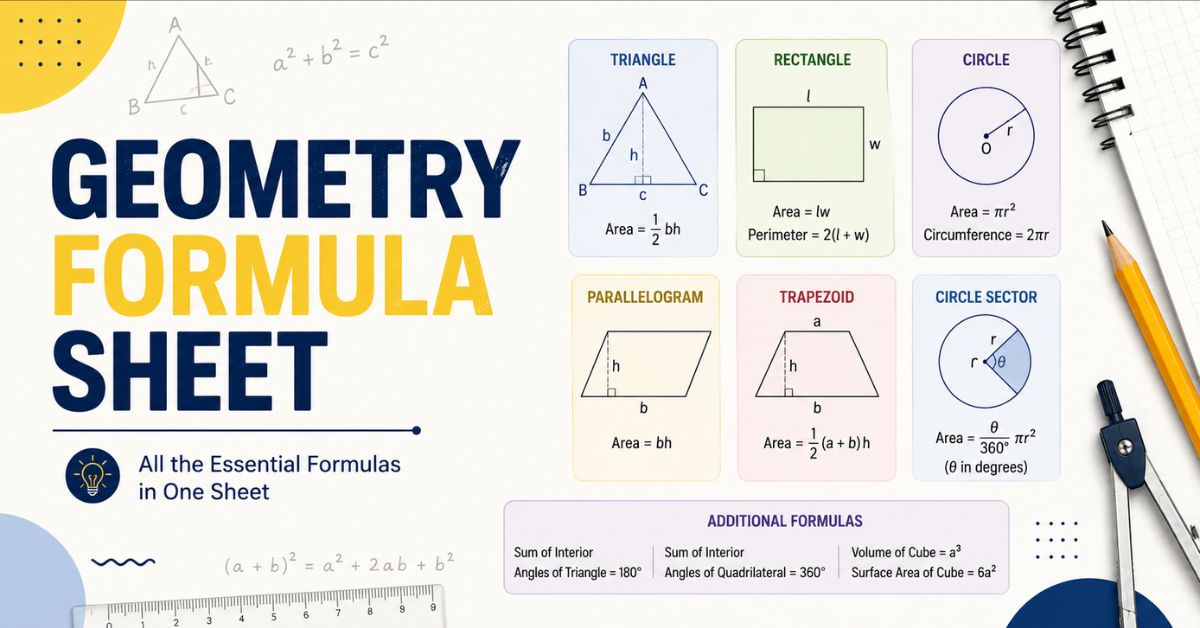
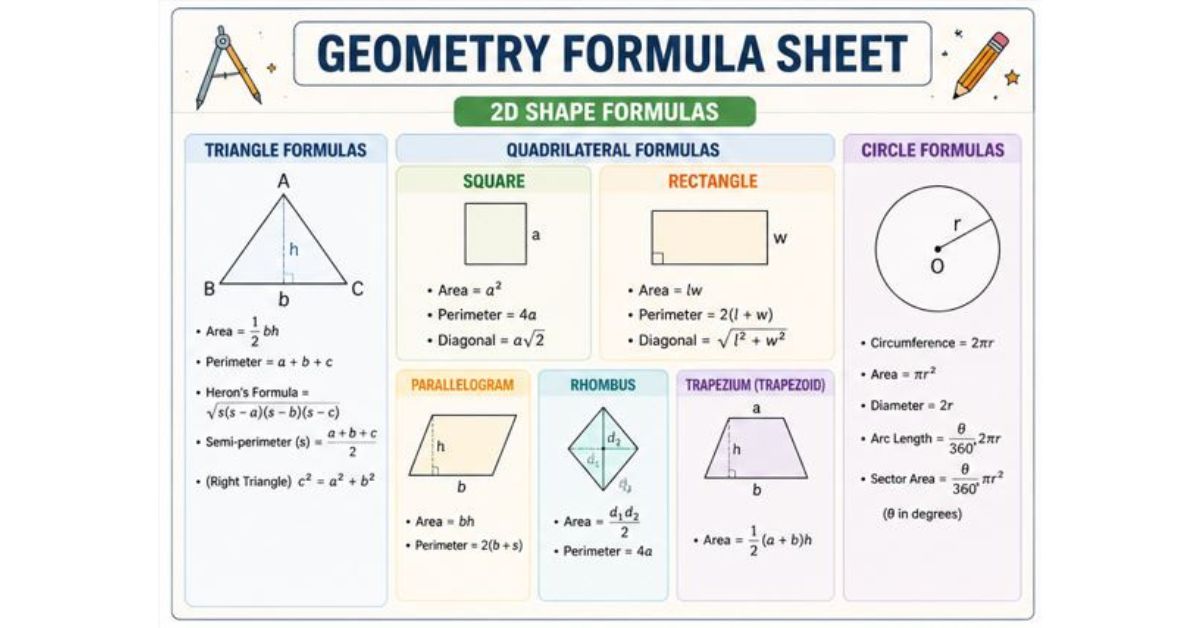
Triangle Formulas
A triangle has three sides and three angles. Here are the key formulas:
| Formula | Expression |
|---|---|
| Area | ½ × base × height |
| Perimeter | a + b + c |
| Area (Heron’s Formula) | √[s(s−a)(s−b)(s−c)], where s = (a+b+c)/2 |
Example:
A triangle has a base of 8 cm and a height of 5 cm.
Area = ½ × 8 × 5 = 20 cm²
Types of Triangles and Special Notes:
- Equilateral Triangle Area = (√3/4) × side²
- Right Triangle: Use the Pythagorean theorem: a² + b² = c²
Quadrilateral Formulas
Quadrilaterals are four-sided polygons. Here are the formulas for the most common ones:
| Shape | Area | Perimeter |
|---|---|---|
| Square | side² | 4 × side |
| Rectangle | length × width | 2(length + width) |
| Parallelogram | base × height | 2(a + b) |
| Rhombus | ½ × d₁ × d₂ | 4 × side |
| Trapezoid | ½ × (a + b) × height | a + b + c + d |
Example:
A rectangle is 12 cm long and 7 cm wide.
Area = 12 × 7 = 84 cm²
Perimeter = 2(12 + 7) = 2 × 19 = 38 cm
Circle Formulas
Circles are unique because they use the constant π (pi) ≈ 3.14159.
| Formula | Expression |
|---|---|
| Area | π × r² |
| Circumference | 2 × π × r |
| Diameter | 2r |
| Arc Length | (θ/360) × 2πr |
| Sector Area | (θ/360) × πr² |
Where r = radius and θ = central angle in degrees.
Example:
A circle has a radius of 6 cm.
Area = π × 6² = π × 36 ≈ 113.1 cm²
Circumference = 2 × π × 6 ≈ 37.7 cm
3D Shape Formulas
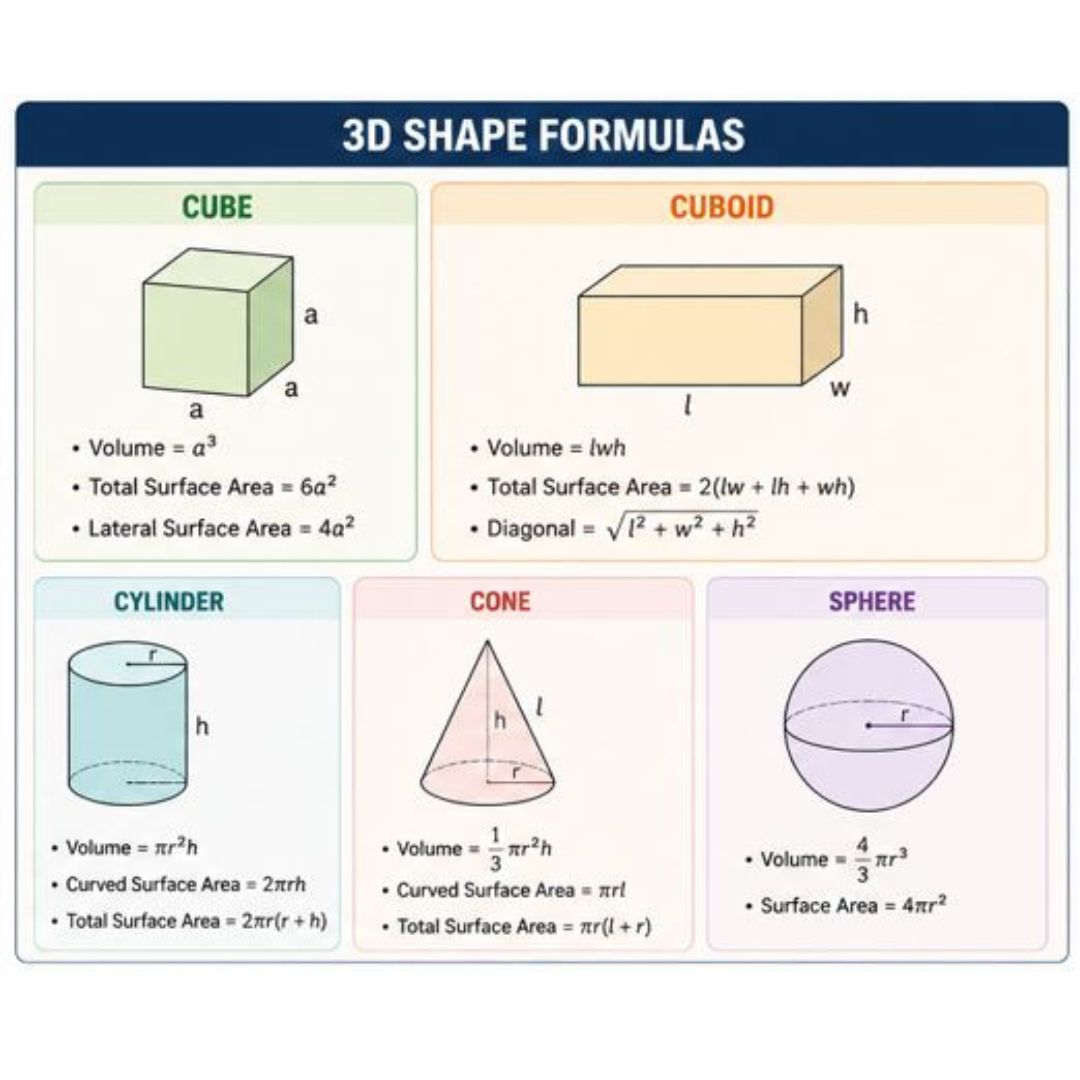
Three-dimensional (3D) shapes have length, width, and depth. For 3D shapes, we typically calculate surface area and volume.
Cube and Cuboid
| Shape | Volume | Surface Area |
|---|---|---|
| Cube | side³ | 6 × side² |
| Cuboid | l × w × h | 2(lw + wh + lh) |
Example:
A cube has a side length of 4 cm.
Volume = 4³ = 64 cm³
Surface Area = 6 × 4² = 6 × 16 = 96 cm²
Cylinder, Cone, and Sphere
| Shape | Volume | Surface Area |
|---|---|---|
| Cylinder | π × r² × h | 2πr(r + h) |
| Cone | ⅓ × π × r² × h | πr(r + l), where l = slant height |
| Sphere | (4/3) × π × r³ | 4 × π × r² |
| Hemisphere | (2/3) × π × r³ | 3 × π × r² |
Example:
A cylinder has a radius of 3 cm and a height of 10 cm.
Volume = π × 3² × 10 = π × 90 ≈ 282.7 cm³
Coordinate Geometry Formulas
Coordinate geometry (also called analytic geometry) deals with shapes and lines plotted on a coordinate plane (x-y axis).
| Formula | Expression |
|---|---|
| Distance Between Two Points | √[(x₂−x₁)² + (y₂−y₁)²] |
| Midpoint of a Line Segment | ((x₁+x₂)/2, (y₁+y₂)/2) |
| Slope of a Line | (y₂−y₁) / (x₂−x₁) |
| Equation of a Line (Slope-Intercept) | y = mx + c |
| Equation of a Line (Point-Slope) | y − y₁ = m(x − x₁) |
| Distance from a Point to a Line |
Example:
Find the distance between points A(2, 3) and B(6, 7).
Distance = √[(6−2)² + (7−3)²] = √[16 + 16] = √32 ≈ 5.66 units
Angle and Line Formulas
Understanding angles is central to geometry. Here are the key rules and formulas:
| Concept | Formula / Rule |
|---|---|
| Angles on a straight line | Sum = 180° |
| Angles at a point | Sum = 360° |
| Vertically opposite angles | Equal |
| Interior angles of a triangle | Sum = 180° |
| Interior angles of a quadrilateral | Sum = 360° |
| Interior angles of an n-sided polygon | (n − 2) × 180° |
| Each interior angle of a regular polygon | [(n − 2) × 180°] / n |
| Exterior angle of a polygon | 360° / n |
| Complementary angles | Sum = 90° |
| Supplementary angles | Sum = 180° |
Example:
A regular hexagon (6 sides) has interior angles of:
[(6 − 2) × 180°] / 6 = (4 × 180°) / 6 = 720° / 6 = 120° each
Pythagorean Theorem
One of the most famous formulas in all of mathematics, the Pythagorean Theorem applies to right-angled triangles:
a² + b² = c²
Where c is the hypotenuse (the longest side, opposite the right angle), and a and b are the other two sides.
Example:
A right triangle has legs of 3 cm and 4 cm. Find the hypotenuse.
c² = 3² + 4² = 9 + 16 = 25
c = √25 = 5 cm
Common Pythagorean Triples to Remember:
- 3, 4, 5
- 5, 12, 13
- 8, 15, 17
- 7, 24, 25
Worked Examples
Example 1: Finding the Volume of a Cone
A cone has a radius of 5 cm and a height of 12 cm. Find its volume.
Formula: V = ⅓ × π × r² × h
V = ⅓ × π × 25 × 12
V = ⅓ × 300π
V = 100π ≈ 314.16 cm³
Example 2: Area of a Trapezoid
A trapezoid has parallel sides of 8 cm and 14 cm, and a height of 6 cm.
Formula: A = ½ × (a + b) × h
A = ½ × (8 + 14) × 6
A = ½ × 22 × 6
A = 66 cm²
Example 3: Midpoint of a Segment
Find the midpoint between points P(−2, 4) and Q(6, −2).
Formula: M = ((x₁+x₂)/2, (y₁+y₂)/2)
M = ((−2+6)/2, (4+(−2))/2)
M = (4/2, 2/2)
M = (2, 1)
Tips for Using a Geometry Formula Sheet
- Organize by topic — Keep 2D, 3D, and coordinate geometry formulas in separate sections so you can find what you need fast.
- Write formulas in your own words — Understanding why a formula works helps you remember it better than pure memorization.
- Practice with real examples — Apply each formula to at least one problem before your exam.
- Note the units — Area is always in square units (cm², m²), and volume in cubic units (cm³, m³).
- Keep a personal formula sheet — Write out your own version by hand. The act of writing helps commit formulas to memory.
- Double-check what’s given — Many errors come from mixing up radius and diameter, or base and height. Always re-read the problem.
FAQs
Q1. What is the most important formula in geometry?
The Pythagorean theorem (a² + b² = c²) is widely considered the most fundamental formula in geometry. It connects algebra and geometry and is used in countless real-world applications.
Q2. How many geometry formulas are there?
There is no fixed count, but a standard geometry formula sheet for school covers around 40–60 key formulas across 2D shapes, 3D shapes, coordinate geometry, and angle relationships.
Q3. What is π (pi) and why is it used in geometry?
Pi (π ≈ 3.14159) is a mathematical constant that represents the ratio of a circle’s circumference to its diameter. It appears in all formulas involving circles, cylinders, cones, and spheres.
Q4. Can I use a geometry formula sheet during exams?
This depends on your school or exam board. Many standardized tests (like SAT or GRE) provide a reference sheet. For school exams, check with your teacher. Either way, understanding the formulas — not just having them — is what leads to success.
Q5. What is the difference between area and surface area?
Area refers to the space inside a 2D (flat) shape. Surface area refers to the total area of all the outer faces of a 3D shape — essentially, the area you would need to “wrap” the shape.
Q6. How do I find the area of an irregular shape?
For irregular shapes, break the shape into smaller regular shapes (rectangles, triangles, etc.), find the area of each, and add them all together. This technique is called the decomposition method.
Q7. What are the basic shapes I should know for a geometry formula sheet?
At minimum, you should know the formulas for: triangle, square, rectangle, parallelogram, circle, trapezoid, cube, cuboid, cylinder, cone, and sphere.
Conclusion
A well-organized geometry formula sheet is one of the most powerful tools a math student can have. Whether you are calculating the area of a circle, the volume of a sphere, or the distance between two points on a graph, having the right formula at hand saves time and prevents errors.
In this guide, we covered:
- All major 2D and 3D shape formulas
- Coordinate geometry formulas
- Angle rules and polygon formulas
- The Pythagorean theorem
- Worked examples and study tips
The next step is practice. Go through each formula, try a few examples on your own, and build your confidence one formula at a time. With this complete geometry formula sheet, you are fully equipped to tackle any geometry problem that comes your way.
You may also visit: CATMOCK INDIA|CATMOCK