

Table of Contents
- Introduction
- What is an Algebra Formula Sheet
- Basic Algebra Formulas
- Properties of Algebra
- Exponent Rules
- Algebraic Identities
- Square and Cube Formulas
- Difference of Squares and Cubes
- Linear Equations Formulas
- Quadratic Equations Formulas
- Polynomials and Factoring Formulas
- Logarithm and Exponent Formulas
- Sequences and Series Formulas
- Tips for Memorizing the Algebra Formula Sheet
- FAQs About the Algebra Formula Sheet
- Conclusion
Introduction
Whether you are a student preparing for your next exam in 2026 or someone brushing up on math skills, having a reliable algebra formula sheet by your side can make all the difference. Algebra is the foundation of almost every branch of mathematics — from geometry and trigonometry to calculus and statistics. Yet, many students struggle to remember the dozens of formulas spread across their textbooks.
Fortunately, this guide brings everything together in one place. You will find a complete algebra formula sheet organized by topic, with clear explanations and worked examples so you understand not just what the formulas are, but how and when to use them. Moreover, all formulas in this guide are mathematically verified and aligned with standard curricula followed across schools and competitive exams in 2026.
As a result, you can bookmark this page and refer to it whenever you need a quick formula lookup.
What Is an Algebra Formula Sheet?
An algebra formula sheet is a concise reference document that lists all the important formulas, rules, and identities used in algebra. In other words, it covers everything from basic properties of numbers to complex polynomial factoring and logarithmic rules.
Think of it as your math cheat sheet — a quick-access toolkit that saves you from flipping through an entire textbook when you need a single formula during study sessions or exam prep.
Why You Need One
- Saves Time: Quickly find the formula you need without searching through notes.
- Boosts Confidence: Knowing the formulas are there reduces exam anxiety.
- Improves Accuracy: Using the correct formula reduces calculation errors.
- Organizes Learning: Seeing all formulas together helps you spot patterns and connections between topics.
Basic Algebra Formulas
Let’s start at the very beginning. These are the foundational rules every algebra student must know before moving on to advanced topics.
Properties of Algebra
| Property | Formula | Example |
|---|---|---|
| Commutative (Addition) | a + b = b + a | 3 + 5 = 5 + 3 = 8 |
| Commutative (Multiplication) | a × b = b × a | 4 × 6 = 6 × 4 = 24 |
| Associative (Addition) | (a + b) + c = a + (b + c) | (2+3)+4 = 2+(3+4) = 9 |
| Associative (Multiplication) | (a × b) × c = a × (b × c) | (2×3)×4 = 2×(3×4) = 24 |
| Distributive | a(b + c) = ab + ac | 3(4+5) = 12+15 = 27 |
| Identity (Addition) | a + 0 = a | 7 + 0 = 7 |
| Identity (Multiplication) | a × 1 = a | 9 × 1 = 9 |
| Zero Property | a × 0 = 0 | 100 × 0 = 0 |
| Additive Inverse | a + (−a) = 0 | 5 + (−5) = 0 |
| Multiplicative Inverse | a × (1/a) = 1, (a ≠ 0) | 4 × (1/4) = 1 |
Example: Expand 5(x + 3). Using the distributive property: 5(x + 3) = 5x + 15
Exponent Rules
Exponents appear constantly in algebra. Here are the must-know rules — understanding these will make simplifying expressions much faster:
| Rule | Formula | Example |
|---|---|---|
| Product Rule | aᵐ × aⁿ = aᵐ⁺ⁿ | x³ × x⁴ = x⁷ |
| Quotient Rule | aᵐ ÷ aⁿ = aᵐ⁻ⁿ | x⁶ ÷ x² = x⁴ |
| Power of a Power | (aᵐ)ⁿ = aᵐⁿ | (x²)³ = x⁶ |
| Power of a Product | (ab)ⁿ = aⁿbⁿ | (2x)³ = 8x³ |
| Power of a Quotient | (a/b)ⁿ = aⁿ/bⁿ | (x/2)² = x²/4 |
| Zero Exponent | a⁰ = 1, (a ≠ 0) | 7⁰ = 1 |
| Negative Exponent | a⁻ⁿ = 1/aⁿ | x⁻³ = 1/x³ |
| Fractional Exponent | a^(m/n) = ⁿ√(aᵐ) | 8^(2/3) = (³√8)² = 4 |
To apply the product rule: x³ × x⁴ = x³⁺⁴ = x⁷
Similarly, for the power of a product: (2x²)³ = 2³ × x⁶ = 8x⁶
Algebraic Identities
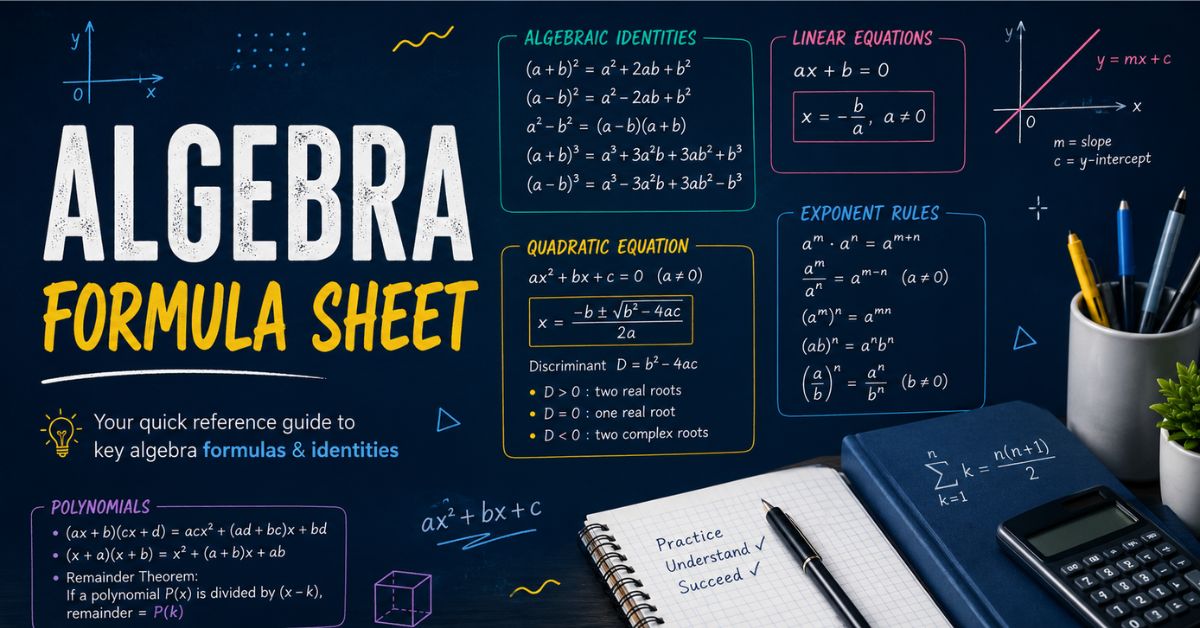
Algebraic identities are equations that hold true for all values of the variables. They are the heart of any algebra formula sheet because they dramatically speed up expansion and factoring.
Square and Cube Formulas
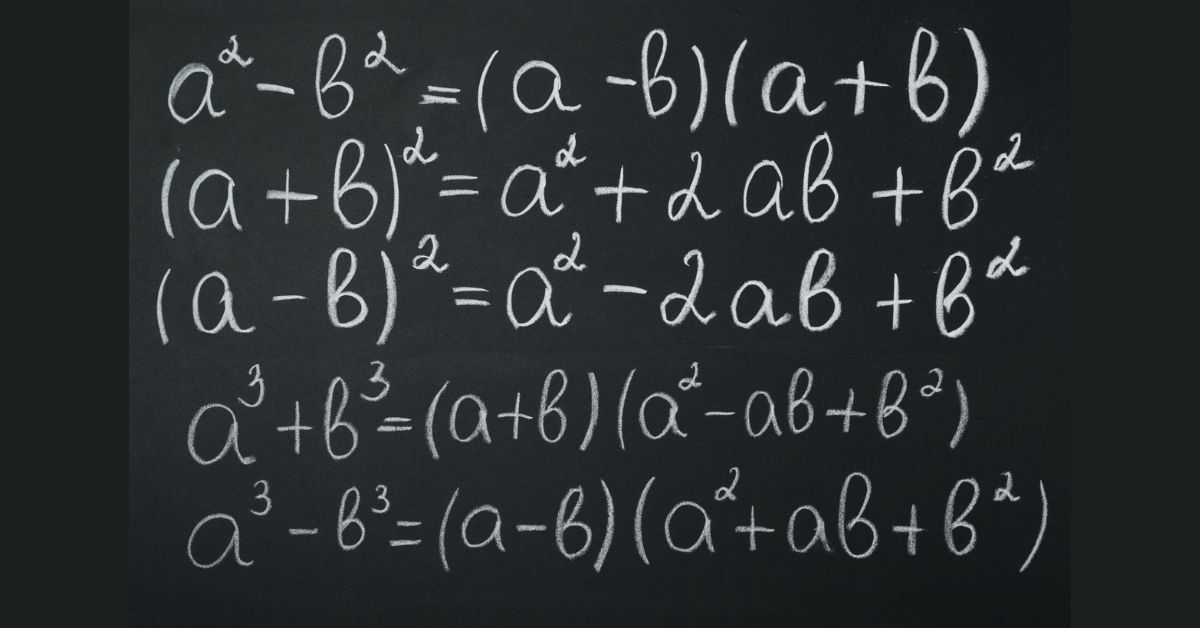
(a + b)² = a² + 2ab + b²
(a − b)² = a² − 2ab + b²
(a + b)(a − b) = a² − b² (also called the Difference of Squares)
(a + b)³ = a³ + 3a²b + 3ab² + b³
(a − b)³ = a³ − 3a²b + 3ab² − b³
(a + b + c)² = a² + b² + c² + 2ab + 2bc + 2ca
Difference of Squares and Cubes
These identities are especially useful for factoring expressions quickly. In particular, recognizing these patterns can save significant time in exams:
- a² − b² = (a + b)(a − b) ← Difference of Squares
- a³ + b³ = (a + b)(a² − ab + b²) ← Sum of Cubes
- a³ − b³ = (a − b)(a² + ab + b²) ← Difference of Cubes
Linear Equations Formulas
A linear equation is an equation of the first degree — that is, no variable has an exponent greater than 1. These formulas are, therefore, among the most commonly used in algebra.
Standard Forms and Key Formulas
| Formula | Expression |
|---|---|
| General Form | ax + b = 0 |
| Solution of General Form | x = −b/a |
| Slope-Intercept Form | y = mx + b |
| Point-Slope Form | y − y₁ = m(x − x₁) |
| Standard Form (Two Variables) | Ax + By = C |
| Slope Formula | m = (y₂ − y₁) / (x₂ − x₁) |
| Distance Between Two Points | d = √[(x₂ − x₁)² + (y₂ − y₁)²] |
| Midpoint Formula | M = ((x₁+x₂)/2, (y₁+y₂)/2) |
Quadratic Equations Formulas
A quadratic equation has the standard form ax² + bx + c = 0 where a ≠ 0. Unlike linear equations, quadratics can have two, one, or no real solutions depending on the discriminant.
Key Formulas
| Formula | Expression |
|---|---|
| Quadratic Formula | x = [−b ± √(b² − 4ac)] / 2a |
| Discriminant | D = b² − 4ac |
| Sum of Roots | α + β = −b/a |
| Product of Roots | α × β = c/a |
| Vertex of Parabola | x = −b / 2a |
Interpreting the Discriminant
The discriminant D = b² − 4ac is the key to determining how many real solutions a quadratic equation has:
| Discriminant Value | Nature of Roots |
|---|---|
| D > 0 | Two distinct real roots |
| D = 0 | One repeated real root (equal roots) |
| D < 0 | No real roots (two complex conjugate roots) |
Solve x² − 5x + 6 = 0: Here a = 1, b = −5, c = 6. D = (−5)² − 4(1)(6) = 25 − 24 = 1 x = (5 ± √1) / 2 = (5 ± 1) / 2 Therefore, x = 3 or x = 2 ✓
Verify using root formulas: Sum of roots = 3 + 2 = 5 = −(−5)/1 ✓ Product of roots = 3 × 2 = 6 = 6/1 ✓
Determine the nature of roots for x² + x + 1 = 0: D = 1² − 4(1)(1) = 1 − 4 = −3. Since D < 0 → No real roots
Polynomials and Factoring Formulas
Important Polynomial Identities
- (x + a)(x + b) = x² + (a + b)x + ab
- Perfect Square Trinomial: x² + 2ax + a² = (x + a)²
- Perfect Square Trinomial: x² − 2ax + a² = (x − a)²
The Factor Theorem
If f(a) = 0 for a polynomial f(x), then (x − a) is a factor of f(x). Conversely, if (x − a) is a factor, then f(a) = 0. This theorem is particularly useful when factoring higher-degree polynomials.
Logarithm and Exponent Formulas
Logarithms are the inverse operation of exponentiation. If aˣ = b, then logₐ(b) = x. Understanding this relationship is essential before applying the rules below.
Logarithm Rules
| Rule | Formula | Example |
|---|---|---|
| Product Rule | logₐ(mn) = logₐ m + logₐ n | log₂(4×8) = log₂4 + log₂8 = 2+3 = 5 |
| Quotient Rule | logₐ(m/n) = logₐ m − logₐ n | log₂(8/2) = log₂8 − log₂2 = 3−1 = 2 |
| Power Rule | logₐ(mⁿ) = n × logₐ m | log₂(8²) = 2 × log₂8 = 2×3 = 6 |
| Change of Base | logₐ(b) = log(b) / log(a) | log₂(10) = log10/log2 ≈ 3.32 |
| Log of 1 | logₐ(1) = 0 | log₅(1) = 0 |
| Log of Base | logₐ(a) = 1 | log₇(7) = 1 |
| Natural Log Inverse | ln(eˣ) = x | ln(e³) = 3 |
| Exponential Inverse | e^(ln x) = x | e^(ln 5) = 5 |
Simplify log₂(8): = log₂(2³) = 3 × log₂(2) = 3 × 1 = 3
Next, simplify log₃(27) − log₃(3): = log₃(27/3) = log₃(9) = log₃(3²) = 2
Sequences and Series Formulas
Arithmetic Progression (AP)
An arithmetic progression is a sequence where each term differs from the previous by a fixed value called the common difference (d). Consequently, the terms increase or decrease by the same amount each step.
| Formula | Expression |
|---|---|
| nth Term | aₙ = a + (n − 1)d |
| Sum of n Terms | Sₙ = n/2 × [2a + (n−1)d] |
| Sum (using first & last term) | Sₙ = n/2 × (a + l), where l = last term |
Find the 10th term of the sequence 2, 5, 8, 11, …: Here a = 2, d = 3, n = 10. a₁₀ = 2 + (10 − 1) × 3 = 2 + 27 = 29
Furthermore, find the sum of the first 10 terms: S₁₀ = 10/2 × [2(2) + (10−1)(3)] = 5 × [4 + 27] = 5 × 31 = 155
Geometric Progression (GP)
In contrast to an AP, a geometric progression is a sequence where each term is obtained by multiplying the previous term by a fixed value called the common ratio (r).
| Formula | Expression |
|---|---|
| nth Term | aₙ = a × rⁿ⁻¹ |
| Sum of n Terms (r ≠ 1) | Sₙ = a(rⁿ − 1) / (r − 1) |
| Sum of Infinite GP | S∞ = a / (1 − r), valid only when |
Find the 5th term of 3, 6, 12, 24, …: Here a = 3, r = 2, n = 5. a₅ = 3 × 2⁴ = 3 × 16 = 48
Find the sum of the infinite series 1 + 1/2 + 1/4 + 1/8 + …: Here a = 1, r = 1/2 (since |r| < 1, the formula applies). S∞ = 1 / (1 − 1/2) = 1 / (1/2) = 2
Harmonic Progression (HP)
A Harmonic Progression (HP) is a sequence whose reciprocals are in Arithmetic Progression (AP)
Harmonic Mean of Two Numbers
HM=a+b2ab
Relationship Among Means
AM×HM=GM2
nth Term of HP
Three Numbers in HP
Tips for Memorizing the Algebra Formula Sheet
Knowing formulas is only half the battle — you also need to remember them reliably under exam pressure. Here are some proven strategies, divided into two categories to make them easier to apply.
Active Recall and Practice Habits
These methods focus on retrieving information from memory, which is far more effective than simply re-reading your notes:
- Practice Daily: Challenge yourself to write down key formulas from memory every day. Repetition over time builds strong long-term retention, especially when you space it out rather than cramming.
- Use Flashcards: Put the formula name on one side and the actual formula on the other. Testing yourself regularly forces your brain to actively retrieve — not just recognize — the information.
- Apply Formulas to Problems: Rather than just memorizing, solve fresh problems using each formula. Active application reinforces memory far better than passive reading. For instance, solving five quadratic equations is more effective than reading the formula ten times.
- Teach Someone Else: Explaining a formula out loud to a friend or even to yourself forces your brain to fully process and consolidate it. If you can teach it clearly, you truly know it.
Understanding and Organization Strategies
In addition to practice, building a deeper understanding of formulas helps them stick far longer:
- Understand the Derivation: When you understand why a formula works, it becomes much harder to forget. For example, try deriving (a+b)² by expanding (a+b)(a+b) step by step — you will never mix it up again.
- Group Related Formulas: Study square identities together, exponent rules together, and log rules together. Grouping creates strong mental links, so recalling one formula often triggers the others nearby.
- Create a Personal Cheat Sheet: Rewriting this formula sheet in your own handwriting physically engages memory in a way that typing does not. Over time, the act of writing becomes a recall cue itself.
- Use Mnemonics: For the quadratic formula, many students memorize it by singing it to the tune of a familiar song. The rhythm and melody create an additional memory hook that purely visual study cannot.
FAQs About the Algebra Formula Sheet
Q1. What are the most important formulas on the algebra formula sheet?
The most critical formulas include the algebraic identities (such as (a+b)², a²−b², and sum/difference of cubes), the quadratic formula, exponent rules, slope and distance formulas, and logarithm rules. These appear most frequently in school exams and competitive tests, so mastering them first is advisable.
Q2. How many algebra formulas are there?
There is no fixed number, but a standard algebra formula sheet for high school covers roughly 40–60 core formulas. Advanced algebra at college level introduces many more, including matrices, complex numbers, and the binomial theorem.
Q3. Is an algebra formula sheet enough for competitive exams in 2026?
For most school-level competitive exams, yes. However, for exams like the SAT, ACT, or JEE, knowing formulas is necessary but not sufficient — you also need consistent practice applying them under timed conditions.
Q4. How do I remember the quadratic formula?
Start by practicing writing it from memory daily. Many students find the song trick helpful: sing x = (−b ± √(b²−4ac)) / 2a to a familiar tune. Within a week of daily repetition, it becomes automatic. Additionally, understanding its derivation through completing the square helps cement it even further.
Q5. What is the difference between an algebraic identity and a formula?
An identity is true for all values of the variable (for example, (a+b)² = a² + 2ab + b² holds for any a and b). A formula, on the other hand, is a rule that applies under specific conditions (for example, the quadratic formula applies only to equations of the form ax² + bx + c = 0).
Conclusion
A well-organized algebra formula sheet is one of the most powerful tools in any student’s arsenal for 2026. From basic properties and exponent rules to quadratic equations, logarithms, and sequences, having all these formulas in one place makes studying faster, more efficient, and less stressful.
However, remember that the goal is not just to have the sheet — it is to understand every formula on it. Work through the examples, verify your results, and practice consistently. Algebra rewards steady effort, and over time, these formulas will feel completely natural. Whether you are preparing for a class test, a board exam, or a competitive entrance test, this algebra formula sheet will be your most reliable companion throughout 2026.
Finally, bookmark this page, print it out, or save it offline. Every formula you master is one more step toward lasting mathematical confidence.
Happy Studying! Math gets easier with every formula you master.
You may also visit: CATMOCK INDIA|CATMOCK