

Your Fastest Way Into an IIM
Most people don’t think about management school until after a bachelor’s degree, three or four years in, once CAT enters the picture. JIPMAT skips that wait entirely. One national-level test, taken right after Class 12, and you’re on your way into a 5-year IIM program—no separate undergraduate degree first, no years of second-guessing whether management is really the path. If you already know it is, this is one of the most direct routes in.
And it’s a genuinely accessible one. JIPMAT typically sees 7,000–10,000 candidates competing for roughly 240–260 seats combined across IIM Jammu and IIM Bodh Gaya—a fraction of what you’d face at CAT a few years down the line. Both institutes are newer additions to the IIM family. Still, they carry the same faculty standards and institutional backing the name is known for, and both are actively building strong placement track records. Start early, prepare consistently through Class 12, and the odds here are genuinely in your favor.
This blog covers everything you need:
what JIPMAT actually is, expected 2027 dates, eligibility, exam pattern, participating IIMs, expected cutoffs, section-wise topics, a realistic prep timeline, and answers to the questions students most often ask.
What is JIPMAT?
JIPMAT (Joint Integrated Programme in Management Admission Test) is conducted by the National Testing Agency (NTA) — the same body behind JEE and NEET — for admission to the 5-year Integrated Programme in Management (IPM) at IIM Jammu and IIM Bodh Gaya. One application, one exam, one score: you indicate your preference for one or both institutes during registration itself, and each runs its own shortlisting from there.
The program structure is straightforward: the first 3 years build a BBA-equivalent foundation across business fundamentals, and the final 2 years complete the MBA portion. Most students stay on for the full 5-year degree, though a 3-year exit option exists if someone chooses not to continue into the management years.
JIPMAT 2027: Important Dates (Expected)
NTA hasn’t released the official JIPMAT 2027 notification yet. Based on the pattern from previous cycles (JIPMAT 2026 was held on June 7, 2026), here’s what the 2027 timeline is expected to look like—treat these as planning estimates only.
| Event | Expected Timeline |
| Registration opens | March/April 2027 |
| Registration closes | May 2027 |
| Admit card release | Late May / early June 2027 |
| Exam date | First/second week of June 2027 |
| Result declaration | June/July 2027 |
| WAT/PI shortlists & counselling | July/August 2027 |
Keep an eye on the official NTA JIPMAT portal (jipmat.nta.ac.in) from March 2027 onward for the official notification, since dates typically firm up about 6–8 weeks before registration opens.
Eligibility Criteria
| Criterion | Requirement |
| Academic qualification | Passed Class 12 in 2025 or 2026, or appearing in 2027, from a recognised board |
| Class 10 timing | Must have passed Class 10 not before 2022/2023 (exact year confirmed in the official notification) |
| Minimum marks | 60% aggregate in Class 10 and Class 12 for General/OBC-NCL/EWS; 55% for SC/ST/PwD |
| Age limit | No hard upper age limit; eligibility is enforced indirectly through board completion years (with relaxation for SC/ST/PwD) |
| Stream | Open to Arts, Commerce, and Science stream students equally |
Note: IIM Jammu and IIM Bodh Gaya may apply slightly different eligibility nuances beyond the common NTA criteria, so it’s worth checking both institutes’ individual admission pages once the official notification is out.
Exam Pattern
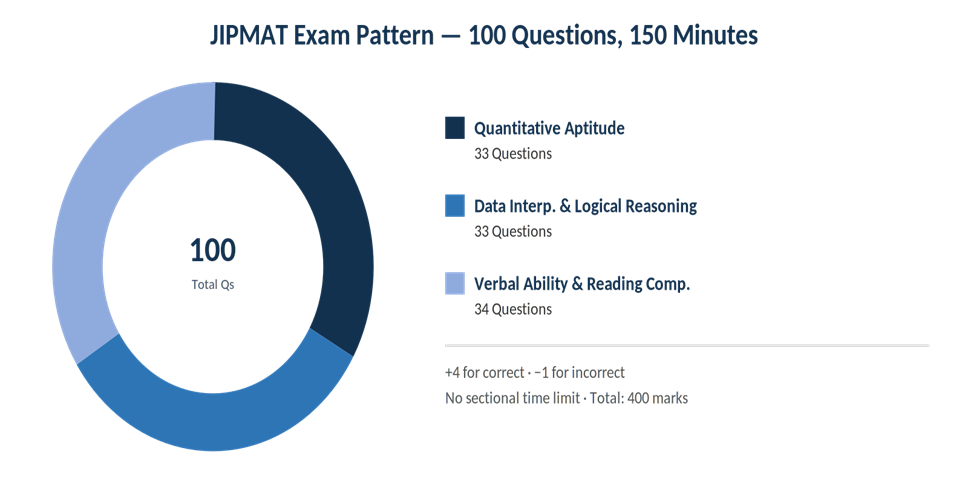
JIPMAT is a 150-minute computer-based test with 100 MCQs across three sections. It carries negative marking—+4 for every correct answer and −1 for every incorrect one—so accuracy matters as much as speed here.
| Section | Questions | Marks (approx.) |
| Quantitative Aptitude | 33 | 132 |
| Data Interpretation & Logical Reasoning | 33 | 132 |
| Verbal Ability & Reading Comprehension | 34 | 136 |
| Total | 100 | 400 |
There’s no sectional time limit, so you can allocate your 150 minutes across sections as you see fit. Since wrong answers cost you a mark, an educated, calculated guess is fine, but blind guessing across every uncertain question can actually hurt your score—this is one of the biggest mindset shifts to build into your prep from day one.
Colleges Accepting JIPMAT Scores
A single JIPMAT score and application cover both primary participating institutes—you indicate your preference for one or both during the application itself, and each institute runs its own shortlisting and interview process independently.
| Institute | Approx. Seats | Selection Beyond JIPMAT Score |
| IIM Jammu | 140 | Written Ability Test (WAT) + Personal Interview (PI) |
| IIM Bodh Gaya | 120 | Written Ability Test (WAT) + Personal Interview (PI) |
Beyond these two, TAPMI Manipal has also accepted JIPMAT scores as an alternate route for its integrated program in some cycles—worth checking their admissions page directly if that’s on your list. Final selection at both IIMs is based on a composite score combining your JIPMAT marks, WAT performance, PI performance, and academic record, not the JIPMAT score alone — so clearing the written test is only the first stage, not the finish line.
Expected JIPMAT Cutoff
NTA does not publish an official JIPMAT cutoff—what circulates online (including the numbers below) are estimates based on previous years’ results and educator analysis, not a confirmed release. Cutoffs also aren’t uniform: IIM Jammu and IIM Bodh Gaya release theirs separately, and requirements shift year to year based on paper difficulty, number of applicants, and seats available.
| Institute | Expected Cutoff (out of 400) |
| IIM Jammu | Around 310+ for a competitive shortlist |
| IIM Bodh Gaya | Around 300+ for a competitive shortlist |
A few things worth keeping in mind: this cutoff only gets you shortlisted for the WAT-PI round; it isn’t the final admission bar. Reserved category candidates typically have a comparably lower threshold under each institute’s own reservation policy. And since scores are normalized across different test sessions if the exam runs in multiple shifts, small variations in a ‘good score’ from year to year are expected and not something to overanalyze. Rather than chasing an exact number, aim to comfortably clear 75%+ of the total marks with balanced accuracy across all three sections—a lopsided score (e.g., very strong Quant but weak VARC) can hurt you even if the total looks fine, since WAT-PI panels sometimes look at sectional performance too.
Section-Wise Topics to Focus On
Quantitative Aptitude
- Arithmetic — percentages, profit & loss, time-speed-distance, time & work, ratios
- Algebra — equations, number systems, sequences & series
- Geometry and Mensuration — basic theorems, areas, volumes
- Class 9–12 level mathematics overall—nothing beyond board syllabus, but expect solid depth
Data Interpretation & Logical Reasoning
- DI sets—tables, bar graphs, line graphs, pie charts, caselets
- Logical reasoning — seating arrangements, blood relations, syllogisms, puzzles
- Analytical reasoning — coding-decoding, direction sense, series
Verbal Ability & Reading Comprehension
- Reading Comprehension—Inference-based and Detail-based passages
- Grammar—Error spotting, Sentence correction, Para-jumbles
- Vocabulary—Synonyms, Antonyms, Contextual usage, Fill-in-the-blanks
How to Prepare: A Proper Timeline
Most successful JIPMAT candidates start preparing 6–8 months before the exam—ideally by October/November 2026 if you’re targeting the June 2027 window. Since negative marking is in play, your prep needs to build accuracy alongside speed, not just speed alone. Here’s a realistic 24-week plan broken into five phases.
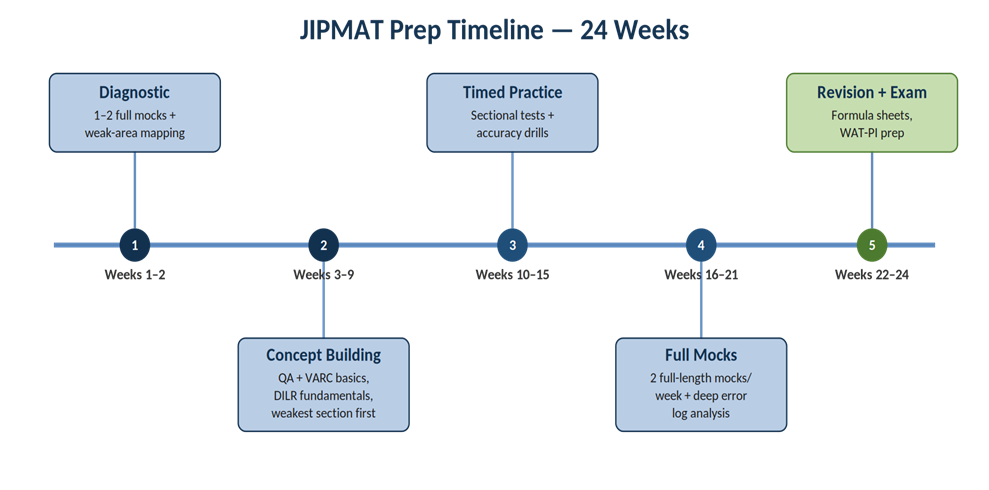
Phase 1: Diagnostic (Weeks 1–2)
Take 1–2 full-length mocks under real exam conditions before starting any structured study. Given the negative marking, pay attention not just to how many you got right but to how many you attempted versus skipped—that ratio tells you a lot about your current risk calibration.
Phase 2: Concept Building (Weeks 3–9)
- Start with your weakest section, but don’t neglect VARC—it’s often the highest-scoring section if prepared consistently.
- Build Class 9–12 fundamentals for Quant thoroughly; JIPMAT’s QA section rewards genuine conceptual depth, not just formula recall.
- Read editorials and long-form articles daily from week 3 onward for VARC—comprehension speed compounds slowly.
- Keep a running formula and shortcut notebook for Quant and DILR from day one.
Phase 3: Timed Practice (Weeks 10–15)
- Shift to timed sectional tests — 45–50 minutes per section, matching realistic exam pacing.
- Practice calibrating your attempt strategy: given the +4/−1 marking, know your personal ‘safe accuracy threshold’ before attempting a guess.
- Keep an error log—categorize mistakes as concept gaps, silly errors, or misjudged guesses, and revisit weekly.
Phase 4: Full Mocks (Weeks 16–21)
- Take 2 full-length mocks a week under strict exam conditions, ideally at your actual exam time slot.
- Analyze each mock in as much depth as you took it—specifically review which guesses paid off and which didn’t, given the negative marking.
- Start light WAT practice in parallel—writing structured, opinion-based short essays on current affairs and business topics.
Phase 5: Revision, Exam & Beyond (Weeks 22–24)
- Shift to pure revision — formula sheets, error log review, lighter practice sets.
- Once JIPMAT is done, start WAT-PI preparation in earnest if you’re shortlisted—current affairs, basic economic awareness, and a clear, honest narrative about why IPM.
- Remember that the JIPMAT score alone doesn’t secure a seat—treat the exam as stage one of a two-stage process, not the final hurdle.
Frequently Asked Questions
Q. Is there negative marking in JIPMAT?
Yes. JIPMAT awards +4 for a correct answer and deducts −1 for an incorrect one, so blind guessing carries real risk.
Q. Which institutes accept JIPMAT scores?
IIM Jammu and IIM Bodh Gaya are the primary participating institutes. TAPMI Manipal has also accepted JIPMAT scores as an alternate route in some cycles.
Q. Are JIPMAT scores alone enough for admission?
No. Shortlisted candidates must also clear a Written Ability Test (WAT) and Personal Interview (PI) at the respective IIM. Final selection is based on a composite of JIPMAT score, WAT, PI, and academic record.
Q. What is the exam pattern for JIPMAT 2027?
100 MCQs across Quantitative Aptitude (33), Data Interpretation & Logical Reasoning (33), and Verbal Ability & Reading Comprehension (34), to be completed in 150 minutes with no sectional time limit.
Q. Is there an age limit for JIPMAT?
There’s no hard numerical age limit, but eligibility is indirectly enforced through your Class 10 and 12 completion years, with relaxation available for SC/ST/PwD candidates.
Q. How is JIPMAT different from IPMAT Indore?
JIPMAT is conducted by the NTA for IIM Jammu and IIM Bodh Gaya, while IPMAT Indore and IPMAT Rohtak are conducted independently by their respective IIMs. The exam patterns, eligibility nuances, and application processes are all separate.
Q. When should I start preparing for JIPMAT 2027?
Ideally, 6–8 months before the exam—around October/November 2026 for a June 2027 exam. Earlier is better if your fundamentals in Math or English need significant work.
Q. What is a good JIPMAT score?
This varies by year since NTA doesn’t publish an official cutoff, but past trends suggest scores upward of 300 out of 400 are generally competitive for both IIM Bodh Gaya and IIM Jammu shortlists—treat this as a directional estimate, not a guarantee.
Final Thoughts
JIPMAT isn’t the only door into management education, but it’s one of the earliest and most direct ones—and that’s exactly why it rewards early, consistent preparation over last-minute cramming. If you start now, treat the diagnostic phase seriously, and respect the negative marking through your entire prep (not just on exam day), there’s no reason a Class 12 student with average board scores can’t turn this into a genuine IIM seat. The seats are limited, but so is the applicant pool compared to what you’ll face a few years down the line at CAT. Start early, track your errors honestly, and let your mock performance — not your assumptions — decide your prep priorities.
Disclaimer: NTA has not released the official JIPMAT 2027 notification at the time of writing. Dates, fee, eligibility, and cutoff details in this article are estimates based on previous years’ patterns and should be verified against the official website (jipmat.nta.ac.in) once the notification is out.