
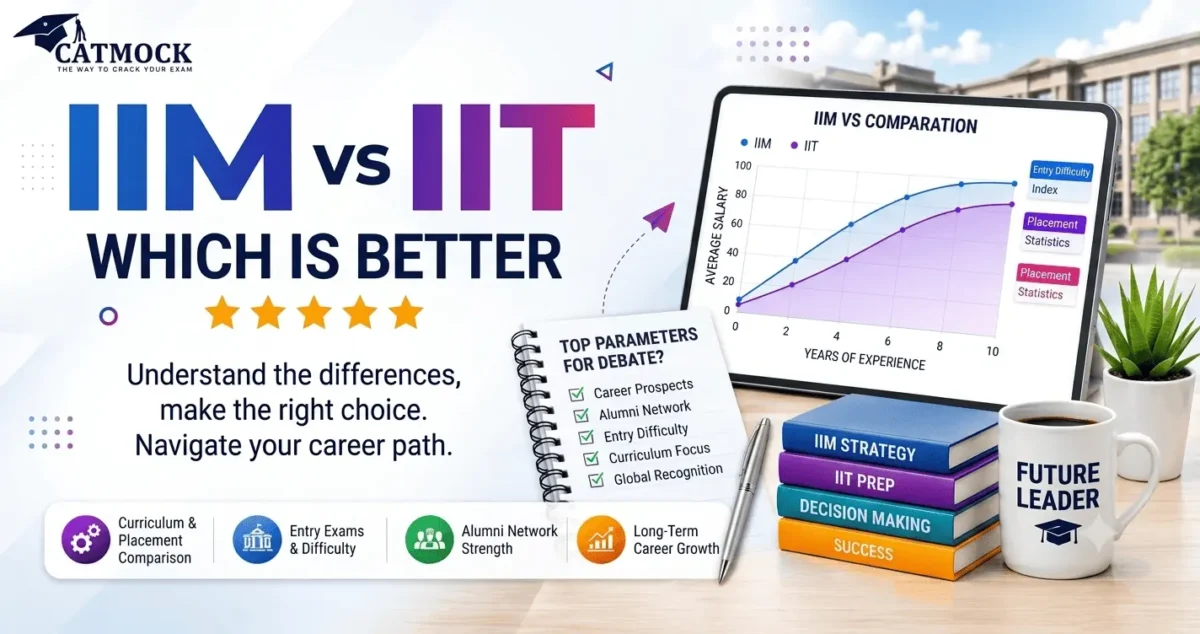
You’ve cracked a solid CAT percentile, and now the real dilemma begins. Do you chase an IIM call for the brand and the alumni network, or does an IIT’s management programme — with its lower fees and a surprisingly strong placement record — make more financial sense? This is one of the most searched questions every CAT season, and for good reason: the answer genuinely depends on your budget, your career goals, and how much weight you put on brand versus return on investment.
This guide breaks down IIM vs IIT for MBA across every metric that actually matters in 2026 — fees, placements, average salary, ROI, curriculum style, and admission difficulty — so you can make a decision based on data, not just reputation.
IIM vs IIT: The Core Difference
Before comparing numbers, it helps to understand what each institution actually is. The Indian Institutes of Management were set up by the Government of India specifically for management education, starting with IIM Calcutta and IIM Ahmedabad in 1961. Today there are 21 IIMs, ranging from decades-old institutes with global brand recognition to newer campuses still building their placement track record.
IITs, on the other hand, were built for engineering and technology — the first, IIT Kharagpur, was established in 1951. Over the years, six major IITs (Bombay, Delhi, Kharagpur, Madras, Kanpur, and Roorkee) opened dedicated management schools that run full-time, two-year MBA programmes admitted primarily through CAT. These aren’t watered-down business courses; they blend core management theory with a technology-first pedagogy, which appeals strongly to engineers and candidates eyeing product, analytics, or tech-consulting roles.
In short: IIMs are built for management education. IITs added it as a second identity, and it shows in how each program is structured.
IIM vs IIT MBA: Fees Comparison
Fees are usually the first filter for most CAT aspirants, and this is where the gap between the two is the sharpest.
| Institute Type | Total Fees (2-Year Program) | Notable Examples |
|---|---|---|
| Top IIMs (A/B/C) | ₹24–33.5 lakh | IIM Ahmedabad ₹27.5L, IIM Calcutta ₹33.5L, IIM Bangalore ₹26.3L |
| Established IIMs | ₹17–21 lakh | IIM Lucknow, IIM Indore, IIM Kozhikode |
| Newer IIMs | ₹13–19 lakh | IIM Ranchi, IIM Trichy, IIM Raipur |
| IIT Management Schools | ₹3–15.5 lakh | IIT (ISM) Dhanbad ₹3L, IIT Delhi (DMS) ₹12L, IIT Bombay (SJMSOM) ₹15.5L |
Figures are indicative and compiled from official institute fee disclosures. Fee structures are revised almost every admission cycle, so always cross-check the latest numbers on the respective institute’s website or the AICTE approved-institute portal before applying.
The takeaway is straightforward: even the cheapest top-tier IIM costs roughly double what IIT Bombay’s SJMSOM charges, and nearly nine times what IIT (ISM) Dhanbad charges for the entire two-year program. If fees alone are your constraint, IITs are the more accessible route into a nationally respected MBA.
IIM vs IIT Placements: Average Salary Compared
This is where the conversation gets interesting, because IIT MBA placements have closed the gap with IIMs far more than most aspirants expect.
| Institute | Average Package (Recent Batch) | Highest Domestic Package |
|---|---|---|
| IIM Calcutta | ₹36 LPA | ₹1.45 Crore |
| IIM Ahmedabad | ₹35.5 LPA | ₹1.10 Crore |
| IIM Bangalore | ₹34.88 LPA | Not publicly disclosed |
| IIM Lucknow | ₹33.2 LPA | ₹1 Crore |
| Newer IIMs (Ranchi, Trichy, Raipur) | ₹18–22 LPA | ₹40–70 LPA |
| SJMSOM, IIT Bombay | ₹28.16 LPA | ₹45+ LPA |
| DMS, IIT Delhi | ₹22.52 LPA | ₹40+ LPA |
| Other IIT Management Schools | ₹17–20 LPA | ₹30–40 LPA |
Notice that IIT Bombay’s SJMSOM now out-earns several mid-tier and newer IIMs on average package, while charging a fraction of their fees. That single data point is why “IIM vs IIT for MBA” has become such a genuinely close call for candidates who don’t specifically clear the 99+ percentile bar needed for the very top IIMs.
Also Check: IIM Kashipur CAT Cutoff 2025: Category-Wise Percentile List
IIM vs IIT ROI: Which Gives Better Value for Money?
Average salary alone doesn’t tell the full story — return on investment (fees divided by average package) is the more honest number to look at.
| Institute | Total Fees | Average Package | Approx. ROI (Fees ÷ Package) |
|---|---|---|---|
| IIM Ahmedabad | ₹27.5L | ₹35.5 LPA | Recovered in under 10 months |
| IIM Calcutta | ₹33.5L | ₹36 LPA | Recovered in about 11 months |
| SJMSOM, IIT Bombay | ₹15.5L | ₹28.16 LPA | Recovered in about 7 months |
| DMS, IIT Delhi | ₹12L | ₹22.52 LPA | Recovered in about 6.4 months |
| IIT (ISM) Dhanbad | ₹3L | ~₹17–19 LPA | Recovered in about 2 months |
The math is hard to argue with: on pure ROI, most IIT MBA programs recover their fees faster than even the top three IIMs, simply because the entry cost is so much lower relative to the payout. This doesn’t make IIT MBAs “better” outright — it makes them the stronger financial decision for candidates who prioritise a fast fee-recovery period over brand prestige.
Curriculum, Culture & Career Focus: IIM vs IIT MBA
Numbers aside, the two paths genuinely feel different day to day.
IIM Learning Style
IIMs lean heavily on case-study pedagogy, cold calling, and classroom debate. The curriculum covers core management functions — finance, marketing, strategy, operations, and human resources — with electives layered on top in the final year. Peer learning is a huge part of the value here, since batches are filled with candidates from diverse academic and professional backgrounds who push each other during discussions.
IIT Learning Style
IIT MBA programs blend the same core management fundamentals with a stronger emphasis on data-driven decision-making, analytics, and technology management. Many electives lean toward operations research, supply chain analytics, and fintech, which naturally appeals to candidates with an engineering background who want to combine domain expertise with business skills.
Career Focus
- IIMs tend to dominate in consulting, investment banking, and general management leadership tracks, largely because of decades-old recruiter relationships with firms like McKinsey, BCG, Bain, and top investment banks.
- IITs carry an edge in product management, analytics, and technology-consulting roles, since recruiters visiting these campuses often specifically want candidates who can speak both “business” and “engineering” fluently.
CAT Percentile Required: IIM vs IIT Admission Difficulty
Getting a call from a top IIM is meaningfully harder than getting into most IIT management schools, and the CAT percentile requirement reflects that gap clearly.
| Institute Type | Typical CAT Percentile Needed |
|---|---|
| Top IIMs (A/B/C) | 99+ percentile |
| Established IIMs | 95–98 percentile |
| Newer IIMs | 85–95 percentile |
| IIT Management Schools | 90–98 percentile |
Both pathways use CAT as the primary entrance route — the same exam conducted every year by one of the IIMs on a rotational basis, most recently through the official CAT portal. After the written exam, both IIMs and IIT management schools run their own separate shortlisting, Written Ability Test (WAT), and Personal Interview (PI) rounds, so a high percentile alone doesn’t guarantee a seat at either.
If you’re still deciding between the two paths, it’s worth digging one level deeper — a side-by-side look at IIM Ahmedabad vs. IIM Bangalore vs. IIM Calcutta shows how much cutoff, fees, and placement outcomes vary even within the “top IIM” bracket alone, which matters just as much as the IIM-vs-IIT question itself.
IIM vs IIT: Which Should You Choose?
There’s no universally “correct” answer here — it depends on which of these describes you best.
Choose an IIM if:
- You’re clearing (or expect to clear) a 95+ CAT percentile comfortably.
- You want to break into consulting, investment banking, or general management leadership roles.
- Brand value and a decades-deep alumni network matter more to you than upfront cost.
- You can comfortably afford — or take a loan for — ₹17–33 lakh in fees.
Choose an IIT for MBA if:
- You have an engineering or technical background and want to build on it rather than pivot away entirely.
- You’re targeting product management, analytics, or tech-consulting roles.
- Minimising fees and maximising ROI matters more to you than brand prestige alone.
- Your CAT percentile sits in the 90–98 range, which may not clear the cutoff for the very top IIMs.
For a broader look at every CAT-accepting option beyond just IIMs and IITs — including private institutes with strong placement records — our guide to top MBA colleges accepting CAT is worth a read before you finalise your college preference list.
Scholarships and Education Loans: Making Either Option Affordable
Fees alone shouldn’t rule out a top IIM if that’s genuinely the better fit for your career goals — both IIMs and IITs offer meaningful financial support, and it’s worth factoring this in before you decide based on sticker price alone.
Most IIMs run need-based and merit-based scholarship schemes, often covering a significant portion of tuition for candidates from economically weaker backgrounds, along with additional support for female candidates at several campuses. IIT management schools offer similar, if typically smaller, scholarship pools, plus fee waivers tied to GATE scores or academic merit at select institutes.
On the loan side, nationalised banks and NBFCs both offer education loans specifically for IIM and IIT admits, frequently without requiring collateral for loan amounts up to a certain threshold, given how strong the placement track record is at both categories of institute. The Reserve Bank of India’s model education loan scheme outlines the baseline framework banks follow, though individual banks add their own terms on interest rates and moratorium periods. Since an IIT MBA’s lower principal means a smaller loan and a shorter repayment runway, some candidates find the loan-approval process itself smoother, even before factoring in the faster ROI discussed above.
The practical takeaway: don’t eliminate a top IIM purely on sticker-price fear, and don’t dismiss an IIT MBA as “settling.” Run the actual numbers — fees minus scholarship eligibility, against expected loan EMI versus your likely starting salary — before deciding either option is out of reach.
Key Takeaways
- Fees: IIT MBA programs cost roughly a third to half of what top IIMs charge, with IIT (ISM) Dhanbad the cheapest at around ₹3 lakh total.
- Placements: Top IIMs still lead on average salary (₹33–36 LPA), but SJMSOM IIT Bombay’s ₹28.16 LPA average now beats several mid-tier and newer IIMs.
- ROI: Most IIT MBA programs recover their fees faster than even IIM Ahmedabad or IIM Calcutta, thanks to the lower entry cost.
- Career fit: IIMs suit consulting, finance, and general management aspirants; IITs suit candidates targeting product, analytics, and tech-driven roles.
- Admission bar: Top IIMs need 99+ percentile; most IIT management schools and mid-tier IIMs are realistically reachable in the 90–98 percentile range.
Frequently Asked Questions
Q1. Is an IIT MBA better than an IIM MBA?
It depends on your goals. Top IIMs still lead on brand value, average salary, and consulting/finance placements, but IIT MBA programs like SJMSOM IIT Bombay offer excellent ROI due to significantly lower fees paired with strong average packages, making them a genuinely competitive choice rather than a fallback option.
Q2. What CAT percentile is required for IIT MBA admission?
Most IIT management schools require a CAT percentile between 90 and 98 for General category candidates, considerably lower than the 99+ percentile typically needed for top IIMs like Ahmedabad, Bangalore, or Calcutta.
Q3. Which is cheaper, IIM or IIT, for an MBA?
IIT MBA programs are significantly cheaper. Total fees range from about ₹3 lakh at IIT (ISM) Dhanbad to ₹15.5 lakh at IIT Bombay’s SJMSOM, compared to ₹17–33.5 lakh at most IIMs.
Q4. Do IIT MBA graduates get placed as well as IIM graduates?
Placement outcomes vary by institute, but SJMSOM IIT Bombay’s average package of around ₹28.16 LPA and DMS IIT Delhi’s ₹22.52 LPA now exceed several newer and mid-tier IIMs, though they still trail the top three IIMs on average salary.
Q5. Should I choose IIT over IIM for a better ROI?
If return on investment is your primary concern, IITs generally offer a faster fee-recovery period because of their lower total cost relative to average placement packages — but candidates prioritising brand value, alumni network, or consulting/finance careers may still find a top IIM worth the higher fees.
Final Verdict: IIM or IIT — Which Is Better for You?
There’s no single right answer to “IIM vs IIT,” because the two paths are optimised for different priorities. If your CAT percentile clears 99+ and you’re aiming for consulting, investment banking, or a leadership track, a top IIM’s brand and alumni network are hard to match. If you’re coming from an engineering background, want a technology-driven MBA, or simply want the fastest possible return on your fees, an IIT management school is a genuinely strong — and increasingly popular — alternative.
Whichever path you’re targeting, the first gate is the same: a strong CAT percentile. Start your preparation early, take full-length mocks regularly, and shortlist your final list of institutes only after comparing fees, placements, and ROI side by side, exactly the way we’ve broken it down here.
Explore these related articles to make a more informed MBA decision:
- Top 100 MBA Colleges in India 2026
- MBA in Artificial Intelligence Colleges in India
- MBA After Engineering: Is It Worth It?
- 25 Common MBA Interview Mistakes and How to Avoid Them
You May Also Like : CAT MOCK / CAT MOCK PYQ
Follow Us On : Facebook / Instagram