
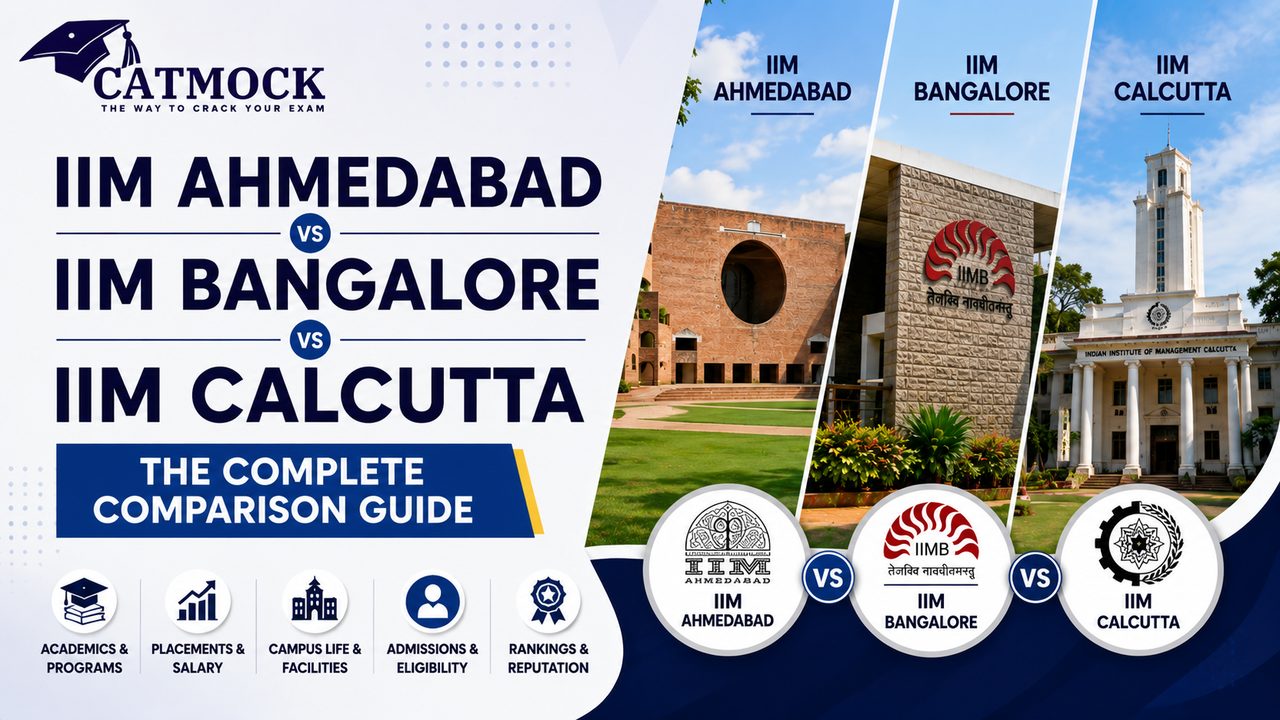
Every CAT aspirant who breaks past the 95th percentile eventually runs into the same beautiful problem: a shot at IIM Ahmedabad, IIM Bangalore, or IIM Calcutta — and no easy way to pick between them. Ask around, and you’ll get three different answers depending on who you talk to, because most comparisons stop at “all three are great” without actually showing you the numbers.
This guide does the opposite. We’re lining up IIM Ahmedabad vs. IIM Bangalore vs. IIM Calcutta on eligibility, CAT cutoffs, selection weightage, fees, placements, and rankings—one table at a time—so you walk away knowing exactly what separates the three, not just that they’re all “top-tier.”
IIM ABC at a Glance
| Factor | IIM Ahmedabad | IIM Bangalore | IIM Calcutta |
|---|---|---|---|
| Established | 1961 | 1973 | 1961 |
| Flagship Programme | PGP, 2 years | PGP, 2 years | MBA, 2 years |
| Min. Qualifying CAT %ile (Gen) | 95 overall / 85 sectional | 85 overall | 85 overall |
| Total Programme Fee | ₹31–32.5 lakh | ₹25–27 lakh | ₹28.5–31.5 lakh |
| Average CTC (Recent Batch) | ~₹35 LPA | ~₹35.9 LPA | ~₹32.6 LPA |
| Placement Rate | 100% | 100% | 100% |
| Global Accreditation | Partial | Partial | Triple Crown (AACSB, AMBA, EQUIS) |
Keep this table open in a tab—we’ll unpack every row below.
Why “IIM ABC” Isn’t Really a Contest
IIM Calcutta was the first of the three to open, in 1961, with IIM Ahmedabad following the same year and IIM Bangalore joining over a decade later in 1973. All three now run a two-year, full-time residential flagship program—the Post Graduate Programme in Management at IIM Ahmedabad and IIM Bangalore and the MBA Programme at IIM Calcutta—and none of them accept GMAT or GRE for this route.
Over six decades, each has built a distinct identity rather than competing on the same turf. IIM Ahmedabad is built around a rigorous, Harvard-style case method and is generally seen as India’s strongest general-management and consulting brand. IIM Bangalore has grown into a technology and entrepreneurship powerhouse, helped along by its incubation ecosystem and Bengaluru’s start-up density. And IIM Calcutta leans hardest into finance and quantitative rigor, and holds a rare triple accreditation—AACSB, AMBA, and EQUIS—that neither of the other two currently holds in full.
So when people ask which of IIM A, IIM B, or IIM C is “better,” the honest answer is that they’re not really solving the same problem. The real decision points are cutoff difficulty, cost, and which sector—consulting, tech, or finance—you’re actually aiming for. Let’s get into each one.
Eligibility Criteria: The Baseline Is Identical
Before cutoffs and weightage even enter the picture, all three institutes apply the same baseline eligibility norm used across CAT-based MBA admissions in India.
| Eligibility Factor | IIM Ahmedabad | IIM Bangalore | IIM Calcutta |
|---|---|---|---|
| Minimum Graduation Marks | 50% (45% SC/ST/PwD) | 50% (45% SC/ST/PwD) | 50% (45% SC/ST/PwD) |
| Final-Year Students | Eligible, provisional | Eligible, provisional | Eligible, provisional |
| Entrance Exam Accepted | CAT only | CAT only | CAT only |
| Minimum Work Experience | Not mandatory | Not mandatory | Not mandatory |
A three-year bachelor’s degree with at least 50% aggregate (45% for SC/ST/PwD candidates) gets you in the door at all three, and final-year students can apply provisionally as long as they clear the marks requirement before the admission deadline. Foreign nationals typically apply through a separate GMAT- or GRE-based route rather than the general CAT-based batch.
CAT Cutoff Comparison: IIM Ahmedabad vs. IIM Bangalore vs. IIM Calcutta
This is where the three genuinely diverge—and where most comparisons get sloppy by conflating two very different numbers: the minimum qualifying percentile (which only gets you into the next round) and the effective cutoff (the percentile competitive candidates realistically need to land an interview call).
| Institute | Minimum Qualifying Percentile (Gen) | Typical Interview-Call Percentile |
|---|---|---|
| IIM Ahmedabad | 95 overall / 85 sectional | 98–99+ |
| IIM Bangalore | 85 overall / 75–80 sectional | 98–99.5+ |
| IIM Calcutta | 85 overall / 75–80 sectional | 98–99.5+ |
IIM Ahmedabad raised its General/EWS qualifying bar sharply for the 2026-28 cycle — a jump to 95 overall with 85 in every section, up from 80 overall in the previous cycle. IIM Bangalore and IIM Calcutta have both held their qualifying bar closer to 85 overall, but don’t let that number lull you: actual interview shortlists at both institutes typically go to candidates well above the 98th percentile.
In other words, a 90th percentile score technically clears the eligibility bar at IIM Bangalore or IIM Calcutta, but it rarely converts into an interview call in a competitive applicant year. Prepare for the higher, effective benchmark — not the published minimum.
Selection Process and Weightage Breakdown
CAT score is only one input into the final merit list. Each institute runs its own composite formula blending the Personal Interview, academic record, work experience, and a written component.
| Selection Stage | IIM Ahmedabad | IIM Bangalore | IIM Calcutta |
|---|---|---|---|
| Personal Interview (Final) | ~50% | ~40% | ~45–48% |
| CAT Score (Final) | ~25% | ~25% | ~30% |
| Academics / Application Rating | ~15% | ~15% | ~15% |
| WAT / AWT | ~10% | ~10% | ~8% |
IIM Ahmedabad weighs the interview the heaviest of the three at roughly 50%, with CAT contributing 25%, the Application Rating 15%, and the Analytical Writing Test the remaining 10%. IIM Bangalore spreads its weightage more evenly—interview at 40%, CAT at 25%, academics at 15%, work experience at 10%, and the Written Ability Test at 10%. And IIM Calcutta actually leans on the CAT score harder at the shortlisting stage, where it can account for over half the composite, before the interview takes over as the single biggest factor in the final list.
These percentages shift slightly every cycle, so confirm the current year’s exact policy on each institute’s official admissions page before you build a prep strategy around them.
Fee Structure: Which of the Big Three Costs the Least
IIM Ahmedabad vs. IIM Bangalore vs. IIM Calcutta.
| Institute | Approximate Total Programme Cost (2 Years) | Scholarship Support |
|---|---|---|
| IIM Ahmedabad | ₹31–32.5 lakh | Need- and merit-based |
| IIM Bangalore | ₹25–27 lakh | Need- and merit-based |
| IIM Calcutta | ₹28.5–31.5 lakh | Need- and merit-based |
IIM Bangalore sits at the lower end of the range for the 2026-28 batch, IIM Calcutta lands in the middle, and IIM Ahmedabad’s total investment runs closest to the top. None of these figures should be read as the full cost, either—hostel, mess, laptop, and study-tour charges add meaningfully on top of tuition at every campus, so always pull the latest fee circular directly from the admissions office rather than relying on last year’s number.
Education loans remain the default financing route for most admitted candidates, and most banks offer dedicated MBA loan products with a moratorium period that runs through the course.
Placements: Average Package, Highest CTC, and Where Recruiters Actually Come From
This is usually the deciding factor for candidates weighing IIM Ahmedabad vs. IIM Bangalore vs. IIM Calcutta against each other—and it’s also where the three are the closest.
| Placement Metric | IIM Ahmedabad | IIM Bangalore | IIM Calcutta |
|---|---|---|---|
| Average CTC | ~₹35 LPA | ~₹35.9 LPA | ~₹32.6 LPA |
| Highest Domestic CTC | ₹1.46 crore+ | 1 crore+ (undisclosed) | ₹1.15 crore |
| Placement Rate | 100% | 100% | 100% |
| Leading Recruiting Sectors | Consulting, Finance | Consulting, Technology | Consulting, BFSI |
All three have closed their most recent final placement season at, or very close to, 100% for the eligible batch. The average package sits in a tight ₹32–36 LPA band across the trio, with the highest domestic offers crossing a crore of rupees at every campus. Consulting firms, investment banks, and global technology companies remain the anchor recruiters everywhere, alongside a growing share of product and analytics roles—the real difference shows up in which sector dominates each campus’s mix rather than in the headline average.
Rankings, Accreditation, and Global Recognition
IIM Ahmedabad and IIM Bangalore have consistently occupied the top two spots in the NIRF Management ranking in recent years, with IIM Calcutta close behind among the top three to five nationally. Internationally, IIM Ahmedabad and IIM Bangalore both appear regularly in the Financial Times Global MBA rankings.
IIM Calcutta’s edge here is different but arguably rarer: it holds triple accreditation from AACSB, AMBA, and EQUIS, a credential neither of the other two currently holds in full. That matters most if you’re eyeing an international career or exchange program, since triple-crown status signals that curriculum, faculty research output, and governance meet globally benchmarked standards across all three accrediting bodies simultaneously.
So, Which One Should You Choose?
If you get calls from more than one of the three, the decision usually comes down to fit, not prestige—brand value across IIM ABC is close to interchangeable in a recruiter’s eyes. A rough framework:
- Choose IIM Ahmedabad if a case-based, intensely competitive academic culture and India’s strongest general-management and consulting brand appeal to you.
- Choose IIM Bangalore if entrepreneurship, technology, and a slightly better fee-to-outcome ratio matter more in your decision.
- Choose IIM Calcutta if global accreditation, a strong finance-and-consulting placement record, and India’s oldest IIM legacy weigh heavily for you.
Very few candidates who clear the interview bar at all three institutes end up regretting whichever one they pick—the long-term career outcomes are genuinely comparable. Don’t let a marginal fee or ranking difference make the call for you; talk to current students, check the specific elective strengths that match your career goal, and weigh campus location and culture before you finalize.
Quick Reference Summary
| Factor | IIM Ahmedabad | IIM Bangalore | IIM Calcutta |
|---|---|---|---|
| Established | 1961 | 1973 | 1961 |
| Programme | PGP, 2 years | PGP, 2 years | MBA, 2 years |
| Min. Qualifying CAT %ile (Gen) | 95 | 85 | 85 |
| Total Programme Fee | ₹31–32.5L | ₹25–27L | ₹28.5–31.5L |
| Average CTC (Recent Batch) | ~₹35 LPA | ~₹35.9 LPA | ~₹32.6 LPA |
| Placement Rate | 100% | 100% | 100% |
| Global Accreditation | Partial | Partial | Triple Crown |
Frequently Asked Questions
Q1. Which is better: IIM Ahmedabad vs. IIM Bangalore vs. IIM Calcutta?
No single institute is objectively “better”—all three sit among India’s top management schools with near-identical recruiter trust. IIM Ahmedabad edges ahead on national ranking and case-study pedagogy, IIM Bangalore leads on entrepreneurship and cost efficiency, and IIM Calcutta stands out for its triple-crown global accreditation.
Q2. What CAT percentile is required for IIM Ahmedabad, IIM Bangalore, and IIM Calcutta?
IIM Ahmedabad’s minimum qualifying percentile for General category candidates stands at 95 overall with 85 in each section. IIM Bangalore and IIM Calcutta both keep their minimum qualifying bar closer to 85 overall, though competitive candidates at every institute typically need scores above the 98th percentile to receive an interview call.
Q3. Which IIM among A, B, and C has the lowest fees?
IIM Bangalore generally has the lowest total program cost among the three, followed by IIM Calcutta, with IIM Ahmedabad’s total investment sitting at the higher end for the 2026-28 batch.
Q4. Do IIM Ahmedabad, IIM Bangalore, and IIM Calcutta accept GMAT or GRE scores?
No. All three require a valid CAT score for admission to their flagship two-year MBA or PGP program. GMAT and GRE routes generally apply only to executive or one-year programs and to foreign national applicants.
Q5. What is the average placement package at IIM ABC institutes?
Recent batches at all three institutes reported an average CTC in the ₹32–36 LPA range, with the highest domestic offers crossing a crore of rupees at each campus during the final placement season.
Conclusion
Choosing between IIM A, IIM B, and IIM C for the 2026-28 batch isn’t about ranking one above the other—it’s about matching each institute’s cutoff, cost, and sector strength to your own career target. Track each institute’s exact CAT cutoff, selection weightage, and fee circular directly on its official admissions page before you finalize a prep strategy, since these figures shift slightly every cycle.
Whichever of the three you eventually walk into, you’re stepping into one of the most selective and well-connected management ecosystems in the world—one where the CAT score you post over the next few months decides which door actually opens.
You May Also Like: CAT MOCK, CAT MOCK PYQ
Follow Us On: Facebook, Instagram