
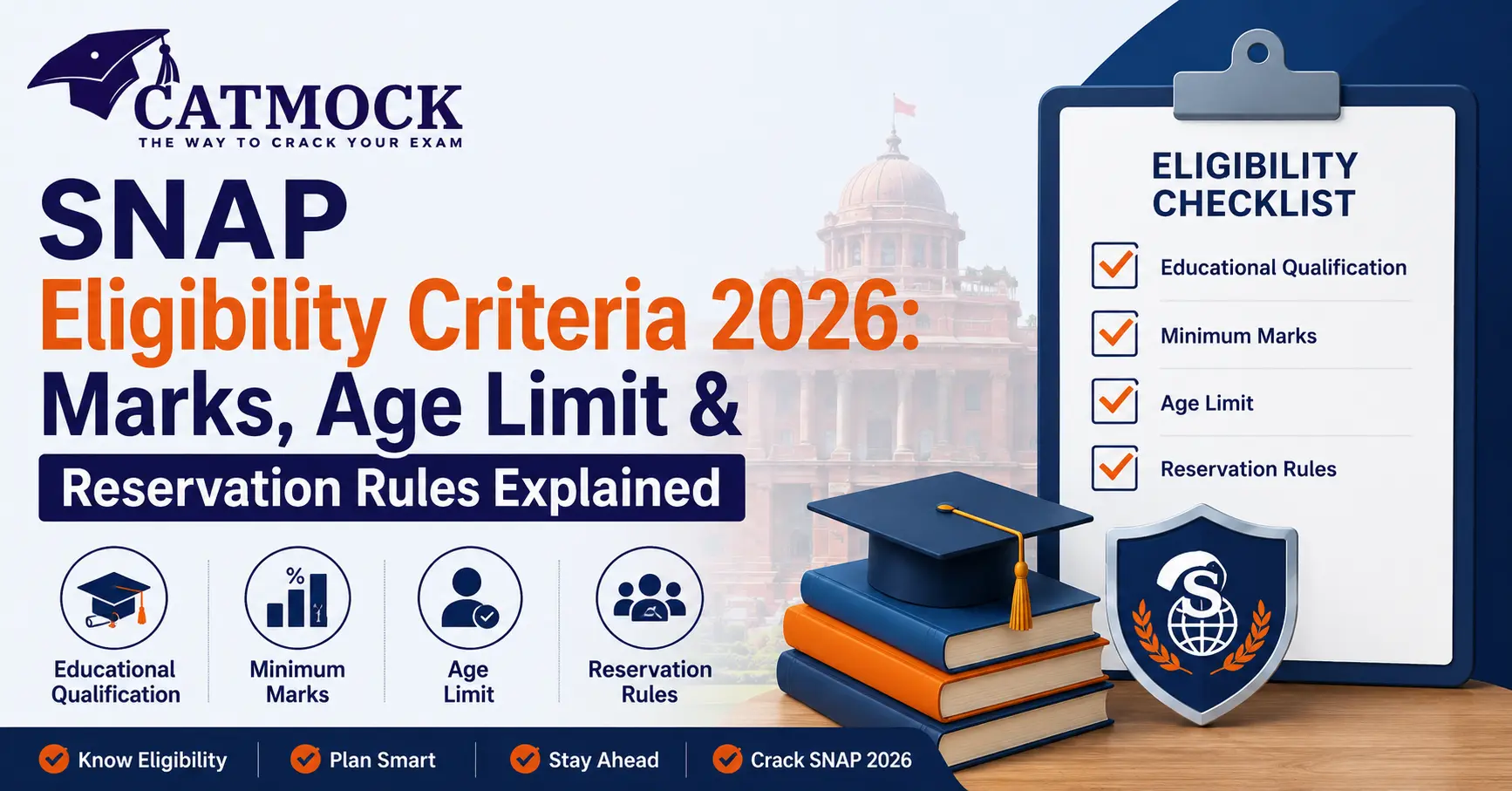
If you’re planning to appear for the Symbiosis National Aptitude Test this year, here’s the short answer: you’re eligible for SNAP 2026 if you hold a bachelor’s degree (or are in your final year) from a recognised university with at least 50% aggregate marks — 45% if you belong to the SC/ST category. There is no upper age limit. That covers the base requirement for most of the 29 MBA programmes offered across Symbiosis International (Deemed University)’s 17 institutes, as confirmed on the official SNAP eligibility page.
But “eligible for SNAP” and “eligible for the specific Symbiosis programme you want” aren’t always the same thing. A handful of specialised programmes — Business Analytics, Infrastructure Development & Management, Operations Management, and the dual-degree options — carry additional conditions around work experience, degree stream, or minimum percentage. This guide breaks down exactly what applies to you, category by category and institute by institute, based on the official SNAP 2026 Bulletin.
Key Takeaways
- General eligibility: Bachelor’s degree in any discipline, minimum 50% marks (45% for SC/ST) from a recognised university or Institution of National Importance.
- No age limit: SNAP has never had an upper age cap.
- Final-year students can apply, but admission stays provisional until you prove you’ve met the minimum marks in your qualifying exam.
- Reservation: 15% SC, 7.5% ST, 3% PwD (within sanctioned intake), plus separate Defence and Nagpur-domicile quotas depending on the institute.
- International candidates (Foreign Nationals, OCI, PIO, NRI) apply through the Symbiosis Centre for International Education (SCIE) and are generally exempt from sitting the SNAP test itself.
- Some programmes need more than the base criteria — check the institute-wise table below before you register and pay.
SNAP 2026 Eligibility Criteria: The Basic Requirement
Symbiosis International (Deemed University) (SIU) sets one baseline academic requirement that applies to the standard MBA programme at nearly every participating institute — SIBM Pune, SIBM Bengaluru, SIBM Hyderabad, SIBM Nagpur, SIBM NOIDA, SCMHRD, SIIB, SIDTM, SICSR, SIMC, SIHS, SSBF, and SSSS:
- A bachelor’s degree in any discipline from a university recognised by the UGC/AICTE, or an Institution of National Importance.
- A minimum of 50% aggregate marks or equivalent grade at graduation.
- 45% aggregate marks for candidates in the Scheduled Castes (SC) and Scheduled Tribes (ST) categories.
- No specified upper age limit — SNAP is open to candidates of any age who meet the academic criteria.
This is the requirement to sit the SNAP test and to be considered for the general MBA seats at those institutes. It is not, however, a blanket rule for every Symbiosis programme — several specialised courses layer on extra conditions, covered in the table below.
Institute-Wise and Programme-Wise Eligibility (2026)
Because eligibility genuinely differs by programme, checking only the “50%/45%” headline can cost you a wasted registration fee if you’re aiming for a specialised course. Here’s the complete, programme-specific breakdown as per the official SNAP 2026 Bulletin, covering the full list of MBA colleges accepting SNAP scores.
| Institute | Programme | Eligibility |
|---|---|---|
| SIBM Pune, SCMHRD, SIBM Bengaluru, SIBM Hyderabad, SIBM Nagpur, SIBM NOIDA | MBA (General) | Graduate, any discipline, 50% marks (45% SC/ST) |
| SIBM Pune | MBA (Innovation & Entrepreneurship) | Graduate, any discipline, 50% marks (45% SC/ST) |
| SICSR | MBA (Information Technology) | Graduate, any discipline, 50% marks (45% SC/ST) |
| SIIB | MBA (International Business / Agri Business / Sustainability Management) | Graduate, any discipline, 50% marks (45% SC/ST) |
| SIDTM | MBA (Digital and Telecom Management) | Graduate, any discipline, 50% marks (45% SC/ST) |
| SIMC | MBA (Communication Management) | Graduate, any discipline, 50% marks (45% SC/ST) |
| SIHS | MBA (Hospital and Healthcare Management) | Graduate, any discipline, 50% marks (45% SC/ST) |
| SSBF | MBA (Banking and Finance) | Graduate, any discipline, 50% marks (45% SC/ST) |
| SSSS | MBA (Sports Management) | Graduate, any discipline, 50% marks (45% SC/ST) |
| SIBM Bengaluru | MBA (Business Analytics) | Graduate, any discipline, 50% marks (45% SC/ST) |
| SCIT | MBA (IT Business Management / Data Science & Data Analytics) | Graduate, any discipline, 50% marks (45% SC/ST) |
| SIOM Nashik | MBA (Operations Management) | Engineering graduate only (B.E./B.Tech), 50% marks (45% SC/ST) |
| SIOM Nashik | MBA (Agri Operations Management) | Graduate, any discipline, 50% marks (45% SC/ST) |
| SIBM Nagpur | MBA (Food and Agri Business Management) | Graduate, any discipline, 50% marks (45% SC/ST) |
| SCMHRD | MBA (Business Analytics) | Graduate, any discipline, 50% marks (45% SC/ST) + minimum 2 years’ full-time work experience post-graduation |
| SCMHRD | MBA (Infrastructure Development & Management) | Option A: Engineering/Architecture/Planning graduate, 50% marks (45% SC/ST) OR Option B: Non-engineering graduate, 50% marks (45% SC/ST) + minimum 12 months’ work experience in infrastructure, energy, real estate, logistics or an allied sector |
| SIMS | MBA (General) | Graduate, any discipline, 50% marks. Defence-category seats require the candidate to be a son/daughter/spouse of Defence personnel |
| SSCANS | MBA (Food Technology & Food Enterprise Management) | Graduate in Food Technology, Hotel Management, Home Science, Nutrition, Agriculture, Biotechnology or an allied field, 50% marks (45% SC/ST) |
| SSBF | MBA (Banking & Finance) — Dual Degree with Aston University, UK | Graduate, 65% marks or equivalent + Aston University’s own English-proficiency and academic requirements |
| SSBF | MBA (Banking & Finance) — Dual Degree with Macquarie University, Australia | Graduate, 65% marks + completion of SSBF year 1 with WAM 65+, IELTS 6.5, and applicant must be under 30 years of age at the time of application |
| SIOM Nashik | MBA (Operations Management) — Dual Degree with Durham University, UK | Engineering graduate, 50% marks (45% SC/ST); final-year candidates can apply, subject to meeting the minimum marks in the qualifying exam |
What this means in practice: if you’re a non-engineering graduate targeting SIOM Nashik’s core Operations Management MBA or SCMHRD’s Infrastructure programme (via Option A), you won’t meet the base eligibility — you’d need to look at Agri Operations Management, the Infrastructure programme’s Option B work-experience route, or a different Symbiosis institute altogether, such as SIBM Pune, which follows the standard general eligibility rule.
Are Final-Year Students Eligible for SNAP 2026?
Yes. Candidates who are in the final year of their graduation programme can register for and appear in SNAP 2026. However, your admission remains provisional — you must produce proof of having secured the minimum required percentage (50%, or 45% for SC/ST) in your qualifying degree before the institute confirms your seat. If your final result falls short of the minimum, the offer is withdrawn regardless of your SNAP score or GE-PI performance. Keep your provisional degree certificate and final mark sheet ready for verification during the admission process, and track the SNAP 2026 exam dates so your registration and result timelines line up.
SNAP 2026 Reservation Policy: Category-Wise Relaxation
SIU’s reservation policy (as per the official SNAP 2026 Bulletin) applies within the sanctioned intake of each programme, except SIMS, which follows a separate Defence-linked structure:
| Category | Reservation (within sanctioned intake) | Notes |
|---|---|---|
| Scheduled Castes (SC) | 15% | As defined under Article 341 of the Constitution; caste certificate from a competent authority mandatory |
| Scheduled Tribes (ST) | 7.5% | As defined under Article 342 of the Constitution |
| Persons with Disabilities (PwD) | 3% | Covers locomotor, visual, hearing, intellectual, and specified chronic/blood disorders; UDID card and disability certificate required at registration |
| Children/Wards of Defence Personnel | 5% (at SIIB, SIDTM, SCIT, SICSR programmes listed in the Bulletin) | Elsewhere, Defence-category applicants are considered under the Open category |
| Nagpur Domicile (SIBM Nagpur only) | 25% | Reserved for candidates domiciled in Nagpur for 5+ continuous/intermittent years, at the Nagpur off-campus centre only |
| International Candidates (FN/PIO/OCI/NRI) | Up to 25% (supernumerary, over and above sanctioned intake) | Routed through SCIE, not the general merit process |
A candidate can claim benefit under only one reserved category at the time of registration — you cannot combine, for example, SC and PwD benefits. If your category details are found incorrect at any stage, SIU reserves the right to cancel your candidature, even after admission.
Note on SIMS (Symbiosis Institute of Management Studies): This institute follows a distinct structure tied to a Memorandum of Association with the Ministry of Defence — 80% of seats for Defence Open category, 10% for Defence Special category (war-disabled/killed-in-action next of kin), and only 10% Open/Industry category for civilian candidates. If you’re not from a Defence background, SIMS is not the right target within the SNAP ecosystem.
SNAP Eligibility for International Students (FN, OCI, PIO, NRI)
Symbiosis reserves up to 25% over-and-above intake for international candidates through the Symbiosis Centre for International Education (SCIE), as detailed on the official SNAP page for international students. The four categories are defined and treated differently:
- Foreign National (FN): Citizen of any country other than India, holding a foreign passport. Must apply through SCIE and is exempt from the SNAP test, but must clear an English Proficiency Test instead.
- Overseas Citizen of India (OCI): Holds an OCI card. Same SCIE route; also exempt from SNAP, subject to the English Proficiency Test.
- Person of Indian Origin (PIO): Holds a PIO card and is a citizen of another country (PIO cardholders are now treated as OCI cardholders per the 2015 Government of India notification).
- Non-Resident Indian (NRI): An Indian national who took either their 12th-grade exam or their graduation outside India (at least one of the two must be completed abroad). NRI applicants can skip the SNAP test and apply directly through SCIE.
If you don’t fit any of these four definitions, you apply as a general/domestic candidate and must sit SNAP like any other Indian applicant.
Who Is NOT Eligible for SNAP 2026?
To avoid a wasted registration fee, you are not eligible if:
- You do not hold (or are not in the final year of) a bachelor’s degree from a UGC-recognised university or Institution of National Importance.
- Your graduation aggregate falls below 50% (or 45% for SC/ST) and you cannot meet it by the time of admission confirmation, in the case of final-year candidates.
- You’re targeting a programme with a stricter stream requirement (e.g., SIOM Nashik’s core Operations MBA) without the required engineering background.
- You’re applying for SCMHRD’s Business Analytics MBA without the mandatory two years of full-time post-graduation work experience.
- You provide false or unverifiable category/document information — this leads to disqualification at any stage, even retroactively after admission.
SNAP 2026 Eligibility vs CAT, XAT and Other MBA Exams
SNAP’s eligibility bar (50%/45%, no age limit, final-year candidates welcome) is broadly similar to most Indian MBA entrance exams, including CAT. The meaningful differences lie less in “who can apply” and more in “what happens after”: SNAP allows three attempts in a single admission cycle with the best score counted, no normalisation across sittings — a structural feature that shapes strategy even though it isn’t strictly an eligibility rule, especially given the SNAP 2026 new exam pattern. If you’re deciding between SNAP and other OMET exams, our detailed comparison of CAT vs SNAP syllabus, eligibility and difficulty covers this side by side.
Frequently Asked Questions
Q. What is the minimum percentage required for SNAP eligibility 2026?
50% aggregate marks in graduation for the general category, and 45% for SC/ST candidates, from a recognised university or Institution of National Importance.
Q. Is there an age limit for SNAP 2026?
No. SNAP has no upper age restriction — candidates of any age who meet the academic criteria can apply.
Q. Can final-year students apply for SNAP 2026?
Yes, final-year undergraduates can register and appear for SNAP 2026. Admission is provisional until you submit proof of meeting the minimum marks in your final qualifying result.
Q. Do all Symbiosis institutes have the same eligibility criteria?
No. While most follow the standard 50%/45% rule for any-discipline graduates, a few programmes (SIOM Nashik’s Operations MBA, SCMHRD’s Infrastructure and Business Analytics MBAs) require a specific degree stream or minimum work experience in addition to the base marks requirement.
Q. Is CAT required to appear for SNAP?
No. SNAP is an independent entrance exam conducted by Symbiosis International (Deemed University). You do not need to appear for, or clear, CAT to apply for SNAP.
Q. Can NRI or foreign national candidates skip the SNAP test?
Yes. Foreign Nationals, OCI, PIO, and NRI candidates generally apply through the Symbiosis Centre for International Education (SCIE) and are exempt from the SNAP test itself, though FN/OCI/PIO candidates must clear an English Proficiency Test.
Q. What documents are needed to claim reservation benefits in SNAP?
SC/ST candidates need a caste certificate from a competent authority (with certified English translation if issued in a vernacular language); PwD candidates need a disability certificate from a competent government medical authority and a UDID card, uploaded at the time of registration.
Q. Does meeting the SNAP eligibility criteria guarantee admission?
No. Meeting the eligibility criteria only allows you to register for and appear in the SNAP test. Admission depends on your SNAP percentile, followed by performance in the institute’s Group Exercise–Personal Interaction (GE-PI) round.
Conclusion
For the vast majority of MBA aspirants, SNAP 2026 eligibility comes down to one clear rule: a recognised bachelor’s degree with 50% marks (45% for SC/ST), no age bar, and final-year students welcome. Where it gets nuanced is at the programme level — engineering-only requirements at SIOM Nashik, work-experience clauses at SCMHRD, and category- or domicile-specific quotas that can materially change your odds at a given institute. Confirm your exact eligibility against the programme you’re targeting before you complete your SNAP 2026 registration and pay the fee, and once you’ve cleared that check, shift your focus to where it matters most: your SNAP score. If you’re already eligible and building your prep plan, start with the SNAP 2026 syllabus and CatMock’s SNAP mock tests and previous-year question papers — a good next step to benchmark where you stand.
You May Also Like : CATMOCK / CATMOCK PYQ
Follow Us On : Facebook / Instagram