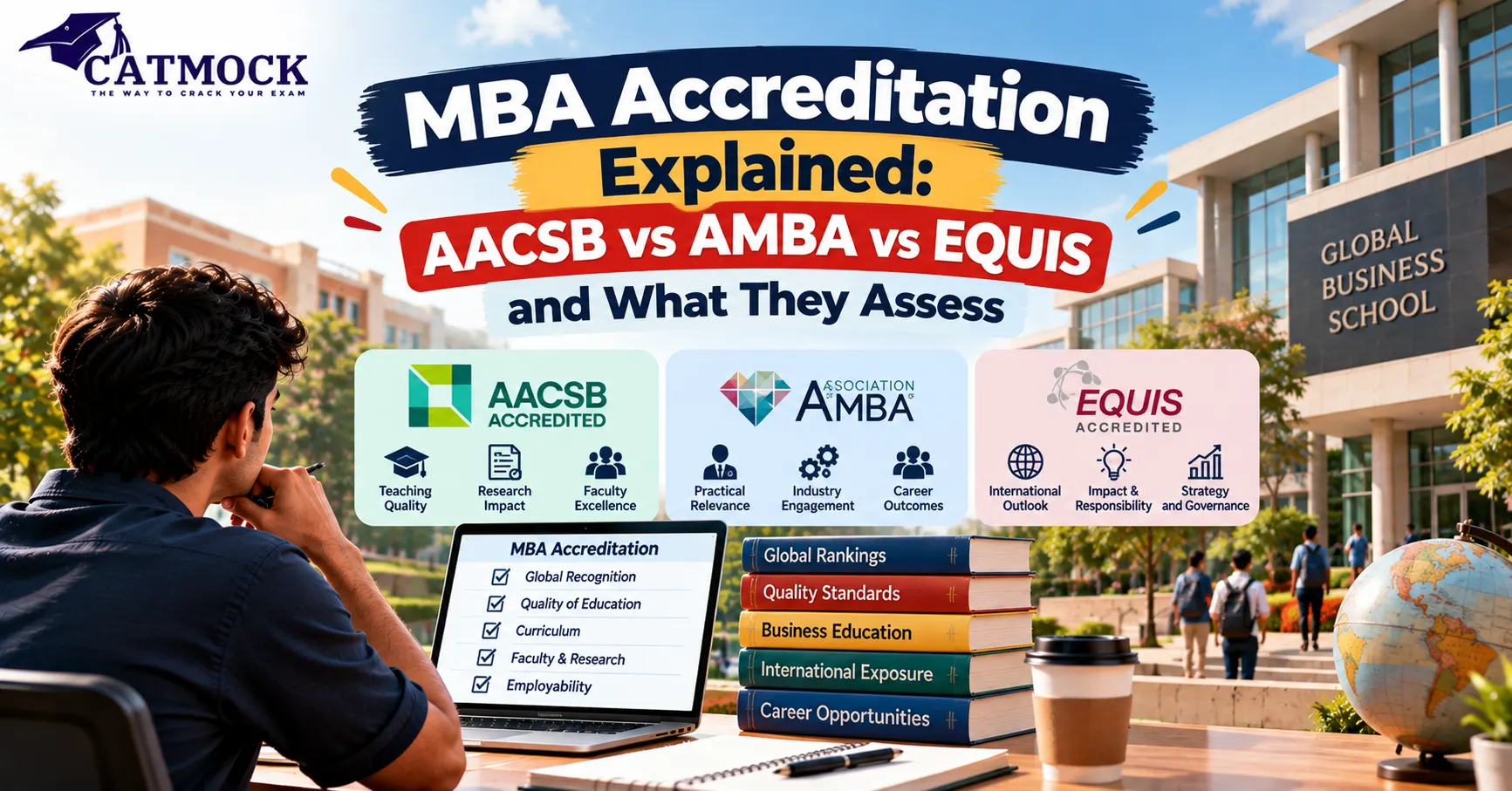
Choosing an MBA is one of the biggest financial and career decisions you will make. Yet many applicants compare schools using rankings, brochures and fee tables while ignoring a quiet quality signal that sits on almost every business school website: three acronyms, AACSB, AMBA and EQUIS.
These logos appear everywhere, but few candidates know who awards them, what they actually check and whether a missing logo is a warning sign. This guide gives you the full picture. You will learn how MBA accreditation works, how the three major bodies differ, what each one assesses, what “triple accreditation” really means and how to use all this when you shortlist schools.
Note: Accreditation figures and standards are updated regularly. Use the numbers here as general guidance and check the official directories before you decide.
What Is MBA Accreditation?
MBA accreditation is an independent quality check on a business school or its programme. An outside body reviews areas such as faculty quality, curriculum, student support, governance and outcomes, then confirms whether the school meets its published standards.
In simple terms, accreditation answers one question: has someone credible and independent verified that this school or programme meets a recognised quality benchmark?
It is important to understand what accreditation is not:
- It is not a ranking. Accreditation is a pass or fail standard, not a league table.
- It is not a guarantee of a job or salary.
- It is not permanent. Schools must be reviewed again periodically to keep it.
Institutional vs Programme Accreditation
Before comparing the three bodies, you need one key distinction.
| Type | What Is Reviewed | Example Bodies |
|---|---|---|
| Institutional (school-level) | The business school or institution as a whole, including its mission, faculty, governance and portfolio of programmes | AACSB, EQUIS |
| Programme-level | Specific programmes such as the MBA, Executive MBA or DBA | AMBA |
This difference explains why a school can hold one accreditation and still be missing another. It also explains why comparing them as if they were identical products can be misleading.
AACSB Accreditation Explained
Who They Are
AACSB (the Association to Advance Collegiate Schools of Business) is a US-founded global body, established in 1916. It is widely seen as the oldest and most widely held of the three, with accredited schools spread across many countries.
Level of Accreditation
AACSB accredits at the institutional level. It looks at the business school and its overall quality, rather than a single MBA programme.
What AACSB Assesses
AACSB standards focus on a school’s mission and how well it delivers on it. Broadly, reviewers look at:
- Strategic management and innovation: Does the school have a clear mission, and does it plan, invest and improve accordingly?
- Faculty quality: Are teachers academically and professionally qualified, and are there enough of them?
- Learner success: Do curriculum, assessment and student support help learners achieve the stated outcomes?
- Research and societal impact: Does the school contribute to knowledge and to business or community practice?
- Continuous improvement: Does the school regularly review and enhance its offerings?
Review Cycle
Schools typically go through a multi-year journey to achieve AACSB accreditation and are reviewed again periodically to keep it. The standards are also updated from time to time, so check the current version on the official site.
Best known for: Strong emphasis on research, faculty qualification and a mission-driven approach. It is especially recognised in North America, though it is global.
EQUIS Accreditation Explained
Who They Are
EQUIS is awarded by EFMD, a European organisation focused on management development, based in Brussels.
Level of Accreditation
EQUIS is also institutional. It reviews the business school as a whole, covering its programme portfolio, not only the MBA.
What EQUIS Assesses
EQUIS places particular weight on:
- Internationalisation: Student and faculty diversity, international exposure, exchange agreements and global outlook.
- Corporate connections: Links with employers, industry projects, advisory boards and career support.
- Ethics, responsibility and sustainability: How the school teaches and practises responsible management.
- Governance and strategy: How the school is run and how it plans for the future.
- Faculty and programme quality: Academic strength and relevance of teaching.
- Innovation and engagement: How the school responds to changes in business and society.
Review Cycle
Like the other bodies, EQUIS accreditation is granted for a fixed period and reviewed again afterwards.
Best known for: Internationalisation, corporate engagement and a strong European footprint, although schools from many regions hold it.
AMBA Accreditation Explained
Who They Are
AMBA is the Association of MBAs, a UK-based body focused on postgraduate management education. It accredits programmes in many countries.
Level of Accreditation
AMBA accredits specific programmes, such as the MBA, Executive MBA, Master in Business Management or DBA. It does not accredit a whole institution. A school can therefore have an AMBA-accredited MBA while other programmes at the same school are not covered.
What AMBA Assesses
AMBA’s review is closely focused on the quality of the MBA experience itself:
- Programme design and curriculum: Is the MBA coherent, rigorous and relevant to managers?
- Student cohort and admissions: AMBA pays attention to the quality and professional experience of the students admitted.
- Faculty and teaching: Are teachers suited to postgraduate management education?
- Learning outcomes and assessment: Do graduates achieve the skills the programme promises?
- Careers and student support: What help do students get with development and progression?
- Alumni and community: Is there an engaged network, and does the school keep improving?
Review Cycle
AMBA accreditation is granted for a defined period and reviewed again to maintain it.
Best known for: Its sharp focus on the MBA itself and on experienced learners, making it especially relevant if you want proof that this specific MBA meets a recognised benchmark.
AACSB vs AMBA vs EQUIS: Side-by-Side Comparison
| Feature | AACSB | AMBA | EQUIS |
|---|---|---|---|
| Origin | United States | United Kingdom | Europe (EFMD, Brussels) |
| Level | Institutional | Programme | Institutional |
| Scope | Whole business school | MBA, EMBA, DBA and related programmes | Whole business school |
| Core emphasis | Mission, faculty, research, learner success | MBA quality, cohort and learning outcomes | Internationalisation, corporate links, ethics |
| Geographic reputation | Very strong in North America, global reach | Strong in UK, Europe, Asia-Pacific and the Middle East | Strong in Europe, global reach |
| Best for | Judging overall academic strength of a school | Verifying a specific MBA programme | Judging international and corporate orientation |
| Review | Periodic renewal | Periodic renewal | Periodic renewal |
No row in this table says one body is “better”. Each looks through a different lens.
What They Assess: A Quick Reference Matrix
| Assessment Area | AACSB | AMBA | EQUIS |
|---|---|---|---|
| Strategy and mission | Strong focus | Moderate | Strong focus |
| Faculty qualifications | Strong focus | Moderate | Strong focus |
| Curriculum design | Strong focus | Very strong focus | Strong focus |
| Student cohort and admissions | Moderate | Very strong focus | Moderate |
| Learning outcomes | Strong focus | Strong focus | Moderate |
| Internationalisation | Moderate | Moderate | Very strong focus |
| Corporate and employer links | Moderate | Moderate | Very strong focus |
| Ethics and sustainability | Moderate | Moderate | Strong focus |
| Research and societal impact | Very strong focus | Lower | Moderate |
| Careers and alumni | Moderate | Strong focus | Strong focus |
This matrix is a simplified guide to relative emphasis, not an official scorecard. For precise criteria, read the current standards published by each body.
What Is Triple Accreditation (Triple Crown)?
Triple accreditation, often called the “triple crown”, means a business school holds AACSB, AMBA and EQUIS at the same time. Because each body uses different standards, and the process is long and costly, only a small fraction of business schools worldwide achieve all three. Estimates generally place the figure at under 1% of schools globally, though numbers vary by source and year.
Why It Matters
- It signals strong quality across institution, programme and international dimensions.
- It can improve brand recognition with employers and partner universities.
- It often reflects heavy investment in faculty, research and student services.
Why You Should Not Over-Value It
- Many excellent schools hold only one or two accreditations. Some US schools, for example, focus on AACSB and do not pursue the European bodies.
- Triple accreditation does not guarantee a good fit for you.
- A missing accreditation is a prompt to look closer, not proof that a school is weak.
Think of triple accreditation as a strong quality floor, not a finish line.
Does Accreditation Matter for Your Career?
Accreditation can help in several practical ways:
- Employer confidence. Recruiters often use accreditation as a quick, independent signal when they have never heard of a school.
- Degree recognition. Accredited degrees may be easier to validate for visas, further study or professional recognition.
- Exchange and partnership options. Many schools prefer to partner with other accredited schools.
- Programme quality assurance. Accredited schools are regularly reviewed and pushed to improve.
Accreditation alone does not decide career outcomes. Network, performance, internships, location and personal effort still matter enormously.
Accreditation vs Rankings: Not the Same Thing
| Factor | Accreditation | Ranking |
|---|---|---|
| Purpose | Confirms a minimum quality standard | Orders schools relative to each other |
| Outcome | Pass or fail (with periodic renewal) | A numbered position |
| Who decides | An independent accrediting body | A publication or ranking organisation |
| Methodology | Published standards and peer review | Surveys, salary data and other metrics |
| Use it for | Filtering out low-quality options | Comparing already good options |
A smart approach is to use accreditation first as a filter, then rankings, graduate outcomes, cost and fit as comparison tools.
How to Verify a School’s Accreditation
Marketing claims can be vague. Always verify.
- Open the official directories. Search for the school on the AACSB, AMBA and EFMD websites.
- Check the exact scope. Is the whole school accredited (AACSB, EQUIS) or only a specific programme (AMBA)? Does the accreditation cover the MBA you are applying for?
- Read the status wording. “Accredited” is different from “in process”, “candidate” or “applying”. Only the first confirms completed accreditation.
- Check the validity period. Accreditation is time-bound.
- Match the campus and delivery mode. Make sure online, executive and part-time versions are covered if you plan to study that way.
- Ask the admissions team. A reputable school will happily confirm details in writing.
Common Myths About MBA Accreditation
| Myth | Reality |
|---|---|
| “More accreditations always means a better MBA for me.” | More badges signal more review, but fit, cost and outcomes still matter |
| “AACSB, AMBA and EQUIS are the same thing.” | They differ in origin, level and focus |
| “No accreditation means a bad school.” | It is a prompt to investigate, especially for new, niche or regional schools |
| “Accreditation guarantees a job.” | It indicates quality, not outcomes |
| “Accreditation is permanent.” | It is time-bound and must be renewed |
| “Accreditation equals ranking.” | Accreditation is a standard, ranking is a comparison |
How to Use Accreditation in Your School Shortlist
Follow this simple process:
- Set your goals. Do you want an international career, a specific industry, a research-based path or a regional network?
- Filter by accreditation. Aim for at least one major accreditation, and look for the type that matches your goals.
- Compare programme details. Review curriculum, specialisations, class profile and faculty.
- Check outcomes. Look at placement reports, salary ranges and alumni destinations.
- Balance cost and return. Compare total fees and living costs against realistic outcomes.
- Talk to people. Contact alumni and current students for honest views.
| If Your Priority Is… | Pay Extra Attention To… |
|---|---|
| Overall academic strength | AACSB status |
| Quality of the MBA programme itself | AMBA status |
| International exposure and employer links | EQUIS status |
| Maximum recognition worldwide | Triple accreditation (plus fit and cost) |
| Affordability | Accredited schools with strong value, not just brand |
Summary
MBA accreditation is an independent quality check, and the three most recognised bodies are AACSB, AMBA and EQUIS. AACSB and EQUIS accredit whole business schools, while AMBA accredits specific programmes. AACSB focuses on mission, faculty, learner success and research impact. EQUIS stresses internationalisation, corporate links and ethics. AMBA examines the quality of the MBA itself, including curriculum, student cohort and learning outcomes. Triple accreditation is rare and impressive, but it is a quality floor, not a guarantee of the right fit. Use accreditation to filter your options, verify claims on official directories and then compare schools on outcomes, cost and personal goals.
Frequently Asked Questions (FAQs)
1. What is MBA accreditation?
It is an independent review that confirms a business school or programme meets recognised quality standards.
2. What is the difference between AACSB, AMBA and EQUIS?
AACSB and EQUIS accredit whole business schools, while AMBA accredits specific programmes such as the MBA. They also emphasise different areas, such as research, MBA quality and internationalisation.
3. Which MBA accreditation is the best?
None is universally best. The right one depends on your goals. AACSB is widely recognised, AMBA focuses on the MBA itself and EQUIS stresses international and corporate links.
4. What is triple accreditation?
It means a school holds AACSB, AMBA and EQUIS at the same time. Only a small share of business schools worldwide achieve it.
5. Is a school without all three accreditations a bad school?
No. Many strong schools hold one or two. Treat a missing accreditation as a reason to look closer, not as proof of weakness.
6. Does AMBA accredit a whole university?
No. AMBA accredits specific programmes, not entire institutions.
7. Does accreditation guarantee a better job or salary?
No. It signals quality, but career outcomes depend on many other factors.
8. How do I check whether a school is accredited?
Search the school in the official directories of the accrediting bodies and confirm that the specific programme and delivery mode are covered.
9. What does “accreditation in process” mean?
It means the school is working toward accreditation but has not yet earned it. Do not treat it as the same as being accredited.
10. Is accreditation the same as ranking?
No. Accreditation confirms a standard, while rankings compare schools against each other.
Conclusion
AACSB, AMBA and EQUIS are not marketing decorations. They are the result of serious, independent review, and each looks at a different side of what makes a business school good. Understanding what they assess helps you read a school’s claims with confidence instead of confusion.
Use accreditation as your first filter, verify every claim on the official websites and then compare programmes on curriculum, outcomes, cost and fit. The right MBA is the one that is credible, relevant to your goals and worth the investment. Accreditation helps you find that school, but your own research makes the final decision.
Disclaimer: This article is for general informational purposes. Accreditation standards, school status and figures change over time. Always confirm details on the official websites of the accrediting bodies and with the school directly.
You May Also Like : CAT MOCK, CAT MOCK PYQ
Follow Us On : Facebook, Instagram, Youtube