


Finance has always been regarded as the language of commerce. Indeed, few institutions in India have been as consistent in teaching it as the Department of Financial Studies (DFS) at the University of Delhi. Established in 1987 on the South Campus in Moti Bagh, DFS has, over nearly four decades, shaped thousands of finance professionals. Today, many of them hold leadership positions across banking, consulting, asset management, and corporate finance.
Consequently, every year, thousands of CAT aspirants consider DFS Delhi as a top-tier destination. However, because the department is often overlooked in favour of the IIMs, many students remain unaware of what makes it genuinely distinctive. This blog, therefore, covers every facet of DFS — from its academic philosophy and 2025–27 admission cycle to placement statistics and career outcomes — so you can make a well-informed decision.
📋 Table of Contents
- Overview & Key Highlights
- History & Institutional Identity
- Courses & Fee Structure (2025–27)
- Curriculum & Academic Approach
- Admission Process for 2026–27
- Eligibility Criteria
- Faculty & Research
- Placement Record & Industry Outlook
- Campus Life & Infrastructure
- Scholarships & Financial Aid
- Rankings & Recognition
- Career Paths After DFS
- Frequently Asked Questions (15 FAQs)
1. Overview & Key Highlights
Before diving into the details, here is a quick statistical snapshot of DFS Delhi for the 2025–27 cycle. These numbers effectively capture why the department continues to be held in such high regard despite having a small batch size and modest infrastructure compared to private B-schools. Overall, these figures demonstrate why the department continues to enjoy a strong reputation.
Established
1987
University of Delhi
Highest CTC
₹32L
Per annum (2023–25 batch)
Average CTC
₹19.1L
Per annum
Top 10%
₹23.5L
Average package
MBA Fee
₹97K
Total (2 years)
Ranking
#55
Management – Collegedunia 2025
2. History & Institutional Identity
The Department of Financial Studies was founded in 1987 as a specialised postgraduate centre under the University of Delhi’s South Campus. Since then, the institution has been dedicated solely to finance and business economics — a focused mandate that has allowed it to build remarkably deep expertise in a narrow but consequential domain.
Notably, DFS became affiliated with the CFA University Affiliation Program (USA), making it one of a select few Indian institutions to carry this distinction. Consequently, students gain exposure to globally recognised concepts from the beginning of the programme. As a result, students who graduate from DFS are fundamentally better prepared for CFA examinations than peers from non-affiliated programmes.
“DFS Delhi’s MBA curriculum is so interwoven with CFA-level concepts that graduates often find the Level I examination far more accessible than those who self-study.”
Furthermore, the department is situated at the Benito Juarez Marg campus in South Delhi, spanning approximately five acres. Nevertheless, its strategic location offers significant professional advantages within the sprawling University of Delhi ecosystem grants students access to a vast alumni network, inter-departmental resources, and Delhi’s dense professional ecosystem.
3. Courses & Fee Structure (2025–27)
DFS Delhi currently offers four programmes at the postgraduate and doctoral levels. Furthermore, each course is carefully structured to combine theoretical rigour with practical financial skills. Below is a comprehensive breakdown of the programmes available for the 2025–27 admission cycle.
| Programme | Duration | Total Fee | Admission Basis |
|---|---|---|---|
| MBA (Financial Management) | 2 Years | ₹97,000 | CAT + GD-PI |
| MBA (Business Economics) | 2 Years | ₹99,000 | CAT + GD-PI |
| Ph.D. (Finance) | 3–5 Years | As per DU norms | DUET / UGC NET-JRF + Interview |
| Ph.D. (Business Economics) | 3–5 Years | As per DU norms | DUET / UGC NET-JRF + Interview |
In fact, the programme delivers one of the strongest returns on investment among Indian B-schools. While a full two-year MBA programme is completed for under ₹1 lakh, the average placement package exceeds ₹19 LPA — a return on investment that is structurally superior to most private institutions charging ten to twenty times more. Additionally, students from the PWD category are charged a concessional fee of ₹12,125, making the programme genuinely accessible.
4. Curriculum & Academic Approach
Core Subjects
The MBA (Financial Management) programme follows a dual-track structure. Initially, students build a strong foundation in management concepts. During the first year, the curriculum covers foundational subjects such as Managerial Economics, Quantitative Techniques, Organisational Behaviour, and Financial Accounting. The programme deliberately combines these subjects with finance-specific modules to help students develop both general managerial acumen and specialised financial insight.
Specialisation Modules
In the second year, the programme exposes students to advanced electives such as Investment Management, International Finance, Derivatives and Risk Management, Portfolio Theory, Credit Analysis, and Corporate Valuation. Thereafter, students choose advanced finance electives. The curriculum aligns these modules with CFA Level I and II content areas, giving students a meaningful head start in the globally recognised examination. As a result, students gain an advantage while preparing for CFA examinations. Moreover, the department integrates live case studies, Bloomberg terminal sessions, and industry practitioner lectures throughout the curriculum.

Research & Doctoral Work
The Ph.D. programmes at DFS are research-intensive and typically culminate in peer-reviewed publications. Faculty members actively contribute to journals in finance, macroeconomics, and capital markets — research that subsequently informs classroom teaching and ensures the curriculum remains current. Moreover, their research frequently informs classroom discussions. Thus, even MBA students benefit indirectly from the department’s active scholarly environment.
5. Admission Process for 2026–27
DFS Delhi has already initiated the admission process for the 2026–27 session. Accordingly, candidates should closely track the official timeline to ensure they do not miss any deadlines. The process unfolds in the following stages. First, candidates must appear for CAT. Next, shortlisted applicants participate in GD and PI rounds. Finally, DFS prepares the merit list.
| Stage | Details | Approximate Timeline |
|---|---|---|
| CAT Examination | Mandatory entrance test; only valid CAT scores accepted | November 2025 |
| Application Form | Online application via DU portal; ₹750 application fee | Nov 2025 – Jan 2026 |
| Shortlisting | Based on CAT percentile (General: ~95th percentile) | January – February 2026 |
| GD-PI Rounds | Group Discussion + Personal Interview on South Campus | February – March 2026 |
| Merit List & Enrolment | Final selection & document verification | April – June 2026 |
Importantly, DFS Delhi calculates the final merit by combining multiple components, including CAT scores, performance in the GD-PI rounds, academic performance in Classes X and XII, and additional weightage for female candidates. This composite scoring system ensures that the institute values a well-rounded profile rather than relying solely on competitive exam performance.
6. Eligibility Criteria
For MBA Programmes
Candidates must hold a graduation degree under the 10+2+3 system in any discipline, with a minimum aggregate of 50% marks. Additionally, Mathematics at Class XII is compulsory . This requirement reflects the quantitative nature of the curriculum and ensures students arrive equipped to handle financial modelling and statistical analysis from day one.
For Ph.D. Programmes
Doctoral applicants must hold a postgraduate degree or its equivalent with at least 60% marks (or 55% marks for SC/ST candidates) to qualify for admission. Beyond academics, a Research Proposal and UGC NET/JRF qualification are essential components of the selection process, which also includes a Personal Interview. Delhi University conducts the entire doctoral admission process through the Delhi University Entrance Test (DUET) framework.
7. Faculty & Research
The academic strength of DFS rests heavily on its faculty, all of whom hold doctoral degrees from reputed universities. The department conducts significant research in capital markets, behavioural finance, international economics, and banking regulation, earning recognition for its contributions in these fields. The following faculty members play a prominent role in shaping the academic and research environment at DFS Delhi:
| Faculty Member | Qualification | Area of Expertise |
|---|---|---|
| Prof. Sanjay Sehgal | Ph.D. | Capital Markets, Asset Pricing |
| Prof. Amitabh Gupta | Ph.D. | Corporate Finance, Valuation |
| Dr. Nidhi Jain | Ph.D. | Banking & Financial Services |
| Dr. Varun Dawar | Ph.D. | Investment Analysis |
| Dr. Ritesh Kumar Mishra | Ph.D. | Macroeconomics, Policy |
| Dr. Pankaj Chaudhary | Ph.D. | International Finance |
| Dr. Saurabh Singh | Ph.D. | Risk Management |
Furthermore, the department regularly invites industry practitioners — from investment bankers to credit analysts — for guest sessions and workshops. In addition, students regularly interact with experienced industry professionals. Consequently, the department provides students with perspectives that go well beyond classroom theory and regularly exposes them to real-world deal structures, market developments, and career guidance.
8. Placement Record & Industry Outlook
DFS Delhi delivered its strongest placement performance to date for the 2023–25 batch. Not surprisingly, the placement outcomes remian among the department’s biggest strenghts. These outcomes reflect both the quality of the students enrolled in the programme and the trust that leading financial institutions have placed in DFS graduates over the years.
Highest CTC ₹32 LPA
Average CTC ₹19.12 LPA
Top 10% Average ₹23.46 LPA
Top Recruiters
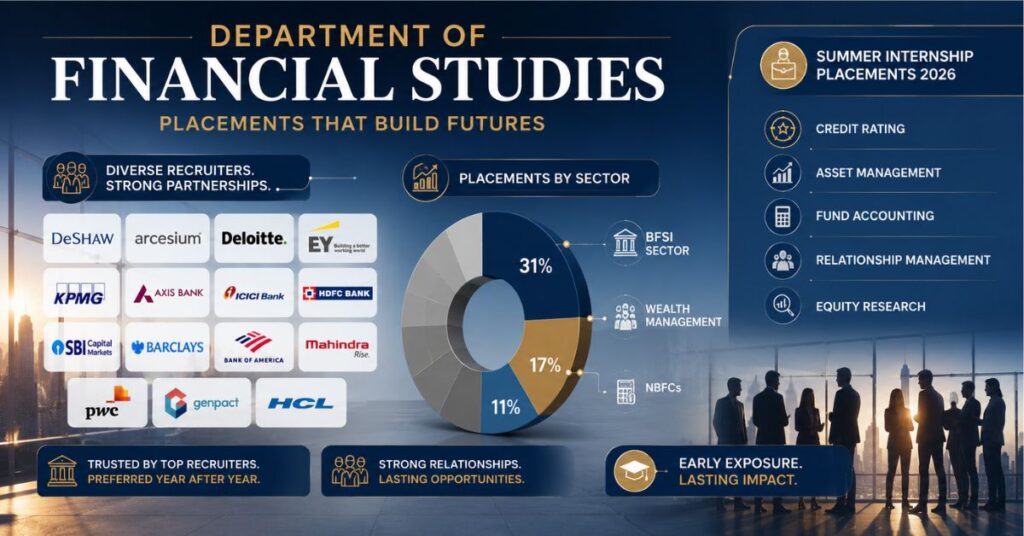
Over the years, the DFS placement cell has successfully attracted a diverse mix of firms from the BFSI, consulting, and analytics sectors. Some of the most prominent recruiters who have consistently participated in campus drives include DeShaw, Arcesium, Deloitte, Ernst & Young, KPMG, Axis Bank, ICICI Bank, HDFC Bank, SBI Capital Markets, Barclays, Bank of America, Mahindra Group, PwC, Genpact, and HCL. Notably, the BFSI sector alone accounted for 31% of all placements, followed by Wealth Management at 17% and NBFCs at 11%. Moreover, many recruiters have been returning to campus year after year.
The department completed summer internship placements for 2026 and placed students in roles across Credit Rating, Asset Management, Fund Accounting, Relationship Management, and Equity Research. Alumni frequently cite this early internship exposure as a pivotal element of the DFS experience.
9. Campus Life & Infrastructure
Although the DFS campus spans only five acres, DFS operates as an integral part of the University of Delhi’s South Campus. This integration gives students access to the university’s extensive library, sports facilities, inter-departmental cultural activities, and alumni networks. The department maintains a dedicated computer lab with Bloomberg terminal access, a well-stocked finance library, and seminar halls designed for case study discussions.
Beyond academics, the student community at DFS is notably active. Likewise, students actively participate in clubs and competitions. The department regularly organises fests, finance conclaves, inter-college competitions, and invited speaker series throughout the academic year. Moreover, student clubs focused on investment analysis, entrepreneurship, and CSR provide structured opportunities to apply classroom learning in real-world contexts.
10. Scholarships & Financial Aid
Financial support is available to students through multiple channels. Besides merit-based scholarships, students can also apply for several government-funded schemes. The University of Delhi awards merit-based scholarships to high-scoring students. Need-based assistance is additionally provided through government-backed central schemes, including those administered by the Ministry of Social Justice and the Ministry of Minority Affairs. Importantly, DFS follows Delhi University’s reservation policy, which includes a dedicated seat in each programme for single-girl-child students — a provision that specifically addresses gender equity in postgraduate education.
Furthermore, SC/ST and OBC category students receive fee concessions as mandated by university guidelines. As a result, the already low programme fee becomes even more accessible for students from historically underrepresented communities, making DFS one of the most economically inclusive finance programmes in the country.
11. Rankings & Recognition
| Ranking Body | Category | Rank / Status | Year |
|---|---|---|---|
| Collegedunia | Management | #55 | 2025 |
| CFA Institute (USA) | University Affiliation | Affiliated | Ongoing |
| University of Delhi | Constituent Department | Approved | Since 1987 |
| NIRF | Management | Evaluated | 2025 |
While national rankings do not fully capture DFS’s unique positioning, the CFA University Affiliation is perhaps the most consequential recognition the department holds. More importantly, the CFA affiliation distinguishes DFS from many competing institutions. The CFA Institute grants this affiliation only to institutions whose curricula meet its rigorous standards. As a result, the affiliation carries substantial weight with international finance employers and enjoys recognition in more than 160 countries.
12. Career Paths After DFS
Graduates from the Department of Financial Studies work across a wide spectrum of financial roles. Consequently, alumni are able to pursue careers across multiple finance domains. The programme’s CFA-aligned curriculum and the department’s strong industry connections shape their career outcomes and help them secure diverse opportunities in the financial sector. Below are the primary career domains that DFS alumni typically enter.
| Career Domain | Sample Roles | Key Employers |
|---|---|---|
| Investment Banking | Analyst, Associate | Barclays, SBI Capital, ICICI Sec |
| Asset Management | Fund Manager, Research Analyst | Arcesium, DeShaw, HDFC AMC |
| Credit Rating | Rating Analyst | ICRA, CRISIL, CARE Ratings |
| Consulting | Financial Consultant | Deloitte, EY, KPMG, PwC |
| Corporate Finance | Finance Manager, Treasury Analyst | Mahindra, Axis Bank |
| Wealth Management | Relationship Manager, Wealth Advisor | HDFC Bank, ICICI Private |
Additionally, a growing number of DFS alumni are choosing entrepreneurial paths in fintech, micro-lending, and alternative investment management — a trend that aligns with the broader digital finance revolution taking place across India between 2025 and 2027. The department has also begun facilitating startup incubation conversations through its alumni network, further broadening post-graduation possibilities.
15 Frequently Asked Questions
Q1. what is the Department of Financial Studies (DFS), and where is it located?
The Department of Financial Studies (DFS) is a government postgraduate institution under the University of Delhi. Moreover, it is located at Benito Juarez Marg, South Campus, New Delhi — 110021. Delhi University established the Department of Financial Studies (DFS) in 1987.DFS Delhi’s affiliation with the CFA University Affiliation Program (USA) has helped the department establish itself as one of India’s most distinguished finance schools.
Q2. Which courses does DFS Delhi offer for the 2025–27 cycle?
DFS Delhi offers four programmes: First, MBA in Financial Management, second, MBA in Business Economics, third, Ph.D. in Finance, and lastly, Ph.D. in Business Economics. Most candidates choose the MBA in Finance, which serves as the flagship programme of DFS Delhi. The institute offers all its programmes at the postgraduate and doctoral levels, and it has already started the admission process for the 2026–27 academic cycle.
Q3. What is the total fee for the MBA programme at DFS Delhi?
The total fee for the MBA in Financial Management is ₹97,000 for the entire two-year programme. However, the MBA in Business Economics costs ₹99,000 for the same duration. Although, DFS Delhi charges remarkably low fees compared to private B-schools, and the institute has kept the fee structure unchanged for the 2025–27 batch based on available data. As per Delhi University guidelines, DFS Delhi charges ₹12,125 from students belonging to the PWD category.
Q4. What CAT percentile do candidates need for admission to DFS Delhi?
Typically, General category candidates require around a 95 percentile or higher in CAT to secure a shortlist for the GD-PI rounds at DFS Delhi, based on past trends. However, DFS Delhi does not base its final selection solely on CAT scores. Moreover, the institute also evaluates candidates’ Class X and XII academic performance, GD-PI performance, and awards gender-based bonus marks while preparing the final merit list. SC/ST/OBC candidates typically qualify at lower percentile thresholds.
Q5. Is Mathematics mandatory for admission to DFS Delhi’s MBA programme?
Yes, Mathematics or Business Mathematics at the Class XII level is a mandatory eligibility requirement for the MBA programme at DFS Delhi. This prerequisite is in place because the curriculum involves quantitative finance, financial modelling, and statistical analysis. Candidates with a Commerce or Science background and Mathematics meet the eligibility criteria, whereas the institute does not permit candidates without Mathematics to apply, regardless of their CAT score.
Q6. What is the highest salary package offered at DFS Delhi placements?
The highest CTC recorded during DFS Delhi placements for the 2023–25 batch stood at ₹32 LPA. The average package was ₹19.12 LPA, while the top 10% of students received an average of ₹23.46 LPA. The lowest CTC offered was ₹10.78 LPA. These figures reflect strong placement outcomes across sectors like BFSI, Wealth Management, and Consulting.
Q7. Which companies recruit from DFS Delhi during placement drives?
DFS Delhi has attracted recruiters from top-tier financial institutions and consulting firms including DeShaw, Arcesium, Deloitte, Ernst & Young, KPMG, PwC, Axis Bank, ICICI Bank, HDFC Bank, Bank of America, Barclays, SBI Capital Markets, Mahindra Group, Genpact, Airtel, and Delta X, among others. The BFSI sector dominates at 31% of placements, reflecting the department’s strong finance specialisation.
Q8. What is the CFA University Affiliation and why does it matter for DFS students?
The CFA University Affiliation Program, offered by the CFA Institute (USA), recognises universities whose curricula significantly incorporate CFA Program content. DFS Delhi has been awarded this affiliation, meaning its syllabus substantially overlaps with CFA Level I and Level II content. Consequently, students preparing for the CFA examination find themselves at a considerable advantage, and global finance employers recognise the affiliation as a quality signal for the institution’s academic standards.
Q9. How is the application process structured for the DFS MBA 2026-27 batch?
The application process is fully online and begins with appearing for the CAT examination. Subsequently, candidates must submit the DFS admission form through the Delhi University portal, paying an application fee of ₹750. Shortlisted candidates are then called for Group Discussion and Personal Interview rounds held on the South Campus. Final selection is determined by a composite score involving CAT, academics, and interview performance.
Q10. Are scholarships available at DFS Delhi for MBA students?
Yes, scholarships are available at DFS Delhi through both merit-based and need-based channels. Government-backed schemes from the Ministry of Social Justice and the Ministry of Minority Affairs cover several categories of students. Additionally, Delhi University provides a dedicated seat for single-girl-child students in each programme, and SC/ST/OBC students receive fee concessions as per reservation norms. The already low total fee further enhances the overall financial accessibility of the institution.
Q11. What is the Ph.D. admission process at DFS Delhi?
Doctoral admission at DFS Delhi is conducted through the Delhi University Entrance Test (DUET) or UGC NET/JRF scores. Candidates are additionally required to present a Research Proposal and appear for a Personal Interview. Eligibility requires a postgraduate degree with a minimum of 60% marks (55% for SC/ST candidates). The Ph.D. programmes span three to five years and are oriented towards peer-reviewed research publication.
Q12. What is DFS Delhi’s ranking in India for management programmes?
DFS Delhi has been ranked 55th in the Management category by Collegedunia in 2025. While this rank may seem modest at first glance, it does not fully capture the department’s exceptional fee-to-placement ratio or its CFA affiliation advantage. When return on investment is calculated — first-year salary divided by total programme fee — DFS Delhi significantly outperforms many institutions ranked above it in traditional lists.
Q13. How many seats are available in the DFS Delhi MBA programme?
DFS Delhi maintains a deliberately small batch size, which contributes to an intensive and personalised learning environment. While the exact seat count is subject to University of Delhi guidelines each academic year, the programme typically accommodates a limited cohort. Seat reservations are applied as per DU’s norms for SC, ST, OBC, EWS, and PWD categories. One dedicated seat per programme is additionally reserved for single-girl-child applicants.
Q14. Is DFS Delhi better than a private B-school for a finance career?
For students specifically targeting a finance career — particularly in investment management, credit analysis, or capital markets — DFS Delhi offers a structurally superior return on investment compared to most private B-schools. The total programme fee is under ₹1 lakh, yet average placements exceed ₹19 LPA. Additionally, the CFA affiliation and Delhi University brand carry global recognition. However, students seeking general management or diverse sector placements might find broader programmes at IIMs or top private institutes more suitable.
Q15. What are the career prospects for DFS alumni in 2025-27?
Career prospects for DFS alumni remain very strong through 2025–27, driven by India’s rapidly expanding BFSI sector, the growth of mutual fund penetration, SEBI regulatory reforms, and rising foreign institutional investment in Indian markets. DFS graduates are particularly well-positioned for roles in Asset Management, Equity Research, Credit Rating, Wealth Advisory, and Investment Banking. Moreover, the fintech and alternative investments segment is creating entirely new demand for finance professionals with rigorous analytical training — precisely the kind DFS provides.
You may also visit: CATMOCK INDIA|CATMOCK