


Complete Chapter-Wise Preparation
Around 3 lakhs students apply for the CAT, one of the toughest MBA entrance exams in India, every year. The biggest way of understanding the exam pattern of the latest exam, difficulty level, and types of questions asked by IIMs is through CAT Previous Year Questions (PYQs). This CAT preparation guide covers the CAT 2026 exam pattern, section-wise PYQ analysis, solved PYQs, and effective study tips.
| 2.95 Lakh | 68 Questions | 87% |
| Candidates Registered for CAT 2025 | Total Questions in 120-Minute Paper | Overall Attendance Rate |
Table of Content:
- What Are CAT PYQs and Why Do They Matter?
- Understanding the CAT 2025–26 Exam Pattern
- Section-Wise PYQ Breakdown: VARC
- Section-Wise PYQ Breakdown: DILR
- Section-Wise PYQ Breakdown: QA
- Sample Solved PYQs
- Mistakes to avoid in PYQ Practice
- About CatMock- Free PYQ Platform
- Frequently Asked Questions (FAQ’s)
What are CAT PYQ’s and Why It Matter:
Some of the best ways to prepare are by solving previous year question papers of CAT. This differs from mock tests, because, by solving PYQs, students can understand the paper pattern, difficulty level, and recurring concepts of VARC, DILR, and QA. The practice of solving PYQs chapter-wise enables students to develop time management skills, speed, and accuracy, which are very important to crack the two-hour long CAT exam. One can easily find chapter-wise CAT PYQs with solutions on CatMock.
Three Reasons PYQ’s beat Every Other Resources:
- Authentic questions have the depth and context that are often missing from mock tests, showing the examiner’s intentions.
- Via the chapter-wise accuracy scores, they pinpoint certain areas of weakness and allow for targeted improvement.
- Their confidence in the exam hall improves because of their familiarity with authentic questions.
Understanding CAT 2025-2026 Exam Pattern
The student must clearly understand the structure of the paper before he proceeds with PYQ practice. The CAT is a computer-based test that takes 120 minutes. This CBT is divided into three sections, each taking 40 minutes. Once you get into a section, you cannot move to another section. Thus, selecting the right question is paramount. Secondly, the CAT marking scheme awards 3 marks for every correct MCQ and deducts 1 mark for every incorrect MCQ. TITA questions carry no negative marking. This is an area where smart candidates take advantage of by attempting all TITA questions regardless of their confidence levels.
| Section | Questions | Marks | Time (min) |
| VARC (Verbal Ability & Reading Comprehension) | 24 | 72 | 40 |
| DILR (Data Interpretation & Logical Reasoning) | 22 | 66 | 40 |
| QA (Quantitative Aptitude) | 22 | 66 | 40 |
| Total | 68 | 204 | 120 |
According to estimates, the total number of questions in CAT 2026 will be 68, and there will be 204 marks, and there will be 40 minutes per section. DILR and QA each will consist of 22 questions (66 marks), while VARC will consist of 24 questions (72 marks). However, candidates must balance accuracy with smart question selection because each section has a fixed time limit and MCQs carry negative marking.. Thus, the best way to improve the speed and efficiency would be to solve CAT PYQs.
Section- Wise PYQ Breakdown: VARC
Though it is common for students preparing for CAT to postpone their VARC preparation, there is one huge advantage of starting the preparation early on. It is necessary to practice RC regularly since about 24 out of total 24 VARC questions consist of Reading Comprehension (RC). Since CAT topics cover various subjects and evaluate reasoning and comprehension skills and not the vocabulary skills, it will help to increase the RC speed and accuracy.
VARC Topic Weightage(Based on 2017-2025)
- Reading Comprehension (RC): The RCs are estimated to be about 65–75% of the VARC section and are made up of 16-18 Reading Comprehensions questions.
- Para Jumbles: There are two to three TITA questions where the candidate has to arrange the sentences in order.
- Paragraph Completion/Paragraph Summary: There are two to three questions testing your capability in choosing the right paragraph completion/summary sentence.
- Odd One Out: There are two to three TITA questions in which the applicant is required to find out the sentence which does not fit in the paragraph.
Section- Wise PYQ Breakdown: DILR
Since each set applies a unique combination of data interpretation and logic, DILR is viewed as the most unpredictable section of the CAT exam. 22 DILR questions, including tables, charts, puzzles, and caselets that require reasoning, were present in CAT 2025. Selection of the right sets within the given 40 minutes is equally crucial for success in this section as problem-solving skills. Hence, the best approach to improve set selection, accuracy, and speed is solving CAT PYQs.
DILR Topic Frequency (Historical PYQ Analysis)
- Graphs & Charts (Bar, Line, Scatter): maximum of 6–8 questions
- Distributions & Arrangements: 5–6 questions based on ranking, sequencing and seating arrangements
- Tables & Caselets: multi-level/condition data set with two to five questions
- Data Sufficiency: Using 3–5 questions to determine if the given information is sufficient.
- Logical Sequences & Puzzles: 1–3 questions varying frequently
Section- Wise PYQ Breakdown: QA
QA does not test any complicated computations; instead, QA tests conceptual understanding and problem-solving abilities. QA and DI are the two most important topics for preparation as per the CAT PYQ trends, and there will be maximum questions from Arithmetic & Algebra. Though they have less weightage, Geometry, Number Systems, and Modern Math also appear regularly. Therefore, one of the best ways to improve your accuracy and increase your QA score is to solve chapter-wise CAT PYQs.
QA Topic Weightage Breakdown
| Topic | Expected Weightage (CAT 2026) | Preparation Priority |
| Arithmetic (Percentages, Ratio & Proportion, Time & Work, Time-Speed-Distance, Profit & Loss, Averages, SI & CI) | 35–40% | Highest – Master these topics first |
| Algebra (Linear & Quadratic Equations, Functions, Logarithms, Inequalities, Progressions) | 25–30% | High – Second priority |
| Geometry & Mensuration | 15–20% | Medium – Focus on frequently tested concepts |
| Number Systems | 10–15% | Medium – Practice divisibility, remainders, HCF & LCM |
| Modern Mathematics (Permutation & Combination, Probability, Set Theory, Sequence & Series) | 5–10% | Lower – Cover after strengthening the core topics |

Sample Solved PYQ’s
QA Sample – Time, Speed-Distance(Arithmetic)
Question1: A train travels from City A to City B at 60 km/h and returns at 40 km/h. What is the average speed for the entire journey?
Formula: Average Speed = 2ab ÷ (a + b) [Harmonic Mean for equal distances]
Calculation: = 2 × 60 × 40 ÷ (60 + 40) = 4,800 ÷ 100 = 48 km/h ✔
Common Trap: Averaging (60 + 40) ÷ 2 = 50 km/h is wrong. When the same distance is covered at two speeds, always apply the harmonic mean. This trap recurs across multiple years of CAT PYQs.
Question2: In a 3-digit number N, the digits are non-zero and distinct such that none of the digits is a perfect square, and only one of the digits is a prime number. Then, the number of factors of the minimum possible value of N is_
Formula: Number of Factors = ((a+1)(b+1)(c+1)), where (N = p^a \times q^b \times r^c)
Calculation:
Allowed digits = 2, 3, 5, 6, 7, 8 (excluding perfect squares 1, 4, and 9)
Only one prime digit ⇒ Choose the smallest possible digits: 2, 6, 8
Minimum number = 268
Prime factorization: 268 = 2² × 67
Number of factors = (2 + 1) × (1 + 1) = 3 × 2 = 6✔
Common Trap: Many candidates mistakenly include 1, 4, or 9, forgetting that perfect-square digits are not allowed. Others choose 236 or 238, overlooking the condition that only one digit must be prime**. Always verify every condition before forming the minimum possible number.
VARC Sample -Para- Jumble
Sentences1: A. The internet was supposed to flatten hierarchies and democratise information.
D. Early optimists celebrated it as the great equaliser.
B. Yet in practice, a handful of platforms now dominate how billions access knowledge.
C. Critics argue this reproduces the very inequalities the internet was meant to dismantle.
Correct Sequence: A → D → B → C ✔
Logic: A introduces the promise; D reinforces optimism; B pivots with “Yet” to reality; C delivers the critical conclusion. Transition words are the sequencing signals.
Sentence2: 1. But man, woman or otherwise, there is no denying that the quality of our life and character will be significantly shaped by the way we handle our anger.
2. Once the taboos have been broken, women usually experience letting their fists fly as intensely liberating.
3. Though this might seem a stereotype, women—unlike men, who are frequently applauded for unbridled aggression—are often socialized to keep a lid on their ire.
4. Many of them are so at odds with their aggressive feelings that, as a coach, I often have to stop them from pulling their punches and encourage them to extend their arms so their blows might actually reach their fleshy target. Correct Sequence:3→4→2→1✔
DILR Sample
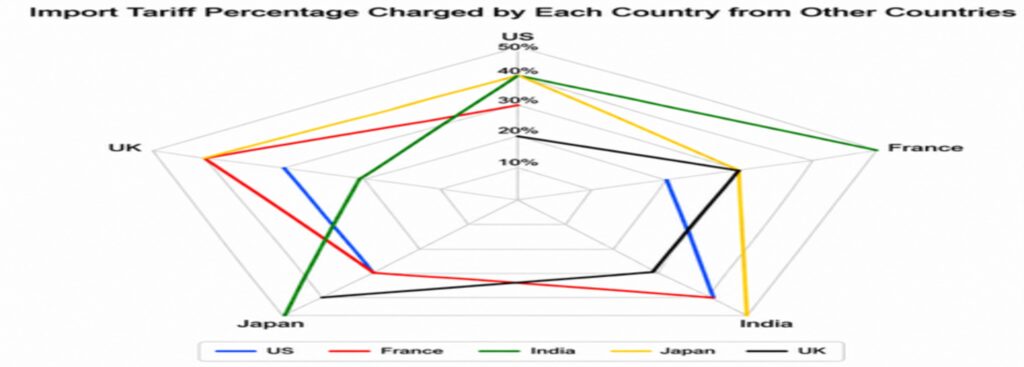
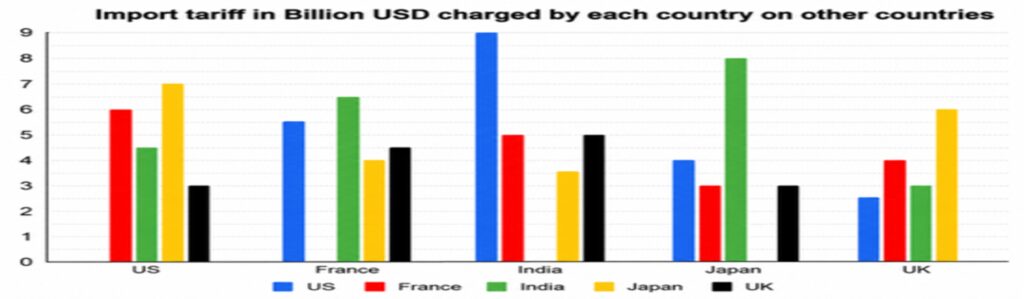
Five countries engage in trade with each other. Each country levies import tariffs on the other countries. The import tariff levied by Country X on Country Y is calculated by multiplying the corresponding tariff percentage with the total imports of Country X from Country Y.
The radar chart below depicts different import tariff percentages charged by each of the five countries on the others. For example, US (the blue line in the chart) charges 20%, 40%, 30%, and 30% import tariff percentages on imports from France, India, Japan, and UK, respectively. The bar chart depicts the import tariffs levied by each county on other countries. For example, US charged import tariff of 3 billion USD on UK.
Assume that imports from one country to another equals the exports from the latter to the former.
The trade surplus of Country X with Country Y is defined as follows.
Trade surplus = Exports from Country X to Country Y – Imports to Country X from Country Y.
A negative trade surplus is called trade deficit
Question1: How much is Japan’s export to India worth?
A 7.0 Billion USD
B 1.75 Billion USD
C 16.0 Billion USD
D 8.5 Billion USD
Formula:
Imports = Import Tariff ÷ Tariff Percentage
Calculation:
- From the radar chart, India charges a 25% import tariff on imports from Japan.
- From the bar chart, India collected 1.75 Billion USD as import tariff from Japan.
- Therefore,
Imports of India from Japan = 1.75 ÷ 25% = 1.75 ÷ 0.25 = 7.0 Billion USD
- Since Imports of one country = Exports of the other country, Japan’s exports to India = 7.0 Billion USD ✔
Common Trap:
Many candidates multiply the tariff amount by the tariff percentage instead of dividing by it. Another common mistake is confusing imports with exports. Always remember:
Import Tariff = Tariff Rate × Imports
So,
Imports = Import Tariff ÷ Tariff Rate, and Imports of Country A from Country B = Exports of Country B to Country A.
Answer: A 7.0 Billion USD
Mistakes To Avoid in PYQ Practice
• No timer while taking CAT: There is a fixed time duration in the CAT. 40 minutes of sectional time should be allocated at any cost.
• Not analyzing the test afterwards: We learn only if we understand our mistake. Even if you get the answer correct but unsure about it, check the solution in the video of CatMock.
• Missing out on TITA: All TITAs should be attempted at any cost if there is no negative marking. You are losing free +3 marks.
• Over attempting DILR: Rather than solving all four sets with errors, try to solve two or three sets with perfect accuracy. Set picking is not the trick, rather it’s an art.
• Not preparing for sectional cutoffs: Both sectional cutoffs and overall cutoff of the CAT carry equal weightage. Equal effort should be made for all three sections.
About CatMock – Free PYQ Platform
CATMock (www.catmock.com) is one of the best free PYQs available in India, and you do not even need to log in. There is a study timer, bookmark feature, progress tracker, and video explanation for each problem set on the website. Five major MBA entrance exams which include CAT, XAT, SNAP, NMAT, and CMAT are all offered in one place. From month 1-3, concept building happens chapter-wise, while from month 4, exam simulations happen year-wise. Every seat for CAT 2017 – CAT 2025 full papers is free of cost. CatMock — www.catmock.com
FAQ’s(Frequently Asked Questions)
1. How many years of CAT PYQs should I solve?
Ideally, attempt CAT PYQs in the present computer-based mode from 2017 to 2025. The last three years (2023-2025) deserve the most attention as they are the best indicators of the present exam trend.
2. Where can I access free CAT PYQs with video solutions?
CatMock (www.catmock.com/pyq) provides all CAT PYQs from 2017 to 2025 with chapter-wise practice and video solutions for every question, completely free with no login required.
3. How many questions are in the CAT 2024 paper?
CAT 2024 had 68 questions — 24 in VARC (72 marks), 22 in DILR (66 marks), and 22 in QA (66 marks) — for a total of 204 marks
4. Is there negative marking in the CAT exam?
Yes, MCQ questions carry -1 mark for every wrong answer. However, TITA (Type-In-The-Answer) questions carry no negative marking, so all TITA questions should always be attempted.
5. How many PYQs should I solve per day?
During the chapter-wise phase (months 1–3), aim for 20–30 questions per day from one chapter. During the full-paper phase (months 4–6), one complete timed paper per week with deep analysis is optimal.
6. What score is needed for a 99 percentile in each section?
Based on CAT 2024 data: VARC needs approximately 41 marks (14 correct), DILR needs about 38 marks (13 correct), and QA needs around 33 marks (11 correct).
7. Does CatMock offer PYQs for exams other than CAT?
Yes. CatMock covers five exams: CAT, XAT, SNAP, NMAT, and CMAT — all chapter-wise with video solutions, making it ideal for aspirants targeting multiple MBA colleges.
8. Should I solve all three slots of PYQs or just one?
Solve all three slots from the most recent two to three years. Different slots sometimes have different difficulty profiles, and exposure to all variations builds adaptability.
9. What is the attendance rate for the CAT exam?
As per the IIM Calcutta official release, CAT 2024 had an 89% attendance rate — the highest in recent years — with 2.93 lakh out of 3.29 lakh registered candidates appearing.
10. Is it advisable to attempt every question in the CAT?
No. Selective, high-accuracy attempts consistently outperform rushed, high-volume attempts. In DILR especially, expert strategy involves solving 2–3 sets with near-perfect accuracy rather than attempting all four.
You may also visit: CATMOCK INDIA|CATMOCK