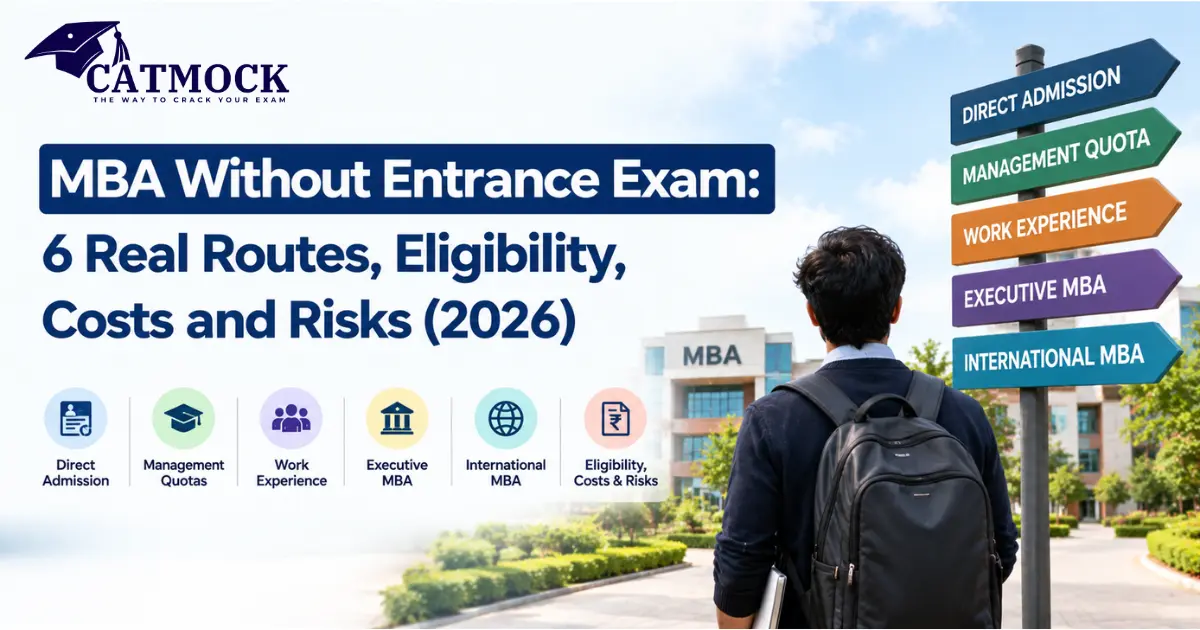
“Direct MBA admission. No CAT, No GMAT. No stress.” You have probably seen that pitch on a banner, a WhatsApp forward or a counsellor’s call. Parts of it are true. Parts of it can cost you lakhs and leave you with a degree that doesn’t open the doors you were promised.
Quick answer: Yes, you can do an MBA without entrance exam in India, but only through specific routes:
- merit-based direct admission at private colleges
- management or institute-level quota seats
- UGC-DEB-entitled online MBAs
- executive or part-time MBAs for working professionals
- integrated BBA+MBA programmes after Class 12
- NRI and foreign-national quota
What you can’t do is enter an IIM or XLRI without an exam. So the real question isn’t “is it possible?” It is “which route is legitimate, and is it worth the money?”
This guide answers both. You’ll see each route, who it suits, the eligibility, the admission process, a verification checklist and a simple way to judge ROI before you pay.
One distinction first: an MBA without CAT is not the same as an MBA without entrance exam. Most colleges that skip CAT still ask for XAT, NMAT, SNAP, CMAT or MAT. If that’s your situation, read our guide to MBA colleges without CAT. This article covers the smaller, trickier category: no standardised entrance test at all.
Can You Really Do an MBA Without Entrance Exam?
Yes, but “no exam” works for some institute types and not others. The table shows where MBA admission without entrance exam is realistic.
| Institute type | Entrance exam usually required? | What decides admission |
|---|---|---|
| IIMs (flagship MBA/PGP) | Yes | CAT score plus the institute’s selection rounds |
| XLRI | Yes | XAT score, then interview rounds |
| Symbiosis institutes, NMIMS | Yes | SNAP / NMAT scores |
| Many private universities and AICTE-approved private B-schools | Often no | Graduation marks, interview, sometimes a short institute test |
| Online MBA (UGC-DEB entitled) | Usually no | Graduation marks, sometimes an interview |
| Executive / part-time MBA | Varies | Work experience and interview; top schools also use GMAT/GRE |
A warning about “back-door” claims. Some listings say premier institutes can be entered through a management quota. Their own admission notices say otherwise: IIM flagship programmes run on CAT, and XLRI shortlists on XAT scores (see our XLRI selection process guide). Anyone promising a quota route into a top-tier B-school is a red flag, not a shortcut.
6 Routes for MBA Admission Without Entrance Exam
| Route | Exam needed? | Best for | Biggest risk |
|---|---|---|---|
| 1. Merit-based direct admission | No (marks + interview) | Freshers who want to start right after graduation | Weak placements, unverified claims |
| 2. Management / institute-level quota | No (usually a higher fee) | Candidates set on one specific college | Higher fees, usually no merit scholarship |
| 3. Online MBA | Usually no | Working professionals, remote learners | Programme not actually entitled by UGC-DEB |
| 4. Executive / part-time MBA | Varies (experience instead) | Professionals with several years of work | Top-school versions still need GMAT/GRE |
| 5. Integrated BBA+MBA after Class 12 | Some private ones, no | Class 12 pass-outs sure about management | Five-year commitment |
| 6. NRI/PIO/foreign-national quota, global waivers | Often no, or waiver | NRIs, experienced applicants | Quota fees, case-by-case waivers |
1. Merit-Based Direct MBA Admission
You apply straight to the college. Selection rests on your graduation percentage, Class X and XII marks, and often a personal interview, GD or short written test. The usual minimum is around 50% aggregate (45% for reserved categories), though each institute sets its own bar.
This route suits freshers who want to start immediately instead of spending months preparing for an exam. Many private colleges run rolling admissions, so seats fill progressively and earlier applications get more choice. Apply to the college directly, not through agents or consultants.
2. Management Quota and Institute-Level Seats
Some states let private unaided institutes fill a share of seats at institute level. In Maharashtra, for example, the state technical-education authority (DTE) sets the process. Institutes are expected to invite applications through public notice and publish a brochure with the admission rules. Similar seats exist in states like Karnataka and Tamil Nadu.
This is a recognised direct MBA admission route, but read the fine print. Fees are often higher, and students admitted through management quota are generally not eligible for merit scholarships.
3. Online MBA From a UGC-DEB Entitled University
Online MBAs usually admit on graduation marks, sometimes with an interview. The check that matters is UGC-DEB entitlement. Recognition of a university for its on-campus degrees is not the same as permission to run an online MBA. Entitlement is given per programme and renewed each academic year.
Online and distance admission also requires a DEB-ID, and DEB-linked intakes commonly run in January and July. Institutes such as Amity Online, Manipal Online, Jain Online and LPU Online are often named for online MBAs. Treat that as a checking list, not an endorsement.
This route works best if you already have a job and want a credential and a promotion path. Campus placement support is usually weaker than at a full-time programme..
Source: UGC-DEB portal
4. Executive and Part-Time MBA for Working Professionals
These programmes weigh work experience and an interview more than a written test. Many run 12–18 months, and some stretch to two or three years. Experience requirements are often five years or more.
There is a catch. Executive programmes at top institutes such as ISB or the IIMs typically ask for GMAT/GRE, a CAT score or an institute-level test alongside experience, so they are not exam-free.
Also Read: Top Executive MBA Colleges in India (2026): Rankings, Fees, Eligibility & ROI
5. Integrated BBA+MBA After Class 12
A few private universities offer five-year integrated management programmes with direct admission on marks and an interview. The IIMs’ integrated programmes use IPMAT or JIPMAT, so they don’t count as exam-free. Choose this only if you are sure about management at 17 or 18, because it’s a long commitment.
6. NRI/PIO/Foreign-National Quota and Global Waivers
Many private universities and AICTE-approved PGDM B-schools reserve seats for NRI, PIO and foreign-national candidates. Even here, “no exam” isn’t guaranteed. In some states, candidates without an entrance score may be asked to take the state-level common test.
Abroad, many business schools grant GMAT/GRE waivers case by case. They look at your academic record or several years of work experience. Waivers aren’t automatic, and many admitted students still submit a score.
Eligibility for MBA Without Entrance Exam
| Criterion | Typical requirement |
|---|---|
| Degree | Bachelor’s degree in any discipline from a recognised university |
| Marks | About 50% aggregate (45% for reserved categories); varies by institute |
| Final-year students | Often allowed to apply provisionally, with the degree certificate submitted later |
| Work experience | Not needed for regular MBA/PGDM; usually required for executive MBA |
| Age limit | Generally none for online and executive formats |
| Selection | Interview, sometimes a short institute test or GD |
Documents you will usually need: Class X and XII marksheets, all graduation marksheets and the degree or provisional certificate, ID proof, passport-size photographs, and category or domicile certificates if applicable. Keep a few attested sets, because colleges may ask for originals. You don’t need an entrance scorecard.
Step-by-Step: How Direct MBA Admission Works
- Define your goal and budget (specialisation, city, total spend, loan comfort).
- Shortlist five to eight institutes that publish clear admission criteria.
- Verify approvals (see the checklist below) before you contact anyone.
- Read the admission notice for seats, eligibility, the fee schedule and refund policy.
- Apply on the official website and pay application fees only through official channels.
- Prepare for the interview or GD, where your profile and communication matter.
- Review the offer letter, including what the fee covers.
- Pay and complete formalities within the stated deadline, and keep every receipt.
How to Verify an MBA Without Entrance Exam Before You Pay
| What to check | Where | What you’re looking for |
|---|---|---|
| AICTE approval | AICTE website | Institute and programme listed for the current year |
| University recognition | UGC website | Recognised university, not on the fake-university list |
| Online entitlement | UGC-DEB portal | Your exact programme and admission session |
| Accreditation | NAAC/NBA; AACSB/AMBA/EQUIS for global signals | See MBA accreditation explained |
| Placement report | Institute’s official report | Median package, batch size, recruiter mix, not just the highest offer |
| Fee schedule | Official admission notice | Total cost including hostel, quota premium and deposits |
Red flags:
- “Guaranteed admission” or “no eligibility check, no interview”
- Pressure to pay within hours
- Payments to personal accounts or agents
- Vague “UGC approved” claims with no programme details
- A quota route into an IIM or XLRI
- Placement claims with no methodology
Costs and ROI: Is an MBA Without Entrance Exam Worth It?
The admission route doesn’t decide your ROI. The institute does Starting pay after an MBA is hugely uneven.
Use one simple check: median package ÷ total programme cost. Use the median, not the highest offer, and count hostel, quota premiums, deposits and loan interest.
| Hypothetical direct-admission college (for the maths only) | XLRI (exam route, 2026 batch) | |
|---|---|---|
| Total programme cost | ₹10 lakh | About ₹30.6 lakh (programme fee; hostel and mess may be extra) |
| Median package | ₹5 lakh | ₹29 lakh |
| Ratio | 0.50× | 0.95× |
A ratio of 0.50× means about two years of gross pay just to cover the fee. See list of top MBA colleges in India. Placement outcomes depend on the college’s reputation, not on how you got in, so ask for the official report before you pay.
MBA Without Entrance Exam vs With Entrance Exam
| Factor | Without entrance exam | With entrance exam |
|---|---|---|
| Time to start | Can start in the same cycle | Needs months of preparation and fixed test dates |
| College choice | Mostly private, online and executive | Wide, including IIMs, XLRI, Symbiosis, NMIMS |
| Brand pull | Varies widely; verify | Top-tier brands only through exams |
| Cost | Quota seats often cost more; scholarships limited | Merit scholarships possible at some institutes |
| Placement data | Varies; demand the report | Check the institute’s published report |
| Flexibility | High (online, part-time) | Mostly full-time |
Who Should (and Shouldn’t) Choose This Route
| Good fit | Poor fit |
|---|---|
| Working professionals with several years of experience who need a credential | Aspirants targeting top consulting or banking campus placements |
| People joining a family business | Anyone expecting IIM-level brand value |
| Candidates who can’t meet fixed exam dates | Candidates who haven’t verified approvals or placement data |
Is the Exam Really the Hard Part?
Many people skip exams because CAT feels intimidating. But other exams are more forgiving. Some offer multiple attempts, and a few windows are still open:
- XAT 2027 is on 3 January 2027, with registration open until 6 December 2026.
- SNAP 2026 registration runs until 25 November 2026.
Frequently Asked Questions About MBA Without Entrance Exam
1. Can I do an MBA without entrance exam in India?
Yes, through routes such as merit-based direct admission, management or institute-level quota seats, UGC-DEB-entitled online MBAs, executive MBAs and integrated programmes after Class 12. Top institutes like the IIMs and XLRI still select through exams (CAT, XAT).
2. Is CAT compulsory for MBA admission?
No. CAT is required mainly for the IIMs and other CAT-affiliated institutes. Other colleges accept XAT, NMAT, SNAP, CMAT, MAT, GMAT or CUET-PG, and some admit on marks and interview.
3. Can I get into IIMs or XLRI without an entrance exam?
No. IIMs use CAT-based selection and XLRI shortlists on XAT scores. Treat any claim of a management-quota back door into these institutes as a red flag.
4. Which is the best MBA college without entrance exam?
There is no official ranking. Judge by AICTE/UGC approvals, median placements, recruiter mix, total cost and accreditation, not by the label “no exam”.
5. What is the minimum percentage for direct MBA admission?
Typically 50% aggregate in graduation (45% for reserved categories), though it varies by institute.
6. Is an online MBA without entrance exam valid?
Yes, if the university is UGC-recognised and the specific online MBA is entitled by UGC-DEB for your admission session. A DEB-ID is required, so verify on the UGC-DEB portal before paying.
7. Can I do an MBA without work experience?
Yes for regular full-time MBA/PGDM programmes. Executive and many part-time MBAs ask for several years of experience, often five or more.
8. Is management quota admission worth it?
It can be, if the college is approved, the fee schedule is transparent and the placement record is verifiable. Fees tend to be higher and quota students are generally not eligible for merit scholarships.
Conclusion
An MBA without entrance exam is real, but it is a narrower path than the ads suggest. It works through merit-based direct admission, management quota seats, UGC-DEB-entitled online programmes, executive MBAs, integrated programmes and NRI or waiver routes. It doesn’t open the doors of the IIMs or XLRI. The route itself rarely decides your outcome. What matters is whether the institute is genuinely approved, whether its median placements justify its total cost, and whether the admission process is transparent.
So verify before you pay: check AICTE and UGC status, confirm UGC-DEB entitlement for online programmes, read the official placement report, and calculate median package against total cost. If you still have time before exam windows such as XAT or SNAP close, test yourself on a few mocks first. Skipping the exam should be a deliberate choice, not a reaction to fear.
You May Also Like : CAT MOCK, CAT MOCK PYQ
Follow Us On : Facebook, Instagram, Youtube