
Reading Comprehension (RC) makes up 66% of the VARC section in CAT — 16 out of 24 questions come from just four passages. That’s a huge chunk of one-third of the exam riding on your ability to read four passages well. The good news: CAT doesn’t pick these passages randomly. Year after year, they come from the same small pool of magazines, journals, and newspapers. This guide breaks down exactly where, backed by real data from the last several years, plus a proper reading list you can start today.
Table of Contents
- Why RC Is Worth Studying Strategically
- The Subject Areas CAT Keeps Coming Back To
- The Four Types of Sources CAT Draws From
- Real Data: What Actually Appeared, Year by Year
- Source Frequency Compared: A Year-on-Year Look
- Why CAT Picks These Sources (Not Random Ones)
- The Question Types You’re Actually Being Tested On
- Your Reading List: Where to Actually Read From
- A Practical Study Plan
- Quick Tips That Actually Move the Needle
- Quick FAQ
1. Why RC Is Worth Studying Strategically
Quant and DILR can throw a genuinely new problem type at you each year. RC doesn’t work that way.
| Section | Weightage in VARC | Predictability |
| Reading Comprehension | 16 questions (~66%) | High recurring sources & themes |
| Verbal Ability (Para jumbles, summary, odd one out) | 8 questions (~33%) | Moderate — format-based, not source-based |
Because RC draws from known sources, you can prepare for it almost like a vocabulary or GK topic—by building familiarity with the style of writing CAT prefers, not just practicing questions blindly. CAT RC passages are typically 400–600 words long, and each passage usually has 4 questions attached to it.
1. Why RC Is Worth Studying Strategically
Quant and DILR can throw a genuinely new problem type at you each year. RC doesn’t work that way.
| Section | Weightage in VARC | Predictability |
| Reading Comprehension | 16 questions (~66%) | High — recurring sources & themes |
| Verbal Ability (Para jumbles, summary, odd one out) | 8 questions (~33%) | Moderate — format-based, not source-based |
Because RC draws from known sources, you can prepare for it almost like a vocabulary or GK topic—by building familiarity with the style of writing CAT prefers, not just practicing questions blindly.
Note: CAT RC passages are typically 400–600 words long, and each passage usually has 4 questions attached to it.
2. The Subject Areas CAT Keeps Coming Back To
Based on an analysis of past papers, RC passages consistently draw from these topic areas:
| Subject Area | What It Typically Covers | Why It’s Tricky |
| Philosophy | Ethics, knowledge, existence, Western & Eastern thought | Abstract, argument-heavy — you must track reasoning, not facts |
| Psychology | Cognition, memory, decision-making biases, behaviour | Blends science with abstract theory |
| History | Colonialism, political change, social reform | Fact-dense; tests fact vs. interpretation |
| Society | Inequality, gender, social mobility | Opinion-driven; multiple viewpoints in one passage |
| Culture | Traditions, language, cross-civilization themes | Descriptive but nuanced — easy to over-generalize |
| Arts & Museums | Painting, architecture, curatorial practice | Tests interpretation over recall |
| Science & Technology | New research, AI, innovation and its effects | Data-heavy, cause-effect reasoning |
| Business & Economics | Policy, globalization, markets | Common in slot papers, less abstract than philosophy |
Note: There’s no official fixed syllabus for RC — this list is drawn from patterns across previous years’ papers, so treat it as a strong guide, not a guarantee.
3. The Four Types of Sources CAT Draws From
| Source Type | Examples | Why CAT Likes It |
| Newspapers & magazines | The Economist, The Guardian, Smithsonian | Clear argument + strong evidence, self-contained |
| Academic journals & encyclopaedia’s | JSTOR, Stanford Encyclopaedia of Philosophy | Dense; tests sustained focus |
| Books & essays | Non-fiction, philosophy, travel writing excerpts | Tests following an author’s individual voice |
| Long-form online essays | Aeon, Prospect Magazine, Public Books | Argument-driven, easy to trim to passage length |
4. Real Data: What Actually Appeared, Year by Year?
CAT 2025 (all 3 slots)
| Slot | Passages & Topics |
| Slot 1 | Diagnosing mental disorders (Alienists) · Income inequality & economic growth · Objections to electronic music as a genre · Complex systems & tail events |
| Slot 2 | How tetra fish adapted and evolved · Biases of AI · Role of “place” in literature · Science and culture |
| Slot 3 | Ill-effects of dams · AI and ethical decision-making · Forest Conservation Act, 1980 · Tribal art |
CAT 2024 (Slot-wise topics)
CAT 2024 dropped Para jumbles entirely that year (replaced with paragraph completion and summary questions), and RC passages ran slightly longer than usual — around 450–550 words each.
| Slot | Passage Topics |
| Slot 1 | Digital rights (DVD vs. Blu-ray) · Critique of behavioural economics · Revival of bandicoots in Australia · Craftsmanship vs. materialism/AI |
| Slot 2 | Technology and its unintended consequences · European colonization and spices · Peer review in science · Human–animal conflict |
| Slot 3 | Chinese “Moutai madness” (liquor culture) · AI and environmental ethics · Two additional passages on nuanced contemporary themes |
Note: 2024 is a fantastic example of why source-hunting alone isn’t enough—several of these topics (bandicoot extinction, peer review, Moutai culture) were constructed from niche current-affairs pieces rather than a flagship newspaper like The Economist.
This is why it’s better to have a wide reading habit across multiple outlets.
CAT 2023 (Slot-wise, with sources)
| Slot | Passage | Source | Genre |
| 1 | Wolves returning to France | The Economist | Environment |
| 1 | Geographic Determinism | Academic journal | Sociology |
| 1 | Indian Ocean | Writing Ocean Worlds (book) | Literature |
| 1 | Original Affluent Society (Sahlins) | publicbooks.org | Literature |
| 2 | Second-hand clothing’s environmental cost | Prospect Magazine | Environment |
| 2 | Netflix & European culture | The Economist | Culture |
| 2 | On being a historian | Academic (Richmond) | History |
| 2 | Liberalism as an idea | The Economist | Political Science |
| 3 | Romantic Aesthetics | Stanford Encyclopaedia of Philosophy | Philosophy |
| 3 | Archaeology & patrimony | LA Times | Archaeology |
| 3 | Nutmeg’s history | The Third Pole | History |
| 3 | Power of rational thinking | Washington Post | Literature |
CAT 2022 (Slot-wise, with sources)
| Slot | Passage | Source |
| 1 | The Chinese Copy | Aeon |
| 1 | Stoicism | Encyclopedia of Emotion |
| 1 | Critical theory of technology | O’Reilly |
| 1 | Stories of the undead | Atmostfear Entertainment |
| 2 | Octopuses | Superpowers on the Shore |
| 2 | Philosophy of social sciences | SAGE Handbook |
| 2 | Tech-social dualism | Scientific American |
| 2 | Humans make music | JSTOR |
| 3 | Automation | Wall Street Journal |
| 3 | Biology & technology | Design Indaba Magazine |
| 3 | Orientalism | JSTOR |
| 3 | The Great Migration | iResearch Net |
CAT 2021, 2020, 2019, 2018, 2017—recurring sources at a glance
| Year | Sources that appeared |
| 2021 | Smithsonian, Aeon, NY Times, New Scientist, American Ethnologist, Cambridge Core, Marxist Internet Archive |
| 2020 | The Atlantic, The Spectator, MIT Press Direct, The Guardian, Britannica, Denver Post |
| 2019 | The Guardian, The Atlantic, The Economist, Prospect Magazine, TIME, NPR |
| 2018 | NY Times, NY Times Magazine, Scientific American, Aeon, The Economist, Smithsonian, Hindustan Times |
| 2017 | BBC, NY Times, TIME, The Guardian, Smithsonian |
Sources across the years, at a glance:
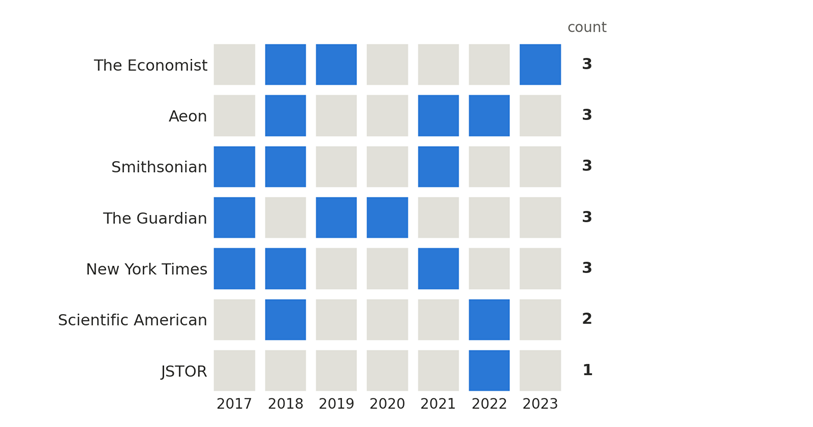
Note: This matrix is built only from years where the blog names exact sources (2017-2023). CAT 2024 and 2025 papers are known to us only by topic, not by named source, so they’re left out of the grid rather than guessed at.
5. Source frequency compared: a year-on-year look
Pulling together the data from 2017-2025, here’s how often the top recurring publications actually showed up as CAT RC sources:
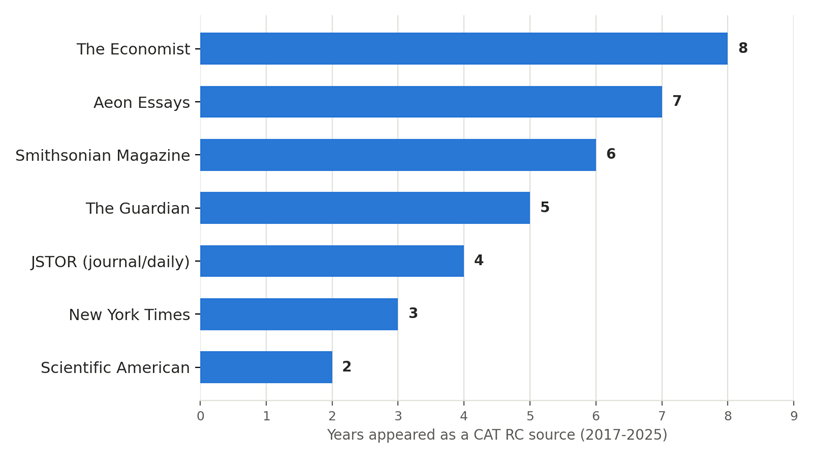
Note: This isn’t an exact citation count — it’s a rough frequency pattern based on how often each name recurs across the year-wise breakdowns above. Treat it as a priority order for your reading list, not a precise statistic.
That single chart is really the whole argument for this blog: two-thirds of one full section depends on how well you read four passages — and now you know where those four passages are likely to come from.
6. Why CAT picks these sources (not random ones)
| Requirement | What it means |
| Self-contained | Makes sense without extra background — rules out breaking news |
| Argument-driven | Has a clear thesis and counterpoints for questions to test |
| Moderately technical | Hard enough to challenge you, not so niche only experts follow it |
| Easy to trim | Can be adapted into a clean 400-600 word passage |
7. The question types you’re actually being tested on
Knowing the source is only useful if you also know what CAT asks about the passage. These are the recurring question types:
| Question type | What it tests |
| Main idea | Can you identify the passage’s central theme? |
| Fact/detail-based | Can you locate specific stated information? |
| Inference-based | Can you draw a conclusion that isn’t explicitly stated? |
| Tone/attitude-based | Can you identify the author’s stance (critical, neutral, optimistic)? |
| Vocabulary-based | Do you understand a word’s meaning in context? |
| Title-based | Can you pick the most fitting title for the passage? |
| Logical structure | Can you follow how the argument is organized? |
Note: Inference and tone-based questions are where most students lose marks — not because they didn’t understand the passage, but because they didn’t track the author’s opinion separately from the facts being discussed.
8. Your reading list: where to actually read from
Indian newspapers & editorials
- The Hindu—Editorial and Opinion pages (the single most recommended daily source; formal, argument-driven, closest in tone to CAT passages)
- Indian Express — the “Explained” section, good for breaking down complex current issues
- Business Standard / Mint — best for business, economy, and policy-style passages
International publications
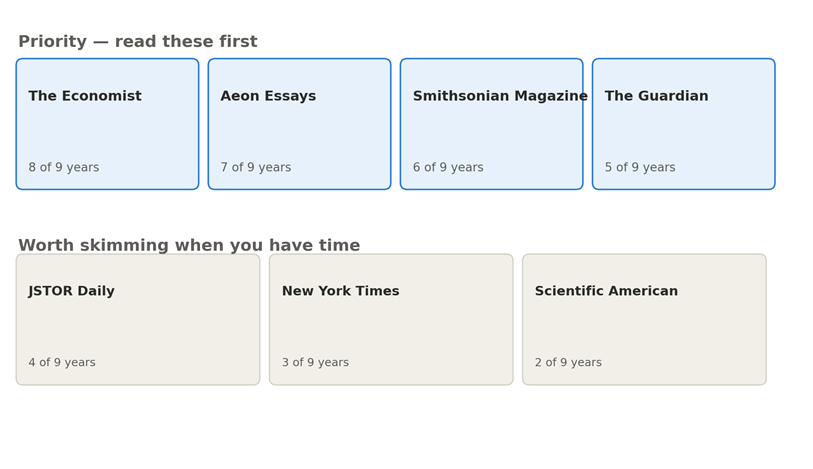
- The Economist — dense, opinion-rich; the most consistently recurring source across years
- The Guardian—Long Reads section covers culture, science, and society
- The New York Times — strong on global affairs and cultural perspectives
Long-form & academic reading
- Aeon Essays — arguably the single closest match to CAT’s passage style: philosophy, psychology, science, and society, at the exact length and complexity CAT favors
- Smithsonian Magazine — history, science, and culture blended
- JSTOR Daily / Stanford Encyclopedia of Philosophy — for the denser, academic-style passages
- Prospect Magazine, Scientific American — solid secondary picks
Note: Reading widely builds vocabulary and stamina, but only solving actual past CAT RC passages trains you on CAT’s specific question traps (extreme-word options, partially-true-but-irrelevant choices, etc.).
9. A practical study plan
Don’t jump straight into timed mocks. Comprehension needs to be genuinely solid before adding time pressure — speed built on shaky understanding just produces confident wrong answers.
| Phase | Focus | Goal |
| Weeks 1-2 | Indian newspaper editorials (The Hindu, Indian Express) | Build baseline reading speed and comfort with argument-driven writing |
| Weeks 3-4 | International magazines (The Economist, Smithsonian) | Handle denser vocabulary and multi-sided arguments |
| Weeks 5-6 | Aeon essays + academic sources (JSTOR, Stanford Encyclopedia) | Push comprehension of abstract, non-narrative writing |
| Weeks 7-8 | Full timed mock RC sets, mixed genres, real past papers | Simulate exam-day conditions; aim for 7-8 minutes per passage |
10. Quick tips that actually move the needle
- Read the first and last paragraph carefully — the intro usually states the main idea, and the conclusion often carries the author’s final stance. Together they answer most main-idea and tone questions.
- Keep a vocabulary notebook — note unfamiliar words from your daily reading and revisit them weekly rather than looking them up once and forgetting.
- Eliminate extreme-word options first — answer choices using words like “always,” “never,” or “completely” are frequently wrong.
- Separate the author’s opinion from the facts being discussed — especially in philosophy, society, and culture passages, which often present multiple viewpoints.
- Track your mistakes in a notebook — note why you got a question wrong (missed inference, misjudged tone, factual slip) and revisit those specific gaps.
11. Quick FAQ
Q: What’s the best single source to prioritize?
The Economist, followed closely by Aeon Essays — both recur almost every year and match CAT’s tone closely.
Q: Is there one fixed source CAT draws from every year?
No fixed source. But a consistent handful — The Economist, Aeon, Smithsonian, and The Guardian — dominate year after year.
Q: What genre mix should I expect on exam day?
On the day of the CAT exam, you will be provided with a mix of 4 RC passages (500-900 words each). The genre mix is usually: Social Sciences (sociology, history, politics), Philosophy/Abstract (human consciousness, morality), Science/Technology (biology, AI), Business/Economics.
Q: How much time should I spend per passage?
Aim for 7-8 minutes per passage, including all 4 attached questions.
Q: Should I focus on speed or accuracy first while practicing?
Focus on accuracy first. Add pressure on timing only once your comprehension is genuinely solid. (Speed built on shaky understanding just produces confident wrong answers.)
Q: Is reading newspapers enough, or do I need academic sources too?
Newspapers build your baseline, but CAT also pulls from denser academic and philosophical writing. A reading habit limited to only newspapers will leave you underprepared for the harder 1-2 passages in a typical set.
“No shortcut replaces consistent reading, but there is a smarter way to prepare than reading anything and everything. CAT has shown a clear, repeatable preference for a specific kind of writing—argument-driven, moderately dense, self-contained essays from a small set of publications. Once you build a reading habit around that pattern, RC stops feeling unpredictable and starts feeling like the most trainable part of the exam.
Start small: pick two publications from the reading list above, read one article a day, and revisit this guide in a month to track how much easier dense passages have become. That’s really the whole game — not reading more, but reading the right things, consistently.”