AI-Powered GD-PI Prep: Pros, Cons & Smart Strategies for CAT 2026
📋 Table of Contents
- Why GD-PI Preparation Matters More Than Ever in 2026
- How AI Helps You Prepare for GD-PI
- The Weightage of GD-PI-WAT in IIM Admissions
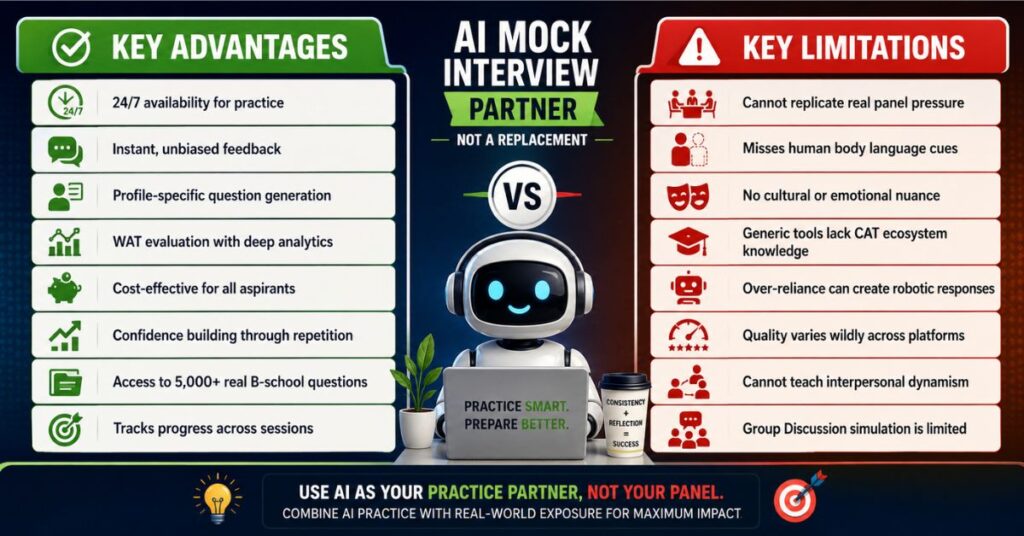
- The Pros: How AI Is Revolutionizing GD-PI Preparation
- The Cons: Limitations Every CAT Aspirant Must Understand
- Top AI Tools Available for GD-PI-WAT Preparation in 2026
- How to Strike the Right Balance: AI + Human Mentoring
- A Note for Parents and Relatives of CAT Aspirants
- 7 Smart Tips to Get the Most Out of AI Prep Tools
- Conclusion
- Frequently Asked Questions (FAQs)
Why GD-PI Preparation Matters More Than Ever in 2026
Every year, thousands of students clear the CAT exam with impressive percentiles — yet only a fraction of them ultimately secure a coveted seat at a top IIM. So, what separates the ones who make it from those who fall short? The answer, more often than not, is the GD-PI-WAT round. Consequently, serious preparation for this critical stage has never been more important than it is right now.
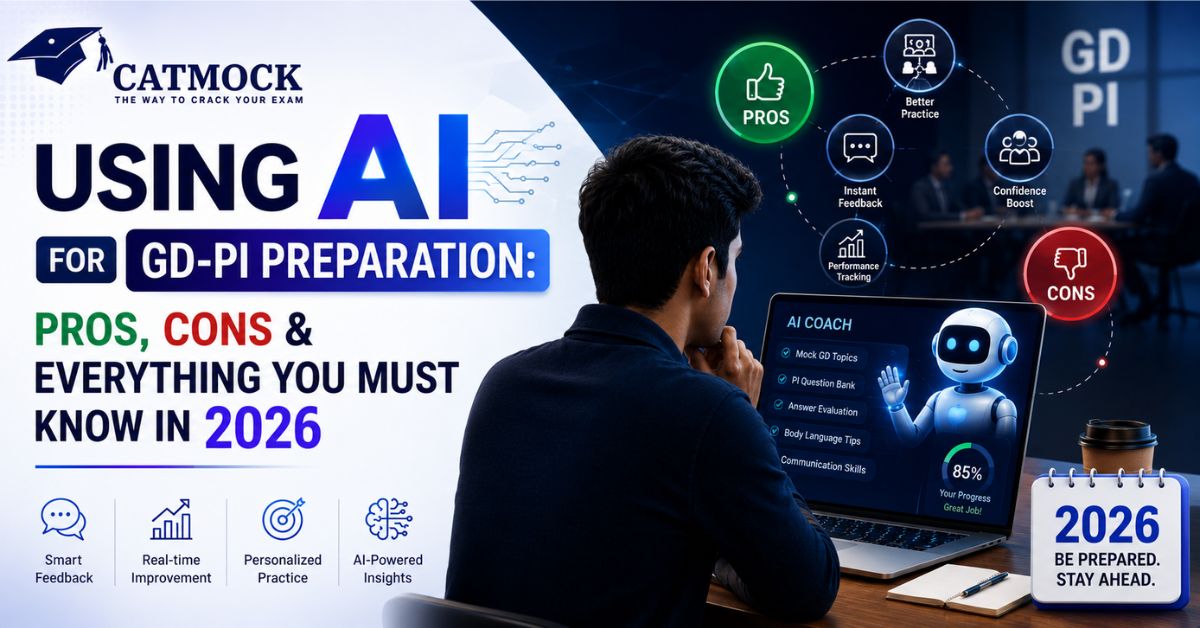
Furthermore, the landscape of GD-PI preparation has changed dramatically. Today, MBA aspirants use Artificial Intelligence as a practical, accessible, and increasingly powerful tool rather than viewing it as a futuristic concept reserved for tech companies. Nevertheless, like any powerful tool, AI comes with both exciting advantages and important limitations that every aspirant, parent, and mentor should clearly understand.
Therefore, in this detailed guide, we break down everything you need to know about using AI for GD-PI preparation — the genuine pros, the real cons, the best tools available in 2026, and exactly how you should be integrating AI into your overall strategy.
How AI Helps You Prepare for GD-PI
Simply put, AI-powered GD-PI preparation refers to the use of artificial intelligence tools and platforms to simulate, evaluate, and improve a candidate’s performance across Group Discussions, Personal Interviews, and Written Ability Tests. Moreover, these tools go far beyond basic question banks — they actively listen, evaluate, and provide structured feedback in real time.
For example, platforms like IMS India’s AI PI Lab, iQuanta’s AI MBA Interview Tool, and Rehearsal AI offer mock interview simulations where an AI interviewer asks questions and then immediately evaluates responses based on parameters such as content depth, clarity, articulation, vocabulary, confidence score, and even filler word usage. Additionally, AI WAT labs evaluate written essays for structure, coherence, argument quality, and grammar.
💡 Quick Context for Parents: GD-PI-WAT stands for Group Discussion, Personal Interview, and Written Ability Test.IIMs and other top B-schools conduct these final selection rounds after the CAT exam. Even if you score a 99 percentile in CAT, a weak GD-PI performance can cost you an admission offer. That’s why you must prepare for GD-PI in a structured and consistent manner.
The Weightage of GD-PI-WAT in IIM Admissions
Before diving into the pros and cons of AI, it is essential to understand just how much GD-PI-WAT matters. According to the latest IIM admission criteria, GD-PI-WAT carries 35–50% of the total weightage in the final composite score. Additionally, IIMs and top B-schools primarily use CAT scores for initial shortlisting—not for final selection. This means that your performance in GD-PI essentially determines your MBA destiny.
Moreover, several IIMs have replaced traditional Group Discussions with Written Ability Tests (WAT), Group Exercises (GE), or Case Discussions. Regardless, IIMs and top B-schools test the same core skills: communication, critical thinking, leadership, and situational awareness. Thus, comprehensive preparation across all these formats is non-negotiable.
The Pros: How AI Is Revolutionizing GD-PI Preparation
1. Unlimited, Instant Practice — Anytime, Anywhere
One of the most significant advantages of AI-powered tools is the sheer volume of practice they make possible. Unlike human mentors who are available only for scheduled sessions, AI platforms are accessible 24/7. Therefore, whether you want to practice at midnight before your PI round or squeeze in a quick mock session between college lectures, AI tools accommodate your schedule seamlessly.
Furthermore, databases like IMS’s PI Lab contain close to 5,000 real interview questions sourced from top B-schools. As a result, candidates are exposed to a wider variety of question types than any single human mentor could realistically cover.
2. Instant, Objective, and Structured Feedback
Traditional mock PIs rely on a mentor’s subjective perception — which, while valuable, can vary from session to session. AI tools, however, provide structured feedback based on consistent parameters every single time. For instance, IMS’s AI Mock Interview tool evaluates content quality, clarity, articulation, and overall performance simultaneously, delivering a comprehensive report immediately after each session.
Additionally, this objectivity means that candidates receive unbiased assessments. Consequently, aspirants can identify specific, recurring weaknesses — such as overusing filler words or lacking depth in answers about their graduation subject — without feeling judged or embarrassed.
3. Profile-Specific, Personalized Question Generation
Modern AI prep tools are increasingly capable of personalizing the interview experience. For example, platforms like Rodha GDPI allow candidates to upload their resume and academic profile, after which the AI generates questions specifically tailored to their background. As a result, engineering graduates are grilled on their technical subjects, while arts graduates face questions relevant to their field — exactly as IIM panels do in reality.
4. WAT Evaluation with Detailed Analytics
Writing ability is notoriously difficult to self-assess. However, AI-powered WAT labs — such as Career Launcher’s AI WAT Analyzer — evaluate essays for argument structure, vocabulary richness, grammatical accuracy, coherence, and word count compliance. Moreover, these tools compare your essay against a database of high-scoring sample responses, providing personalized suggestions for improvement and recommended reading to strengthen your content.
5. Cost-Effective Access to High-Quality Practice
Traditional GDPI coaching, especially from top institutes, is expensive. However, many AI tools offer free or affordable access to thousands of practice questions, WAT topics, and even AI mock interviews. Therefore, aspirants from Tier-2 and Tier-3 cities who previously lacked access to quality GDPI coaching can now level the playing field significantl.
6. Confidence Building Through Repetition
Ultimately, confidence in a PI room comes from one thing — practice. Because AI tools eliminate the social anxiety of facing a human evaluator, many aspirants find it easier to practice more frequently and more honestly. Gradually, through repeated simulations, they build the verbal fluency and composure that translates into genuine confidence on interview day.
The Cons: Limitations Every CAT Aspirant Must Understand
1. AI Cannot Replicate Real Panel Pressure
Despite impressive advances, AI interviewers simply cannot recreate the psychological weight of sitting before a panel of experienced IIM professors who are silently judging your every response. Interestingly, this pressure — the slight discomfort, the silence between answers, the panel’s deliberate poker face — is itself a test of how you perform under stress. Therefore, no AI tool, however sophisticated, can fully substitute for mock interviews conducted by experienced human mentors.
2. Body Language and Non-Verbal Communication Are Largely Ignored
Personal Interviews are not merely verbal exercises. Rather, they are holistic assessments where eye contact, posture, hand gestures, and facial expressions communicate as much as words do. Unfortunately, most AI tools focus exclusively on verbal content. Consequently, a candidate who gives technically correct answers but slouches, avoids eye contact, or speaks in a monotone could receive a high AI score while still performing poorly in the actual room.
3. Group Discussion Simulation Remains Inadequate
By definition, a Group Discussion requires a group. While some platforms attempt to simulate GD environments, the unpredictable dynamics of a real GD — multiple personalities competing for airtime, someone interrupting your point, a quieter candidate suddenly making a brilliant observation — cannot be authentically replicated by AI. Accordingly, GD preparation still benefits most from practice with real peer groups.
4. Generic AI Tools Lack CAT-Specific Intelligence
As of early 2026, even ChatGPT acknowledged that most AI tools available are not built for the specific CAT-IIM PI ecosystem. Notably, they don’t understand IIM-specific probing patterns, the significance of your 10th and 12th board scores in the interview, CAT percentile discussions, or the unique academic-depth questioning that IIM panels favor. Therefore, choosing the right AI tool — one specifically designed for MBA admissions in India — matters enormously.
5. Risk of Developing Robotic, Over-Rehearsed Responses
Perhaps the most subtle yet most damaging risk of over-relying on AI is that candidates begin to memorize responses rather than develop genuine perspectives. Indeed, IIM panelists are highly experienced at spotting rehearsed answers — and they actively probe beyond them. Consequently, an aspirant who has practiced only with AI tools may give technically polished but authentically hollow responses, which often leave a negative impression.
⚠️ Parent Advisory: If your child is relying exclusively on AI tools for GDPI preparation, that is a concern worth addressing. While AI tools are tremendously valuable supplements, they should always be combined with human mentoring, peer GD sessions, and real-time feedback from experienced coaches. The best outcomes are achieved through a balanced approach.
Top AI Tools Available for GD-PI-WAT Preparation in 2026
Fortunately, the market for AI-driven GDPI preparation has grown significantly. Below is a comparison of the most notable tools currently available to CAT aspirants:
| Tool / Platform | Key Features | Best For | Pricing |
|---|---|---|---|
| IMS AI PI Lab | ~5,000 real PI questions, instant structured feedback on content, clarity & articulation | PI practice & answer depth improvement | Paid |
| IMS AI WAT Lab | 750+ curated WAT topics, sample essays, smart AI evaluation, personalised feedback | WAT writing improvement & evaluation | Paid |
| Rehearsal AI | DeepProbe active questioning, Credibility + Confidence dual scoring (0–100), IIM-A PhD designed | Advanced IIM-specific PI simulation | Paid |
| iQuanta AI MBA Tool | Adaptive questioning, customizable for target IIMs, strong CAT ecosystem awareness | Flexible PI mock sessions | Freemium |
| Career Launcher AI WAT Analyzer | Trained on 450+ real B-school essays, mentor-calibrated, structure & vocabulary analysis | WAT improvement with mentor insights | Paid |
| Rodha GDPI | Profile-driven PI questions based on resume, bundled GD+PI+WAT+SOP review | Personalised, profile-specific prep | Paid (₹8K–₹26K) |
| ChatGPT / Claude (DIY) | Custom roleplay sessions, WAT drafting, current affairs discussion, SOP feedback | Flexible supplementary practice | Freemium |
How to Strike the Right Balance: AI + Human Mentoring
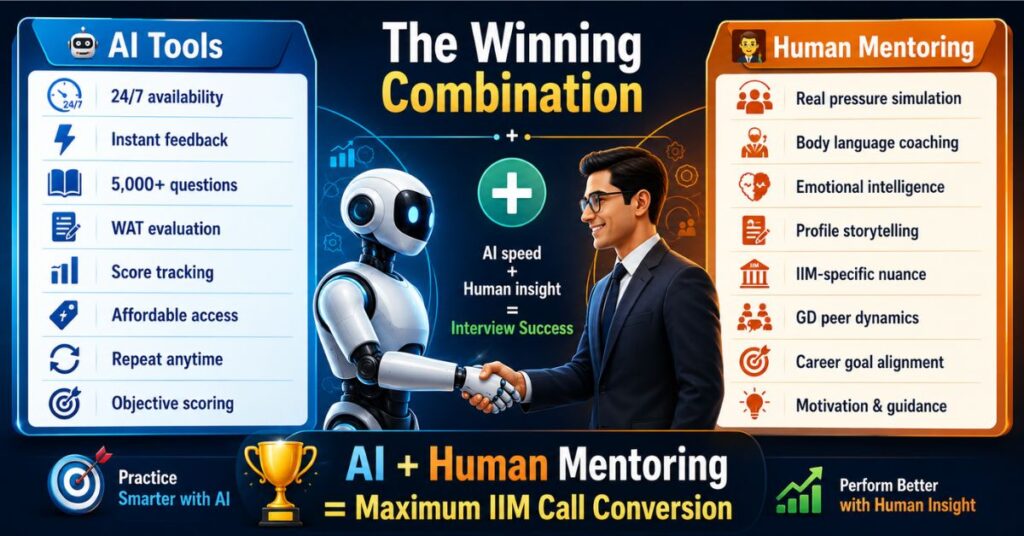
The most successful CAT aspirants in 2026 are not the ones who rely entirely on AI — nor are they the ones who dismiss AI tools entirely. Rather, they are the candidates who strategically blend both approaches into a cohesive preparation plan.
Specifically, AI tools should be used for high-volume practice, self-evaluation, and content building. Meanwhile, human mentors and peer groups should be engaged for pressure simulation, body language refinement, GD dynamics, and profile storytelling. Additionally, current affairs should be consumed daily through reliable news sources, and the resulting knowledge should be tested through both AI WAT labs and mentor-led discussions.
✅ Recommended Weekly Prep Split
AI Tools (60% of practice time): Daily WAT writing practice, AI PI lab sessions, current affairs quizzes, feedback review and improvement.
Human Mentoring (40% of practice time): 2–3 mentor-led mock PI sessions per week, peer GD practice groups, SOP/profile review with experienced counselors.
A Note for Parents and Relatives of CAT Aspirants
If your child is preparing for CAT and the subsequent GD-PI rounds, you may be wondering how you can best support them. Understandably, the world of AI tools and mock interviews may feel unfamiliar. However, here is what you truly need to know.
First, investing in a structured GDPI program — whether from IMS, Career Launcher, or similar institutes — is absolutely worthwhile, because these programs now combine AI tools with experienced human mentors. Second, encourage your child to practice speaking about their life experiences, career goals, and opinions on current events confidently at home — this builds the authenticity that no AI can teach. Finally, understand that GD-PI preparation takes time. Therefore, ideally, your child should begin GDPI preparation immediately after the CAT exam rather than waiting for results.
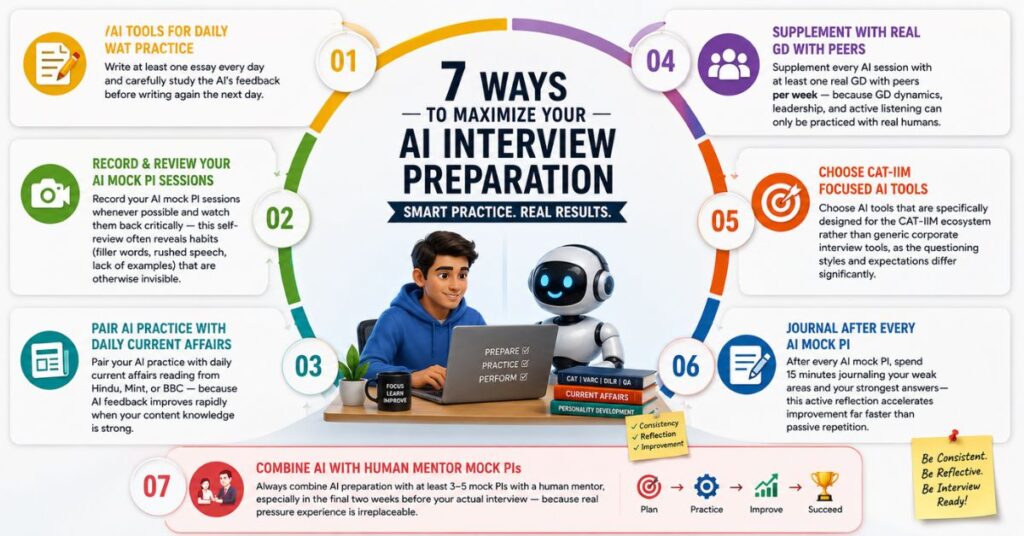
7 Smart Tips to Get the Most Out of AI Prep Tools
🏆 Conclusion: The Future of GD-PI Preparation Is Hybrid
Ultimately, AI has genuinely transformed GD-PI preparation for CAT aspirants — and the transformation is overwhelmingly positive. Thanks to AI tools, aspirants today have access to more practice, more feedback, and more personalized preparation than any previous generation of MBA hopefuls. Furthermore, as these tools continue to evolve rapidly through 2026 and beyond, their ability to simulate real interview pressure, evaluate body language, and understand the nuanced CAT ecosystem will only improve.
Nevertheless, AI cannot replace the irreplaceable — the human judgment, the emotional intelligence, the authentic storytelling, and the real-time adaptability that distinguishes truly outstanding GD-PI performers. Therefore, the wisest approach is a hybrid one: use AI tools enthusiastically for volume, feedback, and content building, while investing meaningfully in human mentoring for the subtler, higher-stakes dimensions of your preparation.
Ultimately, your IIM dream is within reach. With the right combination of technology, mentorship, consistency, and genuine self-awareness, you are fully equipped to convert your CAT call into a final offer. So start early, stay consistent, and use every tool available to you — including AI — as a stepping stone toward your goal. 🚀
❓ Frequently Asked Questions (FAQs)
Q1. Can AI tools completely replace human mentors for GD-PI preparation?
No — AI tools are powerful supplements but not substitutes. While AI excels at providing instant feedback, unlimited practice, and WAT evaluation, it cannot replicate real panel pressure, body language coaching, or the interpersonal dynamics of a Group Discussion. Therefore, a combination of AI tools and human mentoring always delivers the best results for CAT aspirants.
Q2. When should a CAT aspirant start GD-PI preparation?
Ideally, GD-PI preparation should begin immediately after the CAT exam — typically in late November or December. Since results are usually declared in January and IIM interview calls are sent shortly after, aspirants typically have 2–3 months to prepare. Starting early allows adequate time to use both AI tools and human mentoring effectively.
Q3. Can strong GD-PI performance compensate for a low CAT percentile?
Yes, to a meaningful extent. Since GD-PI-WAT carries 35–50% of the final composite score in most IIM admission processes, an outstanding performance in these rounds can significantly improve your chances — especially at institutes that place high weightage on interviews, SOP, and academic diversity. However, you still need to clear the initial CAT percentile cutoff to receive an interview call in the first place
Q4. Are AI mock interviews used by actual IIM B-schools as well?
Yes, notably. As highlighted by IMS India’s GDPI program for 2026, select B-schools are themselves incorporating AI-conducted interviews as part of their admission process. Consequently, practicing with AI interview tools is not just useful for preparation — in some cases, it may also directly mirror the actual experience you will face during the selection process.
Q5. Which is the best AI tool for GD-PI preparation in 2026?
For CAT-specific PI preparation, Rehearsal AI (designed by IIM-A PhD and XLRI faculty) and IMS’s AI PI Lab (with ~5,000 real B-school questions) are highly regarded. For WAT, IMS’s AI WAT Lab and Career Launcher’s AI WAT Analyzer are considered among the best. However, the “best” tool ultimately depends on your specific needs and budget.
You may also visit: CATMOCK INDIA|CATMOCK