


A Practical, Day-by-Day Routine to Build Your Percentile Steadily
Table Of Contents: –
1. Introduction: Small Daily Wins, Big CAT Results
2. Morning Routine: The Beginning
3. Evening Sessions: Drilling Speed and Accuracy
4. Month-wise Study Plan: Smart Scaling
5. Mock Tests: The Core Engine of CAT 2026 Preparation
6. Weekly Study Schedule
7. Strategies for Each Section for CAT 2026
8. Mental Fitness: The Silent Pillar of CAT 2026 Preparation
9. Conclusion
10. Frequently Asked Questions (FAQs)
Introduction: Small Daily Wins, Big CAT Results

The Common Admission Test (CAT) is beyond just a test; it requires mental focus, careful planning, and daily effort. Thousands of applicants hope to get into an IIM or a top B-school, but only those who establish regimented daily schedules succeed. As a result, knowing what to do every day is just as important as knowing what to study.
Fortunately, the route is clearly described. They anticipate that the CAT 2026 exam will follow the same format as its predecessors, with three sections, a total of 120 minutes, and a weighting system that prioritizes accuracy over speed. As a result, your daily practice needs to reflect this pattern, balancing speed and selection strategy while practicing each portion with accuracy and precision.
Understanding the CAT 2026 Exam Pattern: –
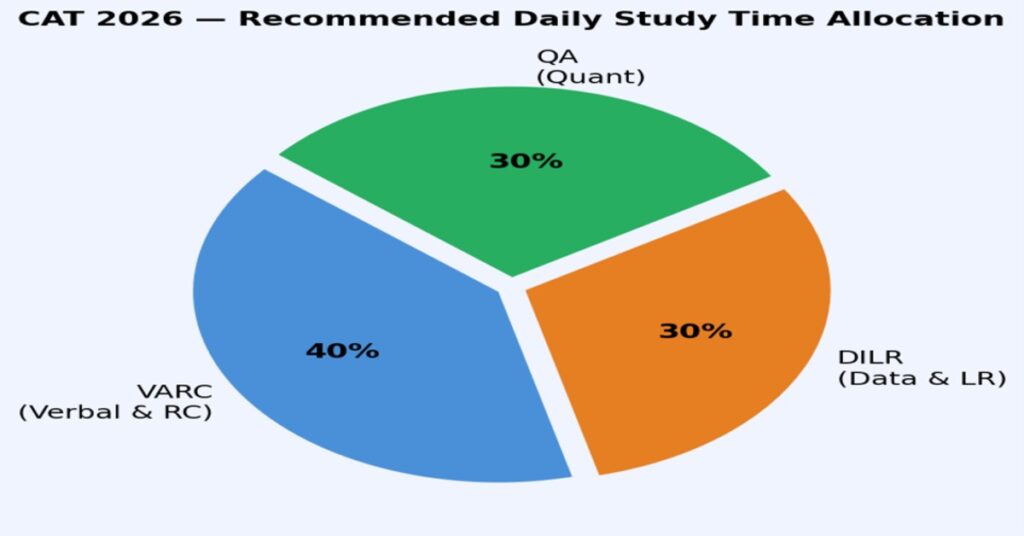
CAT 2026 divides the exam into three sections: Verbal Ability and Reading Comprehension (VARC), Data Interpretation and Logical Reasoning (DILR), and Quantitative Aptitude (QA). Each section allocates 40 minutes, and it does not permit candidates to move between sections during the allotted time.
Importantly, they apply negative marking of one mark for every incorrect MCQ response, while TITA (Type in The Answer) questions carry no penalty.
Morning Routine: The Beginning
According to cognitive psychology research, waking up is among the most productive for cognitive function. As a result, students or instructors best use this session for high-difficulty content, such as difficult DILR sets, intricate Reading Comprehension passages, or number-theory questions in QA. The brain eventually conditions itself to function analytically at the beginning of the day when this habit is developed consistently.
A five-minute warm-up should also start morning practices. Complete two or three basic math problems, read an editorial in the newspaper, or mentally go over the error log from the previous day. This practice shortens transition times and enhances session quality by alerting the brain that focused activity is about to start.
Recommended Morning Activities: –
| 🌅 Morning Practice Tip • Avoid social media for the first 30 minutes after waking. • Solve from physical books or PDFs — not short-form content that fragments focus. • Keep a dedicated “error diary” beside your study space every morning. |
- RC Deep Dive: Read one long-form RC passage (600–800 words) and attempt all questions before reviewing answers. Time yourself strictly at 12–14 minutes.
- DILR Warm-Up: Solve one four-question DILR set from a previous CAT paper. Focus on selection speed — decide within 90 seconds whether a set is approachable.
- QA Concept: Dedicate 30–40 minutes to one QA topic per day. Cover theory first, then solve 8–10 problems of increasing difficulty.
Evening Sessions: Drilling Speed and Accuracy
While mornings reserve time for concept-heavy work, evenings serve a different purpose—speed drilling and sectional practice. By this point in the day, someone should simulate the pressure of the exam setting. “Set strict timers, maintain a question-attempt log, and track your net score after each drill.” Over time, we will see patterns emerge: specific question types where time is consistently lost, or topics where accuracy drops below 70%.
Furthermore, evenings are the ideal time for mock-section practice. Attempting a full 40-minute VARC or QA section in the evening builds the stamina and pacing awareness that full-length mocks alone cannot replicate. After each drill, at least 20 minutes of analysis is non-negotiable.
Recommended Evening Activities: –
- Attempt 15 QA questions in 30 minutes. Review every error immediately.
- Solve 2 DILR sets back-to-back under timed conditions (20 minutes per set).
- Read one editorial and summarise it in three bullet points — this sharpens inference skills for VARC.
- Work through para-jumbles and para-completion questions (10 questions in 12 minutes).
Month-wise Study Plan: Smart Scaling
The amount of preparation varies month to month. However, experts advise taking a structured strategy, progressively increasing from basic concept-clearing in July to peak mock-test frequency in November. The bar chart below clearly shows this increase. As the exam date draws near, see how the study hours per day purposefully rise:
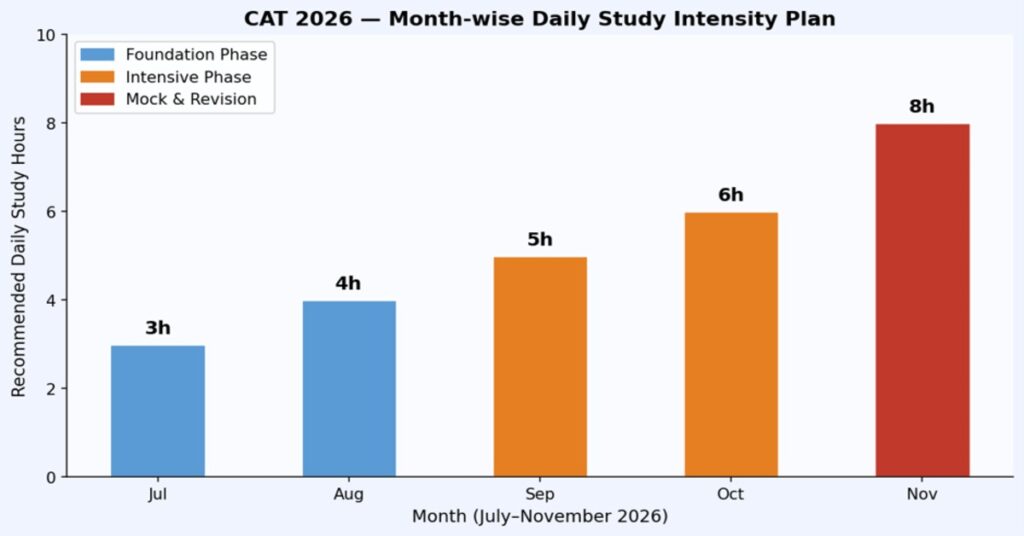
*Recommended daily study hours by month — from foundation to peak intensity
Phase 1: Foundation (July–August): 3–4 Hours/Day: –
The foundations must be established first. Every QA topic should be reviewed, from basic math to permutations and combinations. Additionally, throughout these months, foundations for the DILR method and VARC grammar rules are created at the base level. At this point, conceptual clarity takes priority over shortcuts and techniques.
Phase 2: Intensive Practice (September–October): 5–6 Hours/Day: –
By September, the concepts should be perfect. As a result, the attention must be completely switched to the application. Every day, sectional mocks are attempted, error logs are kept up to date, and weak themes are reviewed every weekend. Speed should be deliberately prioritized, with per-question time targets set for each topic.
Phase 3 — Mock and Revision (November): 7–8 Hours/Day: –
This is the crunch phase. Full-length mocks are taken every alternate day, and the days in between are used for thorough analysis. Revision of high-yield formulas, RC strategies, and DILR frameworks occupies the rest of the time. During this month, we strictly avoid new topics — only consolidation is carried out.
Mock Tests: The Core Engine of CAT 2026 Preparation
Mock test analysis is an exercise for improving scores. But the majority of candidates make the error of taking mock exams without thoroughly analyzing them. It is much more beneficial to take 15 mocks with thorough post-test analysis following each one, rather than just 30 mocks without evaluating errors.
Mock exams should also coincide with the real CAT, which is usually between 8:30 and 10:30 in the morning.. This teaches the body’s internal clock to remain focused and attentive during that particular period, which is a modest but effective benefit on test day.
Post-Mock Analysis Checklist: –
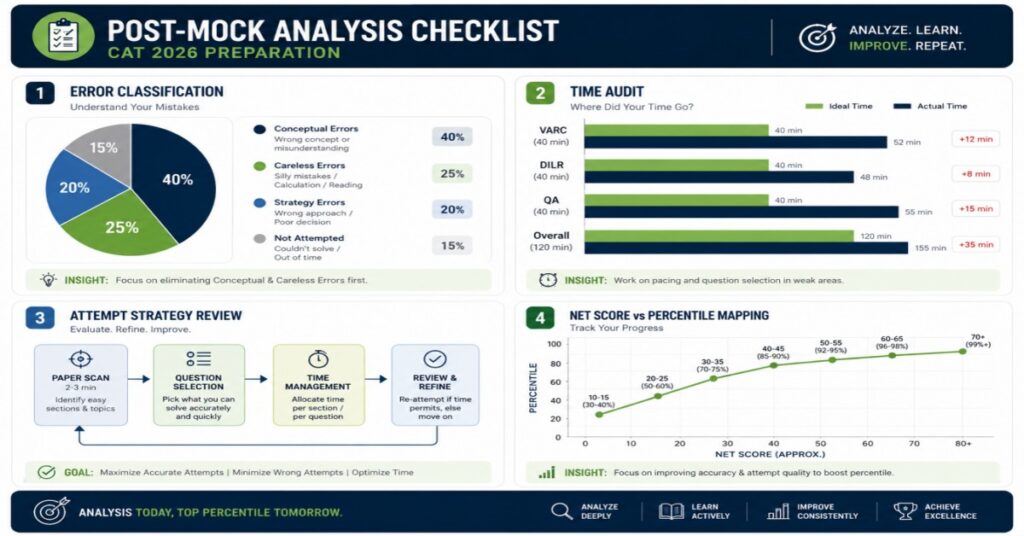
- Error Classification: Tag every wrong answer as a conceptual error, calculation mistake, or misread question.
- Time Audit: Review time spent per question. Identify where time was wasted on non-negotiable problems.
- Attempt Strategy Review: Assess whether the question-selection order was optimal. Would a different starting point have improved the score?
- Net Score vs. Percentile Mapping: Use the mock provider’s percentile data to understand how your score translates relative to other aspirants.
Weekly Study Schedule
Making decisions becomes easier with structure. Deciding what to study next doesn’t waste time when a weekly schedule is in place. The table below shows a practical day-by-day framework that balances all three portions and includes a designated mock day on Saturday.
| Day | Morning (1–2 hrs) | Evening (1–2 hrs) | Night (30 min) |
| Monday | VARC – RC passages | QA – Arithmetic | Revision flashcards |
| Tuesday | DILR – Sets practice | VARC – Grammar drills | Error log review |
| Wednesday | QA – Algebra & Numbers | DILR – Case lets | Concept summary |
| Thursday | VARC – Vocabulary + RC | QA – Geometry | Mock analysis |
| Friday | DILR – Full sets | QA – Modern Math | Weak-area notes |
| Saturday | Full-length Mock Test | Mock analysis & review | Rest/light reading |
| Sunday | Revision of weak topics | VARC – Para-jumbles | Plan for next week |
*Recommended weekly schedule for CAT 2026 aspirants (Timings vary by Phase)
Strategies for Each Section FOR CAT 2026
VARC Strategy: Reading Widely, Thinking Critically: –
- Read at least two RC passages of varied difficulty — abstract and factual.
- Attempt five para-jumbles daily and verify reasoning for each arrangement.
- Solve five odd-sentence-out questions with full justification written down.
- Maintain a vocabulary notebook for challenging words encountered in reading.
DILR Strategy: Practice: –
- Set Triage Drill: Pick 6 DILR sets from old CAT papers. Spend exactly 90 seconds on each to decide: Attempt, Skip, or Attempt Later.
- Accuracy-First Solving: Once you select a set, focus on 100% accuracy rather than speed. Speed naturally follows with practice.
- Variety Exposure: Rotate between DI-heavy sets (charts, tables) and LR-heavy sets (blood relations, seating, scheduling) on alternate days.
QA Strategy: Formula Fluency and Concept: –
Focus High-Priority QA Topics
- Percentages, Ratios, and Proportions — fundamental to most arithmetic word problems
- Time, Speed, Distance, and Work—consistently appear in every CAT exam
- Algebra — linear and quadratic equations, inequalities, functions
- Geometry and Mensuration — triangles, circles, coordinate geometry
- Number Theory — factors, remainders, HCF/LCM, prime numbers
- Permutation, Combination, and Probability — 2–3 questions per paper
Mental Fitness: The Silent Pillar of CAT Preparation
Every coaching platform goes into much detail about preparation techniques, but people rarely give mental health the same consideration. However, most serious CAT candidates face burnout, test anxiety, and performance slowdowns. As a result, the daily routine needs to incorporate a proactive mental healing plan.
| 🧘 Mental Wellness Checklist • Sleep at least 7 hours — consolidation of memory happens during sleep. • Take one full rest day per week—Sunday works well for light revision only. • Practice 10 minutes of mindfulness or breathing exercises before mocks. • Avoid comparing your progress with peers—your trajectory is personal. • Celebrate small wins: finishing a chapter, improving accuracy by 5%, solving a tough set. |
Conclusion
The outcome of CAT results from hundreds of daily sessions between today and November, rather than on exam day. But effort alone is not enough; what really makes a difference is organized, honest, and regular practice. Furthermore, candidates who score highly on the CAT are not always the most brilliant; rather, they are the ones who consistently show up with a plan and effectively carry it out.
So, get started right now. Establish a morning routine, make a weekly calendar, treat mocks seriously, and devote as much time to your mental healing as you do to your studies. CAT 2026 is difficult, but it is totally achievable.
Frequently Asked Questions (FAQs)
1. Is the CAT 2026 notification out yet?
No, no one has released the notification at the time of writing. Industry estimates point to mid-to-late July 2026 for the announcement, with IIM Indore expected to serve as the conducting body.
2. How many hours should I study daily for CAT 2026?
Two to three hours daily works well in the early months, and this can rise to six to eight hours closer to the exam. Consistency across months matters more than occasional long sessions.
3. How many mock tests are enough before the exam?
Most successful aspirants attempt between 25 and 40 full-length mocks. However, the depth of analysis after each mock carries more weight than the raw number attempted.
4. Can a beginner crack CAT without coaching?
Yes, self-preparation is entirely workable with disciplined daily practice, the right books, and a structured mock schedule. Many 99-percentile scorers have followed this exact route.
5. What is the ideal daily practice routine?
A balanced routine includes one RC passage, a Quant practice block, one DILR set, and a short revision session every single day. Weekends are then reserved for full mocks and detailed analysis.
6. Which topics deserve the most daily attention in QA?
Arithmetic and Algebra account for a large share of the Quantitative Aptitude section, so these topics deserve daily attention.Geometry and Modern Math can layer in once the basics feel solid.
7. How important is mock analysis compared to taking more mocks?
Analysis consistently receives higher ratings for value compared to volume. Spending two to three times the test duration reviewing mistakes typically produces a sharper percentile gain than squeezing in extra mocks.
8. Should working professionals follow a different schedule?
Working professionals can shift toward a weekend-intensive model, with shorter daily sessions on weekdays. The same principles of daily RC, DILR, and QA practice still apply, just compressed into available hours.
9. What should the last two weeks before the exam looks like?
The final fortnight is best used for light revision rather than new topics. Formula review, previous-year papers, and a steady sleep schedule matter far more than last-minute cramming.
10. How can exam-day stress be managed effectively?
Regular mock tests under timed conditions build familiarity with pressure well before the actual exam. Alongside this, a stable routine of sleep, hydration, and short breathing exercises helps maintain composure.
You may also visit: CATMOCK INDIA|CATMOCK