

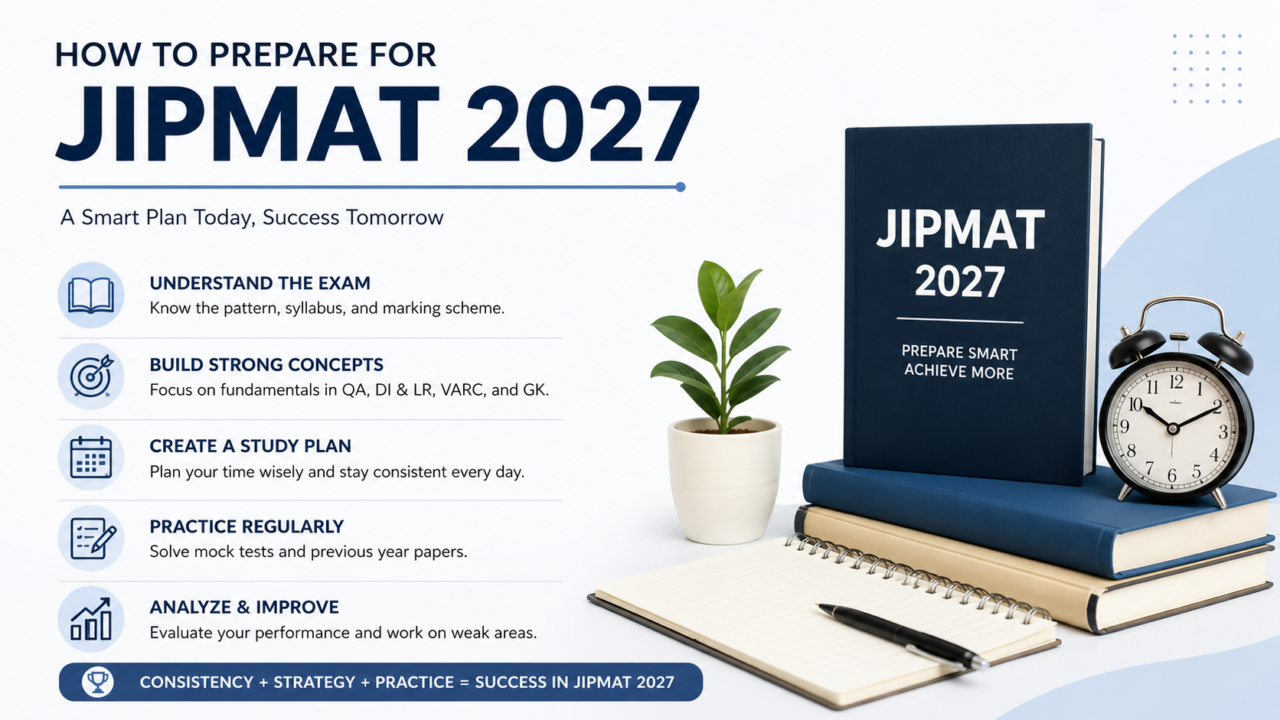
Cracking the Joint Integrated Programme in Management Admission Test isn’t about luck — it’s about having the right roadmap. If you’re wondering how to prepare for JIPMAT 2027, you’re already ahead of thousands of aspirants who wait until the notification drops to start studying. JIPMAT opens a direct pathway into the five-year Integrated Programme in Management (IPM) at IIM Jammu and IIM Bodh Gaya, letting you earn a BBA and MBA back-to-back, right after Class 12.
Because the exam is highly competitive and negatively marked, a scattered approach simply won’t cut it. In this guide, we’ll walk you through the exact JIPMAT 2027 preparation strategy — from understanding the exam pattern and syllabus to building a month-wise study plan, picking the right books, and avoiding rookie mistakes. Let’s get started.
What Is JIPMAT 2027? A Quick Overview
Before diving into preparation, it helps to know exactly what you’re preparing for. The National Testing Agency (NTA) conducts JIPMAT on behalf of IIM Jammu and IIM Bodh Gaya to select candidates for their integrated five-year management programme. Unlike IPMAT Indore or IPMAT Rohtak, which are run independently by their respective IIMs, JIPMAT follows a centralised, NTA-driven process.
| Particular | Details |
| Full Form | Joint Integrated Programme in Management Admission Test |
| Conducting Body | National Testing Agency (NTA) |
| Accepting Institutes | IIM Jammu, IIM Bodh Gaya (also accepted by TAPMI Manipal) |
| Exam Mode | Computer-Based Test (CBT) |
| Total Questions | 100 MCQs |
| Exam Duration | 150 minutes |
| Total Marks | 400 |
| Marking Scheme | +4 for correct, −1 for incorrect |
| Programme Offered | 5-Year Integrated BBA + MBA |
| Exit Option | After 3 years, with a bachelor’s degree |
Since a single application and score work for both institutes, your JIPMAT 2027 preparation directly determines your shot at two of the fastest-growing IIMs in the country.
Why Starting Early Gives You a Real Edge
Early preparation isn’t just a cliché — it’s a measurable advantage. Aspirants who begin four to six months ahead of the exam get enough runway to build strong fundamentals, take multiple mock tests, and correct weak areas without last-minute panic. Since JIPMAT has no sectional time limit, early practice also helps you experiment with different attempt sequences and settle on the one that suits you best, well before exam day. Moreover, starting early reduces the overlap with board exam stress, allowing you to balance both without burning out. If you’re also exploring alternate routes, it’s worth comparing your approach with the IPMAT Indore preparation strategy to understand how the two differ in difficulty and pacing.
Understand the JIPMAT 2027 Exam Pattern Before You Begin
You cannot build an effective strategy without first internalising the exam pattern. JIPMAT tests you across three sections, and — unlike some other IPM entrance exams — it does not impose a sectional time limit, which means you control how you allocate your 150 minutes.
| Section | Approx. Questions | Skills Tested |
| Quantitative Aptitude (QA) | 33 | Number system, algebra, arithmetic, geometry |
| Data Interpretation & Logical Reasoning (DILR) | 33 | Charts, graphs, puzzles, seating arrangement, caselets |
| Verbal Ability & Reading Comprehension (VARC) | 34 | Grammar, vocabulary, cloze tests, reading comprehension |
Notice that VARC carries the highest question count, and quantitative questions largely draw from Class 10-level concepts rather than advanced calculus. This is good news for non-math background students, but it also means competition is fierce because everyone can theoretically attempt these questions — accuracy, not just knowledge, becomes the real differentiator.
JIPMAT 2027 Syllabus at a Glance
A clear syllabus map keeps your preparation focused instead of scattered across random topics. Here’s a breakdown of what typically appears across the three sections. For a deeper, topic-by-topic breakdown along with weightage trends from previous years, check our detailed JIPMAT 2027 syllabus guide.
Quantitative Aptitude Topics
Expect questions rooted in Number System, Percentages, Profit & Loss, Ratio & Proportion, Time-Speed-Distance, Time & Work, Algebra, Mensuration, and basic Geometry. Since these topics come straight from your Class 9-10 NCERT textbooks, revisiting those books before jumping into advanced practice sets pays off enormously.
Data Interpretation & Logical Reasoning Topics
This section blends Data Interpretation (bar graphs, pie charts, tables, caselets) with Logical Reasoning (seating arrangement, blood relations, syllogisms, coding-decoding, and puzzles). Unlike CAT-level DILR, JIPMAT’s sets are usually more straightforward, so speed and pattern recognition matter more than complex multi-layered reasoning.
Verbal Ability & Reading Comprehension Topics
VARC covers grammar rules, vocabulary, para jumbles, cloze passages, idioms, and reading comprehension passages that test inference and summarisation skills. Because this section holds the highest weightage, sharpening it consistently can meaningfully lift your overall percentile.
| Section | Core Topics |
| Quantitative Aptitude | Number System, Algebra, Arithmetic, Geometry, Mensuration |
| DILR | Tables, Graphs, Caselets, Puzzles, Seating Arrangement, Syllogisms |
| VARC | Grammar, Vocabulary, Cloze Test, Para Jumbles, Reading Comprehension |
How to Prepare for JIPMAT 2027: Step-by-Step Strategy
Once you understand the pattern and syllabus, the next question becomes: how do you actually convert that knowledge into a high score? Follow this structured approach.
Step 1: Take a Diagnostic Mock Test First
Before opening a single book, attempt one full-length mock test. This baseline reveals your natural strengths and weak zones, so your preparation strategy is tailored rather than generic. Skipping this step often leads students to over-study topics they’ve already mastered while under-preparing weaker areas.
Step 2: Build a Realistic Study Timetable
Consistency beats intensity. Dedicate at least two to three hours daily, rotating across all three sections rather than obsessing over one. A fixed timetable also builds the discipline you’ll need on exam day, when time management becomes critical.
Step 3: Strengthen Class 10-12 Fundamentals
Since JIPMAT’s quantitative section leans heavily on foundational math, revisit your NCERT Class 9 and 10 textbooks first. Similarly, brush up basic grammar rules using a standard reference like Wren & Martin before attempting advanced VARC practice sets.
Step 4: Follow Section-Wise Preparation Tips
For Quantitative Aptitude: Practise mental calculation daily, memorise squares, cubes, and tables up to 20, and learn shortcut techniques for percentages and ratios. Because negative marking penalises guesswork, prioritise accuracy over attempting every question.
For DILR: Solve one DI set and one LR puzzle daily. Time yourself strictly, since recognising patterns quickly separates high scorers from average ones in this section.
For VARC: Read newspaper editorials, novels, or long-form articles daily to build both vocabulary and comprehension speed. Additionally, solve cloze tests and para jumbles regularly to strengthen your grasp on sentence structure and flow.
Step 5: Practice Previous Years’ Papers
Previous years’ JIPMAT papers reveal the actual difficulty level and recurring question patterns, something generic practice material can’t fully replicate. Solve at least the last three to four years’ papers under timed, exam-like conditions.
Step 6: Take Regular Mock Tests and Analyse Them
Attempting mocks without reviewing them is a wasted effort. After every mock, spend equal time analysing errors — categorise them as conceptual gaps, silly mistakes, or time-management issues, and address each differently.
Step 7: Revise Smartly in the Final Weeks
In the last month, shift entirely from learning new topics to revising formulas, grammar rules, and shortcut techniques. Consistent revision during this phase keeps concepts fresh and reduces exam-day anxiety.
Month-Wise JIPMAT 2027 Study Plan
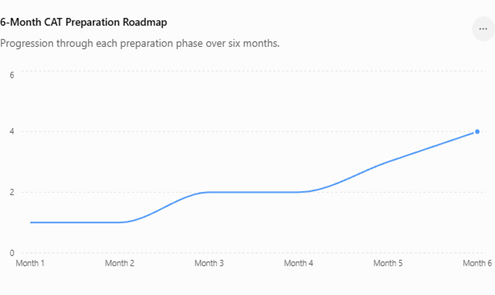
If you’re starting roughly six months before the exam, here’s a phase-wise plan to structure your JIPMAT 2027 preparation effectively.
| Phase | Duration | Focus Area |
| Foundation Phase | Months 1-2 | Cover NCERT basics, grammar fundamentals, and complete syllabus mapping |
| Concept-Building Phase | Months 3-4 | Topic-wise practice across QA, DILR, and VARC; start solving previous papers |
| Mock Test Phase | Month 5 | Attempt full-length mocks weekly; analyse and fix weak areas |
| Revision Phase | Final Month | Daily revision, timed sectional tests, and error-log review |
Adjust the timeline proportionally if you have less time — for instance, a one-month plan should compress the foundation and concept-building phases while prioritising mock tests and revision from day one.
Best Books and Resources for JIPMAT 2027 Preparation
Choosing quality study material matters as much as the hours you put in. For quantitative and grammar basics, NCERT Mathematics (Class 9-10) and Wren & Martin’s English Grammar remain reliable starting points. Beyond these, look for JIPMAT-specific question banks and previous years’ papers that mirror the actual exam’s difficulty level, rather than relying solely on CAT-level material, which can feel disproportionately tough and demotivating.
Supplement your reading habit with newspapers and long-form articles to build comprehension speed naturally over time. Finally, enrol in a structured mock test series — simulated, exam-like practice consistently improves both accuracy and time management more than isolated topic practice alone.
| Resource Type | Recommended For | What It Helps With |
| NCERT Class 9-10 Maths | Quantitative Aptitude | Building core conceptual clarity |
| Wren & Martin | VARC | Grammar rules and sentence correction |
| Previous Years’ Papers | All sections | Understanding real difficulty and pattern |
| Full-Length Mock Tests | All sections | Time management and exam-day simulation |
| Newspapers & Editorials | VARC | Vocabulary and reading speed |
Before finalising your eligibility and application timeline, it’s also worth reviewing the complete JIPMAT 2027 eligibility criteria so there are no last-minute surprises during registration.
Common Mistakes to Avoid While Preparing for JIPMAT 2027
Even sincere aspirants often derail their preparation through avoidable errors. First, many students ignore previous years’ papers, missing out on real insight into question difficulty and pattern. Second, skipping mock test analysis wastes the single most valuable feedback loop in your entire preparation. Third, over-focusing on one strong section while neglecting a weaker one creates lopsided scores that hurt your overall percentile, since all three sections contribute to the final result.
Additionally, attempting every question despite negative marking often backfires; instead, build the discipline to skip questions you’re unsure about. Finally, starting preparation too close to the exam date compresses your learning curve unnecessarily — early, consistent effort consistently outperforms last-minute cramming.
Exam Day Tips to Maximise Your Score
Preparation doesn’t end once you close your books — how you handle the actual test session matters just as much. Reach the exam centre at least 45-60 minutes early to avoid last-minute stress, and carry your admit card along with a valid photo ID, since NTA strictly enforces documentation checks. Once the test begins, resist the urge to start with the toughest section first; instead, attempt the section you’re most comfortable with to build early momentum and confidence.
Throughout the exam, keep an eye on the clock without letting it distract you from accuracy. Since JIPMAT penalises wrong answers, it’s wiser to skip a question you’re genuinely unsure about rather than guess randomly. Finally, if time permits, use the last ten minutes to revisit marked or skipped questions rather than second-guessing answers you’ve already confirmed — over-checking often introduces new errors instead of fixing them.
How to Stay Motivated Through a Long Preparation Cycle
Long preparation cycles often test patience more than intelligence, and staying motivated over four to six months is a skill in itself. Break your larger goal into smaller, weekly milestones so progress feels tangible rather than distant. Tracking your mock test scores over time, even when improvement feels slow, offers proof that your effort is compounding.
It also helps to connect with fellow aspirants, whether through study groups or online forums, since shared accountability often keeps procrastination at bay. Equally important is protecting your physical and mental well-being — adequate sleep, regular breaks, and light physical activity all directly influence how well you retain information and perform under pressure. Remember, consistent moderate effort sustained over months consistently outperforms sporadic bursts of intense, unsustainable studying.
JIPMAT 2027 Cut-Off and Selection Process (Why Preparation Matters)
Because seats are limited to roughly 240-260 across both institutes, and thousands of candidates compete annually, even a small improvement in accuracy can shift your rank significantly. IIM Jammu currently gives substantial weightage to the JIPMAT score, while IIM Bodh Gaya’s selection also depends almost entirely on exam performance. This underscores why a disciplined, well-structured preparation strategy — rather than sporadic studying — directly influences your admission chances. For the most accurate and updated details on dates, fees, and eligibility, always cross-check with the official JIPMAT website.
Quick Summary: JIPMAT 2027 Preparation Checklist
- Understand the exam pattern and syllabus thoroughly before starting.
- Take a diagnostic mock test to identify your strengths and weaknesses.
- Revise Class 9-10 NCERT math and basic grammar as your foundation.
- Follow a structured, section-wise daily study routine.
- Solve previous years’ papers under timed conditions.
- Take weekly full-length mocks and analyse every mistake.
- Dedicate the final month purely to revision and error correction.
- Stay updated through the official NTA notification for exact dates and changes.
Frequently Asked Questions (FAQs)
Q1. How many months are enough to prepare for JIPMAT 2027? Generally, four to six months of consistent, structured preparation is sufficient for most students. However, aspirants with weaker fundamentals may benefit from starting even earlier to comfortably cover the syllabus and practice extensively.
Q2. Is JIPMAT 2027 tougher than IPMAT Indore or IPMAT Rohtak? JIPMAT’s quantitative section is generally considered more accessible since it draws mainly from Class 10-level concepts. However, competition remains intense because of the limited number of seats available across both accepting institutes.
Q3. Can a non-math background student crack JIPMAT 2027? Yes, absolutely. Since the quantitative aptitude section relies on foundational, school-level math rather than advanced concepts, students from commerce, arts, or humanities backgrounds can prepare effectively with consistent practice.
Q4. How important are mock tests for JIPMAT 2027 preparation? Mock tests are essential, as they simulate real exam conditions and reveal time-management gaps that topic-wise practice alone cannot expose. Regular mocks, paired with thorough error analysis, are one of the strongest predictors of a high score.
Q5. What is a good target score for JIPMAT 2027? Historically, cut-offs have hovered around 300+ for IIM Bodh Gaya and slightly higher for IIM Jammu, though this varies each year based on difficulty level and the number of applicants. Aim to consistently score above these benchmarks in your mock tests before the actual exam.
Conclusion
Preparing for JIPMAT 2027 doesn’t have to feel overwhelming once you break it down into manageable, sequential steps. Start by understanding the exam pattern and syllabus, build a realistic study timetable, strengthen your fundamentals, and consistently practice through mock tests and previous years’ papers. Most importantly, treat every mock test as a learning opportunity rather than just a score to chase. With disciplined, early preparation, securing a seat at IIM Jammu or IIM Bodh Gaya through JIPMAT 2027 is a genuinely achievable goal. Stay consistent, track your progress, and adjust your strategy as the exam date approaches.