
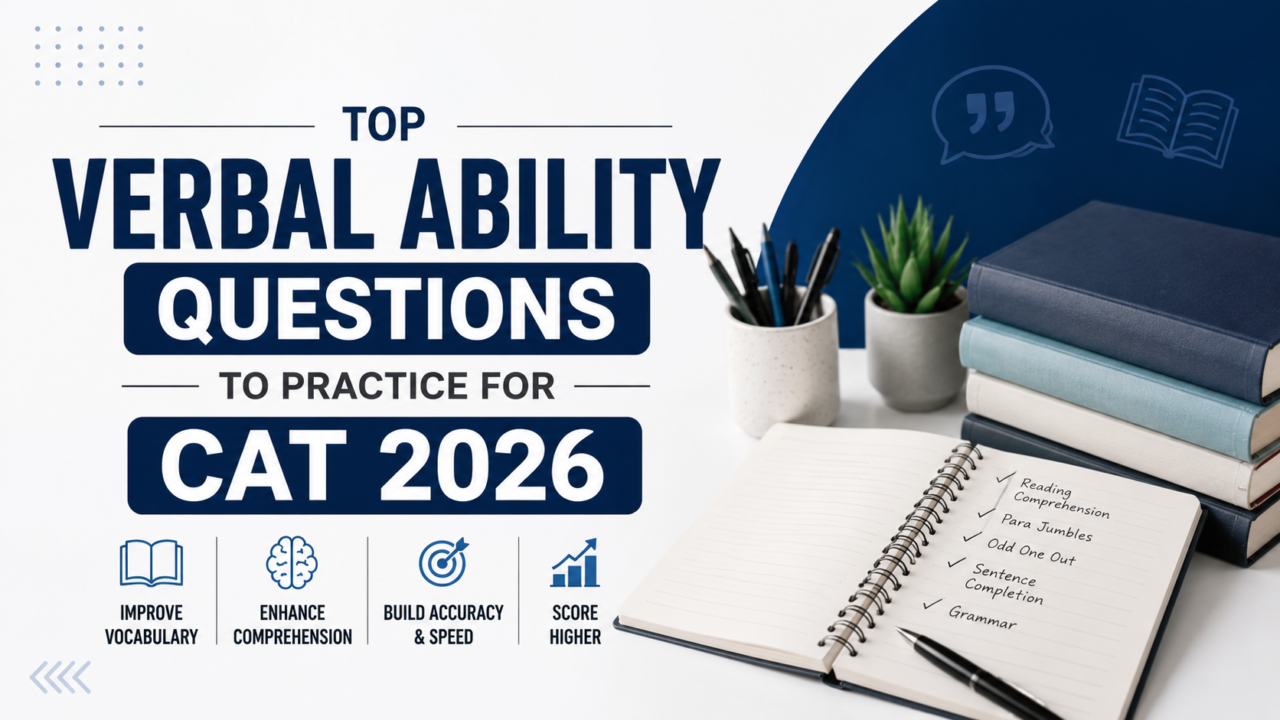
CAT 2026 aspirants often underestimate the Verbal Ability portion of the VARC section, yet this portion delivers some of the fastest, most reliable points on the entire exam. When you practice the top verbal ability questions to practice for CAT 2026, you sharpen your accuracy on para jumbles, para summaries, para completion, and odd-sentence-out questions within a few focused weeks. Moreover, because Verbal Ability questions usually take less time to solve than a full Reading Comprehension passage, mastering them frees up precious minutes for the four RC passages that otherwise dominate the section. This guide walks you through the exact question types you must practice, the weightage each topic carries, a practical four-week study plan, and a genuinely free question bank that removes the guesswork from your preparation. In addition, you gain access to VARC Bhandara on catmock.com, where 2000 Verbal Ability questions and 1000 Reading Comprehension passages await you, free of cost, so you no longer need to hunt across multiple platforms for consistent practice material.
Why Verbal Ability Matters for Your CAT 2026 VARC Score ?
The VARC section carries roughly one-third weightage in the overall CAT exam, and Verbal Ability questions form a compact, high-scoring cluster within it. Unlike Reading Comprehension, which forces you to read long passages before you answer even a single question, Verbal Ability questions let you engage directly with the content. Consequently, a well-prepared candidate can attempt these questions quickly and bank sectional marks early, which then buys extra time for tougher RC passages. Furthermore, because the scoring pattern awards three marks for a correct answer and deducts one mark for a wrong MCQ response, accuracy on Verbal Ability questions protects your overall percentile far more efficiently than a rushed guess on an unfamiliar RC passage. Therefore, treating Verbal Ability practice as a priority, rather than an afterthought, gives you a measurable edge over aspirants who focus only on Reading Comprehension.
CAT 2026 VARC Exam Pattern at a Glance
Before you dive into practice questions, you should understand exactly how the VARC section is structured. The table below summarises the current pattern that CAT 2026 aspirants should prepare around.
| Component | Approx. Questions | Format | Time Allotted | Marking Scheme |
| Reading Comprehension | 16 (4 passages) | MCQ | Shared 40 minutes | +3 / -1 |
| Para Jumbles | 2-3 | TITA / MCQ | Shared 40 minutes | +3 / -1 (MCQ only) |
| Para Summary | 2-3 | MCQ | Shared 40 minutes | +3 / -1 |
| Odd Sentence / Out of Context | 1-2 | MCQ | Shared 40 minutes | +3 / -1 |
| Para Completion | 1-2 | MCQ | Shared 40 minutes | +3 / -1 |
As the table shows, Reading Comprehension still commands the largest share of questions, yet Verbal Ability collectively contributes 8 to 10 scoring opportunities. Since these questions rarely require you to decode a 600-word passage, you can, therefore, convert them into quick, confident points if you practice consistently.
Key Verbal Ability Topics You Must Practice for CAT 2026
Every CAT 2026 candidate should build topic-wise command over four recurring Verbal Ability question types. Let’s break each one down so that you know precisely what to practice.
1. Para Jumbles
Para jumble questions present four or five sentences in random order and ask you to arrange them into a logically coherent paragraph. To solve these quickly, first identify the opening sentence by scanning for a general statement or an introductory idea, and then look for pronoun references, transition words, and chronological cues that link one sentence to the next. Practicing para jumbles daily trains your brain to spot these linking signals almost instantly, which significantly reduces the time you spend per question.
2. Para Summary
Para summary questions give you a short paragraph and ask you to select the option that best captures its central idea. Instead of picking the option that repeats the most words from the passage, you should identify the paragraph’s core argument and then eliminate options that focus on minor details or add information the passage never states. As a result, you avoid the most common trap in this question type: choosing an answer that sounds familiar rather than one that is genuinely accurate.
3. Odd Sentence Out (Out-of-Context)
In this format, you receive four or five sentences that almost form a coherent paragraph, except one sentence disrupts the logical flow or introduces an unrelated idea. To solve it efficiently, read the sentences as a group first, then test each sentence individually by removing it and checking whether the remaining sentences still form a complete, connected paragraph. This method works faster than trying to judge each sentence in isolation.
4. Para Completion
Para completion questions remove the concluding sentence from a paragraph and ask you to choose the option that completes the idea most naturally. Since the correct answer must extend the paragraph’s argument rather than introduce a new one, you should always match tone, tense, and logical direction before finalising your choice. Practicing this question type also sharpens your para-jumble and odd-sentence-out skills, because all three formats reward the same underlying ability: recognising logical sequence.
5. Vocabulary and Grammar Support (Bonus Practice)
Although CAT no longer tests standalone vocabulary or grammar questions directly, a strong grasp of both still supports every Verbal Ability format indirectly. For instance, a wider vocabulary helps you interpret nuanced editorial language faster during para summary questions, while solid grammar instincts help you judge sentence flow accurately during para jumbles and odd-sentence-out questions. Consequently, even a few minutes of daily vocabulary building and grammar revision compounds into noticeably faster reading and reasoning speed over several weeks. Moreover, candidates preparing for allied exams like XAT, IIFT, SNAP, or NMAT benefit directly from this vocabulary and grammar practice, since those exams still test these areas explicitly.
Topic-wise Weightage and Difficulty Level
Once you understand each format, you should allocate practice time according to weightage and difficulty. Use the table below as your planning reference.
| Topic | Avg. Questions in CAT | Difficulty Level | Ideal Time per Question |
| Para Jumbles | 2-3 | Moderate | 60-75 seconds |
| Para Summary | 2-3 | Moderate to High | 50-70 seconds |
| Odd Sentence Out | 1-2 | Moderate | 60 seconds |
| Para Completion | 1-2 | High | 70-90 seconds |
| Reading Comprehension | 16 | Moderate to High | 2.5-3 minutes per question |
Notice that Reading Comprehension still demands the bulk of your time budget, yet Verbal Ability questions offer a faster route to marks once you build familiarity with each format. Therefore, allocate your early practice weeks to Verbal Ability so that your speed there frees up time for RC passages closer to exam day.
How to Practice Top Verbal Ability Questions for CAT 2026 Effectively
Rather than solving random questions without a plan, follow a structured practice approach so that every session builds a specific skill.
| Question Type | What to Practice | Core Skill Tested | Practice Tip |
| Para Jumbles | Daily 5-question sets from mixed difficulty levels | Logical sequencing | Identify the anchor sentence first, then build outward |
| Para Summary | Editorial paragraphs from quality publications | Main-idea extraction | Summarise in one line before checking options |
| Odd Sentence Out | Paragraphs with one deliberately inserted line | Coherence detection | Remove one sentence at a time and re-read |
| Para Completion | Paragraphs missing their final line | Logical continuation | Match tone and direction, not just topic |
This structured approach ensures that you practice with intent, rather than simply completing a question count. Additionally, tracking your accuracy topic-wise, instead of only overall, reveals precisely where you need more repetition.
Proven Strategies to Solve Verbal Ability Questions Faster
- Read quality editorials daily. Sources like well-regarded opinion columns and long-form essays sharpen the same comprehension muscles that Verbal Ability questions test.
- Time every practice set. Since CAT rewards speed and accuracy together, you should always solve questions against a clock, not in isolation.
- Eliminate options actively. Instead of searching for the right answer directly, remove the options that clearly break logical flow or add unstated information.
- Revisit previous year CAT papers. Official past papers reveal the exact difficulty level and phrasing style that CAT 2026 will likely follow.
- Maintain an error log. Recording why you missed a question, rather than just noting that you missed it, prevents you from repeating the same mistake.
- Practice mixed sets, not isolated topics. Since the actual exam mixes question types, mixed practice trains you to switch strategies quickly.
Common Mistakes Aspirants Make While Practicing Verbal Ability
Many CAT 2026 aspirants unintentionally slow down their own progress. First, several candidates spend nearly all their preparation time on Reading Comprehension while treating Verbal Ability as a low-priority topic, even though it offers faster, more reliable marks. Second, many students skip timing their practice sessions, so they never discover how slow they actually are under real exam pressure. Third, aspirants frequently memorise question patterns instead of understanding the underlying logic, which fails them the moment CAT introduces a slightly different phrasing. Fourth, students often skip reviewing their mistakes altogether, which means they repeat the same errors across multiple mock tests. Finally, many candidates practice too few para jumbles and odd-sentence-out questions, even though consistent repetition is the single most effective way to master these formats.
Free Practice Resource: VARC Bhandara by CatMock
If you want a single, reliable place to practice every Verbal Ability format covered in this guide, VARC Bhandara solves that problem directly. This free resource, launching on catmock.com, gives you 2000 Verbal Ability questions spanning para jumbles, para summaries, odd-sentence-out sets, and para completion exercises, alongside 1000 Reading Comprehension passages that mirror the difficulty level CAT 2026 is expected to carry. Because every question comes with a detailed solution, you can review your mistakes immediately rather than waiting for an answer key. As a result, VARC Bhandara lets you build both your Verbal Ability accuracy and your Reading Comprehension stamina from one consolidated, cost-free platform.
4-Week Study Plan for Verbal Ability Questions Practice
Use the following week-by-week plan to convert this guide into consistent, measurable progress.
| Week | Focus Area | Daily Target | Milestone |
| Week 1 | Para Jumbles + Odd Sentence Out fundamentals | 15-20 questions | 80% accuracy on easy-level sets |
| Week 2 | Para Summary + editorial reading practice | 15 questions + 1 editorial | Summarise passages in under 60 seconds |
| Week 3 | Para Completion + mixed topic drills | 20 mixed questions | Consistent sub-70-second solving speed |
| Week 4 | Full-length timed VARC mocks | 1 sectional mock daily | 90%+ accuracy on Verbal Ability questions |
By the end of this four-week cycle, you should notice a clear improvement in both your speed and your accuracy, which directly strengthens your overall VARC percentile for CAT 2026.
Summary
- Verbal Ability questions form 8-10 high-scoring opportunities within the CAT 2026 VARC section.
- Para jumbles, para summary, odd sentence out, and para completion are the four core formats to master.
- Timed, mixed-topic practice builds real exam readiness far more effectively than isolated topic drills.
- An error log and previous year papers help you avoid repeating the same mistakes.
- VARC Bhandara on catmock.com offers 2000 free Verbal Ability questions and 1000 free Reading Comprehension passages for structured practice.
- A focused four-week plan can meaningfully raise your Verbal Ability accuracy before exam day.
Frequently Asked Questions
1. How many Verbal Ability questions appear in CAT 2026?
CAT typically includes 8 to 10 Verbal Ability questions within the VARC section, distributed across para jumbles, para summary, odd sentence out, and para completion formats.
2. What is the best way to practice top verbal ability questions for CAT 2026?
The most effective approach combines daily timed practice, topic-wise accuracy tracking, an error log for reviewing mistakes, and regular exposure to previous year CAT papers alongside a large, varied question bank like VARC Bhandara.
3. Are para jumbles still part of the CAT exam pattern?
Yes, para jumbles remain part of CAT’s Verbal Ability section, though the exact question count can shift slightly from year to year based on the overall exam pattern.
4. How much time should I spend on each Verbal Ability question?
Most Verbal Ability questions should take between 50 and 90 seconds each, depending on the format, so that you retain sufficient time for the four Reading Comprehension passages.
5. Where can I find free practice questions for CAT 2026 Verbal Ability?
VARC Bhandara on catmock.com offers 2000 free Verbal Ability questions and 1000 free Reading Comprehension passages, making it a comprehensive, cost-free practice option for CAT 2026 aspirants.
6. Does Verbal Ability carry negative marking in CAT?
Multiple-choice Verbal Ability questions carry a penalty of one mark for an incorrect answer, while Type-In-The-Answer questions carry no negative marking, so accuracy matters more on MCQ-format questions.
7. Should I attempt Verbal Ability questions before Reading Comprehension in the exam?
Many toppers recommend attempting Verbal Ability questions early because they take less time and build momentum, which then leaves more time to read and answer Reading Comprehension passages carefully.
8. Can consistent practice alone improve my Verbal Ability score for CAT 2026?
Yes, since Verbal Ability formats follow repeatable logical patterns, consistent, structured practice combined with error review typically improves both speed and accuracy more reliably than last-minute revision.
Conclusion
Ultimately, your CAT 2026 VARC score depends heavily on how well you master the Verbal Ability section, since these questions reward preparation far more predictably than Reading Comprehension does. By practicing the top verbal ability questions to practice for CAT 2026 through a structured, topic-wise approach, you build both speed and accuracy well before exam day. Therefore, start today with a clear four-week plan, track every mistake you make, and use a consolidated, free resource like VARC Bhandara on catmock.com to access 2000 Verbal Ability questions and 1000 Reading Comprehension passages in one place. Consistent, focused practice, rather than last-minute cramming, remains the surest path to a strong VARC percentile in CAT 2026.
For official exam notifications and previous year question papers, refer to the official CAT website.