
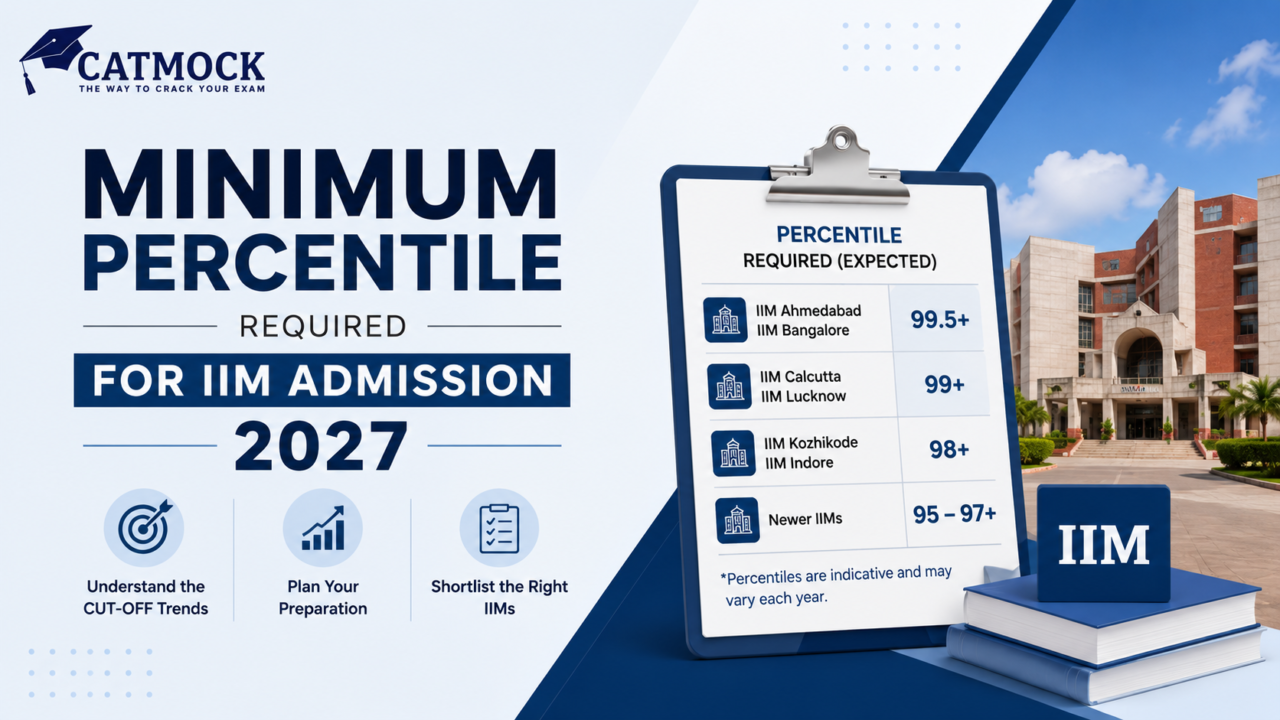
The minimum percentile required for IIM admission 2027 sits at the center of every CAT aspirant’s planning, since a single percentile point can separate a shortlist call from a rejection letter. Because CAT 2026 will decide admission for the 2027-29 MBA batch, this guide walks you through the qualifying percentile, the actual shortlisting percentile, and the category-wise relaxations that apply across the top IIMs, older IIMs, new IIMs, and baby IIMs. Additionally, you will find sectional cutoffs, the factors that push cutoffs up or down every year, and practical strategies that help you cross the required threshold with confidence.
Table of Contents
Understanding CAT Percentile and IIM Admission 2027
IIM Admission 2027 Cycle: Key Dates and Process
Qualifying Percentile vs Final Shortlisting Percentile
Category-Wise Minimum Percentile for IIM Admission 2027
IIM-Wise Minimum Percentile Required for 2027
Sectional Cutoffs: Why Overall Percentile Isn’t Enough
Factors That Influence the Minimum Percentile
How Academic Profile and Work Experience Affect Percentile
Smart Strategies to Reach the Required Percentile
Common Myths About Minimum Percentile
Understanding CAT Percentile and Its Role in IIM Admission 2027
First, it helps to understand what a CAT percentile actually measures, because many aspirants confuse it with a raw score or a fixed mark. A CAT percentile is a relative ranking, not an absolute number. In other words, a 95 percentile means you have outperformed 95 percent of everyone who appeared for the exam that year, regardless of how tough or easy the paper was. Since CAT is conducted across multiple slots, IIMs first normalise raw scores across slots and then convert the normalised score into a percentile.
As a result, the minimum percentile required for IIM admission 2027 will depend on how the overall applicant pool performs in CAT 2026, not on a fixed number of correct answers. Consequently, two candidates with identical raw scores in different slots can still receive different percentiles. This is precisely why IIMs treat percentile, rather than marks, as the true currency of the shortlisting process.
IIM Admission 2027 Cycle: Key Dates and Process Overview
CAT 2026 will be conducted on the last Sunday of November, that is, November 29, 2026, and it will remain the single gateway exam for admission to the 2027-29 MBA batch at 21 IIMs and more than 1,300 other B-schools. Once CAT results are declared, typically in late December 2026 or early January 2027, the shortlisting process begins.
Moreover, IIMs usually release their official admission policies for the 2027-29 batch alongside the CAT 2026 notification, which means aspirants can review qualifying percentile requirements well before results arrive. After the qualifying stage, shortlisted candidates move to Written Ability Test (WAT), Group Discussion (GD) where applicable, and Personal Interview (PI) rounds. Finally, IIMs calculate a composite score using CAT percentile, academic performance, work experience, and interview performance to prepare the final merit list.
For the most accurate and updated eligibility details, always cross-check the official notification on the
For the most accurate and updated eligibility details, always cross-check the official notification on the official CAT website before finalising your target percentile.
Qualifying Percentile vs Final Shortlisting Percentile: The Difference That Matters
One of the most misunderstood aspects of IIM admission is the gap between the qualifying cutoff and the actual shortlisting percentile. The qualifying cutoff is simply the minimum eligibility threshold that IIMs publish in their admission brochure; clearing it only makes you eligible to be considered for WAT-PI, it does not guarantee a call.
The final, or actual, cutoff is the percentile at which real shortlisting happens, and this number is almost always higher than the published qualifying cutoff. For instance, IIM Bangalore’s qualifying cutoff for the General category typically sits around 85 percentile, yet the effective percentile needed for a genuine shortlist call usually falls between 97 and 100 percentile. Therefore, aspirants should always prepare for the effective cutoff rather than the published minimum, since relying on the qualifying number alone can create a false sense of security.
Category-Wise Minimum Percentile for IIM Admission 2027
Because IIMs follow government reservation norms, the minimum percentile required for IIM admission 2027 varies significantly by category. General and EWS candidates face the steepest requirement, while NC-OBC, SC, ST, and PwD candidates receive meaningful relaxation at both the qualifying and shortlisting stages. The table below summarises the expected range for the 2027-29 admission cycle, based on the 2026-28 IIM admission policies and historical trends.
| Category | Qualifying Percentile (Top IIMs) | Qualifying Percentile (Older IIMs) | Realistic Percentile for a Shortlist Call |
| General | 95 – 99+ | 90 – 95 | 97 – 100 |
| EWS | 90 – 95 | 85 – 90 | 95 – 99 |
| NC-OBC | 75 – 90 | 70 – 82 | 90 – 95 |
| SC | 65 – 85 | 55 – 70 | 75 – 92 |
| ST | 55 – 75 | 40 – 60 | 60 – 85 |
| PwD | 50 – 75 | 40 – 60 | 50 – 80 |
Notably, older and more prestigious IIMs, such as Ahmedabad, Bangalore, and Calcutta, keep their qualifying cutoffs comparatively high even for reserved categories, whereas newer and baby IIMs offer wider relaxation because they focus more heavily on diversity and profile-building than on percentile alone.
IIM-Wise Minimum Percentile Required for 2027 Admission
Since every IIM sets its own percentile requirement, grouping institutes into tiers gives aspirants a clearer, more realistic target. Below is a tier-wise snapshot of the expected minimum percentile for the General category, based on 2026-28 admission policies and CAT 2025 conversion trends.
| IIM Tier | Representative Institutes | Expected General Qualifying %ile | Effective %ile for Calls |
| Top 3 IIMs | Ahmedabad, Bangalore, Calcutta | 95 – 95+ | 99 – 100 |
| Other Older IIMs | Lucknow, Indore, Kozhikode | 85 – 95 | 97 – 99 |
| New IIMs | Trichy, Ranchi, Raipur, Kashipur, Udaipur | 85 – 95 | 90 – 95 |
| Baby IIMs | Sirmaur, Bodh Gaya, Nagpur, Jammu, Sambalpur | 85 – 95 | 90 – 95 |
| Top Non-IIM (CAT-based) | FMS Delhi, JBIMS Mumbai, MDI Gurgaon | N/A (holistic) | 95 – 99+ |
Interestingly, IIM Ahmedabad revised its General category qualifying cutoff upward from 80 to 95 percentile for the 2026-28 cycle, which signals that the 2027-29 cycle will likely maintain, or even tighten, this benchmark. Meanwhile, baby IIMs continue to show slightly wider year-on-year variation, so treat their numbers as directional rather than fixed.
Sectional Cutoffs: Why Overall Percentile Alone Isn’t Enough
Even a stellar overall percentile cannot save an application if a candidate misses a single sectional cutoff, because most IIMs enforce independent minimums across Verbal Ability and Reading Comprehension (VARC), Data Interpretation and Logical Reasoning (DILR), and Quantitative Aptitude (QA). In practice, this rule has no workaround: a 99 overall percentile paired with a weak DILR score below the sectional threshold still results in rejection at the shortlisting stage.
| IIM Tier | VARC Sectional %ile | DILR Sectional %ile | QA Sectional %ile |
| Top 3 IIMs | 80 – 85 | 80 – 85 | 80 – 85 |
| Other Older IIMs | 75 – 85 | 75 – 85 | 75 – 85 |
| New IIMs | 70 – 75 | 70 – 75 | 70 – 75 |
| Baby IIMs | 70 | 70 | 70 |
Given this pattern, aspirants should treat each section as an independent target rather than an afterthought once the overall percentile goal is met. If your DILR score consistently lags, for example, dedicate focused practice to that section instead of assuming a strong VARC score will compensate.
Factors That Influence the Minimum Percentile Requirement
Several variables shift the minimum percentile required for IIM admission 2027 up or down each year, and understanding them helps you interpret cutoff data more accurately.
- Applicant volume: A surge in CAT registrations naturally compresses the percentile band at the top, since more candidates compete for the same number of seats.
- Exam difficulty and normalisation: An easier paper often pushes raw-score-to-percentile conversion upward, while a tougher paper can lower the percentile needed for the same raw score.
- Seat availability: When an IIM expands its batch intake, the qualifying bar can ease slightly; a smaller intake tightens it.
- Institute-specific policy revisions: Individual IIMs periodically revise their own admission policy, as seen with IIM Ahmedabad’s cutoff hike for the 2026-28 cycle.
- Category-wise reservation mandates: Government-mandated reservation percentages for OBC, SC, ST, EWS, and PwD candidates directly shape category-wise cutoffs every year.
- Diversity and gender parity goals: Many IIMs maintain dedicated seats for female candidates and non-engineering backgrounds, which can alter the effective percentile within a category.
How Academic Profile and Work Experience Affect Your Effective Percentile
Although CAT percentile opens the door, it rarely decides admission alone. IIM Ahmedabad, for instance, computes a composite score using Class 10, Class 12, and graduation marks alongside CAT percentile, and even reserves a share of shortlist seats for top academic performers within each academic discipline group. Consequently, a candidate with a slightly lower percentile but a stronger academic record can still outscore a peer who has a marginally higher percentile but a weaker academic history.
Work experience follows a similar logic. Candidates with two or more years of relevant work experience, combined with solid academics, have historically received calls from IIM Ahmedabad, Bangalore, Lucknow, and Kozhikode at percentiles between 98.5 and 99, which sits slightly below the pure General category benchmark. Gender diversity and an under-represented academic background, such as humanities or commerce in an engineering-dominated pool, can further improve an aspirant’s effective standing, even at a marginally lower percentile.
Smart Strategies to Reach the Required Percentile for IIM Admission 2027
Because the required percentile depends on your target tier, the smartest first step is to fix a realistic goal and then work backward. The following strategies help you plan a focused CAT 2026 preparation cycle.
- Set a tier-specific target: Decide whether you are aiming for a top-3 IIM, an older IIM, or a new/baby IIM, and prepare for that tier’s effective percentile rather than a vague 99-plus goal.
- Balance all three sections: Since sectional cutoffs apply independently, allocate practice time to your weakest section instead of over-polishing your strongest one.
- Take full-length mocks regularly: Consistent mock attempts under exam-day conditions sharpen time management and reveal section-wise gaps early.
- Track academic consistency: Where possible, strengthen supporting documents and profile elements, since composite scoring rewards steady academic performance.
- Prepare WAT-PI alongside CAT: Because the final selection blends CAT percentile with interview performance, starting WAT-PI preparation early, rather than after results, gives you a real edge.
- Use a percentile predictor cautiously: Percentile predictor tools offer a rough estimate, but treat them as a directional signal rather than a guaranteed outcome.
Common Myths About Minimum Percentile for IIM Admission
Myth 1: A 99+ percentile guarantees admission
In reality, a high percentile only opens the door to WAT-PI; the final call still depends on academics, work experience, and interview performance.
Myth 2: Reserved category candidates can qualify with any low score
Although reserved categories enjoy real relaxation, they still compete within their own category pool and must clear both sectional and overall thresholds set for that category.
Myth 3: The minimum percentile stays the same every year
Cutoffs shift annually based on applicant volume, exam difficulty, seat availability, and institute-specific policy changes, so last year’s number is a guide, not a guarantee.
Myth 4: Only the overall percentile matters
As covered earlier, sectional cutoffs apply independently, so a weak section can disqualify an otherwise strong overall percentile.
Quick Summary Table
The table below condenses every key figure from this guide into a single quick-reference snapshot for your IIM admission 2027 planning.
| Aspect | Key Takeaway |
| CAT 2026 exam date | November 29, 2026 (last Sunday of November) |
| Batch decided | 2027-29 MBA batch across 21 IIMs |
| General category realistic target (Top IIMs) | 99+ percentile |
| General category realistic target (Older IIMs) | 97 – 99 percentile |
| General category realistic target (New/Baby IIMs) | 90 – 95 percentile |
| Sectional cutoff range (Top IIMs) | 80 – 85 percentile per section |
| Reserved category relaxation | Significant, varies by IIM and category |
| Final selection basis | Composite score: CAT percentile + academics + work experience + WAT-PI |
Frequently Asked Questions
What is the minimum percentile required for IIM admission 2027?
The minimum percentile required for IIM admission 2027 typically ranges from 85 to 99-plus percentile for the General category, depending on the specific IIM. Top IIMs such as Ahmedabad, Bangalore, and Calcutta generally expect 99-plus percentile for a genuine shortlist call, while new and baby IIMs may shortlist General category candidates between 90 and 95 percentile.
Does clearing the minimum percentile guarantee an IIM admission call?
No, clearing the minimum percentile only makes you eligible for the Written Ability Test and Personal Interview stage. The final admission decision depends on a composite score that includes academic performance, work experience, and interview performance alongside your CAT percentile.
What is the minimum percentile required for reserved categories in IIM admission 2027?
Reserved category candidates receive meaningful relaxation. NC-OBC candidates typically need 75 to 90 percentile, SC candidates need 65 to 85 percentile, ST candidates need 55 to 75 percentile, and PwD candidates need 50 to 75 percentile, depending on the specific IIM and its tier.
Are sectional cutoffs important for IIM admission 2027?
Yes, sectional cutoffs are critical. Most IIMs enforce independent minimum percentiles for VARC, DILR, and QA, and missing even one sectional cutoff can lead to rejection regardless of a strong overall percentile.
Can work experience help candidates with a slightly lower percentile?
Yes, candidates with two or more years of relevant work experience and a solid academic record have received calls from several top IIMs at percentiles between 98.5 and 99, slightly below the standard General category benchmark.
When will official IIM cutoffs for the 2027-29 batch be released?
IIMs usually release their official admission policies for the 2027-29 batch alongside the CAT 2026 notification, and the final cutoffs become clear once CAT 2026 results are declared in late December 2026 or early January 2027.
Is 90 percentile enough for any IIM admission in 2027?
A 90 percentile can realistically fetch calls from several new and baby IIMs, especially with a strong academic and diversity profile, though it generally falls short of the effective cutoff at the top three or other older IIMs.
Conclusion
Ultimately, the minimum percentile required for IIM admission 2027 is not a single fixed number but a moving target that depends on your category, your target IIM tier, and the overall CAT 2026 applicant pool. General category candidates should aim for 99-plus percentile at the top three IIMs, 97 to 99 percentile at other older IIMs, and 90 to 95 percentile at new and baby IIMs, while reserved category candidates should track their own category-specific benchmarks closely.
More importantly, percentile alone never guarantees a seat. Therefore, build a balanced strategy that combines consistent sectional practice, steady academic performance, and early WAT-PI preparation, so that once you clear the qualifying threshold, your complete profile carries you across the finish line. With the right target percentile and a well-rounded application, your path to an IIM seat in the 2027-29 batch becomes a realistic, achievable goal rather than a guessing game.