Every year, lakhs of aspirants sit for competitive exams — SSC, banking, railways, defence, and management entrance tests — and almost all of them share one section in common: reasoning. It’s the section that rewards preparation the most and punishes guesswork the fastest. A well-structured reasoning mock test is the single most effective tool to convert theoretical knowledge into exam-day speed and accuracy.
If you’ve ever solved a reasoning question correctly in a book but fumbled the same concept under time pressure, you already understand why a reasoning mock test matters more than passive reading. This guide breaks down everything you need — types of reasoning, exam-wise patterns, preparation strategy, time management, and common mistakes — so you can build a genuinely effective practice routine instead of randomly attempting question papers.
What Is a Reasoning Mock Test?
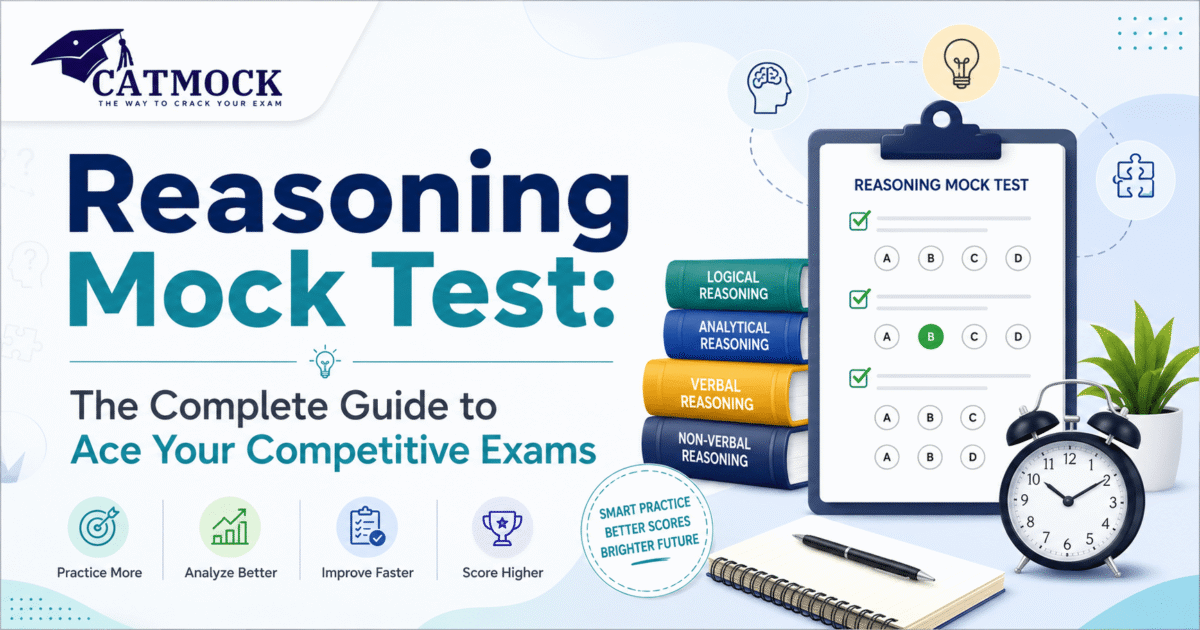
A reasoning mock test is a timed practice exam that simulates the reasoning section of a real competitive exam. It typically includes a fixed number of questions, a strict time limit, and a scoring pattern (often with negative marking) identical to the actual exam. The goal isn’t just to “solve puzzles” — it’s to replicate exam-day conditions so your brain learns to process logical, verbal, and analytical problems under pressure.
Unlike a textbook exercise where you can pause indefinitely, a mock test forces three critical skills simultaneously:
- Speed – solving within a per-question time budget
- Accuracy – avoiding careless errors caused by time pressure
- Decision-making – recognizing which questions to skip, attempt, or revisit
This combination is exactly what separates a strong scorer from an average one in the reasoning ability section of any competitive exam.
Why Reasoning Mock Tests Are Essential for Exam Success
Reasoning is a high-scoring, high-accuracy section if practiced correctly — but it’s also the section where aspirants lose the most time when unprepared. Here’s why a structured reasoning mock test should be non-negotiable in your study plan:
- Reveals your actual weak areas – You may assume you’re strong in puzzles, but a mock test with mixed topics often exposes gaps in coding-decoding or syllogism that untimed practice hides.
- Builds exam temperament – Repeated exposure to timed conditions reduces anxiety and builds familiarity with the real exam interface.
- Improves question selection strategy – You learn which question types to attempt first and which to leave for later.
- Tracks measurable progress – Score trends across multiple mock attempts show whether your preparation is actually improving.
- Reduces negative marking losses – Practicing under penalty conditions trains you to avoid blind guessing.
Types of Reasoning Covered in Mock Tests
A comprehensive reasoning mock test usually spans four broad categories. Understanding each helps you allocate practice time intelligently rather than treating “reasoning” as one monolithic subject.
Verbal Reasoning
This tests logical reasoning expressed through words and language-based problems. It includes syllogisms, blood relations, coding-decoding, direction sense, series completion, and analogy.
Non-Verbal Reasoning
This section relies on shapes, figures, and visual patterns rather than words. Common topics include mirror images, paper folding, figure series, embedded figures, and pattern completion — frequently tested in SSC and railway exams.
Analytical Reasoning
Analytical reasoning tests your ability to draw conclusions from structured data or statements. Puzzles, seating arrangement, data sufficiency, and input-output questions fall under this category and are among the most time-consuming yet high-scoring question types.
Logical Reasoning
Logical reasoning evaluates critical thinking through statement-conclusion questions, cause-effect, statement-assumption, and decision-making scenarios — heavily featured in banking and management entrance exams.
Table 1: Reasoning Types and Common Topics
| Reasoning Type | Common Topics Covered | Typically Tested In |
|---|---|---|
| Verbal Reasoning | Syllogism, coding-decoding, blood relations, direction sense | SSC, Banking, Railways |
| Non-Verbal Reasoning | Mirror/water images, figure series, paper folding | SSC, Railways |
| Analytical Reasoning | Puzzles, seating arrangement, input-output, data sufficiency | Banking, Insurance |
| Logical Reasoning | Statement-conclusion, assumptions, critical reasoning | Banking, CAT, MAT |
Exam-Wise Reasoning Mock Test Overview
Not all reasoning sections are structured the same way. The number of questions, time allotted, and difficulty level vary significantly across exams. Choosing a reasoning mock test that mirrors your target exam’s actual pattern is far more valuable than practicing generic question sets.
Table 2: Reasoning Section Pattern Across Popular Exams
| Exam | Reasoning Questions | Time Allotted | Difficulty Level | Negative Marking |
|---|---|---|---|---|
| SSC CGL (Tier 1) | 25 | ~20 minutes | Easy–Moderate | 0.50 per wrong answer |
| IBPS PO (Prelims) | 35 | 20 minutes | Moderate–High | 0.25 per wrong answer |
| RRB NTPC | 30 | ~30 minutes (combined) | Easy–Moderate | 1/3rd mark deducted |
| UPSC CSAT | Mixed with aptitude | 120 minutes (combined paper) | High | 0.66 per wrong answer |
| CAT (LRDI) | 20 | 40 minutes | High | 1 mark per wrong answer |
Note: Patterns are indicative and may be revised by exam authorities; always cross-check with the latest official notification.
How to Choose the Right Reasoning Mock Test
With hundreds of platforms offering reasoning mock tests, selecting the right one matters as much as taking the test itself. A poorly designed mock test — with unrealistic difficulty or an outdated pattern — can do more harm than good by building false confidence or unnecessary anxiety.
Look for these qualities in a reliable reasoning mock test:
- Exam-specific pattern matching the latest official syllabus
- Detailed solutions, not just correct answers
- Performance analytics (accuracy, time per question, topic-wise strength)
- All-India percentile comparison, if you want to benchmark against peers
- Regular updates reflecting recent exam trends
Table 3: Free vs Paid Reasoning Mock Tests — A Comparison
| Feature | Free Mock Tests | Paid Mock Test Series |
|---|---|---|
| Number of tests | Limited (5–10) | Extensive (50–100+) |
| Solution explanations | Basic or answer-key only | Detailed, step-by-step |
| Performance analytics | Rarely available | Usually included |
| Difficulty calibration | Inconsistent | Closely matches real exam |
| Best suited for | Beginners testing the waters | Serious, exam-focused aspirants |
Step-by-Step Strategy to Prepare Using Reasoning Mock Tests
Simply taking mock tests without a strategy rarely improves scores. Follow this structured approach for measurable results:
Step 1: Diagnose Before You Practice
Take one full-length reasoning mock test without any prior revision. This baseline test reveals your natural strengths and weak topics before you invest study hours in the wrong areas.
Step 2: Study Topic-Wise, Then Retest
After identifying weak areas from Step 1, study those topics in depth using concept notes and shortcut techniques. Then retake a mock test focused specifically on those topics.
Step 3: Simulate Full-Length, Timed Conditions
Once individual topics are strong, shift to full-length reasoning mock tests under strict timing — no pauses, no reference material — exactly as you would on exam day.
Step 4: Analyze Every Attempt
Spend at least 30 minutes reviewing each mock test: which questions were guessed correctly, which were solved too slowly, and which concepts still cause hesitation.
Step 5: Track Trends, Not Single Scores
A single mock test score is noise; a trend across 10–15 tests is signal. Maintain a simple log of accuracy percentage and time taken per test to visualize genuine improvement.
Common Mistakes Aspirants Make While Taking Reasoning Mock Tests
- Skipping the review phase – Attempting test after test without analyzing mistakes wastes most of the learning value.
- Ignoring time-per-question data – Aspirants often know their total score but not which specific question types eat up disproportionate time.
- Ignoring negative marking during practice – Practicing without penalty conditions creates false comfort that disappears on exam day.
- Overloading on puzzles alone – Puzzles and seating arrangements are high-scoring but time-heavy; neglecting quicker topics like syllogism or analogy can hurt overall efficiency.
- Not simulating the real exam interface – If your target exam is computer-based, practicing only on paper reduces familiarity with on-screen navigation and the answer-marking process.
Time Management Tips for the Reasoning Section
Effective time allocation separates high scorers from average ones. Below is a general framework you can adapt based on your target exam’s reasoning pattern.
Table 4: Suggested Time Allocation by Question Type (Per 30-Question Set)
| Question Type | Suggested Time | Priority Level |
|---|---|---|
| Syllogism / Blood Relations | 5–6 minutes | High (attempt first) |
| Coding-Decoding / Series | 4–5 minutes | High (attempt first) |
| Seating Arrangement / Puzzles | 10–12 minutes | Medium (attempt second) |
| Statement-Conclusion / Logical Reasoning | 5–6 minutes | Medium |
| Non-Verbal (Figures, Mirror Images) | 4–5 minutes | Low (attempt last if time permits) |
A practical rule: attempt quick, high-accuracy topics first to secure guaranteed marks, then move to time-heavy puzzles only if sufficient time remains.
Reasoning Mock Test: Beginner vs Advanced Approach
Not every aspirant should approach a reasoning mock test the same way. Your stage of preparation determines how you should use mock tests — treating them identically regardless of experience level is one of the quieter reasons many aspirants plateau.
For Beginners
If you’re just starting out, resist the urge to jump straight into full-length, strictly timed reasoning mock tests. Instead:
- Begin with sectional tests covering one topic at a time (e.g., only syllogism, or only blood relations).
- Use relaxed time limits initially, gradually tightening them as your conceptual clarity improves.
- Focus on understanding the “why” behind each answer rather than just marking correct or incorrect.
- Revisit fundamental shortcuts and formulas before attempting mixed-topic reasoning mock tests.
For Intermediate and Advanced Aspirants
Once fundamentals are solid, the goal shifts from learning concepts to optimizing performance:
- Attempt full-length reasoning mock tests strictly under exam time limits, without pausing.
- Compare your all-India percentile or rank (where available) to benchmark against real competition.
- Focus on shaving seconds off high-frequency question types like puzzles and coding-decoding, since marginal speed gains compound significantly over a full test.
- Use error-pattern analysis — categorize mistakes as conceptual, calculation-based, or time-pressure-induced — to target the final weeks of revision precisely.
This staged approach ensures that a reasoning mock test always matches your current preparation level, making each attempt genuinely productive rather than either too easy to be useful or too difficult to be encouraging.
Benefits of Taking Reasoning Mock Tests Online
Most reasoning mock tests today are delivered online, and this format offers distinct advantages over traditional paper-based practice, especially since the vast majority of competitive exams have moved to computer-based testing (CBT).
- Instant results and analytics – No manual checking required; you immediately see your score, accuracy, and time taken per question.
- Familiarity with the exam interface – Practicing on-screen navigation, the answer palette, and question-marking tools reduces friction on the actual exam day.
- Adaptive difficulty in advanced platforms – Some reasoning mock test platforms adjust question difficulty based on your performance, offering a more personalized practice experience.
- Easy performance tracking over time – Digital platforms often maintain a history of your attempts, making it simple to visualize improvement trends across weeks or months.
- Accessibility – You can attempt a reasoning mock test anytime, anywhere, without needing printed material or manual evaluation.
Key Takeaways
- A reasoning mock test replicates real exam conditions and builds speed, accuracy, and decision-making simultaneously.
- Reasoning questions fall into four categories: verbal, non-verbal, analytical, and logical — each requiring a slightly different practice approach.
- Exam patterns vary significantly; always practice with a reasoning mock test aligned to your specific target exam.
- A structured five-step strategy — diagnose, study, retest, simulate, analyze — outperforms random, unstructured mock test attempts.
- Time management and mistake analysis matter more than the sheer number of tests attempted.
Frequently Asked Questions
Q1: How many reasoning mock tests should I take before my exam?
There’s no fixed number, but most successful aspirants attempt at least 20–30 full-length reasoning mock tests in the final two to three months before their exam, alongside consistent topic-wise practice.
Q2: Is it better to take a full-length mock test or topic-wise reasoning tests first?
Begin with one diagnostic full-length test to identify weak areas, then focus on topic-wise reasoning mock tests to strengthen those specific concepts, before returning to full-length tests closer to your exam date.
Q3: Do reasoning mock tests help improve speed, or only accuracy?
Both. Timed practice trains your brain to recognize question patterns faster while simultaneously reducing careless errors, since you’re conditioned to work accurately under a time constraint rather than at leisure.
Q4: Which reasoning topics are most important for banking exams?
Puzzles, seating arrangement, syllogism, and coding-decoding carry significant weight in most banking exam reasoning sections and should receive proportionally more practice time.
Q5: Should I guess answers during a reasoning mock test if I’m unsure?
Only if you can eliminate at least two of the given options confidently. Practicing under actual negative marking rules during mock tests helps you develop the right instinct for when to attempt versus skip a question.
Conclusion
Reasoning is a skill-based section, and skills are built through deliberate, structured practice — not passive reading. A reasoning mock test gives you the closest possible simulation of exam-day conditions, exposing weaknesses that untimed study conveniently hides. Use the exam-wise patterns, time allocation framework, and five-step preparation strategy outlined above to turn every mock test attempt into measurable progress. Start with a diagnostic test today, track your accuracy trend over the coming weeks, and let the data — not guesswork — guide your final revision plan.
You May Also Like : CAT MOCK, CAT MOCK PYQ
Follow Us On : Facebook, Instagram